
Welcome to Healthcare Markets & Technology.
Rigorous analysis of AI, policy, capital, technology, and clinical operations across U.S. healthcare — written for the people who build, invest in, and lead it.
Free subscribers get 2 public articles per week. Upgrade to paid → for the full 7 articles/week, paid podcast episodes, deal breakdowns, and the complete 538-deep-dive archive.
Subscribe or upgrade here →
One thing to bookmark: the searchable Knowledge Base at kb.onhealthcare.tech isn’t in Substack’s menu. Save it now — on mobile, tap share → “Add to Home Screen.”
Reply to any email with questions. I read every one.
— Trey
Table of Contents
- The Origin Story: HIMSS 2023 and a Problem Worth Solving
- The Team: Why This Founding Group Is Unusual
- The Model: Forward-Deployed, Not Slide-Deck Driven
- The Numbers: ROI That Actually Holds Up
- The Cap Table: Signal, Not Just Capital
- The Thesis: Infrastructure Wins in Every Technology Cycle
- What It Means for the Market
Abstract
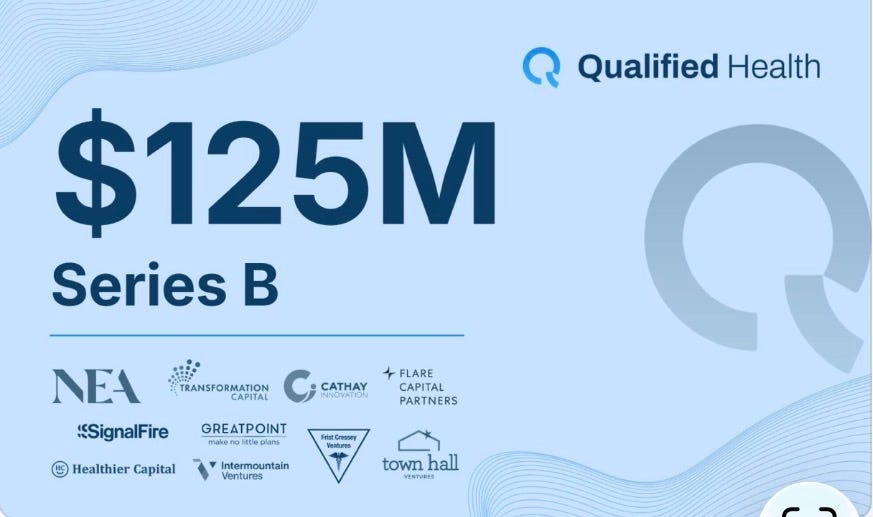
- Qualified Health closes $125M Series B, one of the largest healthcare AI-specific Series B rounds on record, bringing total raised to $155M
- Round led by NEA, with new investors Transformation Capital, GreatPoint Ventures, Cathay Innovation, Menlo Ventures Anthology Fund (Anthropic partnership), and continued support from SignalFire, Flare Capital, Frist Cressey, Healthier Capital, Town Hall Ventures, Intermountain Ventures
- Company founded late 2023 by Justin Norden MD/MBA/MPhil (prev. Trustworthy AI/Waymo), Kedar Mate MD (prev. CEO of IHI), Beau Norgeot PhD (prev. VP AI Elevance Health), Shantanu Phatakwala (prev. CDO Haven, CIO Passport Health)
- 15+ health system customers including UTMB, Mercy, Emory, Jefferson, University of Rochester Medicine, NYC Health + Hospitals, all 8 UT System institutions
- Documented ROI: $15M+ run-rate impact at UTMB in under 6 months, $30M+ annual value track at a second system, 1000+ patients identified and scheduled for evidence-based care, clinical registries automated from days to minutes
- 47x MAU growth; named Fierce 15 of 2026
- Model is enterprise-wide AI infrastructure, not point solutions
The Origin Story: HIMSS 2023 and a Problem Worth Solving
It was early 2023, ChatGPT had been out for less than five months, and a table full of health system CIOs and technology leaders at HIMSS were collectively venting about the same thing. Their organizations had spent the previous eighteen months buying AI tools from dozens of vendors, and somewhere in that process, they had quietly handed over the keys to their technology roadmap. The solutions were fragmented. The governance was nonexistent. The workflows were untouched. And the ROI was somewhere between theoretical and aspirational. Justin Norden was sitting at that table, and he was trying not to start another company.
He had just sold his previous company, Trustworthy AI, to Waymo roughly two years earlier. Trustworthy AI had built AI safety infrastructure that made autonomous vehicle deployments at scale actually safe to run in the real world, and Waymo bought it because that infrastructure mattered. Norden had done the operator-to-investor loop briefly at GSV Ventures, and by most measures he had earned a slower pace. But what he was hearing at that table was exactly the problem he had spent his career thinking about, just transposed from self-driving cars to hospital hallways. The challenge was not finding more AI tools. It was building the infrastructure layer underneath them that made trustworthy deployment at scale possible at all. He could not let it go.
By the winter of 2023, Qualified Health was off the ground. That origin story matters for a few reasons. First, it explains why the company is built the way it is. Norden was not a first-time founder chasing a trend. He had already been through the full cycle of building AI safety infrastructure, taking it to production at a demanding enterprise customer, and exiting it. Second, the genesis being a room full of health system leaders complaining about vendor proliferation and lack of control explains the entire go-to-market posture of the company. The bet from day one was that healthcare does not need more point solutions. It needs a single enterprise partner that can build a unified foundation and then deploy AI across clinical and operational workflows on top of it. That sounds like an obvious thing to say now, but in early 2023 the market was still mostly validating narrow use case after narrow use case and calling it transformation.
The Team: Why This Founding Group Is Unusual
Healthcare AI is a genuinely brutal category to build a founding team for. To do it well you need serious AI and engineering depth, clinical credibility, healthcare operations experience, and enterprise software instincts. Most companies get one or two of these. Qualified Health’s founding team has a legitimate claim to all four, which is not something that can be said often and should not be glossed over.
Norden himself covers the AI depth and clinical credibility overlap in a way that is pretty rare. He is a computer scientist with a medical degree and a master’s in philosophy from Stanford, and his prior work at Trustworthy AI was not superficial. Building the AI safety stack for Waymo is a serious technical credential that transfers directly to the governance and oversight problems that make health system executives nervous about deploying AI at all. His parallel appointment as an adjunct professor in Stanford Medicine’s Department of Biomedical Informatics Research keeps him anchored in the clinical evidence base, not just the product roadmap. The combination of deep technical credibility plus clinical grounding is genuinely uncommon at the CEO level.
Kedar Mate is an equally unusual hire as CMO. As the former President and CEO of the Institute for Healthcare Improvement, he spent years working at the intersection of care delivery reform, patient safety, and health system culture change. IHI is not a software company. It is an organization that has spent decades figuring out how to get clinicians and administrators to actually change how they work, which turns out to be most of the problem when deploying AI across a large health system. Having that background represented at the co-founder level rather than as a later-stage advisory add-on is a structural advantage. He is also on faculty at Weill Cornell, so the clinical legitimacy is not just on paper.
Beau Norgeot brings the production AI credibility. His track record includes pioneering human-in-the-loop clinical AI systems at Lucid Lane and then scaling to VP of AI at Elevance Health, one of the largest payers in the country. Enterprise-scale AI in healthcare is a different animal than research or pilot programs, and Norgeot has been in the engine room of both. That experience is directly applicable to what Qualified is building.
Then there is Shantanu Phatakwala at COO, whose background reads like a tour of the hardest data infrastructure problems in healthcare. Chief Data Science Officer at Haven, CIO at Passport Health Plan, VP of R&D at Evolent. Haven was Amazon, Berkshire, and JPMorgan’s attempt to disrupt healthcare, and whatever one thinks of that effort’s ultimate outcome, the data and infrastructure problems they were working on were as complex as it gets. Phatakwala is the person who knows where the bodies are buried in healthcare data architecture, which is exactly who you want running operations at a company whose core value proposition is building unified data foundations across fragmented systems.
This team composition is not accidental. It directly maps to the four hardest problems in health system AI adoption: technical deployment, clinical trust, organizational change management, and data infrastructure. Most companies in this space have a great answer to one of those problems. Qualified Health has co-founders who have spent careers on each of them.
The Model: Forward-Deployed, Not Slide-Deck Driven
The go-to-market model is worth spending time on because it is a meaningful differentiator from how most health IT vendors operate and it explains a lot about why the early traction numbers are as good as they are.
The standard health IT vendor playbook involves a sales cycle, a scoping engagement, a pilot, a procurement process, an implementation project, and then maybe eighteen months after the initial conversation, something is running in production. Everyone in health IT knows this cycle and most people in it have accepted it as an immutable law of the universe. Qualified Health is running a different play. The company deploys forward-deployed product leaders with deep healthcare expertise directly alongside health system teams. These are not implementation consultants in the traditional sense. They sit with clinical and operational teams, identify the highest-priority problems, build and deploy solutions quickly, and then iterate based on actual feedback from people doing the work. The model is closer to how a great internal product team would operate than how a traditional vendor engagement works.
This approach has two consequences that compound on each other. First, solutions get built around real operational problems rather than generic use cases designed to be broadly sellable. When you start from what a specific health system’s ED workflow actually looks like, you build something different than when you start from a product catalog. Second, the feedback loop is tight enough to actually improve the product in real time, which means deployments get better faster than a traditional implementation cycle would allow. The result is that you can demonstrate measurable impact on a six-month timeline, which is essentially unheard of in health IT and is what the UTMB numbers reflect.
The platform underneath this model has four distinct layers. The first is a connected and secure data foundation that integrates EHR data, operational systems, and external reference sources like clinical guidelines and payer policies into a healthcare-specific data layer with an AI-ready schema. The second layer is builder tooling that lets health system teams and Qualified’s embedded product leaders develop and deploy new applications without starting from scratch each time. The third layer is the AI-powered applications and agents themselves, deployed directly into workflows. The fourth, and arguably the most important from a health system buyer’s perspective, is a centralized governance, monitoring, and evaluation infrastructure with auditability, access controls, and decision traceability baked in. That last piece is what makes the whole stack sellable to a risk-averse hospital executive, and it is also where Norden’s Trustworthy AI background shows up most directly in the product architecture.
The Numbers: ROI That Actually Holds Up
Healthcare vendor ROI claims are notoriously slippery. The standard pitch deck table with a column for potential value and a column for realized value usually has an uncomfortably large gap between them. What makes the Qualified Health traction numbers worth taking seriously is that they are being attributed by named customer executives, not anonymous case studies.
At University of Texas Medical Branch, Peter McCaffrey, the Chief AI and Digital Officer, is on record saying ROI has already exceeded expectations. The specific figures attached to UTMB include more than $15 million in measurable run-rate impact, achieved by establishing a secure data foundation, deploying multiple AI assistants, and automating workflows. That is a number being attributed to a specific named institution by a named executive, which is a meaningful bar above the typical vendor testimonial. A second unnamed health system is on track for nearly $30 million in annual value from Qualified’s deployed solutions.
Dr. Kedar Mate’s announcement post breaks down additional impact dimensions that go beyond the revenue and cost figures. More than $30 million in run-rate impact identified and realized in under six months across partner health systems. More than 1,000 patients who needed evidence-based care not only identified but actually scheduled to receive that care, which is a clinical outcome number and not just a financial one. Clinical care and quality registries that previously took days to execute now running in minutes. These are not vanity metrics. They represent real workflow changes at real institutions, and the diversity of impact types matters because it signals that the platform is genuinely horizontal rather than optimized for one narrow use case.
The user growth number, 47x MAU growth, is worth flagging as well. Monthly active user growth at that rate inside health systems typically means the product is getting embedded into daily workflows rather than sitting as an occasionally-used tool. Health system software that achieves that kind of adoption usually does so because clinicians and operators are finding it genuinely useful in their day-to-day work, not because of a mandate from the CIO. That organic adoption signal is often a better leading indicator of long-term retention than the contract structure alone.
The current client roster also reveals something about Qualified’s positioning. Jefferson Health, Emory Healthcare, University of Rochester Medical Center, UTMB, UT Health San Antonio, the entire University of Texas System, Mercy Health, and NYC Health and Hospitals is not a list of small community hospitals doing cautious pilots. These are major academic medical centers and large regional systems making serious institutional commitments. Getting all eight institutions of the UT System on board simultaneously suggests something more than a standard enterprise SaaS sales motion. That kind of system-wide adoption requires buy-in at a level that comes from demonstrated operational impact, not just compelling demos.
The Cap Table: Signal, Not Just Capital
The investor list on this round is worth reading carefully because it is doing double duty as both a capital source and a market signal. When this many credible and distinct types of health tech investors co-invest in the same company at Series B, the round itself becomes a piece of social proof that reverberates through the market.
NEA leading is the headline. NEA’s health tech portfolio has historically been a pretty reliable indicator of companies with genuine institutional-scale ambitions, and leading a $125M Series B in a company that is less than three years old is a statement about conviction in both the team and the market timing. Transformation Capital and GreatPoint Ventures bring deep health system relationship networks that translate directly into customer access. Cathay Innovation adds the global technology investor perspective. Healthier Capital, Town Hall Ventures, Frist Cressey, and Intermountain Ventures each bring specific healthcare domain depth and operator relationships that matter for a company selling enterprise software to complex institutions.
The most structurally interesting investor in the round is probably the Menlo Ventures Anthology Fund. This is a fund created specifically in partnership with Anthropic, and its participation signals something meaningful about how the AI infrastructure ecosystem is coalescing. Anthropic investing indirectly into the healthcare AI deployment layer through its venture partnership with Menlo is consistent with a broader pattern of foundation model companies wanting exposure to companies that are building the governance, safety, and deployment infrastructure on top of their models in high-stakes regulated domains. It also raises interesting questions about the potential for deeper technical integration between Qualified’s platform and Anthropic’s models down the road.
Flare Capital’s participation is notable both for its continuity and for the framing Ian Chiang used in his announcement post. Flare backed the company through its Flare Scholar Ventures program before the first institutional round, meaning they have been in the deal since it was pre-revenue. Doubling down at Series B with this cohort of co-investors reflects a level of conviction that comes from watching the company operate up close from a very early stage. Chiang’s framing of Justin Norden’s thesis, that AI adoption in healthcare can only move as fast as trust, is a tighter encapsulation of Qualified Health’s product logic than most company pitches manage to achieve.
The advisor roster visible in Sooah Cho’s SignalFire post is its own separate signal. Frank Williams, former CEO of Evolent. Andy Slavitt, former acting CMS Administrator. Senator Bill Frist MD. Kevin Ban MD, former CMO of Athena Health and Walgreens. Patrick Conway, CEO of OptumRx. Matt Lungren MD, former Chief Scientific Officer at Microsoft Health. Lee Fleisher, former CMS Chief Medical Officer. This is not a ceremonial advisory board. These are people with active relationships across the payor, provider, and regulatory infrastructure of American healthcare. That network is a structural moat that most health tech startups never manage to build.
The Thesis: Infrastructure Wins in Every Technology Cycle
The core investment thesis underneath this round is one that should resonate with anyone who has followed prior technology platform cycles closely. In every major technology transition, the companies that end up capturing the most durable value are usually not the ones building the most visible applications. They are the ones who built the infrastructure layer that made all the applications possible. AWS did not win the cloud era by having the best consumer app. Stripe did not win payments by building the most interesting checkout flow. They won by building the horizontal infrastructure that let everyone else deploy faster and more reliably than they could on their own. The pattern repeats.
Healthcare AI is at a very similar inflection point right now. The first wave of healthcare AI investment, roughly 2018 through 2023, went primarily into narrow clinical applications. Sepsis prediction models. Radiology reading assistance. Prior authorization automation. Each of those solved a real problem, and many of them generated real value. But they all hit the same ceiling: they were point solutions layered onto infrastructure that was not designed to support them. The data was siloed. The governance did not exist. The clinical oversight was an afterthought. Adoption was incremental and fragile.
What Qualified Health recognized early, and what the investment community is now endorsing at scale, is that the next wave of healthcare AI value creation is going to go to whoever builds the enterprise infrastructure layer. Not the best clinical NLP model or the most accurate diagnostic tool, but the platform that lets a health system take any AI application and deploy it safely, govern it systematically, monitor it continuously, and retire it cleanly when it stops performing. That platform, if done right, becomes the operating system for AI adoption across the enterprise, and operating systems tend to generate disproportionate returns relative to the applications that run on top of them.
The workforce context makes the timing sharper. Healthcare is entering a period of serious structural cost pressure driven by workforce shortages and demographic demand increases that are not going to resolve quickly. The efficiency gains that AI can theoretically unlock are no longer a nice-to-have for health system CFOs. They are becoming a survival necessity. That changes the buying behavior from cautious pilot programs to serious enterprise commitments, which is exactly what the Qualified Health client list reflects. Systems like UTMB and the UT System are not running a pilot. They are making a platform bet.
What It Means for the Market
This round has implications that go well beyond Qualified Health’s own trajectory. At $155M total raised in under three years, with the customer traction numbers and investor caliber visible in this deal, Qualified Health is staking a serious claim to the enterprise AI infrastructure category in healthcare. That matters for the competitive dynamics of the broader market in a few ways.
First, it accelerates consolidation pressure on point solution vendors. If health systems are genuinely moving toward enterprise platform partners rather than best-of-breed point solutions, the companies in the portfolio of most health tech investors that built narrow applications on the assumption of continued point solution buying behavior are going to face a harder renewal and expansion environment. The transition is not going to happen overnight, but the trajectory is now clearer.
Second, it creates a new benchmark for what evidence-based clinical AI deployment looks like. The UTMB case study with $15M in run-rate impact at six months is going to show up in every health system boardroom conversation about AI vendor selection for the next two years. That is both a marketing asset for Qualified and a problem for competitors who cannot produce equivalent attribution. Named customer executives putting documented ROI numbers on the record is a rare thing in health IT, and once it exists it becomes the standard against which everyone else is measured.
Third, the Anthropic connection through the Menlo Anthology Fund is worth watching closely. Healthcare is one of the highest-stakes domains for AI deployment and one where governance, safety, and auditability requirements are non-negotiable. The pattern of foundation model companies gaining exposure to companies building responsible deployment infrastructure in regulated domains is going to intensify, and Qualified Health is now among the most credibly positioned companies in that layer. That positioning has implications not just for future fundraising but for the technology partnership and model access dynamics that will matter as the agentic AI era matures in healthcare.
The founding team was at the right place at the right moment at HIMSS in 2023, and they had the rare combination of backgrounds to actually build what the problem required. Two and a half years later, with $155M in capital, a roster of major health system customers, documented ROI that stands up to scrutiny, and a cap table that reads like a consensus view from the most informed investors in health tech, the bet is looking like one of the cleaner calls in the space in a while.
The team’s mix of AI, clinical, and operational experience makes this more than just another healthcare startup