🎧 Part I Podcast free on Apple Podcasts and Spotify.

🎧 Part II Podcast episode for paid subscribers only. Also available on Apple Podcasts and Spotify.
To listen to paid episodes in Apple or Spotify, link your Substack subscription via the show settings on those platforms (instructions inside the Substack app under Subscriptions → Podcast).
Table of contents
The invoice comes first
Finding the claims nobody sent
Getting from approved to paid
What Medicare pays and what the drug actually costs
What ninety days of transactions can prove
Who buys this and what they pay for
Financing can wait
Abstract
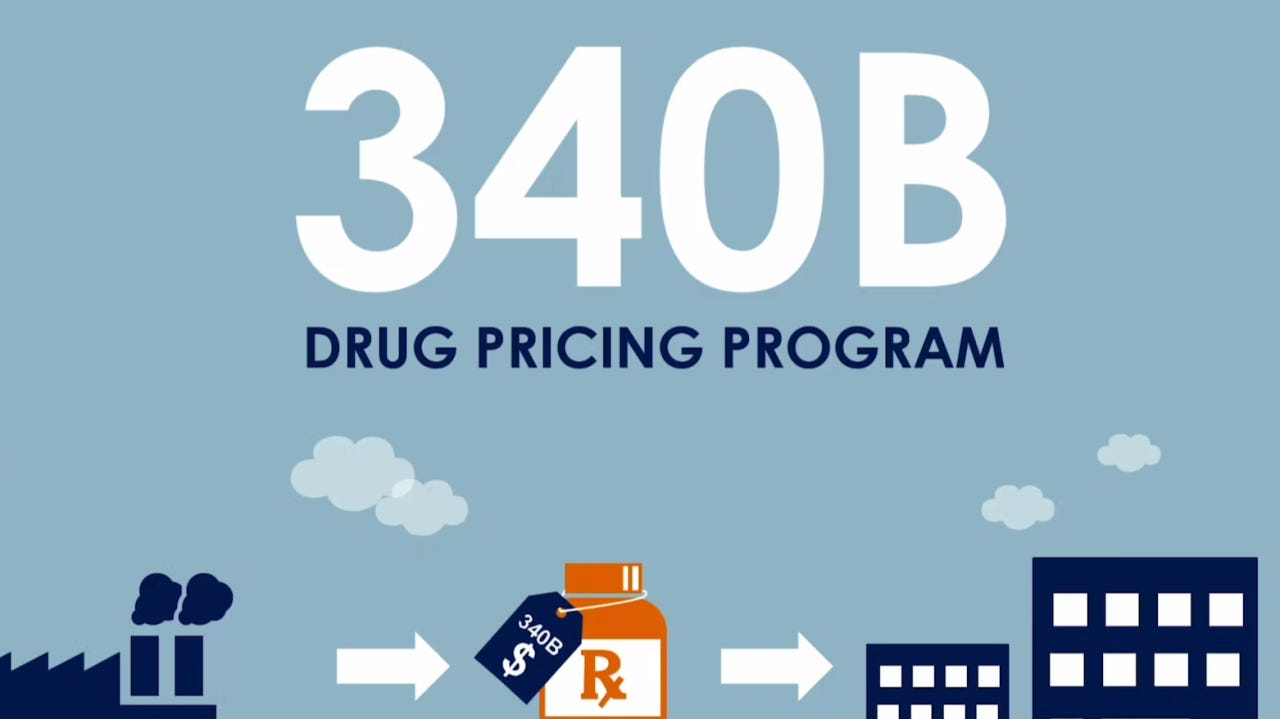
Under the revised 340B rebate pilot scheduled for January 1, 2027, covered entities buy affected drugs at wholesale acquisition cost and claim the discount from the manufacturer after dispensing. The ordinary clock gives a covered entity 45 calendar days from dispense to submit, and the manufacturer 10 calendar days from a complete submission to pay or document a denial. Separately, qualifying Medicare Part D claims with dates of service beginning January 1, 2027, are due to the federal repository on September 30, 2027, for the first two quarters. The hospital outpatient final rule sets payment for affected 340B drugs at average sales price minus 28 percent. The business opportunity is to reconcile these transactions from invoice through cash receipt and show the chief financial officer how much money is tied up by drug and site. A 90-day replay at one health system can distinguish losses the existing administrator missed from ordinary payment delays. That difference determines what the software is worth and whether there is enough real cash exposure to justify financing.
The invoice comes first
The wholesaler bill can be due while the hospital is still waiting for a contract pharmacy to tell it what happened to a prescription. In the old workflow, the purchase discount was generally already reflected in the price the hospital paid. Under the revised pilot, the hospital orders a participating drug through its existing 340B wholesaler account at wholesale acquisition cost and later seeks the rebate from the manufacturer. The same ordering account can now carry both drugs with an upfront discount and drugs whose discount depends on a subsequent claim. An accounts payable report that groups everything purchased through the account under one heading will look perfectly sensible. It can also hide the exact balance the treasurer needs to see. Even a drug the hospital expects to buy at the same net price as before can create very different cash demands if it sits on a shelf, if the claim arrives late, or if the denial takes weeks to resolve.
The Health Resources and Services Administration has posted approved plans for products including Eliquis, Jardiance, and Ibrance. The starting point for a hospital’s exposure model is the actual National Drug Code, including package, strength, and formulation, under the applicable plan and effective dates. A brand name is fine for the executive meeting. It is a lousy way to decide whether an invoice line should carry an expected rebate. The pilot includes selected drugs from the initial price applicability years 2026 and 2027 for which manufacturers have approved plans, during the relevant price applicability periods. The plans can have exceptions for particular covered entities, and the affected drugs can generate rebate claims across payer types. A commercial fill can belong in the manufacturer rebate queue even though it has no business in the Medicare Part D repository. Physician-administered units can also qualify where the selected product is a covered outpatient drug. A pilot inventory file built by starting with the Medicare prescription claims extract will miss part of the exposure before anybody has written a line of code.
The agency’s timetable is fast enough that some hospitals may collect rebates before their wholesaler invoices come due. That will happen when the drug moves quickly, the covered entity can establish eligibility promptly, and the submission is complete on the first pass. The ordinary filing window is forty-five calendar days from dispense, with allowances for circumstances such as changes in a claim’s 340B status. Manufacturers have ten calendar days from a completed submission to pay or issue a documented denial. An incomplete submission restarts the manufacturer clock when the necessary data arrives. Treasury therefore needs the invoice date, the contractual due date, the actual date the money left, and the bank settlement date. Pharmacy needs to know how much of the interval was spent waiting for a fill to occur or a file to arrive and how much was spent correcting something that could have passed the first time. Ten days sounds great in a federal notice. It sounds a little different when someone has already spent three weeks emailing a pharmacy about a fill number.
Finding the claims nobody sent
Start with the wholesaler invoice lines, including credits and returns, and the best available record of what was dispensed or administered. For an owned pharmacy, that will usually come from the dispensing system. At a contract pharmacy, it takes a feed that preserves the original transaction, subsequent reversals and rebills, and the administrator’s eventual eligibility decision. For a clinic-administered drug, the medication administration record tells part of the story and the institutional claim tells another part. The core accounting problem is that the wholesaler sells packages, the pharmacy dispenses quantities, and the medical claim may bill in units defined by a procedure code. One package can support multiple dispenses. A dispense can draw from quantities associated with more than one purchase. The approved rebate is calculated at the unit level using wholesale acquisition cost less the 340B ceiling price on the dispense date. A reconciliation that waits for enough units to replenish an entire package can miss a filing deadline even when its inventory math is right.
Consider a prescription filled at a contract pharmacy the day before a quarter ends. The pharmacy reverses the original claim and rebills it several days later after correcting the payer information. The reversal arrives in one file and the rebill in another. The latest administrator extract has one eligible fill, which looks tidy. The file sent to the manufacturer may contain the original transaction, the corrected transaction, or neither. If the product’s ceiling price changed when the quarter rolled, the original service date matters to the expected rebate even if the corrected record arrived the following month. The hospital needs to retain the event history and link the reversal and rebill where the records support it. Overwriting yesterday’s row with today’s version makes the current report easier to read and the cash discrepancy much harder to explain.
The quickest way to find unsubmitted claims is to build the expected population independently of the submission file. Compare eligible dispenses and administrations against what the manufacturer platform actually received. Build a separate check for purchases that cannot be reconciled to expected units, inventory on hand, or returns. That check is a hospital control. The pilot limits what manufacturers can ask the covered entity to submit, and the hospital’s underlying wholesaler invoices and encounter records stay on the hospital side of that workflow. Pharmacy also needs to see the cases where a submission was expected but the evidence was insufficient. A site registration discrepancy and a package quantity that cannot be reconciled should land with a human owner. The queue should put a fixable claim with two days left ahead of an older discrepancy that can wait. The source records should be visible from the same screen. Otherwise somebody will solve the problem in a spreadsheet and send it back as an attachment called Final Final.
Getting from approved to paid
A submission has a file transmission, an acknowledgment, and a claim-level outcome. A batch may arrive successfully while individual rows fail validation. A corrected row may go back under a new reference, or a later reversal may invalidate a row that the manufacturer already approved. Preserve the original timestamps and associate each submission attempt with the underlying dispense. A record that came back incomplete belongs in the correction queue. A complete submission that is still awaiting disposition belongs in an aging report. A denial with documentary support belongs with the person who can review it against the applicable plan. Under the pilot, concerns about diversion, covered entity eligibility, or Medicaid duplicate discounts are handled through the agency or the applicable statutory processes. The pilot prohibits denying rebates on those grounds or because the manufacturer perceives insufficient wholesale purchases. The person reviewing a denial needs its actual reason and documentation, particularly when the portal’s status label is vague enough to fit almost anything.
Now follow the payment. A single electronic deposit may cover hundreds of claims, and the bank amount may include adjustments to previously settled transactions. The hospital needs the remittance detail that connects that deposit to the manufacturer and its individual rebate lines. Settle against the bank, preserve partial payments and offsets, and keep a balance open when a deposit cannot be assigned confidently. Suppose a deposit is twenty thousand dollars short of the sum marked approved in a portal export. Some of the difference could be prior-period offsets, some could be payments still in transit, and some could be an unpaid balance worth collecting. A controller who sees twenty thousand dollars labeled outstanding will want to know how much is actually owed and to which legal entity. The portal balance is evidence along the way. The hospital’s own records have to explain the result.
For a negotiated Medicare drug, a maximum fair price refund can complicate that arithmetic. The dispensing pharmacy and the covered entity can be different organizations, with separate remittance records and different rights under their contract. A subsequent adjustment can unwind a duplicate discount. The reconciliation should show which party received each payment, the source of the offset, and the amount the hospital is entitled to retain. It should also give the controller enough detail to apply the organization’s accounting policy consistently. Undispensed inventory, an eligible claim waiting on a file, a disputed denial, and a confirmed payment in transit all have a place in the forecast. They deserve different confidence levels. If an analyst has to manually net them each Friday to create one number for treasury, the system has simply moved the spreadsheet to another department.
What Medicare pays and what the drug actually costs
The November hospital outpatient final rule sets payment at average sales price minus twenty-eight percent for affected separately payable 340B-acquired drugs in two thousand twenty-seven. Rural sole community hospitals, children’s hospitals, and cancer hospitals exempt from the inpatient prospective payment system are among the hospital categories exempted from that adjustment. The rule also changes how applicable hospitals identify drug acquisition on the institutional claim. Those billing fields belong in the margin calculation alongside the drug code, administered quantity, and actual remittance. When Medicare says it is redistributing money to non-drug outpatient services for budget neutrality, it is describing the payment system as a whole. An infusion department with a high concentration of affected drugs can still lose contribution margin while the hospital gets some of the money back in other departments. The treasury system should be able to show both without spreading a hospital-wide offset across every infusion and pretending the individual drug economics stayed the same.
Take a hypothetical dose whose average sales price per billed dose is one thousand dollars. At average sales price plus six percent the benchmark allowance is one thousand sixty dollars. At average sales price minus twenty-eight percent it is seven hundred twenty dollars. If the acquisition cost after a collectible rebate is six hundred fifty dollars, the drug spread falls from four hundred ten dollars to seventy dollars before the site accounts for waste, handling, and other relevant costs. If that site’s net acquisition cost is seven hundred fifty dollars, the spread is already negative at the new allowance. The figures describe an allowed payment benchmark. Actual collections still depend on how the claim adjudicates and how much of the patient responsibility the system collects. Pharmacy leadership needs to see the economics of the actual product, dose, and site. A hospital-wide average can conceal the particular location with high waste or a payer mix that makes a service hard to sustain. For a contract pharmacy, the comparable calculation uses the amount actually due to or collected by the covered entity after the contract’s dispensing fees and other charges. A community pharmacy reimbursement and a hospital outpatient drug allowance belong to different payment models even when the underlying drug is the same.
The Medicare Part D reporting requirement runs on a different clock. Affected Medicare-enrolled providers and suppliers that are covered entities must submit specified data for qualifying 340B Part D claims with dates of service beginning in January of two thousand twenty-seven, including applicable contract pharmacy claims. The first and second quarters share a September thirtieth, two thousand twenty-seven deadline, and the entity can submit the first quarter separately ahead of that date. The repository uses the date of service, prescription or service reference number, fill number, dispensing pharmacy’s national provider identifier, and eleven-digit drug code, along with the covered entity information and required certification. An administrator can submit on the entity’s behalf. The entity is still responsible for the accuracy of the submission. The repository is designed to help Medicare assess whether the data can support future inflation rebate calculations. A repository acceptance does not authorize a manufacturer payment. It is entirely possible to file the September submission correctly and have already missed a manufacturer deadline on a January dispense. The hospital can reconcile both submissions against the same underlying pharmacy events while tracking each destination’s rules and receipts independently.
What ninety days of transactions can prove
The first sale should be a paid replay of ninety days at one health system. Pick a system with a centralized treasury team, an owned pharmacy or outpatient department, and contract pharmacy activity large enough to test whether the feeds hold up. Ask for enough history before the window to reconcile opening inventory and enough activity after it to see how claims and cash settle. Obtain the administrator’s original submissions, acknowledgments, work queues, and subsequent corrections, in addition to the final reports. The useful question is what the administrator knew in time to act. A claim visible on a fresh export may have appeared there after the filing window closed. Another claim that looks missing on a daily snapshot could have been queued for a timely submission later that week. A fair comparison replays the information as it was available on each day. Pharmacy and finance should review the biggest exceptions together and decide whether the new process identifies a loss, a timing problem, or a record that only looked wrong because the extract was incomplete.
A prelaunch replay can establish whether the data is good enough to build the expected claim population and estimate what the pilot would do to cash. Historical dispenses generally cannot establish actual pilot denials, payment times, or recovery rates. Model the published plans and historical wholesaler terms, then test those assumptions against live claims once available. After launch, take a sample of what the replay matched as well as what it flagged. If the model found the right amount on a remittance by linking it to the wrong facility, checking only exceptions will miss the error. Track the validity of suggested matches, how many exceptions require manual work, the share of claims complete on the first submission, and the dollar amount associated with each disposition. Dollar-weighted aging matters because a handful of high-cost claims can cause more trouble for treasury than several thousand routine fills.
Suppose a live replay covers two million seven hundred thousand dollars in expected rebates and finds a hundred and ten thousand dollars that the incumbent’s reports did not explain. Forty-eight thousand dollars might be ordinary receipts already in transit. Twenty-four thousand dollars might be a valid adjustment or a reversal. Eighteen thousand dollars might be unresolved and still need evidence. That leaves twenty thousand dollars in confirmed, actionable claims that the incumbent missed. Even that amount should stay in a recoverable category until the hospital can show it was paid or can verify that a timely correction prevented a loss. It is tempting to put the full hundred and ten thousand on a sales slide with a dollar sign big enough to read from the parking lot. The smaller number is the one finance can use when the contract comes up for renewal. The replay should also show whether those claims were scattered across the system or traced to a recurring issue, such as a pharmacy feed that stopped carrying reversals after a vendor change. A fix that prevents the same error next quarter can be worth more than the first recovery.
Who buys this and what they pay for
Sell it to the chief financial officer and the pharmacy director together. Pharmacy sees which contract partner failed to send a file and which claims can still be fixed. Finance sees when the wholesaler payment is due and how much of the expected rebate it can put in the weekly cash forecast. Bringing in only pharmacy can leave the vendor without bank and general ledger access. Bringing in only finance can produce a technically correct aging report that nobody knows how to work. The existing administrator can remain in place and keep doing eligibility, replenishment, or submission where it already does those jobs well. The new vendor earns its fee by connecting that work to purchasing and cash. The incumbent can absolutely build some of this. Its advantage is access to the pharmacy feed and the submission process. A hospital buying an independent reconciliation has to get something its existing vendors cannot easily give it, such as a credible view across administrators, a close reconciled to bank deposits, or margins that include actual acquisition costs and actual payer collections.
The federal agency counted about one hundred billion dollars in 340B purchases in two thousand twenty-five. That gives a sense of the underlying program. The addressable market for a rebate reconciliation vendor starts with health systems that buy enough affected drugs and have enough operational complexity to pay a recurring fee. A hundred customers at seventy-five thousand dollars a year would produce seven and a half million dollars of annual recurring revenue. Finding a hundred qualified buyers is the hard part of that calculation. A single hospital with fast, clean submissions and favorable wholesaler terms may do fine with the manufacturer portal and a monthly review. A system with several legal entities, different pharmacy administrators, and high-dollar exceptions has a different buying calculus. Charge for the replay and implementation, then price the recurring work around the feeds, entities, and transaction volumes the vendor has to reconcile. Make the cost of ongoing human exception work visible in that price. A team that has to download bespoke files and manually chase payments for every client can build a decent service business. Its margins will look like a service business.
The original pilot was vacated, and hospital groups have already challenged the revised version in federal court. HHS later voluntarily dismissed its appeal of the preliminary injunction and withdrew the 2025 pilot, while hospital groups filed a new challenge to the revised program in the U.S. District Court for the District of Maine ahead of the January 1 launch. That makes launch timing a material assumption in any sales forecast. Underwrite a delay or a smaller product list before hiring a team on projected rebate volume. There are already real uses for the same purchasing and claims data in Part D reporting and outpatient margin work. Each can earn its place in the contract on its own merits. For a customer with good reporting already in place, there may be nothing to sell on that front. The underwriting question is whether enough buyers have work they would pay somebody to do every month, after the first year’s cleanup and after the headlines move on.
Financing can wait
The lending opportunity depends on how long the hospital actually has cash out the door. Take that illustrative two million seven hundred thousand dollars of expected rebates over ninety days. At steady volume, that is thirty thousand dollars of rebate exposure per day. If the average time between paying the wholesaler and collecting the related rebate is eighteen days on the balances being modeled, about five hundred forty thousand dollars is tied up. Shorten the interval to six days and the cash requirement falls to about one hundred eighty thousand dollars. The three hundred sixty thousand dollars released is a working capital benefit. At an eight percent annual funding cost, the corresponding carrying cost savings are twenty-eight thousand eight hundred dollars a year. Those are different numbers on purpose. There is a very good chance someone will put the larger one into a return-on-investment calculator as recurring savings. A chief financial officer will spot that before the second slide. A real forecast should use actual payment terms and daily cohorts, because a few large purchases can make the peak funding need materially higher than the steady-state average.
Before adding financing, watch enough live settlement cycles to see what pays on time and what happens when claims reverse, a manufacturer offsets a payment, or the platform goes down. A hospital with thirty-day wholesaler terms and fast collections may be able to fix its remaining cash problem simply by getting tomorrow’s claims out today. Where the gap persists, a lender will want to know which entity is the payee, whether the payment rights can support the arrangement, how cash can be directed, and what happens to the collateral if a claim is corrected after funding. Build any borrowing base around balances that have reliable evidence and predictable settlement. An unsubmitted claim with five days left and a disputed denial might both show a dollar value in the system. Neither should be treated like an approved, undisputed balance with a history of settling on schedule. Concentration also matters. Ten thousand clean claims can still be one large exposure if they all depend on the same manufacturer, processing platform, or pharmacy relationship.
The practical stopping point for an early company is a customer whose treasury team can explain the balance without calling the pharmacy director, and whose pharmacy director can still see which claims have to go out before the weekend. Once that works, look at who repeatedly needs cash even after submitting promptly, taking full advantage of wholesaler terms, and collecting the rebates that are due. That smaller group is the financing market. The others can pay for reconciliation, close the month, and keep buying drugs with the credit they already have.