Welcome to Healthcare Markets & Technology.
Rigorous analysis of AI, policy, capital, technology, and clinical operations across U.S. healthcare — written for the people who build, invest in, and lead it.
Free subscribers get 2 public articles per week. Upgrade to paid → for the full 7 articles/week, paid podcast episodes, deal breakdowns, and the complete 538-deep-dive archive.
Subscribe or upgrade here →
One thing to bookmark: the searchable Knowledge Base at kb.onhealthcare.tech isn’t in Substack’s menu. Save it now — on mobile, tap share → “Add to Home Screen.”
Reply to any email with questions. I read every one.
— Trey
Abstract
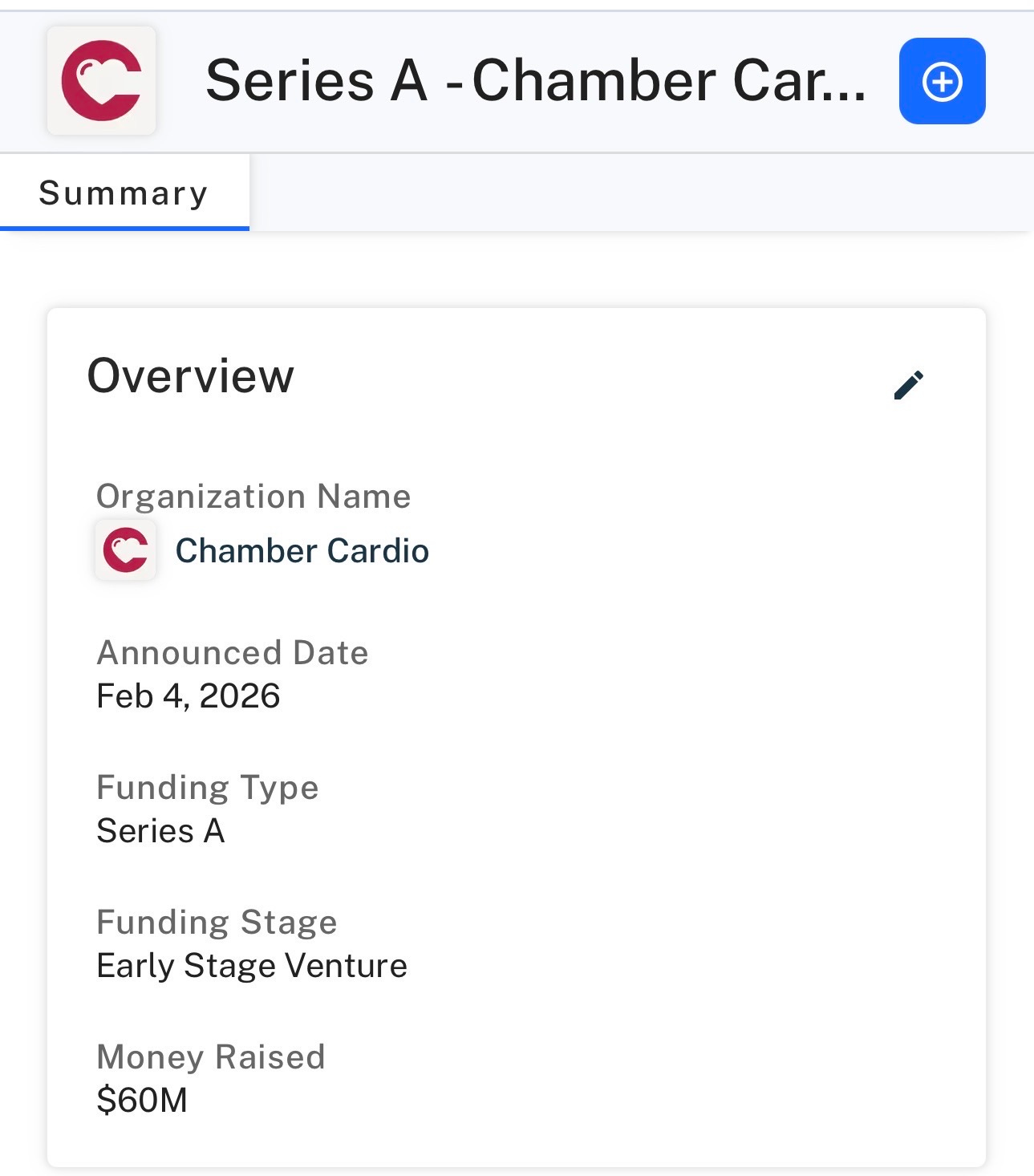
Chamber Cardio closed a $60M Series A in February 2026, led by Frist Cressey Ventures, with participation from General Catalyst, AlleyCorp, Optum Ventures, Healthworx Ventures, American Family Ventures, Company Ventures, Black Opal Ventures, and debt from HSBC Innovation Banking. The company is building value-based care infrastructure for cardiology, operating a dual-sided network model that partners with both payers and cardiologist practices simultaneously. Key data points:
- CVD is the number one driver of US healthcare spend, responsible for roughly 1 in 3 deaths
- 500+ cardiologists across 7 states at time of Series A announcement
- Workflow-native AI embedded directly into EHR systems
- Seed led by General Catalyst at $8M
- Strategic investors include Optum Ventures and Healthworx (CareFirst), signaling payer validation
- Competitive set includes Karoo Health, Novocardia, CardioOne, Heart and Vascular Partners
- Regulatory tailwinds: LEAD Model, ACCESS Model (10-year CMMI program), ARPA-H ADVOCATE program for agentic AI in cardiology
Table of Contents
The Problem Nobody Fixed
Why Cardiology, Why Now
The Model: Both Sides of the Table
The Technology Bet
Investor Signal Reading
Regulatory Wind at Their Back
The Competitive Landscape
Where the Risks Actually Live
The Exit Thesis
The Problem Nobody Fixed
Cardiology has a weird distinction in American healthcare. It is simultaneously the specialty most responsible for patient mortality, the single largest category of healthcare spending in the US, and one of the last major clinical areas to get a serious value-based care infrastructure built around it. That is not an accident. Cardiologists are a particular breed of specialist, historically well-compensated under fee-for-service, protective of their clinical autonomy, and deeply skeptical of administrative overhead. Getting them to change how they operate is not a technology problem. It is a trust and incentive problem. And that is exactly what makes Chamber interesting.
The traditional fee-for-service dynamic in cardiology works roughly like this: a patient sees their PCP, gets referred to a cardiologist, the cardiologist does a procedure or schedules a follow-up, bills for the encounter, and moves on. Whether that patient fills their beta-blocker prescription, shows up to their follow-up three months later, or ends up in the ER with a preventable CHF exacerbation is, structurally speaking, not the cardiologist’s financial problem. This is not a knock on cardiologists as clinicians. Most of them went into medicine to help people. But the payment architecture is not wired to reward longitudinal management. It rewards procedural throughput.
The downstream cost of this is enormous. Cardiovascular disease accounts for roughly 17% of total US healthcare expenditure, which works out to somewhere north of $400 billion annually when you add up direct medical costs and indirect costs from productivity loss. Readmissions for heart failure alone cost Medicare billions per year. A meaningful chunk of that is preventable with better population health management, timely medication titration, and early identification of high-risk patients before they escalate. The data exists to do this. The workflows to act on it, at scale, inside cardiology practices, largely do not. That is the problem Chamber is trying to fix.
What makes this moment different from prior attempts is the combination of EHR maturity, AI capability, and payer willingness to actually write checks for value-based arrangements in cardiology specifically. For years, VBC was primarily a primary care story. ACOs were built around PCPs. Risk-based arrangements largely excluded specialists or tried to subordinate them under primary care-led structures. Cardiologists, watching this play out, mostly stayed on the sidelines or got pushed into clumsy shared savings arrangements that did not reflect their actual role in driving cost and outcomes. The infrastructure was not built with them in mind.
Why Cardiology, Why Now
The timing argument for Chamber is not just about the size of the market, though that helps. It is about a confluence of factors that makes cardiology value-based care specifically tractable right now in a way it was not five years ago.
Start with the epidemiology. The US is aging, and cardiovascular disease prevalence scales aggressively with age. The cohort of Americans over 65 is growing faster than any other demographic segment, and this population disproportionately carries multiple cardiovascular comorbidities simultaneously. Heart failure, atrial fibrillation, coronary artery disease, and hypertension do not travel alone. A significant portion of high-risk cardiology patients also carry diabetes, chronic kidney disease, and obesity, all of which interact with cardiovascular risk in complex ways. Managing these patients well requires coordination across specialties, longitudinal follow-up, and proactive intervention. The fee-for-service model handles none of this gracefully.
The data infrastructure has also matured considerably. EHR penetration in cardiology practices is high, and the major platforms, Epic, eClinicalWorks, Athenahealth, have robust APIs that allow third-party applications to embed into clinical workflows at a level of fidelity that was not really possible at scale until the last few years. FHIR-based interoperability, whatever its limitations in practice, has made it meaningfully easier to aggregate claims data, lab data, and clinical notes across the care continuum and do something useful with it in near-real-time. This matters because the intelligence Chamber is selling to cardiologists is only as good as the underlying data pipeline.
The payer appetite has shifted too. Large commercial payers and Medicare Advantage plans have been burned by broad ACO arrangements that promised savings and delivered mediocre performance. They are now more interested in specialty-specific value-based contracts where the risk is more bounded and the clinical levers are better understood. Cardiology is an obvious target because the spend is concentrated, the patient population is identifiable, and the interventions that reduce cost, medication adherence, timely follow-up, early detection of decompensation, are well-understood clinically. Payers can build a reasonably credible actuarial model around this. That is what makes them willing to sign contracts.
And then there is the workforce math. There are roughly 23,000 practicing cardiologists in the US serving a patient population that by most projections will need substantially more cardiology capacity over the next decade as the Baby Boomer cohort ages into peak cardiovascular risk. You cannot simply train more cardiologists fast enough. The only way to extend cardiologist capacity is to make each cardiologist more effective, which means eliminating low-value work from their day, giving them better signal on which patients need attention right now, and offloading routine monitoring and care coordination to a clinical team they can supervise. This is the operational argument for Chamber’s model, and it is the part that tends to resonate most with cardiologists when it is explained clearly.
The Model: Both Sides of the Table
What Chamber is doing structurally is more nuanced than a lot of the press coverage suggests. The company is not a managed care organization, it is not acquiring practices, and it is not simply a software vendor. It is operating as a two-sided infrastructure layer between payers and cardiologist practices, and understanding why that is strategically important requires unpacking both relationships.
On the payer side, Chamber signs value-based contracts that give health plans visibility into cardiovascular performance, total cost of care, and quality metrics across a defined network of cardiologists. The payer is essentially buying a more manageable cardiology population and cleaner performance data in exchange for sharing some of the savings generated by better care management. For Medicare Advantage plans in particular, this is attractive because cardiology spend is a major driver of medical loss ratio, and RAF scores tied to cardiovascular diagnoses have significant premium implications. Chamber’s ability to surface coding gaps and ensure accurate risk capture is a side benefit that plans appreciate but rarely talk about publicly.
On the provider side, Chamber partners with cardiology practices without acquiring them. This is a deliberate and important choice. Practice acquisition is capital-intensive, creates employment relationships that are complicated to manage across states, and tends to generate the kind of cultural friction that drives away exactly the high-performing cardiologists you need in your network. Chamber’s approach is to come in as a technology and care management partner, wrap operational support around the practice, and share the upside from value-based contract performance. The cardiologist stays independent, keeps their brand, and gets access to a care coordination infrastructure they could not build themselves.
The technology sits in the middle of both relationships. Chamber’s platform does population stratification across the practice’s entire panel, identifying which patients are highest risk for near-term hospitalization or deterioration. It surfaces care gaps, specifically instances where a patient is not on guideline-directed therapy or has not had a recommended follow-up. It integrates directly into the EHR, so the cardiologist is seeing Chamber’s recommendations inside the workflow they already use rather than logging into a separate portal. And it routes lower-acuity work to pharmacists, nurse practitioners, and case managers who can handle medication titration and follow-up calls without consuming a cardiologist’s time. The result, in theory, is a cardiologist who is seeing sicker patients, capturing more accurate diagnosis codes, ordering fewer unnecessary tests because they have better longitudinal data, and generating better outcomes metrics that make the payer contract renew at better economics.
The bet here is on network density. The value of Chamber’s platform to a payer scales with how many cardiologists in a given market are inside the network, because that is what allows the payer to actually manage cardiovascular spend across a population rather than just a subset of it. Building this density state by state requires a lot of practice development work, and it is slow. Seven states and 500 cardiologists at Series A is a meaningful start but represents a tiny fraction of the addressable market. The $60M is largely going toward accelerating that build-out.
The Technology Bet
Chamber’s CMO, Dr. Sameer Sheth, put it well in the Series A announcement: cardiologists do not need more data, they need a clearer signal. That framing is actually a pretty sophisticated product thesis disguised as a one-liner. The failure mode for most clinical decision support tools in cardiology has been information overload. You build a dashboard, populate it with every possible risk metric, and then watch the cardiologist ignore it because it requires too much interpretation effort during a 15-minute appointment. Physicians are not against decision support. They are against decision support that adds cognitive load without reducing it.
What workflow-native AI is supposed to do differently is prioritize and translate rather than just aggregate. The system is not presenting a cardiologist with a panel of 400 patients and asking them to figure out who needs attention. It is surfacing the three patients who are highest risk this week and telling the cardiologist specifically what intervention the evidence suggests. It is flagging the patient on suboptimal beta-blocker dosing and pre-populating the message to the pharmacist. It is identifying the patient who missed their echo follow-up six months ago and automatically scheduling an outreach call. The cardiologist touches this stuff, but they are not the bottleneck for it.
The AI layer has another function that is harder to talk about publicly but drives a lot of the ROI. Accurate hierarchical condition category coding is enormously valuable in Medicare Advantage. Patients with cardiovascular conditions carry significant RAF weight, and a practice that does not systematically document comorbidities and disease severity is leaving premium dollars on the table for the MA plan and underrepresenting the true complexity of their patient population. Chamber’s platform, by surfacing coding gaps and prompting documentation during encounters, helps practices capture this more accurately. This is not upcoding. It is closing documentation gaps that exist because cardiologists are busy and documentation is annoying. But the financial impact is real, and payers are aware of it when they are evaluating whether the value-based contract economics work.
The ARPA-H ADVOCATE program announced in early 2026 is worth flagging specifically. ARPA-H is looking to fund the development of FDA-authorized agentic AI technology that can provide what they are describing as 24/7 specialty care in cardiovascular medicine. The government is essentially signaling that it wants to see AI move from clinical decision support into autonomous care delivery in cardiology. Chamber is not ARPA-H, and ADVOCATE is still early-stage, but the regulatory and funding environment it represents is favorable to any company that has already built the data infrastructure and workflow integrations needed to deploy AI recommendations in cardiology at scale. If agentic AI in cardiology is coming, the companies with the richest longitudinal patient data and the deepest EHR integrations start with a significant structural advantage.
Investor Signal Reading
The cap table on this round tells you a lot if you know how to read it. The lead is Frist Cressey Ventures, co-founded by Senator Bill Frist, who is a cardiac and thoracic transplant surgeon. This is not a generalist firm that landed on cardiology. This is a firm with deep sector-specific conviction and clinical credibility that can open doors with health systems, payers, and cardiology groups in ways that a conventional VC cannot. Frist’s quote in the press release was not marketing. His perspective that cardiovascular care delivery is fragmented and fee-for-service driven reflects genuine clinical knowledge, and his firm’s willingness to lead at this size reflects real conviction about the market timing.
General Catalyst’s continued participation matters for a different reason. GC led the seed at $8M, and the fact that they followed on into the Series A signals that what Chamber showed between seed and Series A was sufficient to maintain their conviction. GC is running their Health Assurance thesis, which is broadly about companies that shift healthcare from reactive to proactive delivery. Chamber fits cleanly into that framework, and GC’s portfolio relationships, particularly in payer and health system land, are potentially valuable for Chamber’s market development.
The strategic investors are the most interesting signal. Optum Ventures is the investment arm of UnitedHealth Group’s Optum segment. Optum is simultaneously one of the largest health plans in the country, one of the largest physician groups, and a major health data and analytics business. Their investment in Chamber is not purely financial. It represents a payer and care delivery organization deciding that Chamber’s model is credible enough to merit a strategic relationship. Whether that eventually becomes a commercial partnership, a distribution arrangement, or an acquisition conversation is worth watching.
Healthworx Ventures is CareFirst BlueCross BlueShield’s venture arm. CareFirst is a large regional Blue operating in the Mid-Atlantic market. Again, a strategic health plan investor is not writing a check to make money on the carry. They are writing a check to get access, learn, and position for potential commercial engagement. Two strategic payer investors at Series A is unusual and meaningful. It suggests Chamber has already had enough substantive conversations with payers to generate this kind of interest, and it de-risks the go-to-market story considerably.
The debt from HSBC Innovation Banking is worth a brief note. Healthcare companies with recurring revenue tied to value-based contracts are increasingly attractive to venture debt providers because the revenue streams are relatively predictable once payer contracts are signed. Using debt alongside equity at Series A is smart capital efficiency: it limits dilution while funding growth, and the availability of the debt facility signals that Chamber’s revenue profile was legible enough to a sophisticated lender to underwrite.
Regulatory Wind at Their Back
The regulatory environment heading into 2026 is materially favorable for specialty-focused value-based care infrastructure, and Chamber specifically called this out in their Series A commentary. A few things worth understanding in detail.
The LEAD Model, which CMS announced in December 2025 as the successor to ACO REACH, is designed to extend accountable care to a broader set of Medicare beneficiaries, including those with complex chronic conditions like cardiovascular disease. ACO REACH had some success in improving care coordination for high-risk patients but struggled to meaningfully include specialists in a way that generated aligned incentives. The LEAD Model is structured to address some of these limitations, and companies that can help physician networks perform under LEAD will find a willing market.
The ACCESS Model from CMMI is potentially even more significant for Chamber’s long-term business. ACCESS is a 10-year payment program offering stable, recurring technology payments for chronic disease management across diabetes, hypertension, chronic kidney disease, obesity, and depression. Cardiovascular disease intersects with nearly all of these categories. A patient with CKD and hypertension is a high cardiovascular risk patient. A diabetic patient is at elevated risk for heart failure. If Chamber’s platform is credentialed as the technology layer enabling ACCESS-aligned care management, the recurring payment structure creates a revenue stream that is more predictable than payer contract performance alone.
The ADVOCATE program from ARPA-H is earlier stage but directionally important. Federal investment in agentic AI for cardiovascular care legitimizes the technology direction Chamber is pursuing and creates a pathway for AI capabilities to receive FDA authorization in clinical cardiovascular settings. This matters for reimbursement. Right now, a lot of the AI-enabled workflow improvements Chamber is selling generate value that accrues to the payer in the form of avoided costs. As AI-enabled care management becomes separately reimbursable, which ADVOCATE seems designed to enable, the revenue model for companies like Chamber could evolve substantially.
There is also the broader political context. The current administration has been friendlier to MA plan flexibility and specialist-inclusive payment models than prior administrations. MA enrollment now covers more than half of Medicare beneficiaries, and the MA market is where most of the commercial innovation in value-based care is happening. A political environment that supports MA plan autonomy to design specialist-inclusive value-based contracts is a tailwind for Chamber’s ability to sign and expand payer partnerships.
The Competitive Landscape
The honest answer is that the competitive landscape in specialty-focused value-based care infrastructure is still relatively early, which is both an opportunity and a reason for caution about market validation. Chamber’s named competitors include Karoo Health and Novocardia, with CardioOne and Heart and Vascular Partners occupying adjacent positions.
Karoo Health is building a similar dual-sided cardiology VBC model and has been relatively quiet publicly, which either means they are heads-down executing or not yet at a scale that generates press. Novocardia is physician-led and focused on heart failure specifically, which is a narrower patient population than Chamber’s broader cardiovascular disease approach. The narrower focus could be a moat or a ceiling depending on whether you believe heart failure VBC is a defensible category or a feature of a broader cardiology platform.
CardioOne and Heart and Vascular Partners are more squarely in the practice acquisition or management services model, which is a different structural bet than Chamber’s partnership approach. Practice acquisition is defensible in the sense that you control the clinician relationship more fully, but it is slower to scale, requires more capital, and creates different regulatory exposure. Chamber’s bet is that you do not need to own the practice to embed deeply enough that switching costs become real.
The EHR vendors and large health system players are a longer-term competitive consideration. Epic has population health tools built into their platform that overlap with what Chamber is doing. The difference, at least for now, is that Epic sells to health systems and large groups, while Chamber is targeting independent and semi-independent cardiology practices that often have less resources to configure and operationalize Epic’s VBC tools. If Epic or another large platform significantly deepens their out-of-the-box cardiology VBC capabilities and makes them accessible to smaller practices, that compresses Chamber’s differentiation. The counter-argument is that Chamber’s combination of technology plus actual clinical operations, the pharmacists, nurse practitioners, and care managers, is not something an EHR vendor is going to replicate.
Where the Risks Actually Live
Being honest about where this could go wrong is more useful than just cheerleading. A few areas that any serious diligence would stress-test.
Network density is the core growth variable and also the core risk. Chamber’s value to payers depends on controlling enough cardiologist relationships in a given market to actually move the needle on cardiovascular spend for a plan’s population. If Chamber has 50 cardiologists in a market of 400, a payer cannot realistically build a value-based contract around that. Getting to meaningful density requires practice development work that is intensive, relationship-driven, and slow. The $60M gives them runway to accelerate, but geography-by-geography market penetration is hard. If a competitor gets to density in key markets first, locking up the better practices, Chamber’s ability to sign payer contracts in those markets gets materially harder.
Payer contract economics are also not as simple as the narrative suggests. Value-based contracts in cardiology are negotiated, and payers have a lot of leverage in those negotiations, particularly for a company that does not yet have the multi-year outcomes data to prove its model with hard numbers. The first generation of these contracts probably have reasonable shared savings percentages but also significant performance thresholds that Chamber needs to clear before any money changes hands. Managing the timing between when Chamber invests in building out a market and when payer contract performance dollars actually flow is a real cash management challenge.
Cardiologist adoption and stickiness is the other big unknown. Chamber’s model requires cardiologists to actually change behavior based on the platform’s recommendations. Physicians are hard to change, and the history of clinical decision support is littered with tools that generated great pilot results and then got ignored once the sales team moved on. The workflow integration into EHRs reduces friction but does not eliminate it. The practices that perform well under Chamber’s model are probably the ones that were already inclined toward proactive population health management. Scaling to practices that need more convincing is operationally harder.
Finally, there is the regulatory execution risk around CMS program participation. Chamber’s growth strategy is explicitly tied to new CMS and CMMI payment models. These programs are designed in Washington, implemented by regional MACs and payer intermediaries, and subject to political and administrative changes. The ACCESS Model’s 10-year structure is appealing precisely because it creates durability, but program rules can change, implementation can be delayed, and the actual payments available to technology companies operating inside these frameworks are not always as large in practice as the program descriptions suggest.
The Exit Thesis
For the investors in this round, the exit landscape is actually pretty clear, which is part of why this was fundable at $60M.
Strategic acquisition is the most obvious path. The list of natural acquirers includes large health plans, diversified health services companies, and major health system operators. A large MA plan with significant cardiovascular spend across its membership has an obvious motivation to own the infrastructure Chamber is building rather than pay for it. Optum’s strategic investment creates an implicit optionality on an acquisition, which the management team is certainly aware of. A deal like this, if Chamber demonstrates strong performance under value-based contracts over the next two to three years, could reasonably be sized in the low-to-mid billions depending on revenue scale and network density.
The IPO path is longer and requires more scale, but it is not implausible. There is a precedent market for VBC infrastructure companies in the public markets, and a company with durable payer contracts, a growing cardiologist network, and demonstrable outcomes data has a reasonably legible story for public market investors. The window depends on market conditions and on whether Chamber can get to meaningful EBITDA or at least a credible path to it within the public company disclosure timeline.
The more speculative but interesting outcome involves the agentic AI trajectory. If the ARPA-H ADVOCATE program produces FDA-authorized agentic AI capabilities for cardiovascular care management, and if Chamber is positioned as one of the few companies with the data and clinical network infrastructure to deploy those capabilities at scale, the strategic value of the asset looks quite different. You are no longer just buying a VBC infrastructure company. You are buying the distribution network and data flywheel for the next generation of AI-enabled specialty care delivery. That is a different valuation conversation entirely.
Chamber is, fundamentally, a bet on the idea that cardiology’s transition to value-based care is inevitable, that the transition requires both technology and operational infrastructure that no existing player has built well, and that the company with the deepest payer relationships and cardiologist network density will control the economics of that transition for a long time. The $60M Series A is the fuel for building that density before the window closes. Whether that thesis plays out depends on execution, market timing, and whether the regulatory tailwinds Chamber is counting on actually materialize the way the current policy trajectory suggests they will. But the underlying logic is sound, the market is enormous, and the investor roster is credible enough to take seriously.