
Video Preview
🎧 Part I Podcast free on Apple Podcasts and Spotify.

🎧 Part II Podcast episode for paid subscribers only. Also available on Apple Podcasts and Spotify.
To listen to paid episodes in Apple or Spotify, link your Substack subscription via the show settings on those platforms (instructions inside the Substack app under Subscriptions → Podcast).
Table of Contents
1. Why this deal and why now
2. What the target actually looks like
3. The certification trap
4. Price, structure and a capital stack the SBA will tolerate
5. Fifty billion dollars of plumbing
6. What states bought in year one and what they are buying in year two
7. Five service lines, ranked by how fast they pay
8. The first hundred days and the three years after
9. A base case without heroics and a downside case without tears
10. Risks, including the one where it all ends in 2030
11. Exit
Abstract
The pitch is an arbitrage with a clinical license. Small service-disabled veteran-owned healthcare contractors trade cheaply because the only buyers who can keep the certification alive are other service-disabled veterans, which shrinks the buyer pool and spooks private equity. At the same time, the Rural Health Transformation Program is pushing $10 billion a year through 50 state agencies from fiscal 2026 through fiscal 2030, and year one taught every state the same lesson: writing a transformation plan is easy and delivering one with a health department staff of 40 is not. Year two procurement, beginning October 31, is mostly implementation, technical assistance, workforce, program management, evaluation and technology deployment. That is services work, and a company that already staffs rural VA clinics and supports community care providers is the connective tissue the states lack. The plan: a service-disabled veteran operator buys a $15M to $30M revenue, $2M to $3M EBITDA federal healthcare services firm at roughly five times, keeps the certification intact through a stock purchase and a 30-day recertification, and bolts on a state-facing capture engine aimed at RHTP contracts in the dozen states where the company already has a VA footprint. Base case takes EBITDA from $2.5M to roughly $5.5M by 2029, with the RHTP piece deliberately migrated toward recurring state and Medicaid work before the federal spigot closes. Downside case still services the debt. The biggest risks are the sunset itself, a recertification stumble, VA concentration, and the compliance rules that make it very easy to accidentally bill a state for something an insurer was supposed to pay for.
Why this deal and why now
Somewhere in an office park a few exits from a VA medical center sits a 61-year-old retired Army nurse who owns a $22 million staffing and care coordination company, has three VA task orders rolling into recompete over the next 30 months, no succession plan, and a business broker telling her she is worth eight times EBITDA because “government services are hot.” She is worth about five. The gap between those two numbers, and what you do with the company after you close it, is this business plan.
The thesis has two halves that happen to fit. The first half is structural mispricing. A certified service-disabled veteran-owned small business, SDVOSB in the trade, carries its contracting preference in the owner’s DD-214 and disability rating, not in the company. Sell it to a non-veteran and the set-aside eligibility evaporates like a free trial. That means the natural acquirers, the lower-middle-market PE shops and the roll-up platforms that pay nine to eleven times for mixed-agency government services, mostly cannot touch these companies without destroying the thing that generates the revenue. The buyer pool collapses to service-disabled veterans with capital, which is a small club. Small clubs pay less.
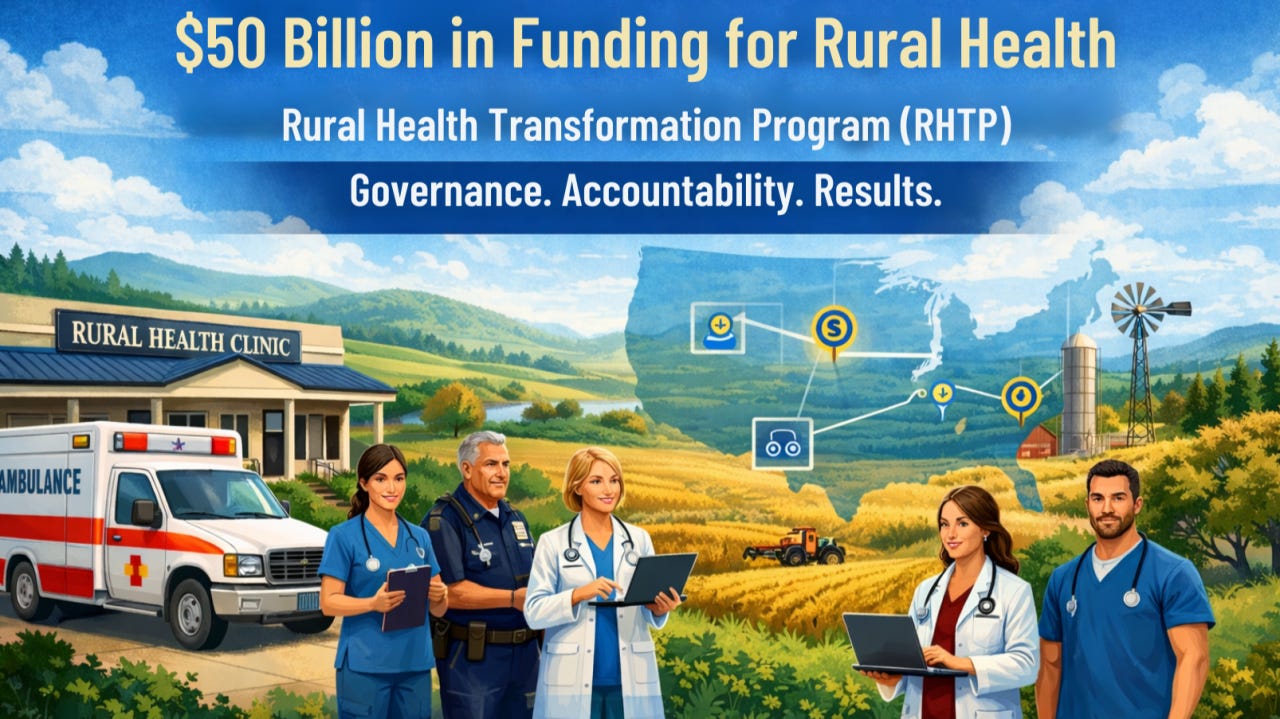
The second half is the money. Public Law 119-21, the July 2025 reconciliation law that goes by at least three names depending on who is talking, created a $50 billion Rural Health Transformation Program administered by CMS. Ten billion a year, five years, all 50 states funded, with CMS required to approve or deny applications by December 31, 2025. The first budget period closed October 30, 2026, and the second budget period began October 31. Year-one awards were made to all 50 states, with individual awards varying materially by state: Texas received $281,319,360.67, while Delaware received $157,394,963.86 and Michigan received $173,128,201.
And here is the bridge. Roughly 4.4 million veterans live in rural America, about 2.7 million of them enrolled in VA care, and close to 40 percent of VA care now gets delivered by non-VA providers through community care. Those community providers are the same critical access hospitals, rural health clinics and FQHCs that states are now trying to shovel RHTP money into. A company that already credentials clinicians for rural VA community clinics and knows how to invoice the federal government without triggering an audit finding is already standing in the right county. It just has never sold to a state.
What the target actually looks like
The profile is narrower than “veteran-owned healthcare contractor” sounds. You want revenue between $15 million and $30 million, EBITDA of $2 million to $3 million, and margins in the 8 to 15 percent range, which tells you the mix is mostly clinical staffing with some higher-margin professional services on top. Typical lines: nurses, mental health providers and telehealth clinicians placed at VA medical centers and community-based outpatient clinics; care coordination and case management; health information management, coding and release of information; suicide prevention and outreach programs; and subcontract work under the community care network administrators, which today means Optum Serve and TriWest. Some of these firms also carry Defense Health Agency or Indian Health Service work, which is a plus for diversification and a minus for complexity.
Contract vehicles matter more than the logo. VA set-aside task orders under agency IDIQs, sole-source awards (VA can sole-source to a certified SDVOSB up to $5 million for services, which is both a gift and a fragility), and subcontracts to the big network administrators. Revenue concentration at VA of 70 to 90 percent is normal and should be priced, not avoided. What should scare you is a recompete calendar that stacks in the first 12 months after close, or professional services revenue that looks like “executive support and training,” because that is exactly the category that got hit in February and March 2025 when VA canceled 585 non-mission-critical or duplicative contracts after reviewing nearly 2,000 professional-services contracts. Pull the termination lists and check every contract number before you fall in love.
Other diligence that separates a real target from a broker’s deck: CPARS ratings on every order, Service Contract Act compliance including wage determinations and the health and welfare benefit, a timekeeping system that would survive a DCAA floor check, documented indirect rates, clinician turnover and credentialing files, and the receipts-based size standard math. Staffing under NAICS 561320 caps at $34 million in five-year average receipts; physician office codes sit near $16 million; outpatient and miscellaneous practitioner codes are lower still. A $28 million staffing business growing 12 percent a year is two years from ceasing to be small, and when it stops being small, the set-aside work stops too. Finally, find out whether the owner is the entire business development function. Usually yes. Price that in, and plan to keep her on a consulting agreement for a year, subject to counsel’s review of applicable SBA eligibility and control rules.
The certification trap
Everything about the certification rewards reading the regulation and punishes reading the summary. Since January 1, 2023, SBA runs the program through VetCert under 13 CFR Part 128, the VA Center for Verification and Evaluation is gone, and the Dynamic Small Business Search is the system of record contracting officers actually check. To qualify as an SDVOSB, service-disabled veterans must unconditionally and directly own at least 51 percent of the company, 51 percent of each class of voting stock and 51 percent of the aggregate, and must control it. Control is where deals die. The qualifying veteran has to hold the highest officer position, manage the business day to day and set its long-term direction, work at it full time during normal working hours, and be the highest-compensated person in the company unless there is a documented reason otherwise. The non-veteran COO has to earn less than the veteran CEO, which may be the only federal rule that founders enforce with genuine enthusiasm.
Negative control kills it just as dead as ownership does. Supermajority voting requirements, veto rights held by non-veteran investors, the ability to block a quorum, buy-back provisions, put or call options that could move ownership away from the veteran, all of it is disqualifying. Operating agreements drafted by generalist deal lawyers routinely contain three or four of these as boilerplate investor protections. Have government contracts counsel draft the operating agreement first and the purchase agreement second, run SBA’s eligibility checker on the structure before signing an LOI, and accept that the investors in this deal are going to be more passive than they are used to.
Then the clock. When ownership changes through a sale, merger or acquisition, the company must recertify within 30 days of the transaction. If the buyer qualifies, the company keeps competing for set-asides. If the buyer does not, the status is gone, existing contracts generally keep running but no new set-aside awards or recompetes, and any contracting officer exercising an option gets to check DSBS first. The 30-day recertification is the one deadline in government contracting nobody lets slip. Buy the stock or membership interests, not the assets, so the contracts stay with the same legal entity and you avoid novation under FAR Subpart 42.12, a process that takes months and that the contracting officer can simply decline. The cost of a stock deal is that you inherit the company’s history, including whatever it certified on every prior award, so budget for False Claims Act diligence on past size and status representations and hold back 10 percent in escrow. Do not even think about the structure where a veteran holds 51 percent on paper while someone else runs the company. The Justice Department has a name for that and it is not “creative.”
One more wrinkle for anyone planning to grow through joint ventures: under the Vets First program, a joint venture must be SDVOSB-eligible at the time of award, and VA rules can be stricter than SBA’s. Teaming for state work does not run through those rules at all, which is one of the quiet advantages of the plan below.
Price, structure and a capital stack the SBA will tolerate
Start with the market and then discount it. Publicly traded government services companies saw enterprise value to EBITDA compress from about 15.4 times at the end of 2023 to roughly 11.5 times by the end of 2025 while defense tech ran off in the other direction. In the private lower middle market, brokers quote government services at anywhere from 6 to 14 times depending on clearances, agency mix and whether the firm is a prime on a vehicle. None of those tiers describe this target. Unclassified, single-agency, set-aside-dependent, sub-$3 million EBITDA, with a buyer pool limited to people who can produce a VA disability rating letter: that is a four to six times business, and five is a fair opening number for a clean one. Pay six only for backlog that covers two full years and a recompete calendar that is empty for 18 months.
Illustrative deal on $2.5 million of EBITDA at five times, $12.5 million enterprise value. SBA 7(a) caps at $5 million per borrower, so this cannot be a pure SBA deal, and the cleanest stack is a conventional senior term loan from a bank that understands government receivables, about $6 million or 2.4 times EBITDA; a seller note of $2.5 million at 6 percent, on full standby for 24 months, with a $750,000 reduction if SBA denies recertification or if a named VA contract fails to have its option exercised within 12 months of close; and $4 million of equity. The equity is the part that takes a lawyer. The veteran CEO owns 51 percent of the common. Outside investors own the other 49 percent and put the balance of their money in as subordinated notes with a modest PIK coupon and no governance rights beyond information and a customary consent on selling the company, which counsel will tell you is right at the edge of what SBA considers acceptable, so get it pre-reviewed. Fixed charges on that structure run about $1.5 million a year, which against $2.5 million of EBITDA, less modest capex and distributions for taxes, gives the senior lender the 1.25 times coverage it will insist on and leaves a cushion for the recompete you are going to lose anyway.
Two operating notes on cash. VA pays through Treasury on a net-30 cadence that is close to reliable; states pay in 45 to 90 days and some of them pay in installments tied to deliverables, so the growth plan needs a $2 million revolver sized to state receivables, and the bank will want it carved out from the term loan collateral. And if the buyer is a veteran, ask the SBA lender about fee relief on the guaranteed portion; the programs change annually and the savings are real but not deal-changing.
Fifty billion dollars of plumbing
Section 71401 of the law appropriates $10 billion for each of fiscal years 2026 through 2030 and hands it to CMS to distribute by cooperative agreement to states, and only to states. No hospital, clinic or vendor applies to CMS for anything. Half of each year’s money, $5 billion, is split equally, so every state gets $100 million a year for showing up. The other half is distributed through the program’s workload and application criteria. First-year awards were released for all 50 states by December 31, 2025, and subsequent state announcements show that awards vary substantially: Texas received $281.3 million, Delaware $157.4 million and Michigan $173.1 million for the first budget period. The state plans, rather than a direct CMS vendor grant program, are the commercial opportunity.
The spending rules are where a vendor either builds a durable business or an audit finding. States had to pick allowable categories covering areas such as prevention and chronic disease, workforce, training and technical assistance, technology-enabled care, health IT and cybersecurity, behavioral health, rural delivery redesign, and capital. Administrative costs, including every subrecipient’s admin, are capped at 10 percent of the award. Capital and infrastructure cannot exceed 20 percent and cannot include new construction; think equipment and minor renovation. Payments to providers under the applicable provider category are capped at 15 percent. RHTP money cannot pay for clinical services that an insurer would reimburse, and it cannot supplant spending that was already planned or funded from somewhere else. All of it lives under 2 CFR Part 200, which brings federal grant-management and audit obligations. Each year’s money must be spent by the end of the following fiscal year, with the program’s funding period ending in fiscal 2030 and final expenditures governed by the program terms.
The single most useful distinction for the acquired company is subrecipient versus contractor. A subrecipient carries out part of the program, takes on flow-down obligations, and gets audited like a grantee. A contractor sells goods or services to the state at a price. Be the contractor wherever possible. It means state procurement rules instead of grant rules, it means SAM.gov registration is irrelevant and state vendor portals are very relevant, and it means the SDVOSB status that made the company cheap to buy is mostly beside the point in winning the work, which is exactly the hedge you want.
What states bought in year one and what they are buying in year two
Year one was uneven and that unevenness is the opportunity. The first budget period ran from December 31, 2025, through October 30, 2026, and the second began October 31. States are now moving from approved plans to implementation awards. Texas announced $78,089,434.73 in Rural Texas Strong grants to 216 rural healthcare providers on October 16, a portion of its $281,319,360.67 first-year award. Nebraska also announced more than $177 million in RHTP funding on October 13. Delaware announced a $157.4 million first-budget-period award, while Maryland announced $16.4 million in workforce awards from its $168.2 million first-budget-period allocation. The number of state documents that contain the word “hub” would make a bicycle shop blush.
The pattern across all of it: nonprofits, hospitals and health centers win the subawards for care delivery, and commercial firms win as the implementation partner, the technical assistance contractor, the evaluator, the fiscal administrator and the technology deployer underneath them. That is the lane. CMS and states are now publicizing concrete workforce, mobile-care, technology and provider-award initiatives, and reading them as a sales document rather than a policy document is the whole trick.
Five service lines, ranked by how fast they pay
First and fastest is workforce. Training and technical assistance is an explicit allowable use, workforce development is a scoring factor, and a staffing company’s core competency is finding, credentialing and deploying clinicians into places nobody wants to live. The trap is supplanting: a state cannot use RHTP money to pay a nurse’s salary at a critical access hospital that was going to employ a nurse anyway, and it cannot pay for billable visits. What it can pay for is recruitment programs, preceptor and residency rotations, community health worker and health aide training, retention stipends, and the design of a regional float pool that a hospital network then funds from operations. Sell the program, not the body.
Second is program management and fiscal administration. Every state has a 10 percent admin cap and a transformation plan with eight to fifteen initiatives, so the management work gets bought as program delivery under the initiative categories rather than as admin. New York’s third-party administrator model and South Dakota’s consulting hires are the template. A federal contractor’s boring assets, DCAA-grade timekeeping, documented indirect rates, a compliance person who has read 2 CFR 200 twice, are exactly what a state health department terrified of a single audit finding wants to see on page one of a proposal.
Third is evaluation and data. CMS’s state-based funding model and reporting requirements give states a direct financial incentive to measure well and report on time. Partner with a university center for the methods credibility and do the data engineering and reporting operations yourself.
Fourth is technology deployment, specifically the last mile. Telehealth, remote monitoring, EHR and HIE integration, and cybersecurity are allowable and heavily funded, but the software vendors who win those categories have no one to put in a 25-bed hospital in a county with one stoplight to make the thing actually work. Be the implementation and change-management layer. For cyber, get on the state-level managed security provider lists the way Texas requires, and remember that state and local buyers can purchase IT and security services off the GSA schedule through cooperative purchasing if the company already holds one.
Fifth, and slowest, is standing up care models: hub-and-spoke networks, mobile units, behavioral health integration, critical access to rural emergency hospital conversions. These are the big-dollar subawards, they go to anchor providers, and the right move is to be named in the anchor’s application as the delivery partner before the application is written. That requires relationships that take a year to build, which is why the capture team gets hired in the first hundred days and not the first year.
The first hundred days and the three years after
Days zero through thirty are entirely defensive. File the recertification. Notify every contracting officer of the change of ownership in writing, because surprises at option time are how a stock deal turns into a novation anyway. Sit with every clinician on a VA site and explain that nothing about their paycheck changed. Confirm the senior lender’s reporting package and get the first covenant test out of the way.
Days thirty through one hundred are hiring and registration. The capture team is three people: a former state Medicaid or health department official who knows which deputy commissioner actually decides, a proposal lead who has written state responses rather than federal ones (different animals, state evaluators read for compliance with the RFP outline and penalize creativity), and a grants compliance lead with 2 CFR 200 scars. Register in the vendor portals of the ten to twelve states where the company already has VA clinics or community care subcontracts, sign teaming agreements with two university evaluation centers and three or four nonprofit anchors, and submit the first five bids before the hundred days are up, knowing most will lose. The point of the first bids is to be on evaluators’ radar when year three RFPs drop.
Year one, calendar 2027, is volume: roughly 20 state submissions at a fully loaded cost of $40,000 to $80,000 each, a 20 to 30 percent win rate for a firm with real past performance, four to six awards. Year two is depth: expand inside the states that awarded something, add the evaluation line, and start converting one-time implementation contracts into multi-year TA agreements structured like Montana’s, which runs through 2030. Year three, 2029, is the pivot that determines exit value: push the state relationships toward money that outlives RHTP, Medicaid 1115 waiver implementation, HRSA-funded state office of rural health programs, Flex program work for critical access hospitals, and commercial contracts with the regional networks that the RHTP hubs turn into once the federal money stops.
A base case without heroics and a downside case without tears
Entry: $20 million of revenue, $2.5 million of EBITDA. Base case assumes the VA book grows 4 percent a year and loses one recompete in year two, roughly offsetting. RHTP-funded state revenue comes in at $3.5 million in 2027, $8 million in 2028 and $12 million in 2029, at 18 to 22 percent contribution margins because technical assistance, program management and evaluation price like consulting rather than like staffing. Capture and compliance overhead adds about $900,000 a year by 2028. Consolidated EBITDA lands around $3.2 million in 2027, $4.5 million in 2028 and $5.6 million in 2029. Senior debt amortizes to roughly $3 million by the end of 2029 and the seller note is paid.
Now the honest part, which is how a buyer in 2029 will value those earnings. Nobody pays seven times for EBITDA attached to a program with a statutory end date. Model the exit as a sum of parts: the federal and recurring state base, call it $3.4 million of EBITDA, at seven times because by then it is multi-agency and multi-state; and the RHTP-specific piece, about $2.2 million, at three times because the acquirer assumes it decays. That is roughly $30 million of enterprise value, about $27 million of equity after net debt, against $4 million of equity in. If the year-three pivot works and half the RHTP revenue has converted to Medicaid or commercial contracts, the blended multiple moves up a turn and the number gets closer to $35 million. Either outcome is a very good five years for a nurse who was told she was worth eight times.
Downside case: recertification hits a snag and takes 90 days instead of 30, one VA option does not get exercised, and the state capture engine wins at half the base case rate. EBITDA in 2029 is about $3.5 million. Fixed charges are still covered at better than 1.4 times, the seller note price adjustment absorbs part of the pain, and an exit at five times still returns the equity roughly three and a half times. The scenario that actually loses money is a buyer who pays seven times at entry, borrows against it, and then discovers that the whole plan hinged on a certification that did not survive the operating agreement.
Risks, including the one where it all ends in 2030
The sunset is the risk that should be on the first slide. Fiscal 2030 is the last appropriation, states spend it through fiscal 2031, and CMS wants every dollar gone by the end of fiscal 2032. A business that is 60 percent RHTP revenue in 2030 is a business with a going-out-of-business sale built in. The entire operating plan is shaped around that, and the discipline is to refuse growth that makes the mix worse after 2028 no matter how easy the money looks. Adjacent to the sunset is rescission risk: unobligated mandatory balances are exactly what future reconciliation bills go looking for, and states that are slow to obligate are the ones most exposed. Prioritize states that moved in year one.
State execution risk is real and uneven. Some states will procure through 12-month cycles with protests, some will route money through a handful of anchor hubs that behave like monopsonies, and a few will spend the fourth quarter of every budget period in a panic because the obligation deadline is the only one that counts. The 15 percent provider payment cap and the supplanting prohibition make it genuinely easy to design a staffing-flavored proposal that an auditor later reclassifies as paying for reimbursable care; the compliance lead earns her salary by killing those proposals before they are submitted.
On the federal side, the recertification is the acute risk and VA concentration is the chronic one. February 2025 proved that a professional services contract at VA can be terminated for convenience on a Tuesday by someone who read a one-sentence justification, and the community care contracts are being re-let in a two-region structure that could reshuffle the subcontract tiers underneath them. Size standard creep is slower but just as fatal to the set-aside base, and the fix is growing the non-set-aside revenue, which the plan does anyway. Working capital from state receivables, clinician retention at rural sites that are hard to staff on a good day, and the key-person problem of a CEO who has to be a full-time service-disabled veteran with no ready substitute round out the list. Buy key-person coverage, and have a succession conversation with a second veteran executive in year one, not year four.
Exit
The exit is designed into the mix shift. At entry, the company’s value lives inside a certification that only a service-disabled veteran buyer can preserve, which is why it was cheap. By 2029, if the plan has worked, more than half of revenue comes from state, Medicaid and commercial contracts that do not care who owns the company, and the buyer universe opens up to the same PE platforms and strategic acquirers that could not bid in 2026. They will pay a full multiple for the state relationships and a haircut for the VA set-aside base, which is fine, because the set-aside base was bought at a haircut too. The alternative exit is to sell to another service-disabled veteran operator, probably with SBA financing, at a multiple closer to entry but on EBITDA that has doubled. And there is a third path that nobody writes business plans about: keep it. A diversified rural health services company doing $45 million with real margins, a federal book, and a Rolodex of state deputy commissioners is a nice thing to own in a decade when rural health finance is going to keep getting rewritten every couple of years, by whichever party is holding the pen
.