🎧 Part I Podcast free on Apple Podcasts and Spotify.
Part I: Building Healthcare Businesses Around Medicare's Twenty Twenty-Seven Shared Savings Rule: Cost-Sharing Administration, ACO Finance, Quality Data, Rural Practices, and Specialty Care

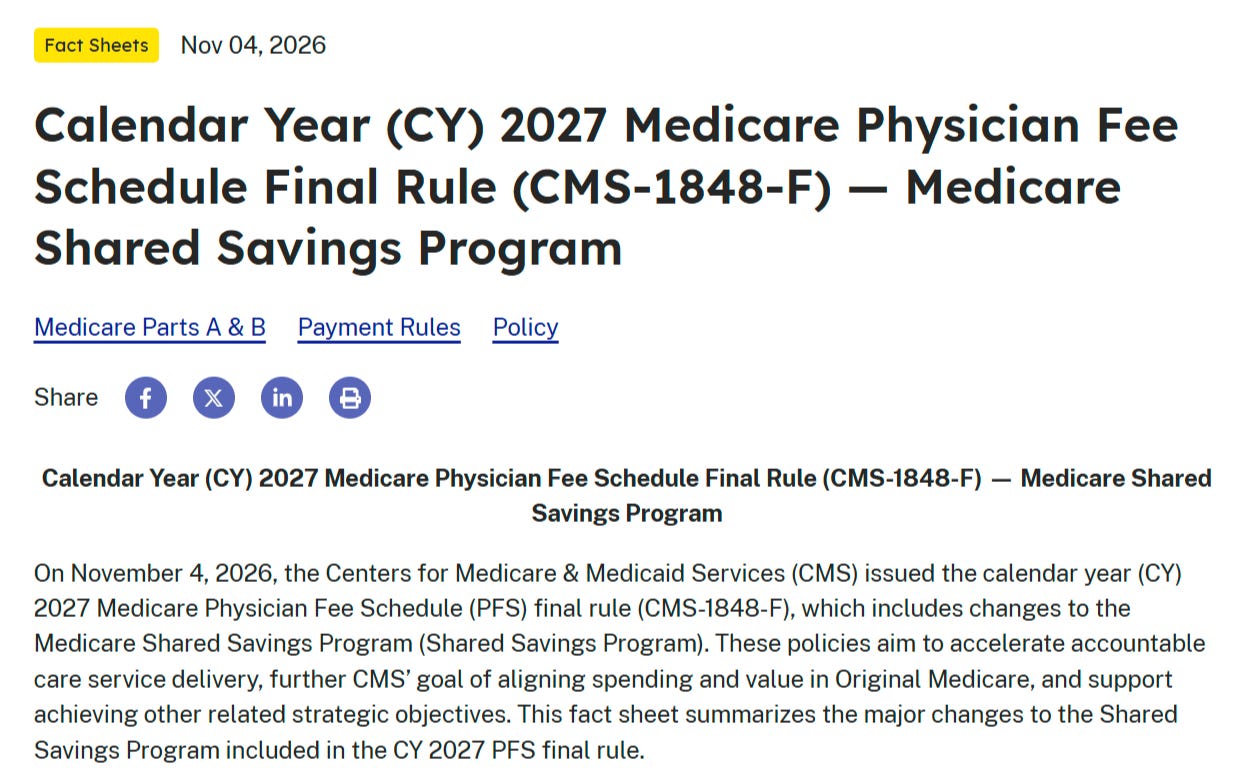
Medicare’s 2027 Shared Savings Program rule creates commercial opportunities - but the addressable budget is not the program’s gross savings. Here is the structure that matters.

🎧 Part II Podcast episode for paid subscribers only. Also available on Apple Podcasts and Spotify.
Part II: Building Healthcare Businesses Around Medicare's Twenty Twenty-Seven Shared Savings Rule: Cost-Sharing Administration, ACO Finance, Quality Data, Rural Practices, and Specialty Care

Medicare’s 2027 Shared Savings Program rule creates commercial opportunities - but the addressable budget is not the program’s gross savings. Here is the structure that matters.
To listen to paid episodes in Apple or Spotify, link your Substack subscription via the show settings on those platforms (instructions inside the Substack app under Subscriptions → Podcast).
Table of Contents
Abstract
The budget that actually matters
Making cheaper visits work at the front desk
A finance department for accountable care
Getting independent practices into the program
Quality reporting that can explain its own answers
A rural operating company with a credible funding plan
Connecting practice revenue to accountable care economics
Specialty businesses that sell measurable clinical performance
Where the first investment should go
Abstract
The commercial opportunity in Medicare’s new Shared Savings Program rules sits in the work required to turn better participation economics into operating results. Patient cost-sharing support needs eligibility checks, billing changes, settlement, and evidence that additional care justifies its cost. Financial changes create demand for better underwriting and cash forecasting. Practice recruitment needs reliable participation histories and onboarding. Quality reporting needs reproducible clinical evidence across disconnected records. Rural organizations need affordable operating capacity, while specialty providers need contracts that connect clinical performance to money an accountable care organization can actually retain. These are business hypotheses, not predictions of guaranteed demand. The strongest products should attach to a named budget owner, solve a recurring operational problem, and leave enough economic value for the customer after implementation costs and provider distributions. Several could become substantial independent companies. Others make more sense as capabilities sold through existing billing, practice management, or accountable care organizations.
The budget that actually matters
An accountable care organization can save Medicare money and still be a lousy customer for an expensive startup. That is the commercial problem running through this entire rule. Medicare’s benefit, the organization’s performance payment, the practice’s revenue, and the vendor’s addressable budget are different amounts. Treating them as interchangeable makes a fundraising slide much easier to write. It also makes the eventual renewal conversation rather unpleasant.
The Shared Savings Program already has enough scale to support meaningful businesses. In 2026, it included 511 accountable care organizations serving approximately 12.6 million people with Traditional Medicare. Those figures describe a substantial population concentrated behind a relatively small number of organizational buyers. A hypothetical product priced at one dollar per beneficiary per month would represent roughly $151 million in annual revenue across that entire population. That is arithmetic, not an obtainable market forecast. Penetration, channel margins, overlapping contracts, implementation costs, and customers doing the work themselves would all shrink it.
The final rule creates reasons for buyers to revisit their operating arrangements. But a regulatory change does not automatically create a separate software category. A calculator that explains a new benchmark adjustment could become a useful feature inside an existing actuarial platform. A service that administers an approved patient financial benefit across dozens of billing systems has a more plausible claim to being an independent business. The difference is how much recurring work the product owns, how difficult replacement becomes, and whether its value survives the next rulemaking cycle.
The financial boundary matters just as much. Shared savings depend on performance against a benchmark and satisfaction of program requirements, including quality standards. The organization receives a portion of qualifying savings; Medicare retains the remainder. A vendor therefore needs to work backward from the customer’s expected retained payment, subtract existing operating commitments, and determine what remains available to purchase an intervention. A proposal that generates attractive gross savings can still consume nearly all the buyer’s economic benefit. The following opportunities are worth building only if they survive that calculation.
Making cheaper visits work at the front desk
Beginning April first, twenty twenty-seven, approved organizations can reduce or eliminate beneficiary cost sharing for eligible Part B services. Prescription drugs and durable medical equipment, prosthetics, orthotics, and supplies are excluded. The practical business opportunity is a service that makes the approved benefit function correctly from scheduling through final settlement. Patients need an accurate explanation of their obligation. Practices need to know what to collect. The organization needs to know what it has committed to fund.
Consider a patient offered reduced cost sharing for an eligible follow-up visit. The scheduling system might identify eligibility correctly, while the billing system still generates a patient statement. A secondary payer could subsequently pay an amount that was already included in the organization’s subsidy calculation. An adjusted claim could change the original liability. None of those problems requires an exotic algorithm. They require reliable transaction handling across systems that were not designed around the same financial arrangement. A patient should not need to become a reimbursement specialist to receive a promised benefit.
A useful product would maintain effective dates for eligibility and approved service categories, connect those rules to participating practices, and preserve the reason each transaction qualified. It would calculate the appropriate patient obligation, support the billing workflow, reconcile claim adjustments, and maintain a ledger of amounts funded or settled. Existing secondary coverage would need to be considered before assuming that reducing nominal cost sharing actually reduces the patient’s spending. The evidence of value should be fewer incorrect bills, less staff rework, reliable financial reconciliation, and better completion of clinically appropriate care.
The economics need a fairly unforgiving pilot. Suppose an organization supports five thousand patients at an average annual cost of sixty dollars each. That is three hundred thousand dollars before administration. If the intervention produces five hundred thousand dollars in net Medicare claims savings, after accounting for additional visits and treatment, a hypothetical sixty-percent sharing rate merely recovers the subsidy. There is no operating margin left for the administrator. Every figure in this example is an assumption, but the mechanism is the point: the organization pays the full intervention cost while retaining only part of the resulting savings.
The initial customer should therefore be an organization with an approved, clinically coherent use case and enough operational discipline to measure it. The chief financial officer and patient engagement leader should buy together, with revenue cycle staff involved before launch. A base administration fee plus a charge tied to covered population or transaction volume would be easier to defend than compensation proportional to the amount waived. The latter rewards spending more subsidy. Distribution through established billing vendors could reduce integration costs, while the specialist administrator owns benefit logic, reconciliation, and performance measurement.
A finance department for accountable care
The rule increases BASIC Level E’s maximum savings share from fifty to sixty percent, reduces ENHANCED’s maximum positive regional adjustment weight to thirty-five percent, and raises prior-savings adjustment scaling to seventy-five percent. It also risk adjusts the five-percent cap on upward adjustments to the historical benchmark and adds guardrails around prospective trend projection error. Those changes create a useful opening for a financial operating service that combines actuarial modeling with the ordinary work of managing cash, commitments, and provider distributions.
The customer does not need another screen showing that spending is above or below a target. The customer needs to understand why the forecast moved, how much confidence to place in it, and which commitments remain affordable. A useful system would distinguish changes in observed utilization from changes caused by benchmark methodology, population composition, claims development, or an updated assumption. It would preserve each forecast vintage so the finance team could explain why a payment estimate from March differed from the estimate presented to the board in September.
Track selection provides a simple illustration. Assume one participation option produces a hundred-million-dollar benchmark against ninety-seven million dollars in spending. At a sixty-percent sharing rate, the simplified payment would be one million eight hundred thousand dollars. Suppose another option produces a ninety-nine-million-dollar benchmark against the same spending, with a seventy-five-percent share. Its simplified payment would be one million five hundred thousand dollars. These are hypothetical benchmarks, not a prediction of the rule’s effect. They exclude payment limits and other adjustments. They show why a higher sharing percentage can coexist with a smaller expected payment.
A serious underwriting product would extend that comparison across unfavorable scenarios. What happens if claims develop above expectations? What happens if a practice leaves, the population changes, or quality performance reduces the payout? How much liquidity remains after funding care management and honoring participant distribution agreements? Implementation must follow each provision’s agreement-cohort and performance-year rules. The product should make those dependencies inspectable, because an unexplained black box is a poor foundation for deciding how much downside risk a physician group can afford.
The strongest initial offer would combine software with a recurring finance service. Sell to organizations that need credible monthly forecasts but cannot justify a large internal actuarial team. Charge for forecasting, reconciliation, scenario analysis, and board reporting. Financing could become an adjacent product once forecast accuracy is demonstrated, but expected shared savings should not be treated like an ordinary, already-earned receivable. The underwriting advantage would come from understanding the uncertainty and contractual obligations behind the estimate. Lending against a colorful dashboard is still lending against uncertainty.
Getting independent practices into the program
The new benchmark growth adjustment rewards expansion involving clinicians and beneficiaries inexperienced in value-based care. Additional assignment changes arrive in twenty twenty-eight. Together, they suggest an opening for a practice onboarding and participation-history business. The valuable work starts after someone identifies a potentially attractive physician group and before that group becomes a functioning participant with usable data, clear obligations, and an operational care model.
A recruiting database alone would be easy to copy. The harder product would connect clinician identities, billing entities, historical participation records, executed agreements, electronic record systems, and the patients likely to be affected by onboarding. It would distinguish a commercial prospect from a practice that has passed financial, technical, and operational diligence. Each conclusion should have supporting evidence. A founder should assume that public directories will contain gaps and that contractual records will occasionally contradict somebody’s spreadsheet.
The onboarding service could then answer practical questions that determine whether growth creates value. Can the practice deliver clinical data in a usable form? Who will act on care gaps? How much staff time will implementation consume? Does the proposed distribution agreement leave enough funding for centralized services? What happens when the physician who championed the arrangement retires or changes employers? These questions deserve answers before recruitment success becomes an announcement. Adding names to a participant roster is easier than adding productive operating capacity.
The buyer would be an existing organization expanding into independent practice networks, or a management company supporting several organizations. Initial pricing could combine implementation fees with recurring charges for maintaining participation records and data connections. The durable advantage would be shorter onboarding cycles, fewer eligibility surprises, and better retention of functioning practices. A commission-only recruitment model would encourage signatures while leaving someone else to absorb the cleanup. A recurring operating relationship gives the vendor a reason to care whether the newly recruited practice is still contributing a year later.
Quality reporting that can explain its own answers
For performance year twenty twenty-seven and subsequent years, Medicare electronic clinical quality measures become a new collection type for the APP Plus quality measure set, reported only for an ACO’s assigned beneficiaries. Other collection options remain. Permitted practice exclusions retain separate ninety-five-percent population-coverage and seventy-five-percent measure-completeness tests. The business opportunity is an evidence and workflow product that helps organizations choose an appropriate reporting route and reproduce the resulting calculations.
The tempting sales pitch is that a narrower reporting population makes quality measurement easy. It makes some aggregation problems smaller. The remaining records can still disagree about patient identity, encounter dates, diagnoses, screening history, or whether a documented result actually satisfies the measure. A claim suggesting that a service occurred may support a different conclusion from a clinical result containing the information needed for measure calculation. The product needs to preserve that distinction instead of flattening every observation into a generic completed-care-gap flag.
Its central object should be an explainable patient-level measure result. For every inclusion, exclusion, numerator event, or unresolved gap, a reviewer should be able to see the underlying evidence, the relevant date, the source system, and the version of the calculation used. An imported screening result should remain traceable to the record that supported it. Conflicting values should enter an exception workflow. A language model might help extract candidate evidence from documents, but the final reporting pipeline needs reproducible logic and accountable review.
Version management is particularly valuable here. CMS updates electronic measure specifications annually and requires the applicable versions for reporting periods. A product should therefore preserve the exact specifications and terminology mappings used for a submission, along with tests that identify unintended changes in results. Otherwise, an apparently improved quality score might reflect an altered mapping, a changed denominator, or newly available historical data. Those can be legitimate changes, but they should be visible before anyone attributes them to better care.
The commercial entry point should be a narrow, difficult workflow at an organization with multiple record systems. Start with one measure, demonstrate that the result can be reproduced, and reduce the manual work required to resolve exceptions. Then expand across the required reporting set and into ongoing clinical operations. The quality leader would own the immediate problem, while the financial leader would care about reporting costs and payment exposure. Pricing should reflect population size and data complexity, with a credible plan for reducing implementation labor. A business that needs a permanent army of analysts for every customer will struggle to earn software margins, however often the pitch uses the word automation.
A rural operating company with a credible funding plan
From twenty twenty-eight, qualifying rural, low-income-subsidy, and dually eligible beneficiaries support forty-five-dollar quarterly advance investment payments, compared with twenty-five dollars otherwise, within the ten-thousand-beneficiary limit. Program eligibility still matters. That creates a plausible opening for a regional operating company that provides shared staff and infrastructure to practices that cannot support those capabilities efficiently on their own.
The existing advance investment payment structure includes a one-time payment of two hundred fifty thousand dollars and a limited period of quarterly payments, with advances generally recouped from earned shared savings under program rules. A business built around this funding needs to show how its service becomes economically sustainable after the initial funding period. Treating an advance as permanent operating revenue would conceal the most important part of the business plan.
Take an illustrative eligible population of ten thousand people, with six thousand qualifying for the higher quarterly amount and four thousand receiving the lower amount. The quarterly total would be three hundred seventy thousand dollars. Annualized over four eligible quarters, that is one million four hundred eighty thousand dollars. It is a meaningful operating resource, but it belongs to the organization’s approved investment effort. It is not automatically a vendor’s revenue opportunity. The vendor needs to demonstrate how its proposed fee translates into functioning capacity and, eventually, recurring economic value.
That capacity might include centralized patient outreach, referral coordination, reporting support, data operations, and finance. Local practices would retain clinical relationships and decision-making, while the operating company supplies work that benefits from shared staffing. Geographic concentration could matter more than rapid national expansion. A team that understands the referral patterns and operational constraints of one region may solve problems that a distant service center repeatedly escalates without resolving.
The initial customer should be a committed regional practice network with clear leadership and a realistic participation plan. Contracts should specify staffing, service levels, implementation obligations, and how performance will be evaluated. A modest fixed operating fee with carefully defined performance compensation could align the relationship. Investors should evaluate the business as a services company until recurring delivery becomes demonstrably efficient. Calling a nurse, an implementation specialist, and a finance analyst a platform does not change payroll.
Connecting practice revenue to accountable care economics
The broader physician fee schedule rule creates another product opportunity closely connected to the Shared Savings Program. The new B-two modifier provides a thirty-two-percent increase to the associated evaluation and management payment for qualifying accountable care practitioners, compared with the sixteen-percent increase associated with B-one. B-two claims enter assignment and expenditure calculations. That creates a need for financial tools that evaluate practice collections and accountable care spending together.
A billing company can show a physician group that a properly supported claim produces more revenue. An accountable care finance team may simultaneously see higher expenditures. Both can be correct. The relevant commercial question is how the additional revenue is distributed, what additional work it funds, and how the arrangement affects the organization’s eventual performance payment. A product that reports only collections would leave part of that calculation unfinished.
The useful business would connect encounter-level billing opportunities to organization-level financial modeling. It would verify participation and applicable billing conditions, estimate collectible revenue, and show the corresponding effect on expenditures for relevant patients. It would also distinguish revenue generated outside the assigned population from spending counted within it. The accounting should make the boundary explicit, rather than assuming every practice dollar has the same effect on the organization’s economics.
A sensible initial buyer would be a physician-led organization whose practices already use different billing vendors. The product could sell through those vendors while maintaining a common financial view for the accountable care organization. Payment could combine implementation and recurring analytics fees, with any performance compensation tied to verified incremental value. Simply taking a percentage of additional billing could reward a result that looks attractive at the practice level but less attractive after reconciliation. The product earns its place by making those tradeoffs visible before compensation agreements are signed.
Specialty businesses that sell measurable clinical performance
The specialty opportunity follows from the same arithmetic. An organization considering a cardiology, kidney care, behavioral health, or musculoskeletal partner needs a plausible connection between the proposed clinical work and savings it can retain. The program’s financial framework concerns Medicare Parts A and B expenditures. A pharmacy intervention therefore needs a medical-spending or quality rationale for this buyer; a reduction in Part D drug spending is a separate economic result. That boundary should shape product design from the beginning.
A heart failure service, for example, could propose faster access after discharge, medication reconciliation, coordination with the treating clinicians, and escalation when patients deteriorate. Those are candidate operating activities, not a promise of savings. The company would need to specify which patients it can reach, which existing services it duplicates, what additional claims its work creates, and how quickly an observable effect might emerge. A clinically valuable intervention with benefits concentrated several years later may face a difficult purchasing conversation with an organization managing near-term financial obligations.
The data architecture should support both operations and evaluation. Medicare’s Beneficiary Claims Data API and claim-line feeds provide relevant claims information, but availability is tied to submission and processing. Partially adjudicated claims can arrive within days after submission; that does not make them a live clinical event feed. A specialty company should combine appropriate clinical notifications with claims-based follow-up, while preserving the distinction between a provisional claim, a finalized expenditure, and a confirmed clinical event.[Tool budget: round 1/1; 0 rounds remain afterward.]
Evaluation needs particular care because high-cost patients often become less costly even without a new intervention. Selecting people after an expensive episode and comparing their subsequent spending with that episode can produce an impressive chart with very little explanatory value. A credible contract should define the eligible population before enrollment, track patients who decline or cannot be reached, and use a defensible comparison strategy. Randomized rollout may be feasible in some settings. In others, carefully designed comparison cohorts and sensitivity analyses would provide a more useful estimate than a simple before-and-after average.
Where the first investment should go
The first investment should go to the workflow with the clearest buyer, the shortest path to measurable value, and the least dependence on a favorable forecast. That usually means administration, reconciliation, or evidence production before it means balance-sheet financing or a broad clinical platform. Products that make a new benefit work, explain a quality result, or connect practice revenue to accountable-care economics can earn trust through observable operational improvements. Products that promise to monetize a benchmark before the underlying data and contracts are stable will have a harder time doing so.
The central discipline is to price from retained economics rather than gross savings. A vendor should know which budget pays, which claims are counted, which operational costs are incremental, and what the customer can still distribute to practices or invest in care. The 2027 rule expands several possible markets, but it does not eliminate implementation risk. The businesses most likely to endure will make that risk visible, own a recurring workflow, and improve the customer’s ability to explain where the money went.
The commercial structure should also recognize overlapping work. If the organization already employs care managers and the specialist bills separately for clinical encounters, a vendor cannot assume that every observed reduction belongs to its intervention. Contracts should specify the baseline, additional service costs, attribution method, payment timing, and treatment of changes in the population. A fixed service component can fund necessary operating capacity, while performance compensation rewards results that survive those adjustments.
For pharmaceutical, biotechnology, and device companies, an adjacent opportunity is an independent implementation and outcomes service that helps provider organizations evaluate a defined treatment pathway. The buyer needs evidence about eligible patients, treatment completion, adverse events, utilization, and total medical spending. A manufacturer may have a reason to support evidence generation, but the provider-facing conclusions need to remain credible even when they are commercially inconvenient. A reusable measurement and implementation capability could serve several therapeutic areas. A service that exists only to make one product look favorable will have a much narrower customer base.
Where the first investment should go
The most promising initial product is cost-sharing administration, provided customers demonstrate real demand and an affordable clinical use case. It owns a new operational transaction that crosses eligibility, patient communication, billing, and settlement. Its value can be observed in day-to-day work before waiting for an annual performance payment. The difficult integration work also offers a more durable advantage than a policy summary or a rules chatbot. The first investment should fund a small number of deeply integrated implementations, with explicit measures of billing accuracy, administrative effort, patient uptake, and subsidy economics.
The finance service is another attractive starting point, particularly for a team with actuarial and operating experience. It can begin as a focused service business, generate revenue while learning customer workflows, and gradually standardize the repeatable work. Quality evidence infrastructure offers a similar path for a team strong in clinical data engineering. Both need disciplined scope. A founder who promises forecasting, quality reporting, recruitment, care management, and patient payments in the first contract has probably volunteered to become the customer’s entire operations department.
Rural operating companies and specialty delivery businesses deserve a different capital structure and a longer assessment of execution risk. Their value depends heavily on staffing, local relationships, clinical performance, and working capital. Those can support excellent businesses, but the evidence should come from functioning operations rather than projected software margins. Early contracts should identify who pays during implementation, how performance is measured, and what happens when the initial funding source or customer agreement changes.
Across these opportunities, the strongest company would be able to show an ordinary operating result: the patient received the promised benefit, the practice was onboarded without months of cleanup, the quality submission can be reproduced, or the financial forecast was reliable enough to support a hiring decision. Regulation creates a reason to reconsider the workflow. The company earns its revenue by making that workflow work, at a price the customer can still afford after everyone else has been paid.