
Welcome to Healthcare Markets & Technology.
Rigorous analysis of AI, policy, capital, technology, and clinical operations across U.S. healthcare — written for the people who build, invest in, and lead it.
Free subscribers get 2 public articles per week. Upgrade to paid → for the full 7 articles/week, paid podcast episodes, deal breakdowns, and the complete 538-deep-dive archive.
Subscribe or upgrade here →
One thing to bookmark: the searchable Knowledge Base at kb.onhealthcare.tech isn’t in Substack’s menu. Save it now — on mobile, tap share → “Add to Home Screen.”
Reply to any email with questions. I read every one.
— Trey
Abstract
Summary of the new community engagement requirements
Timelines that create near term procurement pressure
Key operational gaps states cannot fill internally
Business models that should exist but do not
Existing companies most advantaged in this shift
Guidance for angel investors funding early teams
Why this is a multi year regulatory tailwind with long durability
Table of Contents
Introduction
The new regulatory forcing function
How the rule changes Medicaid operations
Why the practical burden on states is enormous
Where the gaps become founder opportunity
Business models that should exist
Existing companies that benefit
What angels should fund
Why this is a generational buildout moment
Closing thoughts
Introduction
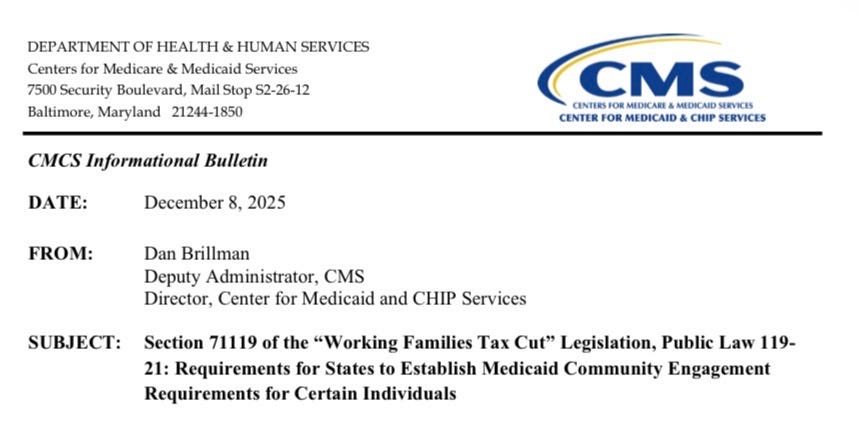
Every now and then, a federal rule hits Medicaid like a meteor that only a handful of people notice at first, but a year later everyone is running around acting like it appeared out of nowhere. The new community engagement guidance is one of those meteors. It’s not sexy. It’s not flashy. It’s buried in legislative cross-references and eligibility logic. But if you read it slowly enough, preferably with a strong coffee and a high tolerance for statutory language, you eventually realize this thing rewires the operational backbone of Medicaid eligibility across most states. And since Medicaid is already buckling under the weight of its post-unwinding workload, the system cannot possibly absorb these new requirements without external infrastructure.
This is the kind of regulatory shift that quietly creates billion dollar companies for founders who get there early. It’s very reminiscent of the environment right before the ACA marketplaces launched, where anyone who actually read the regs could predict exactly which infrastructure layers would break first and which startups would end up filling the gaps. This moment has that same feeling. A massive new compliance framework. A fixed statutory timeline. A large population. A churn heavy eligibility process. And states who, let’s be honest, are still struggling to process basic paperwork without losing people in the mix.
The new regulatory forcing function
The rule requires adults who fall into the Medicaid expansion or expansion equivalent waiver groups to demonstrate at least eighty hours of work or qualifying activity every month. Qualifying activities can include education, community service, job training, and similar engagements. There are plenty of exclusions for medically frail people, caregivers, certain tribal populations, pregnant people, and a variety of edge cases that turn into decision trees long enough to melt a caseworker’s monitor.
The kicker is that states must verify compliance using reliable information before they can ask the beneficiary for documentation. Reliable information basically means any data the state already has access to or can get from third party sources. Think payroll feeds, provider records, higher ed enrollment systems, workforce training program logs, and community service reporting pipelines. This is a huge shift away from the older documentation-driven approach where beneficiaries had to prove eligibility manually, often by mail or by showing up to an office with papers no one wanted to photocopy.
There’s also a mandatory outreach period states must complete before the rule goes live. They need to inform beneficiaries of the new requirements by mail and at least two other methods, such as text or phone. And then, beginning in 2027, most of these same individuals will have renewals every six months instead of annually, which basically doubles the administrative cadence. All of this sits on top of the existing complexity states are still digging out of after the unwinding, where many offices were already months behind on routine work.
How the rule changes Medicaid operations
If you think about the structure of the requirement, it forces Medicaid to operate more like a real time verification engine than a static eligibility program. Historically, eligibility was mostly backward looking and documentation based. Did you send in what we asked for. Did we receive it. Did someone open the envelope. With community engagement layered in, states now have to assess forward moving activity, tie it to calendar months, match it to the right person, interpret exceptions and exclusions, issue notices, provide a thirty day grace period, keep benefits active during the grace window, and only then remove someone if nothing checks out. And if the rule applies to that person in multiple months, states must track which months have already been satisfied.
This means states need systems that look more like workflow automation platforms than static eligibility engines. They need the ability to trigger outbound messages based on timing rules. They need identity resolution strong enough to match payroll data to beneficiaries. They need documentation intake systems capable of triaging medical frailty exceptions. They need the capacity to classify uploaded evidence, determine what qualifies and what doesn’t, and attach that determination to the beneficiary record. States have never needed this level of precision before, and they certainly don’t have that level of tooling today.
This also introduces continuous volume rather than episodic volume. With six month renewals, people will be passing through the compliance review pipeline constantly. This isn’t like open enrollment where everything spikes at once. It’s a perpetual stream. So whatever systems states bring online need to handle consistent throughput year round without buckling under load.
Why the practical burden on states is enormous
It’s worth stating plainly that most state Medicaid offices are not staffed for this. They don’t have the people, systems, or workflows. Many eligibility systems are twenty year old mainframes duct taped to modern portals. Document management is still shockingly physical in many places. And even where digital systems exist, they’re usually stitched together in brittle ways with no capacity for flexible logic or real time verification.
The reliable information requirement is the most important part. It sounds bureaucratic at first, but it’s quietly the biggest driver of tech demand. Because to comply with that requirement, states must ingest data from payroll systems, education systems, workforce boards, and community service organizations. They must resolve that data to individuals accurately enough that they don’t wrongly trigger noncompliance notices. And they must do it fast enough to meet tight renewal windows.
This is not a job for state IT. Even the states with strong tech shops struggle to maintain basic eligibility operations when volumes get high. The guidance pushes them into a new domain that looks more like fintech compliance than traditional public assistance. And whenever government is pushed into fintech territory, the private market fills the gap.
Another problem is the volume of exceptions. People can be excluded if they are medically frail, caregivers, tribal members, or meet one of the hardship criteria involving hospitalization, travel for medical care, or disasters. Every one of those exceptions requires evidence, documentation, or structured attestations. This means a long tail of document types and a need for classification logic that recognizes what someone is sending and how to interpret it. If a beneficiary sends a discharge summary that confirms an inpatient stay, the system needs to know how that affects compliance for that month. Humans can do it, but not at population scale.
Where the gaps become founder opportunity
The obvious opportunity is data ingestion. The rule practically begs for a company that builds pipes into payroll aggregators, workforce training programs, community service logs, and higher ed enrollment systems. The company doesn’t even need to store everything. It can normalize feeds, match identities, and send a simple compliance flag or data packet back to the state. That alone replaces hundreds of thousands of manual verifications every year.
Another gap is identity resolution. Medicaid systems often struggle to match records when names or addresses differ slightly. If you’re trying to match payroll records to beneficiaries, you need sophisticated probabilistic matching. A startup that builds Medicaid tuned identity resolution with lightweight integration can become the backbone of compliance.
There is also a major gap in beneficiary outreach. States must send notifications through multiple channels. The systems for doing that today are old, fragmented, and unreliable. A company that specializes in Medicaid compliant messaging, with tracking, multilingual support, and preference management, becomes valuable overnight. And since outreach must begin months before the rule goes live, states will need vendors quickly.
Another opportunity is document intake and classification. The long list of exceptions and hardship pathways means there will be a constant flow of documentation that needs to be analyzed. A startup could build automated classification, evidence extraction, and routing tools specifically tuned to the categories defined in the rule. Think of it like a Medicaid KYC engine, where the inputs are discharge summaries, pay stubs, school enrollment letters, volunteer logs, and hardship attestations.
And then there’s the orchestration layer. Something that plugs into existing eligibility systems and handles the community engagement logic. This could be a lightweight module that tracks which months a person has satisfied, manages compliance windows, triggers outreach events, and guides caseworkers through review pathways. It must be configurable enough for states to change their month counts and exception handling rules without breaking everything.
Business models that should exist
If you line up all the operational needs that fall out of the rule, a new ecosystem practically draws itself. The first major category is what I’d call a Medicaid employment and activity signal network. Something that plugs into payroll feeds, workforce programs, job training systems, higher ed enrollments, and even community service organizations. It doesn’t need to be perfect on day one, but it needs to be good enough to satisfy the reliable information requirement. This would let states verify compliance without making beneficiaries submit documentation. States get cleaner workflows. Members get fewer letters. And the vendor becomes core infrastructure rather than a lightweight bolt on.
The second category is a Medicaid compliance adjudication engine. This is where documentation goes when a beneficiary can’t be verified through data alone. The engine would parse documents, classify them, check evidence against state rules, and produce a determination that fits neatly into the eligibility system. It’s a mix of OCR, natural language interpretation, structured rules logic, and workflow routing. But unlike generic document classification companies, this engine would be built specifically around the community engagement exceptions. It would need clinical logic for medical frailty cases, plus logic for caregivers, veterans, tribal members, and hardship events. In reality, a company that solves this well could expand into all sorts of Medicaid documentation workflows beyond community engagement, because states have infinite documentation problems.
The third category is a multichannel beneficiary communications layer that states can rely on. No fancy branding needed. It just needs to work every time. States must send notices by mail plus one or more other formats like text or phone. A vendor that handles address resolution, language preferences, reading level filters, delivery confirmations, bounce handling, and opt in management can become a core partner. There’s also the nuance that states need precise timing. If a beneficiary has thirty days to fix an issue, the state better be confident that the message arrived. Right now that’s a hope, not a guarantee.
The fourth category is a Medicaid compliance orchestration platform. This sits between the data ingestion layer, the adjudication engine, and the eligibility system. It handles timing rules, tracks compliance windows, and coordinates outreach events. It could offer dashboards for caseworkers, automate most exception pathways, and standardize how states handle operational logic. Think of it as Zapier but for Medicaid. Except less cute and more battle hardened. States don’t need whimsy. They need stability.
The fifth category is a field operations network attached to the tech stack. Even with all the automation in the world, some beneficiaries will always need help. They won’t respond to texts. They won’t upload documents. They’ll be medically complex or living in unstable conditions where paperwork isn’t a priority. A company that blends community health workers with tech infrastructure can bridge that last mile. This is where Pair Team already shines, because they’ve built exactly this kind of distributed field operation that can reach people states struggle to reach.
Existing companies that benefit
A few companies are positioned to ride this wave without having to reinvent themselves.
Pair Team is the most obvious example. Their entire operational model is built around reaching hard to engage Medicaid members, completing administrative tasks on their behalf, coordinating services, and serving as the connective tissue between community organizations and healthcare organizations. The new rule essentially turns that skill set into a superpower. If states want to avoid inappropriate disenrollments due to noncompliance, they need people who can find beneficiaries who aren’t responding, explain what’s needed, gather documents, and help them navigate exceptions. Pair Team has already built that muscle, and because they aren’t an MCO, they clear the compliance firewall.
Eligibility modernization vendors will also benefit. Companies that sell modular add ons to existing state systems suddenly become central because the states will look for systems that qualify for enhanced matching funds. If a vendor can tie its functionality to design, development, or installation work that CMS classifies under the enhanced match categories, states have financial motivation to adopt it. Founders building modular, API friendly components that can snap on to existing eligibility systems will find themselves in a procurement sweet spot.
Companies working on digital identity, document classification, and structured workflows will also thrive. For example, any startup with strong OCR pipelines, classification logic, and compliance workflows can adapt their core tech to Medicaid’s specific requirements. The long tail of exception categories means there will be endless document types and edge cases. A startup with the right infrastructure can turn that chaos into predictable workflows.
Organizations running workforce training, community service coordination, or job placement programs may also benefit. If they can provide structured, verifiable data that states can ingest, they become part of the reliable information ecosystem. This could open collaboration between tech vendors and community based organizations who have historically operated without much data interoperability.
What angels should fund
The most important trait to look for in founders building in this space is a willingness to live in the weeds of Medicaid operations. This is not a market for armchair theorists. It requires people who understand the ugly reality of how states process documents, how eligibility systems behave under load, and how quickly backlogs can form when new requirements come online. Investors should look for teams with prior experience in Medicaid tech, digital benefits, public sector procurement, or complex operational businesses. Strong engineering is necessary but not sufficient. They need product people who understand how policy translates into workflow. They need ops leaders who know how to manage distributed teams. And they need the patience to build trust with states, which move slower than typical enterprise customers.
Look especially for founders tackling data ingestion. Payroll data is scattered across countless employers and processors. Higher ed enrollment data is not standardized. Workforce programs often use outdated systems. Community service organizations rarely have digital reporting pipelines. A company that builds the pipes between these worlds can become indispensable because it enables states to check compliance without touching beneficiaries. That reduces administrative load and minimizes churn, two things states desperately want.
Investors should also watch for founders building compliance adjudication tools. The exceptions are complicated enough that most caseworkers will struggle to interpret them accurately. A startup that can take the rule logic, codify it, and pair it with smart document analysis becomes a caseworker superpower. It reduces errors, cuts down on appeals, and keeps beneficiaries enrolled when they should be.
Another area worth funding is outreach infrastructure. A startup that can deliver high volume messages across SMS, voice, and mail, with tracking and language support, will get contracts quickly. States don’t have the luxury of hoping messages land. They need confirmation. They need retries. They need clean address data. A startup that makes outreach reliable removes a major administrative headache.
Finally, teams blending tech with field operations are worth serious consideration. Technology alone will not solve the last mile problem. Many beneficiaries don’t engage digitally. They’re juggling life chaos, unstable housing, or complex health conditions. A tech enabled service that can send community health workers into neighborhoods to gather evidence, assist with renewals, or get someone through a hardship exemption becomes crucial. These teams are harder to build. They require management depth and operational discipline. But if executed correctly, they become essential partners for states and for the vendors providing the tech stack.
Why this is a generational buildout moment
The rule’s timeline creates a multi year runway that is unusually predictable. Outreach begins in mid 2026. Implementation begins in 2027. Exceptions and good faith exemptions can only delay things until the end of 2028. And after that, community engagement becomes a permanent part of the eligibility landscape. This is the kind of clarity that founders rarely get in Medicaid. Usually the landscape is full of uncertainty. Rules may be proposed, changed, paused, litigated, or quietly deprioritized. But this rule is statutory. It’s baked into law, not a waiver. States cannot ignore it.
The sheer number of people affected means the market is huge. The adult expansion population in many states is large enough that even a small percentage needing manual verification creates massive administrative volume. And since renewal cycles are shifting to a six month cadence, states will touch these beneficiaries far more often than before. That creates predictable demand for vendors that can reduce burden, automate workflows, and keep eligible people enrolled.
The fact that states get enhanced federal match for some system upgrades makes procurement easier. Legislators love free money. Procurement teams love subsidized contracts. If a vendor can align its product with the match categories, the state can justify the investment easily. This flips the usual Medicaid procurement challenge on its head. Instead of hoping the state allocates scarce funds, vendors can anchor their pitch to federal matching incentives.
Another reason this is a generational buildout moment is that the rule effectively standardizes the problem space across states. While some states may tweak their implementation details, the core requirements are harmonized. Everyone needs to verify monthly activity. Everyone must respect the exclusion categories. Everyone must allow a thirty day cure period. Everyone must provide multichannel outreach. Everyone must demonstrate use of reliable information before requesting documentation. This is a national market with uniform constraints but local politics layered on top. Startups that build configurable but standardized modules can scale across states quickly. If you can solve the compliance workflow in one state, you can port the same module to ten more with relatively minor adjustments. That’s rare in Medicaid, which is usually a patchwork of fifty different interpretations of the same statute.
The final structural advantage is that states are desperate to avoid the political backlash of wrongful disenrollments. The unwinding, even in states that tried their best, created chaos. Millions of people lost coverage because of paperwork issues. Legislators and governors do not want a repeat. Community engagement requirements, by definition, add new failure points. Every time a state sends a noncompliance notice based on incorrect or incomplete data, they create legal risk, press risk, or federal oversight risk. Vendors who can provide audit trails, reliable data ingestion, and strong documentation handling become politically valuable. Not just operationally valuable. Politically valuable. And in Medicaid, political value often determines vendor longevity.
Closing thoughts
If you zoom out long enough, Medicaid’s history is full of moments where regulatory changes created whole new market categories. The ACA did it for exchange infrastructure. Value based care regulations did it for care management and risk adjustment. The unwinding created a wave of modernization around workflows, automation, and document processing. Now the community engagement rule is setting up the next wave. But unlike some earlier shifts, this one hits the absolute core of eligibility itself. It affects volume, timing, workflows, staffing, and data flows. It touches the entire life cycle of enrollment. And it forces states to behave like real time verification engines rather than slow moving paper processors.
For founders, this is the moment to build. The window is open right now, not in eighteen months. By the time states begin outreach in mid 2026, pilots must already be running. By the time 2027 hits, vendors need to be in place. States don’t have the luxury of waiting for perfect products. They need workable solutions fast. Early stage teams can run rapid cycles with pilot counties or targeted beneficiary segments, refine functionality, get caseworker feedback, and build credibility that will matter during procurement.
It’s also the moment for angels to get in early. Once the big federal vendors notice this space, contract capture will get more competitive, and the incumbents will start burning down their proposals with promises they cannot keep. But right now, the space is quiet enough that early teams can shape the narrative. Angels who know Medicaid can identify founders who actually understand operational complexity and aren’t just building slideware.
A word of caution though. The companies that win here are not going to look like typical SaaS startups. They will be messy. They will have ops teams, compliance teams, maybe even field teams. Their margins may not look pretty initially. But if they solve a real state problem, they will scale into massive, durable companies. This is infrastructure that will last decades. Medicaid eligibility does not get replaced. It only gets layered with new rules. And every new rule makes the system more complex, which increases the moat for vendors who have already invested in understanding the system.
Another wise investing lens for angels is looking at where the most friction sits in the process. Anytime a workflow involves beneficiaries sending documents that may or may not meet state criteria, you have the potential for delay, backlog, and error. If a company can clean up even one of those points, that is instantly valuable. For example, imagine a startup that builds a simple photo capture tool that guides beneficiaries through the process of taking clear images of documents, identifies missing pages, detects obstructed text, and confirms that the document matches the expected categories for an exception. That sounds tiny. But when multiplied across millions of documents, it prevents backlogs that can clog the entire system. In Medicaid, tiny improvements often create oversized returns because scale is massive.
Another friction point is matching. If a new mother’s name on a hospital discharge summary doesn’t match the name on her Medicaid record because of a recent name change, states need matching logic smart enough to connect the dots. Otherwise, they’ll treat her as noncompliant even when she’s clearly exempt. A startup that can solve identity matching in a Medicaid specific way becomes essential, because poor matching is one of the leading causes of mistaken disenrollments. If you want a moat, look at places where accuracy is life or death in the eligibility workflow.
There is also enormous opportunity in streamlining provider or community organization attestations. Many exceptions require some form of attestation from a provider or a program. For example, a medically frail individual may need a clinician to confirm their condition. But clinicians are overwhelmed. They don’t want to fill out forms. A startup that builds a lightweight interface for providers to attest electronically, integrated with state systems, can reduce friction massively. It also reduces fraud risk because structured attestations are easier to audit.
On the community side, workforce programs and volunteer organizations often have no digital reporting infrastructure. That means states cannot rely on their records as reliable information. A vendor that builds reporting tools that community organizations actually want to use can create a data flywheel. The value proposition is simple: make reporting easy for community orgs, provide data feeds to states, reduce administrative burden for beneficiaries, and strengthen compliance pipelines. You’re effectively building the connective tissue that lets states trust the data coming from the field.
Another important angle for angels to consider is that the rule prohibits managed care plans from making compliance determinations but does not prohibit them from supporting operations. This is a quiet invitation for startups to build tools that serve both states and plans. Plans want to keep members enrolled. States want accurate determinations. Startups can sit in the middle, providing workflow, outreach, and documentation tools that each side uses for different purposes. This structure is particularly well suited to companies that already work with both groups. Pair Team fits this mold because they do hands on member engagement while also working with community organizations and providers.
Founders should also consider building for state procurement processes explicitly. Most state RFPs require references, pilots, proof of ability to handle sensitive data, SOC compliance, and accessibility standards. Startups that build these capabilities early are better positioned. Angels should encourage founders to treat procurement as part of product development, not a post product box checking activity. If a startup waits until after their first product is built to think about procurement hurdles, they’re already behind.
One more thought about why this moment matters. States are not just trying to comply with a rule. They are trying to avoid large scale harm. Eligibility errors are not abstract. They determine whether someone’s insulin is covered, whether their pregnancy care is paid for, whether they get access to mental health services. When states get overwhelmed and beneficiaries fall through the cracks, the consequences are immediate and severe. Vendors who help states reduce harm become trusted partners. That trust compounds over time, creating multi decade relationships. Angels should invest in companies that approach this work with seriousness, humility, and operational empathy. This is not a place for quick flips. It’s a place for builders who want to shape the future of public benefits infrastructure.
The companies that emerge from this era will not just solve community engagement compliance. They will position themselves to solve whatever comes next. Medicaid always evolves. New eligibility groups get added. New documentation rules appear. New verification requirements get layered on. A company that solves community engagement well will have the infrastructure to tackle future rules, whether related to income verification, household composition, residency, or work requirements in other programs. That’s why the moat here is not just the product. It’s the accumulated trust and familiarity with state operations.
As more founders enter this space, the smartest ones will realize that the real moat is implementation. Anyone can read the rule and build software. But not everyone can deploy it in states with ancient systems, complex policies, and limited staff. The winners will be the companies that invest early in implementation teams that can translate product into state workflows. Angels should encourage founders to build implementation as a first class capability, not an afterthought.
Another interesting dimension here is the interplay between technology and on the ground operations. Many beneficiaries who fall under the community engagement rule will not have stable employment, consistent addresses, or reliable access to technology. They may be housing insecure, dealing with chronic conditions, or navigating other complicated life circumstances. A tech only approach will not work. Startups need hybrid models that combine software with people. Angels should be comfortable funding operationally heavy startups if the margins can improve over time through smart workflow automation. Medicaid businesses often start messy and become more efficient with scale and experience.
The regulatory environment also creates a natural opportunity for cross state learning. States that implement early will become templates for others. Startups with early traction can package those learnings into playbooks for future states. Angels should encourage founders to think about scalability from the start but pilot in a small number of states with receptive agencies. The goal is to build repeatable, defensible processes that can be exported.
The final point worth emphasizing is that Medicaid infrastructure companies built during regulatory shifts tend to endure. They become part of the architecture of public benefits. They get written into RFPs. They get referenced in state plans. Over time they become so integrated that replacing them would be disruptive. Angels should view this as a chance to fund companies with deep durability. The downside is that these companies are hard to build. The upside is that once they’re built, they stick.
The community engagement rule might look narrow on paper, but its implications are wide. It forces states to overhaul data ingestion, identity matching, outreach, documentation handling, workflows, and timing engines. It exposes the fragility of current systems. It creates urgency. And it makes the market hungry for solutions. Founders who build the right layers can slot themselves into a permanent place in the Medicaid ecosystem.
Pair Team is one of the few companies already positioned to help on day one because of their operational footprint and their ability to engage members who state systems cannot. But this market is big enough for many winners. Data companies. Workflow companies. Outreach companies. Document processing companies. Hybrid ops companies. Identity resolution companies. The ecosystem will not form overnight, but it will form. And angels who back founders now will be part of shaping that landscape.
The next two years will determine which companies become the canonical vendors. Those who move early, build with states, and focus relentlessly on solving real operational pain will win. And they will not just win contracts. They will define the future of how Medicaid manages eligibility, compliance, and the human beings behind those processes.
This is the moment. The rule is the signal. The tailwinds are massive. And the founders who build now will be the ones whose infrastructure quietly powers the next decade of Medicaid.
Love how you broke down the implications of the rule
Most folks were just saying “this is a big tailwind” and move on haha