Welcome to Healthcare Markets & Technology.
Rigorous analysis of AI, policy, capital, technology, and clinical operations across U.S. healthcare — written for the people who build, invest in, and lead it.
Free subscribers get 2 public articles per week. Upgrade to paid → for the full 7 articles/week, paid podcast episodes, deal breakdowns, and the complete 538-deep-dive archive.
Subscribe or upgrade here →
One thing to bookmark: the searchable Knowledge Base at kb.onhealthcare.tech isn’t in Substack’s menu. Save it now — on mobile, tap share → “Add to Home Screen.”
Reply to any email with questions. I read every one.
— Trey
Table of Contents
Abstract
The Market Opportunity
The Product and Business Model
Go-to-Market Strategy
Financial Projections and Unit Economics
Regulatory Risk and Mitigation
Competition and Defensibility
Team Requirements and Organization
Exit Strategy and Timeline
Abstract
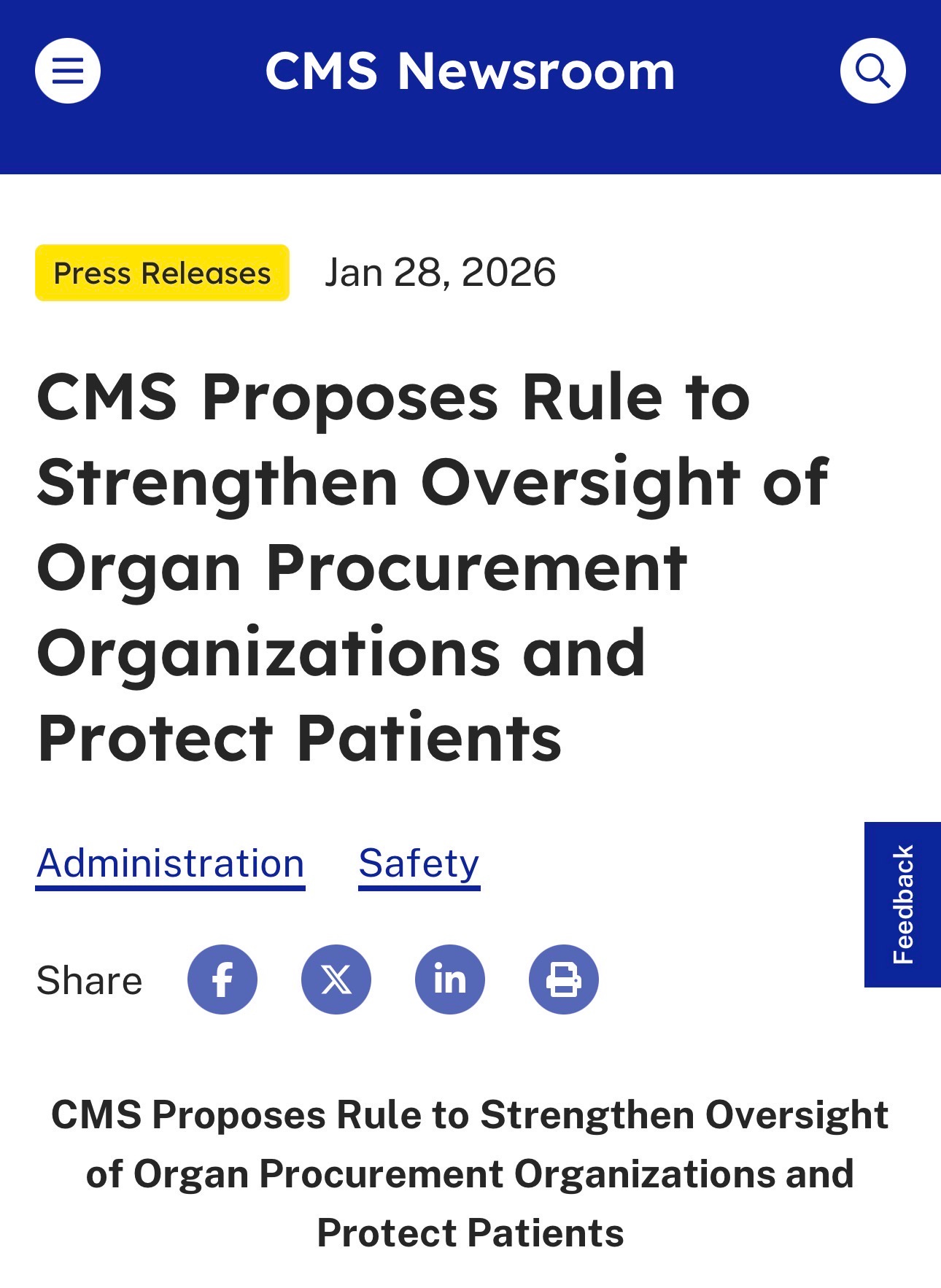
The organ transplant system in America represents one of healthcare’s most inefficient markets, with roughly 17 people dying daily while waiting for organs that could have been procured but weren’t. CMS’s proposed reforms to Organ Procurement Organization (OPO) oversight create a rare opportunity to build venture-scale infrastructure around performance transparency, procurement optimization, and market accountability. This business plan outlines a B2B SaaS platform targeting the 56 OPOs nationwide, offering clinical decision support for donor identification, real-time performance benchmarking against peers, and regulatory compliance automation as CMS moves toward outcomes-based certification. The thesis: as OPOs face actual consequences for underperformance for the first time in decades, they’ll pay for tools that prevent decertification. Revenue model based on per-hospital licensing plus success-based fees tied to procurement volume improvements. Projected path to $30M ARR within four years with Series B fundraise of $15M following successful deployment at 8-10 OPOs representing 15% market share. Exit via acquisition by transplant services incumbent, healthcare data infrastructure player, or quality measurement platform within 5-7 year window.
The Market Opportunity
The organ procurement system in the United States operates through 56 federally designated monopolies called Organ Procurement Organizations, each with exclusive geographic territories covering the entire country. These organizations coordinate the identification, evaluation, and recovery of organs from deceased donors, working with hospitals when patients die or approach brain death. The system has been remarkably resistant to performance pressure despite massive variation in outcomes. Some OPOs recover organs from 60-70% of eligible deaths while others languish below 30%, and until very recently, CMS had never decertified an OPO for poor performance in the program’s entire history.
The proposed rule changes everything. CMS wants to shift from process measures (did you have the right committees and policies?) to outcome measures (did you actually recover organs?). The new framework would establish objective donation and transplantation rate thresholds, measure performance against expected outcomes based on donation service area characteristics, and most critically, create a pathway for decertification and service area reallocation for persistent underperformers. This matters because OPOs that lose certification lose their entire revenue stream overnight. They get paid roughly $30-50k per organ recovered, so a mid-sized OPO might run $20-40M in annual revenue. The threat of losing that creates urgent demand for performance improvement tools that didn’t exist when underperformance had no consequences.
The total addressable market breaks down pretty cleanly. There are 56 OPOs, about 5,500 hospitals in their service areas (though only maybe 1,500 see significant volume of potential donors), and roughly 35,000 deaths annually that should trigger OPO evaluation. If you can sell software that helps OPOs identify more donors, coordinate more efficiently with hospitals, and demonstrate compliance with the new metrics, you’re looking at sales cycles to organizations with eight-figure budgets and existential fear of regulatory consequences. The math works.
Market dynamics favor new entrants right now because the legacy vendors in this space built tools for the old regime. Existing OPO management systems focus on case documentation, organ matching, and regulatory reporting for process metrics. Nobody optimized for donation rate improvement because donation rates didn’t matter for certification. The rule change obsoletes a bunch of incumbent functionality and creates space for purpose-built solutions targeting the new measures. OPOs will need to rebuild their technology stacks anyway, which lowers switching costs and increases willingness to try new vendors.
The regulatory timeline creates urgency but also risk. CMS proposed these rules in 2023, final rules could drop in 2025-2026, implementation probably 2026-2027, with the first performance measurement periods determining certification happening 2028-2029. That gives a venture-backed company maybe three years to build product, acquire customers, and demonstrate value before the actual decertification consequences kick in. Tight window but feasible if execution is clean. The risk is that CMS delays implementation or waters down the standards after industry pushback, which would reduce OPO willingness to pay for performance improvement tools. Mitigating factor is that even if federal rules get delayed, several states (California, New York) are pursuing their own OPO accountability measures, so regulatory pressure seems durable even if federal timeline slips.
The Product and Business Model
The core product is a clinical decision support and performance management platform with three main modules. First module handles donor identification, using predictive models to flag high-likelihood donor candidates in hospital EHRs before families are approached for consent. Most OPOs rely on hospital staff to trigger referrals when patients meet clinical criteria, but hospitals miss tons of cases because ED docs and ICU nurses have other priorities. The software would integrate with major EHR systems, monitor admissions and clinical trajectories in real time, and surface cases to OPO coordinators with probability scores and recommended actions. Think of it like a lead scoring system for organ donation.
Second module provides performance benchmarking and analytics. OPOs need to understand how they’re performing against the new CMS metrics in real time, not six months after the measurement period ends. The platform would ingest data from hospital partners, calculate donation and transplantation rates using CMS methodology, and show how the OPO stacks up against peers and against the certification thresholds. Crucially, it would decompose performance gaps into actionable drivers (are we missing donors because hospitals aren’t referring? because families are declining consent? because we’re ruling out medical suitability too aggressively?) so OPOs can prioritize improvement initiatives. This is basically BI tooling for the organ procurement workflow.
Third module automates regulatory compliance and reporting. The new CMS framework requires OPOs to submit detailed performance data, document quality improvement activities, and maintain specific governance structures. Compliance is a pain but necessary to avoid citation during certification reviews. The platform would template all the documentation requirements, auto-populate submissions from operational data already in the system, and maintain audit trails proving the OPO met all process requirements even while focusing on outcome improvements. This is less sexy than the clinical decision support but probably generates more immediate willingness to pay because compliance officers have budget authority and hate manual reporting.
Revenue model is annual subscription per hospital in the OPO’s service area plus success fees tied to procurement volume growth. Base subscription might run $15-25k per hospital annually, with typical OPOs covering 100-150 hospitals, generating $1.5-3.75M in subscription revenue per OPO customer. Success fee structure could be 5-10% of incremental revenue from additional organs procured above historical baseline, paid quarterly in arrears. If the software helps an OPO go from 300 organs per year to 400 organs per year, that’s 100 additional organs at roughly $40k revenue per organ, or $4M in incremental OPO revenue. A 7.5% success fee would be $300k annually. Blended ARPU across subscription and success fees would probably land around $2.5-4M per OPO customer at steady state.
The subscription model aligns incentives pretty well. OPOs pay base fees for the technology and compliance automation regardless of performance improvements, which funds product development and operations. Success fees tie vendor economics to customer outcomes, ensuring the company only makes serious money if OPOs actually procure more organs. This matters for sales cycles because procurement leadership can tell their boards the vendor only gets paid if results materialize, reducing perceived risk of the purchase decision. It also creates natural expansion revenue as OPOs improve performance and trigger higher success fees over time.
One wrinkle is that OPO payment models might change under the new regulations, which could affect their willingness or ability to pay success fees. Currently OPOs get paid fee-for-service by transplant centers for each organ, but there’s been policy discussion about capitated payments or quality-adjusted reimbursement. If OPO economics shift away from volume-based payment, the success fee model needs adjustment. Could pivot to flat performance bonuses triggered when the OPO exceeds certification thresholds, or could build the success fee into the base subscription as a higher tier with committed service levels. Revenue model has to stay flexible to accommodate regulatory changes.
Go-to-Market Strategy
Initial customer acquisition targets the 10-15 OPOs most at risk of decertification under the new metrics. These organizations know they’re underperforming, their boards are getting nervous, and they have urgent need for tools that demonstrate improvement trajectory before CMS makes certification decisions. Identifying at-risk OPOs is straightforward because CMS publishes performance data. You can literally download the spreadsheets, calculate which OPOs fall below proposed thresholds, and build a target list. Focus on organizations in the 25th-40th percentile of performance, big enough to have budget (at least $15M annual revenue) but scared enough to move quickly.
Sales motion is direct field sales with high-touch implementation support. OPO buying committees typically include the CEO, chief medical officer, VP of operations, and compliance/quality leadership. Sales cycles run 6-9 months from first contact to signed contract because these are mission-critical infrastructure purchases requiring board approval and budget reallocation. Deal sizes in the $2-4M annual range justify dedicated account executives making $200-250k OTE with 60-90 day sales cycles for initial pilots expanding to full deployments. Field sales team probably needs clinical credibility, so former OPO coordinators or transplant surgeons transitioning to commercial roles make sense as AE profiles.
Pilot programs are essential for derisking customer adoption. Offer a 6-month pilot at one or two hospitals in the OPO’s network for $50-75k, with clear success metrics around donor identification rates, consent conversion, and data integration feasibility. Pilots let OPOs test the product with limited financial and operational commitment while building internal champions. If the pilot shows 15-20% improvement in eligible donor identification or 10% improvement in consent rates, expanding to full network deployment becomes an easier sell to the board. Pilots also generate case studies and reference customers for subsequent sales to peer OPOs.
Channel partnerships with EHR vendors and transplant service lines accelerate hospital integration. Epic and Cerner probably won’t build native organ procurement optimization into their core platforms, but they might partner with best-of-breed vendors through app marketplaces or integration partnerships. A deal with Epic where the donor identification module appears in the Cupid marketplace or gets co-marketed to transplant centers dramatically reduces implementation friction and increases credibility. Similarly, partnerships with large transplant centers (Penn, UCSF, Mayo) who can pressure their local OPOs to adopt better tools creates top-down demand that complements the bottom-up OPO sales motion.
Customer success and retention are make-or-break given the revenue model’s dependence on success fees and expansion. Each OPO customer needs a dedicated CSM who understands the clinical workflows, can troubleshoot integration issues, and actively manages the relationship to prevent churn. Gross retention needs to stay above 95% because losing a $3M customer in year two destroys unit economics. Net retention should target 120-130% as OPOs expand from pilot hospitals to full network deployment and as success fees grow with improved procurement volumes. High-touch customer success probably requires 1 CSM per 4-5 customers, with CSMs needing clinical backgrounds to maintain credibility with OPO operations teams.
Financial Projections and Unit Economics
Year one focuses on product development and initial pilot deployments with three OPO customers, generating $500k in revenue primarily from pilot fees and initial subscription. Burn rate runs $4M, funded by a $5M seed round, with the team at 15 people including 5 engineers, 2 clinical advisors, 2 sales, 2 customer success, plus founders and ops. The goal is to prove product-market fit with successful pilots showing measurable performance improvements and customer willingness to expand to full deployments.
Year two targets eight OPO customers with four on full deployment and four in pilot phase, generating $8M revenue. This assumes average customer value around $1M in year one (mix of pilots and early-stage deployments before success fees kick in). Burn increases to $8M as the team grows to 35 people, requiring a $10M Series A to fund growth. Unit economics start to emerge with CAC around $400k per customer (high-touch sales and long cycles) but LTV approaching $15-20M over a 7-year customer lifetime assuming 95% gross retention and 125% net retention. LTV/CAC ratio gets to 3-4x, which is acceptable for B2B SaaS in regulated markets with long implementation cycles.
Year three reaches 15 OPO customers representing roughly 25% market penetration, with revenue hitting $22M as earlier customers reach full deployment and success fees materialize from performance improvements. The business approaches cash flow breakeven with $20M in expenses as go-to-market efficiency improves and product development shifts from core platform to feature expansion. Team size plateaus around 60 people with most incremental hiring in customer success and implementation to support growing customer base.
Year four gets to $35M revenue with 20 OPO customers and strong net retention driving expansion revenue from existing accounts. The business is profitable on an operating basis, generating $5-8M in free cash flow that could fund continued growth without additional capital. This becomes the inflection point for either raising a growth round to accelerate market penetration beyond 35% or beginning exit discussions with strategic acquirers who see the company as critical infrastructure for the evolving transplant ecosystem.
Key assumptions that drive these projections include OPO willingness to pay $2.5-3M annually at steady state (subscription plus success fees), ability to maintain 95%+ gross retention despite regulatory uncertainty, and ability to close 4-5 new logos annually in years 2-3 before market saturation. The most fragile assumption is probably success fee realization, which depends on the software actually improving procurement volumes by 15-25%. If clinical efficacy doesn’t materialize, success fees disappear and ARPU drops by 40-50%, completely breaking the unit economics. This puts enormous pressure on getting the clinical decision support models right in year one.
Burn multiples stay reasonable throughout the growth phase. Year two burn multiple around 1.0 (burning $8M to generate $8M in new ARR), improving to 0.6-0.7 in year three as sales efficiency increases. This is defensible to growth investors who understand that enterprise healthcare sales require investment but should show improving efficiency as the product matures and reference customers derisk the purchase decision for later buyers.
Regulatory Risk and Mitigation
The entire business depends on CMS actually implementing the proposed certification reforms and enforcing them with meaningful consequences for underperformers. If CMS backs down after industry lobbying, waters down the standards, or extends implementation timelines by 3-5 years, OPO urgency to buy performance improvement tools evaporates. This is the single biggest risk to the venture and needs active monitoring and mitigation throughout the company’s lifecycle.
Mitigation strategies start with policy intelligence and advocacy. The company needs full-time regulatory affairs capability tracking CMS rulemaking, participating in public comment periods, and potentially joining coalitions of patient advocates and transplant professionals who support stronger OPO accountability. This isn’t about lobbying to change rules in the company’s favor (that’s gross and probably counterproductive), but about understanding the policy landscape and making sure the product roadmap adapts to whatever final regulations emerge. If CMS shifts from outcomes-based metrics to hybrid measures that include process components, the product needs that functionality before the rules take effect.
Diversifying revenue beyond federal compliance reduces dependence on CMS timelines. Several states (California, New York, Pennsylvania) have independent OPO oversight authority and are pursuing their own accountability measures that might move faster than federal rules. Building the platform to support state-level compliance requirements creates alternative value propositions if federal implementation stalls. Similarly, positioning the product as operational efficiency tooling (helping OPOs do more with existing staff and resources) rather than purely regulatory compliance creates demand even in scenarios where certification rules don’t change as aggressively as proposed.
Customer contracts should include provisions acknowledging regulatory uncertainty and defining how payment terms adjust if rules change materially. For example, success fee structures could trigger differently based on whatever metrics CMS actually finalizes rather than being hardcoded to the proposed rule’s specific donation and transplantation rate thresholds. This protects both the company and customers from rule changes making the contract unworkable. Similarly, subscription agreements might include language allowing scope adjustments if regulatory requirements shift, preventing situations where customers feel locked into paying for functionality that’s no longer relevant.
The timing risk (rules getting delayed by 2-3 years) is actually more manageable than the substance risk (rules getting watered down to meaningless standards). Delays just extend the company’s runway requirements but don’t destroy the market. Watered-down standards could destroy willingness to pay if OPOs realize they can maintain certification without improving performance. Hedge against substance risk by making sure the product creates operational value beyond compliance. If the software genuinely helps OPOs identify more donors, coordinate more efficiently with hospitals, and manage their workflows better, they’ll pay for it even if certification consequences don’t materialize. The compliance and regulatory reporting modules become less valuable, but the clinical decision support and analytics maintain utility.
Competition and Defensibility
The incumbent OPO management systems are companies like UNOS Technology (which runs the organ matching network), TransplantConnect, and various hospital-specific coordination tools. These vendors focus on post-identification workflows: managing the organ offer process, coordinating recovery logistics, documenting medical suitability, and submitting data to the national registry. They’re not optimized for performance improvement under outcomes-based metrics because that wasn’t the regulatory environment they were built for. Their moats come from integration with the UNOS network and deep relationships with OPO operations teams, but they’re vulnerable to disruption if new entrants offer materially better performance management capabilities.
Displacing incumbents requires demonstrating ROI that justifies switching costs. OPOs have years of data in legacy systems, staff trained on existing workflows, and integration dependencies with hospital partners. Rip-and-replace strategies fail in healthcare because implementation risk is too high. The better approach is to position as complementary infrastructure that sits alongside incumbent systems, ingesting their data and augmenting their functionality with predictive analytics and performance management that legacy vendors don’t provide. Over time, as the new platform proves value, it can absorb more workflow and potentially replace legacy systems entirely, but the initial wedge needs to be additive rather than substitutive.
Defensibility builds through data network effects and customer entrenchment. As the platform accumulates more OPO performance data across different service areas, it can benchmark individual OPOs more precisely and train better predictive models for donor identification. An OPO considering alternatives faces the question of whether a competitor’s product, lacking equivalent data assets, can deliver comparable performance. This moat strengthens over time as the platform’s dataset grows. Similarly, once an OPO has rebuilt workflows around the platform and integrated it deeply into hospital partnerships, switching to a competitor requires re-implementation across 100+ hospitals, which is a massive operational lift that most organizations won’t undertake unless the incumbent vendor seriously screws up.
Intellectual property in the form of patents on specific algorithmic approaches to donor identification or predictive modeling could provide some protection but probably isn’t a primary moat. Healthcare software IP is hard to defend, and patents in this space would likely cover relatively obvious applications of machine learning to clinical decision support. More durable is the operational knowhow about OPO workflows, regulatory requirements, and hospital integration patterns that accumulates through customer deployments. This tacit knowledge is hard to replicate and allows the company to execute implementation faster and more reliably than competitors trying to enter the market.
Team Requirements and Organization
Founding team ideally combines clinical expertise in organ procurement with healthcare data and regulatory experience. The CEO probably needs to come from the transplant world (former OPO executive, transplant surgeon, or senior UNOS leadership) to have credibility with customers and deep understanding of the clinical workflows. The CPO/CTO should have background building clinical decision support tools and integrating with EHR systems, ideally with prior experience in healthcare B2B SaaS. Third co-founder could be commercial leadership (VP Sales or Head of Partnerships) with track record selling into hospitals and understanding enterprise healthcare buying processes.
Early engineering hires need healthcare data experience and ability to work with clinical datasets that are messy, incomplete, and governed by strict privacy requirements. Building predictive models from EHR data requires engineers who understand HL7/FHIR standards, can navigate HIPAA compliance, and have worked with clinical terminologies like SNOMED and ICD-10. This probably means hiring from health tech companies (Flatiron, Tempus, etc.) or healthcare analytics firms rather than generic SaaS engineering talent. Data engineering and ML ops capabilities are critical because the product’s value depends on models that actually work in production clinical environments.
Clinical advisory board should include practicing transplant professionals, patient advocacy groups, and former CMS officials involved in the regulatory process. These advisors provide product feedback, create credibility with customers, and help navigate regulatory complexity. They’re probably not full-time employees but get equity and stipends in exchange for quarterly engagement and willingness to make introductions or serve as references. An advisory board with influential transplant surgeons from major academic centers can unlock pilot opportunities and create air cover for OPOs considering adopting new technology.
Sales organization requires people who can navigate complex healthcare buying processes and maintain credibility with clinical audiences. Former medical device reps who sold to hospitals or former OPO coordinators transitioning to commercial roles make sense as AE profiles. Individual contributors probably need at least 5 years healthcare sales experience and proven ability to close six-figure deals with 6-9 month sales cycles. Sales leadership (VP Sales) should have experience building inside/field hybrid sales teams and understanding how to structure incentive compensation in markets with long implementation cycles where revenue realization lags booking by 12-18 months.
Customer success needs clinical backgrounds to effectively support OPO operations teams. CSMs should be former nurses, OPO coordinators, or clinical informaticists who understand organ procurement workflows and can troubleshoot implementation challenges with credibility. They’re not order-takers responding to support tickets but strategic advisors helping customers optimize their use of the platform and achieve the performance improvements that drive success fees. This requires analytical skills (interpreting performance data, diagnosing root causes of underperformance) and relationship management skills (navigating OPO politics and building champion networks within customer organizations).
Exit Strategy and Timeline
Realistic exit window is 5-7 years from founding, targeting acquisition by a strategic buyer in the transplant ecosystem, healthcare data infrastructure space, or quality measurement/value-based care platform. The business probably doesn’t scale to standalone IPO ($500M+ exit) given the 56-OPO market size limitation, but could absolutely be a $200-400M acquisition for the right buyer looking to own critical infrastructure in organ transplant performance management.
Strategic acquirers break into a few categories. First group is the incumbents in transplant technology (UNOS Technology, TransplantConnect) who might buy to eliminate a competitive threat and integrate performance management into their existing platforms. These buyers understand the market intimately but might undervalue the asset because they’ll internalize most integration costs. Second group is healthcare data infrastructure companies (think Veradigm, Health Catalyst, Arcadia) who see organ procurement as an adjacent market where their core capabilities in healthcare analytics and EHR integration translate. These buyers might pay higher multiples because they can leverage the platform across their broader customer base.
Third group is quality measurement and value-based care platforms (Clarify Health, Agathos) who want exposure to the transplant vertical as part of portfolio strategies around healthcare performance optimization. These buyers value the regulatory compliance and benchmarking modules because they align with their core thesis that healthcare reimbursement is shifting toward outcomes-based payment. Fourth group is private equity platforms rolling up healthcare SaaS assets, who might acquire as a tuck-in to a larger transplant services portfolio company. PE buyers care most about predictable revenue and gross margin profile, less about strategic fit, so exit to PE probably requires demonstrating steady-state profitability and 90%+ gross margins.
Exit valuation probably lands in the 6-10x revenue range depending on growth trajectory and market conditions. If the company hits $40M ARR growing 50%+ annually with strong unit economics, a 10x multiple gets to $400M valuation. More realistic might be $30M ARR growing 30% annually with good but not exceptional economics, which probably trades at 7-8x, landing around $210-240M. Multiples compress if growth slows below 25% or if regulatory uncertainty persists, potentially dropping to 5-6x revenue. The key is demonstrating that the 56-OPO market isn’t the ceiling because the platform can expand into adjacent healthcare performance management verticals.
Alternative exit paths include selling to a nonprofit with strategic interest in the transplant ecosystem (maybe UNOS itself if they want to own performance improvement tools) or positioning for acquisition by a major health system that operates a transplant center and wants to build proprietary OPO oversight capabilities. These outcomes probably happen at lower valuations than strategic M&A but might occur faster if regulatory implementation accelerates and creates urgency. A nonprofit buyer like UNOS might pay $100-150M to acquire the platform and make it freely available to OPOs, essentially building the infrastructure for the new regulatory regime.
The founding team should optimize for exit optionality by building relationships with potential acquirers throughout the company’s lifecycle, not just when actively fundraising or seeking acquisition. Partnering with Epic or Cerner on integrations creates visibility with those ecosystems and potential acquirers who operate within them. Publishing research on organ procurement performance improvement establishes thought leadership that attracts attention from strategic buyers. Participating in industry conferences and CMS stakeholder convenings puts founders in rooms with corporate development teams evaluating the space. The exit shouldn’t be a surprise transaction in year seven but the natural culmination of relationships built starting in year one.