
Podcast, Part I (Free)

Podcast, Part II (Paid)
Abstract
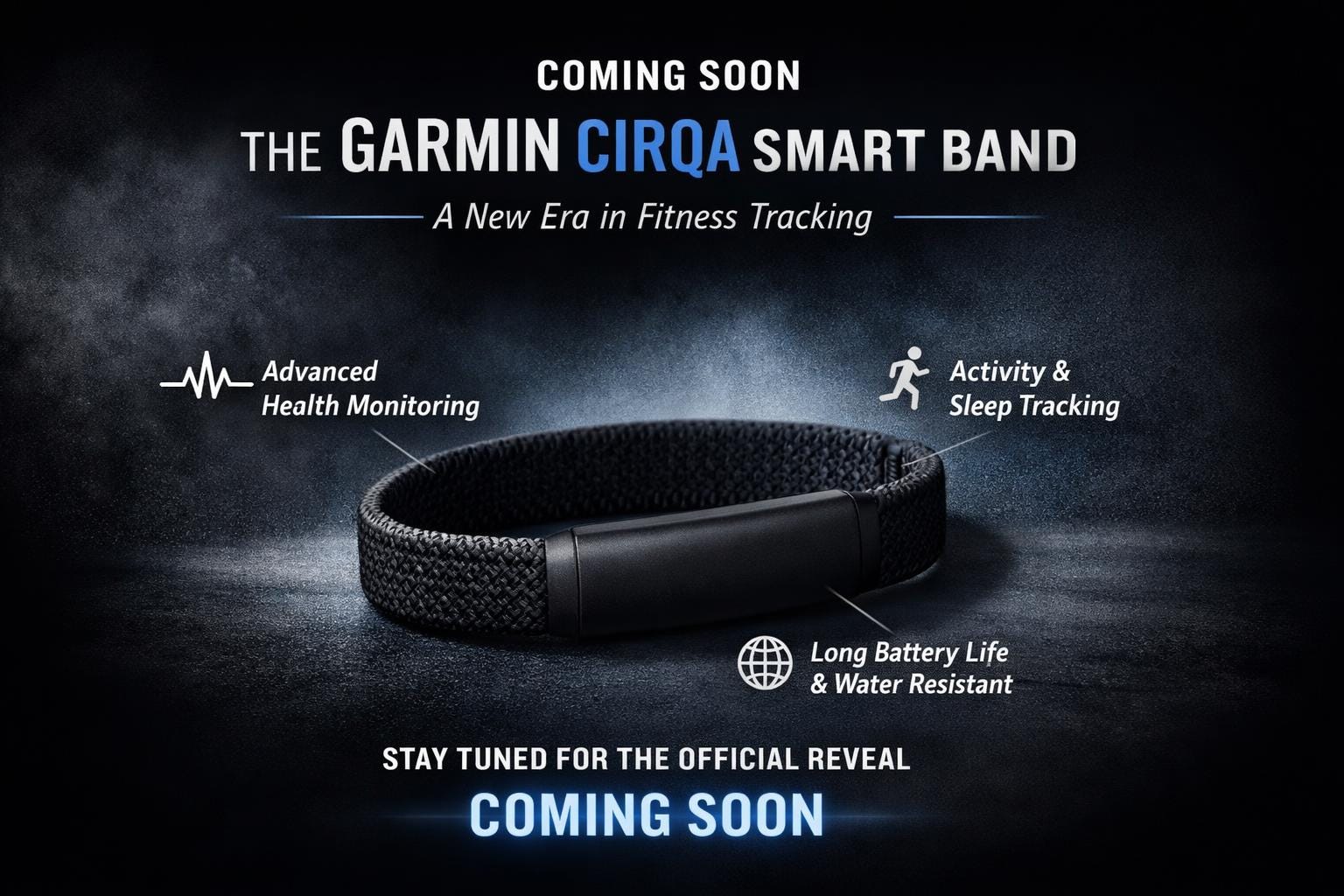
CIRQA drops at $199.99, no subscription, screenless, 7-day battery, from a company with 20+ yrs of sports watch dominance and vertical sensor integration
WHOOP’s model: paid hardware, $239/yr membership (or $30/mo), ~1.0M+ paid subs, valued at ~$3.0B in a 2021 round led by SoftBank
Oura Ring: hardware + $5.99/mo, ~2.5M rings sold, valued around $800M–$1B in 2022; no publicly confirmed $5.2B valuation
The sensor stack (PPG, accelerometer, SpO2, temp, ECG) is now sub-$25 BOM territory; the moat is software, algos, and behavioral loops, not silicon
Chris Hemsworth’s APOE4 reveal and Bryan Johnson’s Blueprint have pulled biomarker tracking into normie territory; TAM is expanding faster than incumbent capacity
Structural question: can a subscription survive when a well-capitalized incumbent bundles equivalent sensing into a one-time buy w/ a real distribution channel (REI, Best Buy, Dick’s)?
Data continuity risk: if consumers churn between devices every 18-24 mos, the longitudinal datasets researchers are starting to lean on (All of Us, Project Baseline, ~40+ published WHOOP-related studies) get fragmented
Clinical implication: FDA-cleared features (AFib detection, sleep apnea flags) are becoming table stakes; the diff is algorithmic tuning and cohort size
Bear case for subs: hardware buyers are stickier than sub buyers; churn on $30/mo wellness apps often runs 40-60% yr one
Bull case for subs: coaching, community, and continuous algo improvement justify recurring rev if the product actually changes behavior
Table of Contents
1. The CIRQA drop and why Garmin waited this long
2. WHOOP’s subscription thesis, deconstructed
3. Sensor commoditization and the BOM math nobody wants to talk about
4. Oura, Eight Sleep, Ultrahuman, and the middle that’s about to get squeezed
5. The Hemsworth-Johnson demand shock
6. What happens to longitudinal health data when consumers device-hop
7. Clinical and research implications, and where FDA sits
8. Investor takeaways, exits, and the next 24 months
The CIRQA drop and why Garmin waited this long
Garmin has been sitting on the sidelines of the “recovery band” niche for years while WHOOP built a cult and Oura built a jewelry line. That’s not because Garmin couldn’t build a screenless tracker. Fenix and Forerunner watches have had HRV, body battery, sleep staging, stress scoring, and pulse ox for a while now. The reason Garmin didn’t launch a CIRQA-style product until 2025 is more boring: cannibalization math. Why sell a ~$200 band when the same customer might buy a $700 Venu or $1000 Fenix? The answer, apparently, is that the band buyer and the multisport watch buyer are not the same person, and Garmin finally decided the addressable market of “wants biometric tracking but hates wearing a watch to bed or in meetings” was big enough to stop worrying about it.
The specs are the point. Seven-day battery, screenless (so no display drain, no glass to crack, no notifications to nag you), water resistant, and it pipes into Garmin Connect which is already one of the most mature health platforms outside of Apple and Fitbit in terms of user-generated activity data. No sub. ~$200 out the door. If you already own a Garmin watch, the band becomes your 24/7 wear and the watch becomes your workout tool. If you don’t, it’s a gateway drug.
Contrast this with WHOOP 5.0, which launched in 2024 with membership now priced at $239/yr (or $30/mo) and with hardware sold or financed rather than permanently free, or Oura Gen 3/4 at roughly $299-$549 plus $5.99/mo. Garmin just walked in and said the quiet part loud: the hardware is not the expensive part anymore, and if you have distribution and a platform, you don’t need to rent the customer.
Garmin also has something the pure-play wearables cos don’t, which is a real B2B channel through fleet, aviation, marine, and fitness partnerships, and a physical retail footprint that WHOOP has been slowly building (they got into Dick’s and some Best Buy locations in 2023-2024, but it’s nothing like Garmin’s shelf presence). Retail matters because impulse buyers convert on hardware more readily than they convert on a subscription commitment.
WHOOP’s subscription thesis, deconstructed
WHOOP’s founder Will Ahmed built the co on a genuinely clever insight around 2015-2016: put the hardware cost in the background and charge for the intelligence layer. It’s the razor and blades model inverted, and it worked because at the time, competent 24/7 HRV tracking with a decent app was genuinely hard to build, and the customer WHOOP targeted (semi-pro athletes, tech execs, tactical/military) had money and cared about performance optimization.
The business scaled fast. By 2021, WHOOP raised a SoftBank-led round that valued the company at roughly $3.0B, and Ahmed had raised over $400M in total. The sub was about $30/mo or discounted for longer commits. Retention was reportedly strong in the early cohorts, though WHOOP has never disclosed churn publicly. Estimated paid subs sit somewhere around the 1.0M mark in public reporting, with some third-party estimates suggesting higher, but not the 2.5M the rumor mill likes to quote.
The pitch to investors was clean: high LTV, low CAC once word of mouth kicked in, and a data moat that grew with every user-month. Every night of sleep and every workout added to a training corpus that made the recovery scores and strain metrics better. WHOOP has published or co-authored research showing correlations between their metrics and everything from COVID detection to menstrual cycle prediction to sleep debt recovery. The Journal of Clinical Sleep Medicine, Sensors, and a handful of sports science journals have carried WHOOP-affiliated studies.
Here’s the structural problem though. Subscription revenue depends on continued perceived value delivery, and once a user has three years of their own baseline data, the marginal insight from month 37 is not that different from month 36. The novelty curve flattens hard. WHOOP has tried to counter this with feature drops (stress monitor, healthspan, ECG on 5.0, blood pressure insights on the roadmap) and with community/coaching features, but each new feature has to justify the ongoing spend against a hardware alternative that keeps getting cheaper.
The other issue is that WHOOP’s TAM ceiling is real. The people who will happily pay ~$239/yr for a wellness band are a subset of the people who will pay ~$200 once for one. When Garmin, or Amazon, or (eventually) Apple with any future health-focused band, pushes a good-enough alternative at a one-time price, WHOOP’s growth becomes a function of how much it can convince people that its algo is measurably better, not just marketing-better.
Sensor commoditization and the BOM math nobody wants to talk about
Let’s get technical for a sec. The core sensor stack in every one of these devices is: a photoplethysmography (PPG) sensor for heart rate and HRV, a three-axis accelerometer and often a gyroscope for movement and sleep staging, a skin temperature sensor for cycle tracking and illness detection, a pulse oximeter (SpO2) for breathing disturbance and altitude, and increasingly a single-lead ECG electrode set for AFib detection.
The BOM cost of all of that, at scale (think 500K units and up), is in the roughly fifteen to twenty-five dollar range. PPG modules from Maxim, TI, or the various Chinese suppliers run a few dollars. MEMS accelerometers from ST or Bosch are under a dollar. Skin temp sensors are pennies. The MCU (usually a Nordic nRF52 or similar) is a few dollars. Battery, strap, PCB, assembly, testing, packaging brings you to maybe forty to sixty dollars all-in for a decently built band. Retail markup and channel margin gets you to a ~$200 sticker with room to breathe.
This is the same dynamic that killed the standalone GPS market when Garmin’s own automotive Nuvi line got wrecked by smartphones. Sensors that were exotic in 2015 are commodities in 2025. What’s not commodity is the software layer: the algorithms that turn raw PPG waveforms into HRV numbers, the ML models that stage sleep, the coaching layer that tells you what to do with the score. That’s real IP and it’s defensible, but it’s defensible for the co that has the biggest labeled dataset and the best clinical validation, and it’s not clear WHOOP wins that fight against Garmin, Apple, and Fitbit/Google on sheer data volume.
There’s also a regulatory dimension. FDA clearances for AFib detection (Apple, Fitbit, Samsung all have them), sleep apnea flagging (Apple secured a de novo clearance for its sleep apnea feature in 2024), and now emerging blood pressure trending features are creating a bifurcated market. Cleared features can be marketed as medical utility; uncleared features are wellness. WHOOP obtained FDA clearance for its single-lead ECG feature with WHOOP 5.0 for certain tiers. Garmin has been slower on FDA but is catching up. If clearances become a competitive requirement, the R&D and reg cost curve favors incumbents with deep pockets, not sub startups.
Oura, Eight Sleep, Ultrahuman, and the middle that’s about to get squeezed
Oura sits in an interesting spot. The ring form factor is genuinely differentiated (you can wear it in a suit, in surgery, in bed, without looking like an athlete) and the co has done a good job of positioning as the “medical-adjacent” premium option. Sales estimates put Oura at around 2.5M rings sold cumulatively, with valuation estimates around $800M–$1B from 2022 funding disclosures, rather than any confirmed $5.2B figure. The sub is $5.99/mo, which is much softer than WHOOP’s ~$30 equivalent, and that lower price point makes it more resilient to hardware competition, but not immune.
The Oura problem is that Samsung launched Galaxy Ring in 2024 with no sub at about $399, and Ultrahuman’s Ring Air (around $349, no sub) has been eating share in the crypto/biohacker crowd. If Apple launches a ring (rumored on and off since 2023), Oura’s premium positioning gets attacked from above. If Chinese OEMs commoditize the smart ring form factor further (and they will), Oura gets attacked from below. The sub is a nice-to-have that becomes a friction point.
Eight Sleep is a different animal. The Pod is a mattress cover, not a wearable, and the sub (~$15-$25/mo) pays for firmware updates, biometric processing, and the adjustable temperature/elevation features. Eight Sleep raised a Series C around 2021 in the ~$80M range at roughly a $500M valuation and has continued raising and expanding, but not with a new $86M Series C in 2024. They have been aggressively marketing to the tech bro cohort (Bryan Johnson uses one, obviously). The subscription there is more defensible because the hardware itself needs cloud compute to work as designed, and the differentiation (dynamic temperature control coupled to sleep stage) is hard to replicate without the mattress form factor.
Ultrahuman has been quietly building a bundled play: ring, CGM patches, and a home hormone testing kit. Their thesis is that you can’t win on hardware alone or software alone, you have to build the full stack including biomarkers that require lab work. That’s a smart hedge but capital intensive.
The middle of the market (WHOOP, mid-tier Oura, Fitbit Premium) is where the compression happens. Fitbit Premium at $9.99/mo has been struggling since Google acquired them in 2021; Google discontinued various Fitbit devices in 2024 and consolidated more of the portfolio into Pixel Watch. The signal is that even Google can’t easily make a wellness sub work at scale against free-tier Apple Watch and cheap Garmins.
The Hemsworth-Johnson demand shock
Two cultural events have done more for the biomarker-tracking category than any product launch. Chris Hemsworth revealing in late 2022/early 2023 that he carries two copies of the APOE4 allele (which raises Alzheimer’s risk substantially) put genetic risk and preventive health into mainstream Hollywood-tier conversation. The National Geographic show Limitless followed him doing cold exposure, fasting protocols, and other longevity-adjacent interventions. Sales of consumer genetic tests, cold plunges, and wearables all saw measurable bumps in the following quarters.
Bryan Johnson is a different phenomenon. His Blueprint protocol, published openly on the internet with every biomarker measured and every intervention tracked, has spawned a subculture of people trying to reverse biological aging through obsessive quantification. Johnson wears (or has worn) basically every wearable on the market and his public spreadsheets have driven meaningful signup traffic for CGMs, sleep trackers, and HRV monitors. Levels Health, Lingo (Abbott’s consumer CGM), Nutrisense, and others owe part of their growth curves to the Blueprint-adjacent audience.
What this means for the wearables market is that TAM is expanding faster than most incumbent business models were designed to handle. The buyer of a wellness wearable in 2020 was overwhelmingly an athletic performance customer or a health-anxious tech worker. The buyer in 2025 includes middle-aged people worried about dementia risk, parents tracking their kids’ sleep, and a rapidly growing cohort of women in perimenopause who have been medically ignored for decades and are now tracking their own hormonal cycles because nobody else will.
That expansion is great for volume but tough for subscription economics. New cohorts are less committed, more price-sensitive, and less tolerant of ongoing fees. They want to buy a thing, wear it, and get answers. That’s a Garmin buyer, not a WHOOP buyer.
What happens to longitudinal health data when consumers device-hop
Here’s the thing researchers and clinicians are starting to sweat about. The value of continuous biometric data compounds over time. A single night of HRV data tells you approximately nothing. Ninety days of HRV data starts to tell you about training load and stress. Three years of HRV data, cross-referenced with life events, medication changes, and diagnoses, starts to look like a personal digital twin.
When consumers hop devices every 18-24 months, that continuity breaks. Oura has its dataset. WHOOP has its dataset. Apple Health has its own silo. Garmin has another. All of Us and Project Baseline and other cohort studies try to stitch multiple sources together, but the moment you switch ecosystems, the longitudinal record either fragments or has to be manually exported and re-imported.
From a research perspective, that creates survivorship bias and data sparsity. The people who stay in one ecosystem for 5+ years look like “ideal” longitudinal subjects, but they’re not representative of the average consumer who churns hardware and apps regularly. From a clinical perspective, it means that the dream of a unified, continuous health graph is still just that—a dream.
There are interoperability efforts. Apple Health and Google Health Connect can ingest data from multiple wearables. Oura and WHOOP both offer APIs. Garmin exports to CSV and third-party platforms. But these are thin pipes, not full semantic integrations. HRV measured as rMSSD overnight on WHOOP is not directly comparable to HRV measured as SDNN in a spot check on a Polar H10, and sleep staging algorithms differ enough that “deep sleep” is not a standardized metric.
Researchers who use wearable data have started to account for this by working with single-device cohorts (e.g., an Oura-only study, a WHOOP-only study) or by focusing on within-subject changes rather than cross-device comparisons. That helps, but it doesn’t solve the macro problem: if the wearable market keeps fragmenting, longitudinal health data becomes more like a collage than a continuous film.
Clinical and research implications, and where FDA sits
Clinically, the rise of commoditized sensors plus fragmented data has pushed regulators into an uncomfortable middle ground. On one hand, FDA wants to encourage innovation in digital health. On the other, it needs to protect consumers from overhyped wellness claims. The compromise has been a line between “medical” features, which require clearance, and “wellness” features, which do not.
AFib detection, sleep apnea screening, and blood oxygen alerts live on the medical side. Readiness scores, recovery scores, and stress metrics live on the wellness side. Companies like Apple, Fitbit, and Samsung have invested heavily in clinical trials to support their medical features. WHOOP and Oura have focused more on validation studies that show correlations between their metrics and clinical outcomes, but they generally stop short of making diagnostic claims.
For researchers, the abundance of wearable data is both a blessing and a curse. It’s a blessing because it allows for large-scale, real-world monitoring of sleep, activity, and HRV. It’s a curse because the data is noisy, device-specific, and often lacks context. You might know that someone’s HRV dropped 20% last week, but you don’t know that they had food poisoning, pulled an all-nighter, or changed jobs.
The clinical implication for patients is that wearables are best used as trend monitors, not as diagnostic tools. If your HRV has been trending down for three weeks and your resting heart rate is up, that’s a signal to talk to a clinician, not to self-diagnose overtraining or illness. If your wearable flags possible AFib, you still need a proper ECG and a doctor.
Investor takeaways, exits, and the next 24 months
For investors, the CIRQA-era reality is that hardware margins are compressing, subscriptions are under pressure, and data moats are only as strong as churn is low. WHOOP, Oura, Eight Sleep, Ultrahuman, and their peers have all raised significant capital on the promise of owning the health graph. Garmin, Apple, Samsung, and Google have quietly been building their own graphs at far larger scale.
Over the next 24 months, expect three things:
More consolidation. Some mid-tier players will get acquired for their datasets and algorithms rather than their brands.
More regulatory scrutiny. FDA will continue to draw lines around what counts as a medical device, especially as blood pressure and glucose-adjacent features roll out.
More consumer skepticism about subscriptions. As CIRQA-style hardware proliferates, the default will shift toward one-time purchases plus optional add-ons, not mandatory subs.
The companies that win won’t necessarily be the ones with the fanciest hardware. They’ll be the ones that turn commoditized sensors into meaningful, behavior-changing feedback loops—and that manage to keep users in the same ecosystem long enough for the data to compound
.