
Welcome to Healthcare Markets & Technology.
Rigorous analysis of AI, policy, capital, technology, and clinical operations across U.S. healthcare — written for the people who build, invest in, and lead it.
Free subscribers get 2 public articles per week. Upgrade to paid → for the full 7 articles/week, paid podcast episodes, deal breakdowns, and the complete 538-deep-dive archive.
Subscribe or upgrade here →
One thing to bookmark: the searchable Knowledge Base at kb.onhealthcare.tech isn’t in Substack’s menu. Save it now — on mobile, tap share → “Add to Home Screen.”
Reply to any email with questions. I read every one.
— Trey
Welcome to Healthcare Markets & Technology.
Rigorous analysis of AI, policy, capital, technology, and clinical operations across U.S. healthcare — written for the people who build, invest in, and lead it.
Free subscribers get 2 public articles per week. Upgrade to paid → for the full 7 articles/week, paid podcast episodes, deal breakdowns, and the complete 538-deep-dive archive.
Subscribe or upgrade here →
One thing to bookmark: the searchable Knowledge Base at kb.onhealthcare.tech isn’t in Substack’s menu. Save it now — on mobile, tap share → “Add to Home Screen.”
Reply to any email with questions. I read every one.
— Trey
Table of Contents
The Current Pecking Order and Why It Matters
AI as Specialty Multiplier vs. Specialty Killer
The Value Based Care Tax on Procedural Specialties
Medicare’s Slow Bleed and the Conversion Factor Death Spiral
The Residency Match Bottleneck and the IMG Pipeline Squeeze
Forecasted Reshuffle: Five to Ten Year Specialty Trajectories
Closing Thoughts on Where Capital and Talent Should Flow
Podcast (Part I, teaser — Subscribe for Part II below)
Video Short
Abstract
The Becker’s annual ranking of wealthiest physician specialties, sourced from Medscape compensation and net worth reporting, currently places ortho, plastic surg, cardiology, ENT, urology, and GI near the top, with FM, IM, peds, and preventive medicine at the bottom. That ranking is unstable.
Four converging forces will reshuffle the list meaningfully by 2030 to 2035:
- AI augmentation: throughput multiplier in radiology, path, anesthesia; modest demand compressor in screening-heavy derm and ophtho; capacity expander for primary care and psych
- VBC pressure: TEAM model (mandatory January 2026) hits ortho, cardiac surg, spine, gen surg via bundled episodes; MA and ACO risk arrangements lift PCP comp ceilings dramatically
- Medicare PFS conversion factor cuts (six consecutive years), site-neutral expansion, 340B reform compress hospital-employed and Part B-heavy specialists
- Residency match constraints plus IMG visa friction (J-1, H-1B, Conrad 30) tighten supply in IM, FM, psych, peds, nephrology, endo, propping wages up
- Net result: cognitive, cash-pay, and risk-bearing specialty PCP economics rise; procedural specialists with heavy Medicare exposure and bundle vulnerability flatten or decline; the ratio between top and bottom of the list compresses from roughly 2.2x today toward 1.3x to 1.5x by 2032.
The Current Pecking Order and Why It Matters
The Becker’s list is essentially a remix of the Medscape Physician Wealth Report and the Medscape Compensation Report, both of which have run for over a decade and sample tens of thousands of US physicians annually. The 2024 to 2025 numbers put ortho on top with average annual comp in the high five hundreds, followed by plastic surg in the mid five thirties, cardiology around five twenty five, ENT in the high four eighties, urology in the five tens to five twenties range, GI around five ten, derm in the high four seventies, radiology around four ninety eight, oncology in the mid four sixties, anesthesia around four seventy, and gen surg at four fifty. The bottom of the list reads like a rebuke to anyone who still believes American medicine rewards primary care: family med and peds float around two fifty, IM at two seventy three, and public health and preventive medicine just under two fifty. The ratio of top to bottom is roughly 2.2x, which is wider than almost any peer industrialized country.
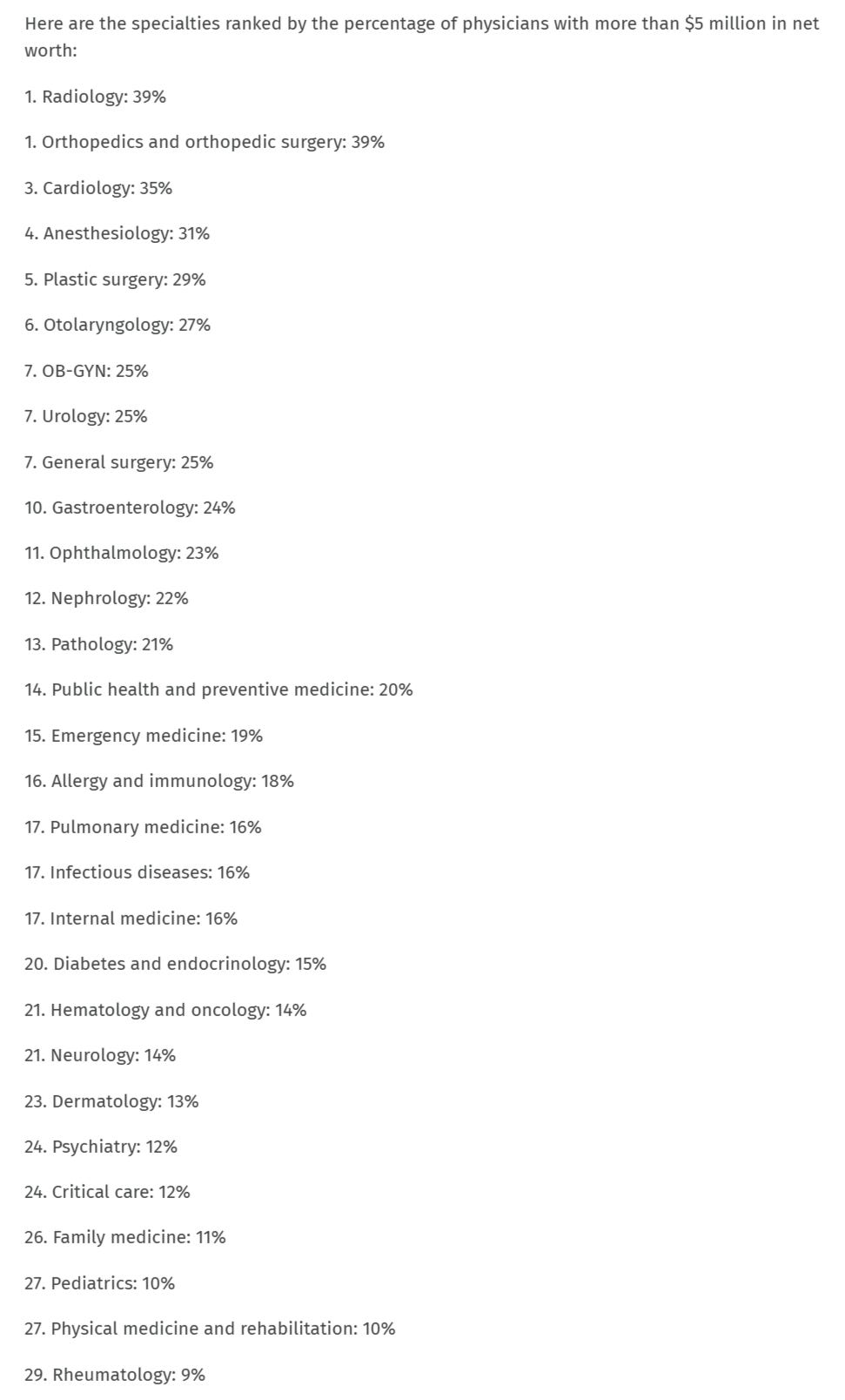
Why this matters beyond cocktail party trivia: med students sort residency preferences by it, PE rollup firms underwrite acquisition multiples around it, hospitals build employment comp ranges off MGMA percentiles tied to it, and payers structure RAF-adjusted PMPM and bundled rates against the implied physician productivity inside it. Lifestyle specialties have crept up the rankings as derm and ENT consolidated through PE; procedural specialties stayed dominant because RVU-heavy fee for service still rewards procedures more than cognitive work. None of that is news to anyone reading this. What is news is that the underlying inputs supporting the ranking are mid-shift, and the next half decade will not look like the last one.
A small methodological note worth getting out of the way: comp and net worth are not the same thing. Net worth captures lifetime accumulated capital and is heavily influenced by debt load, spouse income, geography, and savings discipline. The Medscape net worth tables do show ortho, plastic, ENT, and derm with the largest shares of physicians at five million plus, but FM and IM physicians report the highest satisfaction with comp relative to expectations, which probably says more about anchoring than about economics. For purposes here the ranking under discussion is annual comp, which is what most readers think of when “wealthiest” gets thrown around in trade pubs.
Podcast, Part II
AI as Specialty Multiplier vs. Specialty Killer
Hinton famously declared in 2016 that radiologists should stop training because AI would replace them. Nearly a decade later radiology is the most in-demand specialty in the US, with starting offers commonly above six hundred thousand in non-coastal markets and the ACR reporting persistent staffing shortfalls in academic and community settings. The reason the prediction failed is structural. AI imaging tools from Aidoc, RadAI, Annalise, Viz.ai, and Heuron read priors, flag bleeds and PEs, draft preliminary reports, and triage worklists, but they augment rather than replace. Imaging volume has grown roughly four to seven percent year over year for the last decade as MRI, CT, and PET utilization expanded with cardiac, oncology, and ortho protocols, and that volume growth swallowed any productivity dividend the AI tools generated. Net effect: radiology comp keeps climbing, the AI vendors actually hold negotiating leverage with hospitals more than radiology groups do, and the ranking implication is straightforward. Radiology probably moves up, not down, in the next refresh.
Pathology runs a similar arc. Digital path adoption (Paige, PathAI, Proscia, Tempus) plus the FDA’s 2017 clearance of Philips IntelliSite was supposed to commoditize the field, but specimen volume keeps rising, the ACGME continues to undertrain pathologists relative to demand, and AI tools are still nowhere near autonomous diagnosis on most tissue types. Path comp will likely rise modestly, capped by hospital employment dynamics.
Derm is more nuanced. Consumer-facing AI triage like Visualdx, Skinvision, and Google’s DermAssist, combined with the proliferation of GP-prescribed teledermatology, is starting to absorb low-acuity benign lesion visits. General medical derm comp will likely flatten or compress modestly. But cosmetic derm, Mohs, and procedural derm are largely cash-pay or commercially insured and protected from AI compression for the foreseeable future. The PE-backed derm consolidators (Schweiger, Forefront, US Dermatology Partners, Pinnacle Dermatology) have built businesses around the cosmetic and Mohs upside for exactly this reason. Net derm position: probably stable on average, top-quartile cosmetic derm still rising fast.
Ophthalmology has more direct AI exposure than most realize. Digital Diagnostics’ IDx-DR autonomous diabetic retinopathy screening has been FDA cleared since 2018, EyeArt (Eyenuk) since 2020, and the AAO is working through coding and reimbursement frameworks for autonomous AI screening that bypasses the ophthalmologist entirely for routine diabetic patients. As primary care offices, retail clinics, and Walmart Health style settings deploy these systems, general comprehensive ophtho faces real volume risk. Cataract surgery, retinal procedures, and refractive surgery remain insulated. Mixed picture for ophtho overall.
Cardiology illustrates the segmentation theme cleanly. AliveCor, Eko Health, and Tempus ECG can interpret 12-leads at near-cardiologist accuracy, which affects general cardiology consultative work. Interventional, EP, and structural heart remain insulated and in fact are seeing volume tailwinds from TAVR adoption, pulsed field ablation (Boston Scientific Farapulse, Medtronic PulseSelect), Watchman LAAO growth, and renal denervation (Medtronic Symplicity, ReCor Paradise). General cardiology comp pressured; interventional and EP comp continuing to rise.
Anesthesia has seen incremental AI tooling around depth of anesthesia monitoring and predictive hemodynamic management, but case volume tailwinds from outpatient surgical migration to ASCs, plus persistent CRNA workforce gaps in some markets, keep comp climbing. Anesthesia management companies have absorbed margin gains through PE rollup (USAP, NAPA, Envision dynamics), so the average comp story is closer to flat with top-quartile rising.
Primary care benefits asymmetrically from AI. Ambient documentation tools (Abridge, Ambience, Nuance DAX, Suki, Doximity Scribe) have demonstrated twenty to thirty percent throughput gains in real-world deployments. For PCPs in fee for service that simply means more visits per day, marginally raising comp. For PCPs in capitation or MA risk the math is more powerful: same panel, more time per visit, better RAF capture, better care management, lower MLR, higher shared savings. The comp ceiling for top PCPs in MA risk has moved from the high three hundreds toward seven hundred to nine hundred thousand in well-run risk arrangements (agilon, Privia, Aledade, Oak Street, ChenMed pre-CVS dynamics).
Psychiatry is structurally protected from AI replacement (the therapeutic alliance still requires a human until the FDA says otherwise), augmented by digital therapeutics (Big Health, Talkspace, Headspace Health), and limited by a residency pipeline that has not kept up with demand. Psych comp continues to climb. Telepsych business model economics (Brightside, Talkiatry) make psychiatrists movable from any zip code, which structurally raises wages.
The Value Based Care Tax on Procedural Specialties
VBC has been the slow-rolling reshuffle for two decades, but the next five years compress its impact dramatically because the mandatory bundled episode framework has finally been formalized. The TEAM model (Transforming Episode Accountability Model), which CMS finalized in late 2024 for January 2026 implementation, is mandatory for selected hospitals and covers five high-cost surgical episodes: lower extremity joint replacement, surgical hip and femur fracture treatment, spinal fusion, coronary artery bypass graft, and major bowel procedure. Each episode bundles thirty days of post-acute care into a single price, with hospitals at risk for cost overruns and rewarded for coming in under target.
The implications for the wealthiest specialties list are direct. Ortho surgeons performing TKA and THA in TEAM-mandatory hospitals will face downstream margin compression as hospitals push for shorter LOS, lower-cost implants, and post-acute care substitution (home health over SNF). The Comprehensive Care for Joint Replacement model (CJR) ran from 2016 to 2024 and demonstrated this pattern conclusively. Now extend that across all major joints, hips, fusions, CABGs, and bowel resections. Cardiac surg and spine surg, both of which sit comfortably in the top tier of the rankings, are about to learn what ortho learned during CJR.
Layered on top: third-party MSK risk-bearing entities (Hinge Health, Sword Health, Vori Health, Omada for MSK) are taking PMPM contracts from employers and MA plans to manage musculoskeletal episodes outside the surgical pathway entirely. Conservative PT-first management compresses surgical volume even before the hospital touches the case. PE-backed ortho consolidators (US Orthopedic Partners, Healthcare Outcomes Performance Company, OrthoAlliance) have responded by building risk-taking platforms of their own, which preserves a path to upside but only for the most operationally sophisticated groups. Average ortho comp will probably plateau and possibly compress modestly; top-quartile ortho groups in equity-rich risk arrangements will outperform the average by a wider margin than today.
Cardiology faces a similar segmentation. CABG hits TEAM directly. TAVR is shifting volume from cardiac surg to interventional cardiology, but TAVR procedures themselves are increasingly being scrutinized in episode-of-care pilots. EP and structural heart remain insulated by relative complexity and absence of standardized bundle definitions. The kidney models (KCC, KCF) demonstrate that nephrology is becoming a risk-bearing specialty too, with Strive Health, Somatus, and Interwell Health (the merger of Cricket Health and Fresenius Health Partners) all building nephrology-led risk platforms. Nephrology comp, currently middle-tier, has real upside for risk-bearing nephrologists; non-risk-bearing dialysis-tethered nephrology faces flat to declining margins.
Oncology has been under VBC pressure since the Oncology Care Model launched in 2016 and continues under the Enhancing Oncology Model (EOM) which started in mid-2023. EOM compresses chemo margins and pushes biosimilar adoption, with measurable downside to community onc comp at the margin. The OneOncology and US Oncology consolidators have absorbed the impact at the platform level by extracting value from the broader infusion ecosystem (340B contraction notwithstanding). Comp is flat to mildly compressed, with platform-equity-holding partners doing fine and salaried community onc not.
Primary care wins outsized. The agilon, Privia, Aledade, Oak Street, ChenMed model (and the wave of newer entrants like Crossover, Galileo) has been adding capitated PCPs at fifteen to twenty five percent annual growth. CMS’s Making Care Primary model adds another two hundred plus practices to the risk-bearing PCP universe. Primary care comp at the top quartile is no longer a three to four hundred thousand story; it is a six to nine hundred thousand story for senior partners in risk-bearing platforms with equity participation. That alone reshuffles the list.
Medicare’s Slow Bleed and the Conversion Factor Death Spiral
The Medicare Physician Fee Schedule conversion factor has been cut for six consecutive years on a real basis. The 2024 conversion factor was thirty three twenty nine; 2025 dropped to thirty two thirty five (a roughly 2.83 percent cut, partially offset by congressional patches mid-year); the 2026 proposed rule split the conversion factor into two tracks, one for Qualified APM Participants and one for non-QPs, with both still below 2024 levels in nominal terms and significantly below in real terms after medical inflation. The cumulative real-dollar compression on PFS-billing physicians since 2020 is approaching thirty percent. No equivalent commercial fee schedule has compressed at that rate.
Specialty exposure to PFS is uneven. Specialties that bill predominantly Part B services in the office (cardiology, derm, ophtho, GI, urology, neurology, rheum, endo, allergy, primary care) are most directly hit. Specialties with stronger facility-fee revenue or hospital-based comp (anesthesia, radiology, hospitalist medicine, EM) feel it indirectly through hospital negotiations. Cosmetic-heavy or procedure-heavy specialties with high commercial mix (plastic surg, Mohs derm, refractive ophtho) are largely insulated.
Site-neutral payment expansion under the 2024 OPPS rulemaking compresses the longstanding HOPD versus physician office payment differential for an expanding list of services. For hospital-employed specialists whose comp models depend on facility fee uplift, the squeeze is real. For independent specialists in ASCs and physician offices, site-neutral is closer to neutral. The longer-term direction (the bipartisan site-neutral push, MedPAC commentary, employer purchaser advocacy) suggests further expansion. Cardiology and orthopedic groups whose comp depends on hospital-owned outpatient facility billing are most exposed.
The 340B program has been under pressure from drug manufacturer contract pharmacy restrictions, the proposed HRSA reforms, and the growing list of states that have responded with their own legislation (Arkansas, Louisiana, Maryland, Mississippi, Missouri, West Virginia). 340B revenue subsidizes a meaningful fraction of hospital-employed specialty comp, particularly oncology and rheum. Continued 340B compression flows through to specialty comp at safety net and DSH-heavy hospitals.
The Medicare Advantage RAF coding and Stars dynamics are a separate axis but worth flagging. CMS’s V28 risk model phase-in compresses RAF on chronic conditions that previously generated meaningful reimbursement, hitting MA plan margins, which then squeeze provider risk arrangements that were underwritten on the older curve. Some PCP risk platforms reported real 2024 to 2025 revenue compression as a result. The dynamic eventually self-corrects as bid pricing adjusts, but the next twenty four months will be lumpy for risk-bearing PCP comp before the trajectory resumes.
The Residency Match Bottleneck and the IMG Pipeline Squeeze
The 2025 NRMP Match cycle saw approximately forty four thousand applicants for forty one thousand PGY-1 positions across all specialties. US MD seniors matched at roughly ninety three percent; US DO seniors at around ninety two percent; US IMGs at sixty seven percent; non-US IMGs at fifty eight percent. The most competitive specialties (derm, neurosurg, plastic, ortho, ENT, vascular surg) saw match rates for US seniors in the seventy five to eighty eight percent range despite those being the most desirable specialties on the wealth ranking, which is its own commentary on selection economics. The least competitive (family med, IM prelims, psych in some markets, peds in some markets, pathology) rely on IMGs to fill positions.
IMGs comprise approximately twenty five percent of the active US physician workforce, with concentrations of roughly thirty percent in IM, around fifty percent in nephrology, forty plus percent in geriatrics, and significant shares in family med, psych, and peds. Most IMGs enter on J-1 ECFMG-sponsored visas, with Conrad 30 waivers, Appalachian Regional Commission waivers, and HHS Clinical Sciences waivers providing the path to H-1B or eventually green card status, conditioned on service in HPSAs or Medically Underserved Areas. The pipeline is thin and politically exposed.
Recent administration H-1B fee structure changes, the reinterpretation of specialty occupation rules, and ongoing Conrad 30 reauthorization friction (the program technically requires reauthorization periodically and has been extended via continuing resolutions for years) collectively introduce real risk to the IMG pipeline. Caribbean medical school dynamics add another wrinkle. Several for-profit Caribbean schools have closed or contracted, and the survivors face tightening Title IV federal student loan eligibility. Caribbean grads have historically filled twenty plus percent of US family med and IM residency slots, and that pipeline is narrowing.
The USMLE Step 1 transition to pass/fail in January 2022 made the residency match more program-relationship-driven and less amenable to IMG sorting on test scores. The downstream effect has been a modest tightening of IMG access to the most competitive specialties, with knock-on effects on the supply pipeline for procedural specialties dependent on IMG residents (gen surg, anesthesia, pathology, and to a lesser extent cardiology have meaningful IMG exposure).
Demand-side pressure compounds the issue. The AAMC’s 2024 workforce projections estimate a US physician shortage of eighty six thousand by 2036, with forty thousand in primary care, thirteen thousand four hundred to twenty thousand two hundred in surgical specialties, and ten thousand three hundred to thirty five thousand six hundred in other specialties. The aging physician workforce (about forty percent of practicing physicians are fifty five or older) and the post-COVID burnout-driven early retirement bulge accelerate the timeline. Residency expansion through HRSA’s Teaching Health Center GME program and the slot additions in the Consolidated Appropriations Act of 2021 (one thousand new slots phased in over five years) and the Consolidated Appropriations Act of 2023 (another two hundred per year for five years) add maybe two thousand PGY-1 slots over a decade, which is a rounding error against the projected shortfall.
Forecasted Reshuffle: Five to Ten Year Specialty Trajectories
Putting the four forces together yields a fairly clear directional view of the wealthiest specialty rankings five to ten years out. The specialties moving up: primary care (FM, IM, geriatrics) at the top quartile of risk-bearing arrangements will see comp climb from current two fifty to four hundred thousand range toward five hundred to nine hundred thousand range, particularly for partners with equity in risk-bearing platforms. The average rises more modestly because the long tail of fee for service PCPs lags, but the top of the distribution will look almost unrecognizable. Psychiatry continues climbing on demand-supply dynamics, with average comp likely moving from current three ten to four hundred plus, and cash-pay and concierge psych pulling the top quartile to five hundred plus. Radiology likely moves up the ranking on AI-augmented volume, persistent shortages, and continued imaging utilization growth, with average comp moving from current four ninety eight toward five fifty to six hundred. Anesthesia rises modestly on surgical volume tailwinds, despite the ongoing CRNA scope expansion battles, and ASC migration is largely net positive for the specialty. Cosmetic plastic surg continues rising, partly on cash-pay protection from Medicare pressure and partly on the genuinely surprising tailwind from GLP-1 weight loss creating massive demand for body contouring, skin tightening, and combined procedures (the Ozempic body contouring boom is real and visible in plastic surg practice revenue at platforms like Pacific Plastic Surgery, Form Plastic Surgery, and the larger Hims/Ro adjacencies). Plastic surg probably stays in the top three and possibly takes the top spot from ortho by 2032.
The specialties flat or compressed: ortho faces TEAM bundle compression, MSK risk-bearing third-party pressure (Hinge, Sword, Vori), and ASC migration that shifts margin to facility owners; average comp will probably plateau around current levels in nominal terms, which is real-dollar compression. Cardiothoracic and cardiac surg face TEAM-CABG and TAVR substitution and probably end up flat to mildly compressed. Spine surg faces TEAM fusion bundles and the ongoing migration to outpatient minimally invasive procedures that compress per-case revenue. Gen surg faces TEAM bowel episodes and the broader robotics-driven productivity normalization. General cardiology faces AI ECG compression and PFS pressure while interventional and EP cardiology rise; the specialty bifurcates more visibly than today. GI faces a near-term tailwind from USPSTF expansion of colonoscopy screening to age forty five plus, but Cologuard, Shield (Guardant), Freenome, and other non-invasive screening modalities will bend the colonoscopy volume curve eventually. Plus PFS pressure and PE multiple compression in a specialty that has been heavily rolled up. Modest compression long-term. General ophtho faces AI screening compression for diabetic and AMD work while cataract and retinal procedural work remains strong. Mixed. Derm faces general derm AI compression but cosmetic and Mohs strength. Average likely flat, top-quartile rising. EM faces an oversupply problem (residency expansion plus PE rollup compressing comp at USACS, ApolloMD, TeamHealth), and rural versus urban EM economics are bifurcating. Comp likely declining modestly. Pathology, oncology, and nephrology have specialty-specific dynamics covered above and probably move modestly in either direction depending on the risk-bearing posture of the practice.
A specific call worth flagging: by 2032, the gap between the top-paid specialty (probably plastic surg or ortho) and the top-quartile primary care PCP in a risk-bearing platform may compress to 1.3x or less. That is a meaningful narrowing from today’s roughly 2.2x ratio. Most med students currently sorting residency preferences in 2026 are not pricing this in.
Closing Thoughts on Where Capital and Talent Should Flow
For investors, the implications stack neatly. PE rollups in procedural specialties under bundled episode pressure (ortho, cardiac surg, gen surg) face a margin headwind that will surface in the next funding round multiples. The PE math premised on seven to nine times EBITDA exits at platform scale assumed continued procedural fee growth that will not materialize at TEAM-exposed practices. Specialty groups that built risk-bearing capabilities (Vori, Hinge, Sword on the MSK side; Strive, Somatus, Interwell on the kidney side; agilon, Privia, Aledade on the primary care side) capture the upside. The next generation of healthcare PE platforms should probably be underwritten on bundled-episode and capitation economics, not RVU production growth.
For tech investors, AI augmentation tools that increase throughput in radiology, pathology, primary care, and anesthesia have durable demand. AI plays premised on replacement (autonomous diagnosis without physician oversight, AI-only mental health) face longer reimbursement and liability runways. Ambient scribing has demonstrated PMF at scale; the next layer of clinical AI (orders, prior auth, coding optimization, ambient inbox triage, ambient clinical decision support) is where the next round of five billion dollar plus outcomes likely sit. Companies like Abridge, Ambience, Suki, and the broader Doximity, Athelas, and Tennr workflow stack are early indicators.
For talent, the calculus for fourth-year medical students sorting residency preferences in the 2026 to 2030 cycles is genuinely different from prior cohorts. The historical default of choosing the most procedural, highest-RVU specialty assumed continued PFS stability and minimal VBC penetration. Both assumptions are weakening. Med students should weight cash-pay percentage, VBC exposure, AI substitution risk, and Medicare conversion factor sensitivity into specialty choice. The students who chose derm and plastic surg in the late 2010s are looking smart in hindsight; the students who choose primary care at risk-bearing platforms in 2026 may look smarter in hindsight a decade from now. There is also an underrated case for psych and rad onc as durable demand specialties with limited AI substitution risk and limited VBC episode exposure.
For health systems, comp planning models built off MGMA percentile benchmarks need a structural overlay rather than another year over year incremental adjustment. The historical correlation between RVU production and physician comp will weaken as bundled episodes, capitation, and AI-augmented productivity reshape what an RVU even means. The compensation philosophy at most hospital employers still rewards volume, and the gap between that philosophy and the payer and policy environment is the single largest unforced error sitting on health system balance sheets.
For policymakers, the residency cap (frozen by the BBA of 1997 and only modestly expanded since) remains the single largest lever on physician supply. The one thousand slot expansion in the Consolidated Appropriations Act of 2021 and the additional slots in the Consolidated Appropriations Act of 2023 are directionally correct but inadequate to the demographic curve. Without either a meaningful expansion in GME slots or a more aggressive IMG pipeline (J-1 waiver expansion, faster H-1B-to-green-card pathways for clinical specialties, recognition of foreign training equivalency for primary care in HPSAs), the wealth ranking will continue compressing as supply constraints prop up cognitive specialty wages while VBC and Medicare policy compress the procedural top.
The Becker’s list will look meaningfully different in 2032 than it did in 2024. The top three may still be plastic surg, ortho, and cardiology, but the order will be different, the absolute numbers will reflect bundled episode reality, and the gap between top and bottom will be a great deal narrower than the legacy ranking suggests. Worth keeping on the watchlist, and worth pricing into any healthcare investment thesis with a five year hold or longer.