🎧 Part I Podcast free on Apple Podcasts and Spotify.

🎧 Part II Podcast episode for paid subscribers only. Also available on Apple Podcasts and Spotify.
To listen to paid episodes in Apple or Spotify, link your Substack subscription via the show settings on those platforms (instructions inside the Substack app under Subscriptions → Podcast).
Consulting disclosure. Trey Rawles provides fractional executive leadership in business development, revenue, corporate management, corporate development, strategy and product, along with general management consulting. Engagements are open to companies with more than ten million dollars in revenue or that are past Series B. Every engagement requires cash compensation and a retainer, which rules out success-fee-only and equity-only arrangements. To explore working together, please reply directly to this article.
Table of contents
A circulatory admission with eleven thousand dollars riding on sepsis
What the fever meant at midnight
How the inspectors priced a diagnosis out of a claim
What three days in the hospital can tell an auditor
Why Medicare wanted both recommendations removed
Where the money goes under budget neutrality
What a hospital or a health plan should buy
Abstract
Federal inspectors examined 615,007 traditional Medicare hospital stays billed with sepsis but without a severe sepsis or septic shock diagnosis, excluding a separate category for prolonged mechanical ventilation. Using fiscal year 2024 claims, they estimated that changing how Medicare paid for those stays could have put $2.2 billion to better use. The average payment difference was $4,405 when a stay moved into a different diagnosis group and $11,493 when it stayed in the same group but dropped a severity tier. The inspectors never opened a patient chart. Their analysis shows where a billing distinction moves money, while leaving open how often the medical record supports the diagnosis and what hospitals spend keeping an infection from progressing to organ dysfunction. Medicare asked the inspectors to withdraw both recommendations, and the inspectors kept them. The disagreement has consequences for hospital margins, payer audits and companies selling sepsis diagnostics or clinical review software.
A circulatory admission with eleven thousand dollars riding on sepsis
The most interesting hospital bill in the federal government’s November sepsis report is for a circulatory problem. Medicare paid twenty thousand six hundred dollars. Federal analysts took sepsis off the list of secondary diagnoses and estimated the payment again. It came to nine thousand five hundred dollars. The patient still had the same principal diagnosis. The hospital still had a patient sick enough to qualify for a complication adjustment. What disappeared was the diagnosis that had put the admission in the highest severity tier. Eleven thousand one hundred dollars turned on a word somebody skimming the discharge summary might reasonably have skipped. The more obvious example in the same report, a patient whose payment group changed from sepsis to pneumonia, moved only five thousand dollars. If a health plan sends its reviewers straight to the pile marked sepsis, the circulatory bill stays in the other pile.
There’s a reason the less obvious example moved more money. Traditional Medicare generally pays an acute care hospital a prospective amount for an inpatient stay. The principal diagnosis often determines the family of payment groups where the stay lands. Procedures and other patient characteristics can affect the assignment. Within a family, a qualifying secondary diagnosis may move the stay into a tier intended for patients who take considerably more resources to treat. Consider the last diagnosis supporting that tier. Its financial value depends on what else is on the bill. If another major complication independently supports the same tier, removing sepsis may do precisely nothing to the payment. If sepsis is carrying the tier by itself, the difference can be large enough to cover another admission. A spreadsheet that assigns a fixed dollar value to each mention of sepsis will get both cases wrong.
The Office of Inspector General at the United States Department of Health and Human Services went looking for that difference in fiscal year twenty twenty-four. Out of 6,556,071 traditional Medicare inpatient stays in the payment system it examined, 615,007 carried sepsis without severe sepsis or septic shock and fell outside the sepsis group for prolonged mechanical ventilation. Those 615,007 stays represented 9.4 percent of all inpatient stays in the study. Payments for that narrower group exceeded twelve billion dollars, including beneficiary cost sharing. The average was about twenty thousand dollars. Much of that money would still have gone to the hospital if the word sepsis had never appeared on the claim. The dispute concerns the portion that moved when the inspectors changed how those admissions were classified. It begins several days before the claim exists, when somebody has to decide how sick the patient is tonight.
What the fever meant at midnight
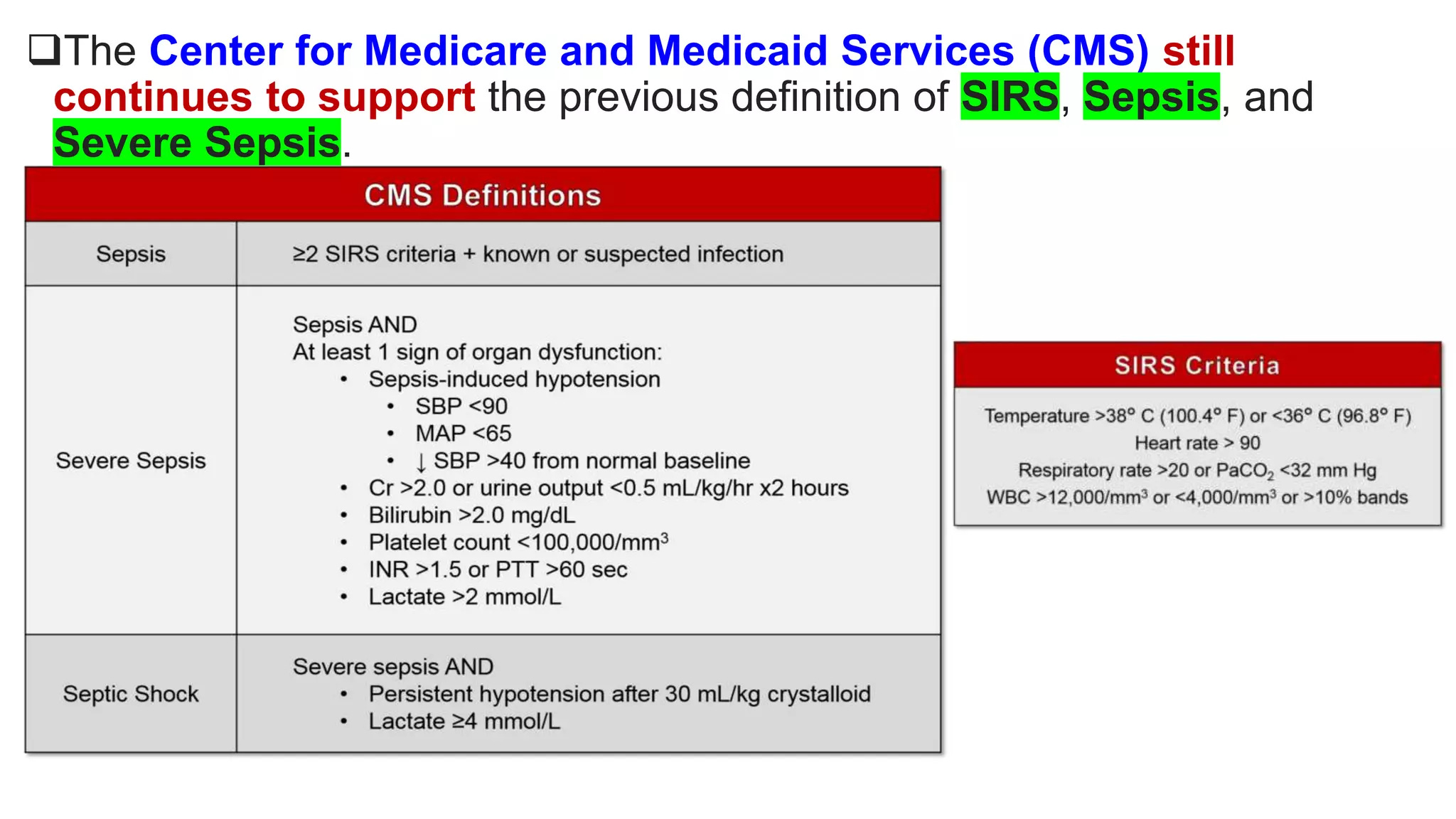
Picture an older adult who comes in with pneumonia, a fever and a pulse well above ninety. Under the framework developed in nineteen ninety-one, an infection accompanied by two signs of a systemic inflammatory response could qualify as sepsis. Temperature and heart rate were two ways in. Respiratory findings and an abnormal white blood cell count offered others. The patient in this example clears the temperature and pulse thresholds before the hospital has an old laboratory result, a decent history or much idea how the next few hours will go. That breadth is easy to appreciate in an emergency department. Somebody has to decide where this person can safely spend the night. It gets harder to defend the same boundary as a price distinction between two completed pneumonia admissions, especially if the hospital across town describes a clinically similar patient simply as having pneumonia.
In twenty sixteen, an international consensus group defined sepsis around life-threatening organ dysfunction attributable to the body’s response to infection. Under that definition, organ dysfunction is part of what makes the illness sepsis in the first place. The older framework gave clinicians a separate term, severe sepsis, for patients further along that path. Both vocabularies can turn up in discussions about the same patient. Suppose the admitting physician is concerned about a kidney injury. An elevated creatinine result gets more informative once somebody finds last month’s result. A genuine acute change still leaves a question about cause. The physician may have good reason to attribute it to the infection, to another condition, or to leave the cause open until more information comes in. A program reading the laboratory feed can calculate a difference to several decimal places. It still needs somebody to explain what happened to the kidneys.
Now suppose the patient improves by breakfast. The admitting team spent the night reassessing blood pressure, following urine output and adjusting care. The attending may reasonably believe that work kept the patient out of intensive care. The payer can see where the patient actually went. Nobody can observe where that same patient would have gone with less attention. This is the strongest economic objection Medicare raised to the inspectors’ analysis. A patient at substantial risk of organ dysfunction can consume real resources before organ dysfunction occurs. There’s a fair question in the other direction, too. How much extra work did this patient require beyond the work already priced into an admission for pneumonia? Documenting that the team gave antibiotics answers very little about that difference. The treatment could have been appropriate under either diagnosis. What a payment designer needs to know is how much additional nursing time, monitoring and intervention the higher-risk patients require, and whether hospitals can identify those patients consistently.
How the inspectors priced a diagnosis out of a claim
The inspectors started with paid fee-for-service claims. Medicare Advantage claims were outside the study, as were hospitals paid outside the acute inpatient prospective payment system, including critical access hospitals, long-term care hospitals and hospitals in Maryland. The analysts set aside admissions that explicitly carried severe sepsis or septic shock, along with admissions assigned to the sepsis payment group for more than ninety-six hours of mechanical ventilation. Those exclusions matter to a hospital comparing the report with its own numbers. A hospital that counts every septic shock patient in its intensive care unit and divides by all discharges, including its managed care business, can produce a perfectly accurate local statistic that bears very little relationship to the federal one.
For stays already in a sepsis payment group, the analysts needed a way to select an alternative group. They looked to the earliest major complication or comorbidity in the order of secondary diagnoses on the claim, or, in its absence, the earliest qualifying complication or comorbidity. Pneumonia and metabolic encephalopathy frequently surfaced in the alternative groupings. The latter deserves a moment. A patient admitted with an infection may also have an acute change in mental status. A physician reading the whole record might have a defensible view of which condition chiefly occasioned admission after study. The order of the secondary diagnoses on a bill wasn’t designed to settle that question in a world where the original principal diagnosis has just been deleted. It does give analysts a reproducible way to run a national estimate. A hospital evaluating an individual denial has access to the very information that the national exercise had to approximate.
The pricing was an approximation, too. Medicare publishes a relative weight for each payment group to reflect the average resources required to care for patients assigned to it. The inspectors took the ratio of the alternative group’s weight to the original group’s weight and applied it to the original payment. That let them estimate the price effect while holding other features of the paid admission broadly constant. They didn’t run every stay through Medicare’s full payment software or reconstruct the admitting physician’s reasoning from the chart. Their biggest assumption was that hospitals reported severe sepsis when infection-related organ dysfunction was present. A missing severe sepsis code can mean the patient had no such dysfunction. It can also mean the clinical relationship never made it clearly into the documentation. Paid claims alone can’t tell how frequently either explanation fits. That missing fact becomes consequential the minute somebody wants to turn a national estimate into a demand for a refund.
Across about three hundred fifty-five thousand stays, the model changed the base payment group. The average difference was four thousand four hundred five dollars, yielding about one point six billion dollars. A much smaller set, about fifty-two thousand stays, stayed in its original family and dropped in severity. The average difference there was eleven thousand four hundred ninety-three dollars, or roughly six hundred two million dollars altogether. The smaller group accounted for about one in eight of the stays with a price change and more than a quarter of the modeled dollars. Another two hundred eight thousand stays, rounded, had no direct change in payment. A chief financial officer can do something with that distribution. Before commissioning hundreds of expensive chart reviews, run the alternative grouping with every other diagnosis left in place. A review can matter clinically even when the result is financially neutral. The finance team deserves to know which question it’s paying to answer.
What three days in the hospital can tell an auditor
One way to look for questionable billing is to ask which hospitals seem unusually good at sending sepsis patients home quickly. There’s a financial reason to ask. In one common sepsis payment group, the report put payment at about sixteen thousand six hundred dollars whether the patient stayed three days or two weeks, subject to exceptions such as extra payments for unusually costly cases. The hospital ordinarily bears the expense of those additional bed days. Nationally, three in ten of the sepsis stays in the length analysis lasted three days or less. At one end of the hospital distribution, short admissions made up about five percent of sepsis stays. At the other, they accounted for about three quarters. The spread in billing frequency was striking, too. Some hospitals reported the broad sepsis category on more than a fifth of their Medicare stays. Others recorded none. An auditor looking at those results on Monday morning has somewhere to start.
The methods section saves that auditor from a few embarrassing phone calls. The inspectors used the first and ninety-ninth percentiles to describe variation. They restricted the hospital frequency analysis to facilities with at least fifty inpatient stays. For hospital comparisons of short stays, they also required at least ten qualifying sepsis stays. They excluded cases where the patient arrived as a transfer from another acute hospital, transferred out to another acute facility, elected hospice, left against medical advice or died. Otherwise, a patient who died soon after admission could wind up in the same quick-turnaround statistic as someone who ate breakfast and went home. Those choices improve the comparison. They still leave differences in patient mix, referral patterns and a hospital’s ability to discharge a recovering patient safely. Ten cases is a particularly small base on which to hang a theory about the corporate culture.
A revealing companion measure is what happens to severity across the same set of bills. Seventy-eight percent of the broad-definition stays were originally paid at high severity. Under the model, that share fell to fifty-three percent. At some facilities more than nine in ten of their sepsis stays landed in a high tier. At others fewer than half did. A medical director investigating one of those hospitals could start with a matched set of pneumonia admissions from the same wards and season. Pull some carrying sepsis and some without it. Let reviewers examine the presenting physiology, evidence of organ dysfunction and subsequent course before showing them the payment difference. Then look at which cases generated documentation queries, who answered and whether the information added was clinically persuasive. If two wards see similar patients and one routinely elicits a sepsis diagnosis after a query, there’s a specific practice to examine. If the wards treat different patients, the hospital can show how. Either result beats a meeting spent arguing over a dot on a percentile chart.
Why Medicare wanted both recommendations removed
The inspector general recommended adjusting hospital payments to reduce the incentive to bill sepsis and using billing surveillance to select hospitals for follow-up. The Centers for Medicare and Medicaid Services asked for both recommendations to be removed. In the peculiar vocabulary of an official agency response, Medicare neither concurred nor nonconcurred. The inspector general kept both. On the first issue, Medicare’s position was that changes to the diagnosis codes had to work through the established public process before it could propose changing the payment grouping logic. The inspector general’s position was that Medicare could change the price attached to combinations of existing codes in its annual hospital rulemaking. A hospital preparing next year’s budget has good reason to keep those arguments straight. One path depends on agreement about the names available to describe disease. The other could change revenue while physicians continue using the same names.
There’s some history behind Medicare’s preference. A proposal concerning the newer sepsis definition went before the federal coding committee in twenty nineteen and failed to move forward after public feedback. In March twenty twenty-six, the Centers for Disease Control and Prevention’s National Center for Health Statistics brought forward a broader proposal that included expanded codes for sepsis and impending sepsis, codes to identify organ dysfunction, and deletion of the severe-sepsis code and related terminology. The public-comment process was considering implementation on April 1, 2027; the proposal had not become final as of November 23, 2026. The idea gives a name to the patient who makes the night team nervous enough to devote extra resources, then gets better before developing organ dysfunction. The word “impending” sounds sensible at the bedside. Give it a price and the definition has to carry more weight. Could clinicians distinguish impending sepsis from an infection requiring ordinary inpatient care consistently enough for two hospitals to bill comparable patients alike? Does the group show a reproducible difference in resource use after accounting for infection site and other conditions? A new code could make it possible to collect the evidence. Agreeing on what to call these patients would still leave the price open.
The inspector general offered ways to proceed with the codes already on the bill. Medicare could reserve the sepsis payment groups for stays with severe sepsis or septic shock, route other admissions to the relevant infection groups, or create a separate group for them. It could also reconsider whether sepsis without those additional diagnoses should count as a major complication when it appears secondarily. Medicare replied that its own resource-use analysis supported keeping sepsis on the major-complication list. On oversight, the agency pointed to prepayment and postpayment reviews, recovery auditors and hospital-specific billing reports that it had resumed making available in December twenty twenty-five. The inspectors wanted to see what happens after a hospital shows up in those reports. A review of selected records or education aimed at a documented problem serves a different purpose from sending the hospital its ranking. Anybody who has ever received a compliance report as an email attachment can probably guess which step is easier to verify.
Where the money goes under budget neutrality
Suppose Medicare adopted the inspectors’ payment approach and the claims behaved exactly as the analysts modeled. The Treasury still couldn’t pencil in two point two billion dollars of annual savings from an ordinary change to hospital payment groups and their weights. Those changes generally have to be budget neutral across the inpatient prospective payment system. Dollars taken out of one set of classifications remain available for other hospital payments through the systemwide adjustment. That matters to a health system trying to price an acquisition. A target with unusually high exposure to sepsis as its only major complication could lose revenue under a new classification. Another hospital with very little exposure could benefit from the offsetting adjustment across its other cases. Even the first hospital could get some of the money back on unrelated admissions. Applying the entire gross sepsis reduction to the seller’s operating income would overstate the hit if its other cases picked up part of the offset.
A hospital can model this with its own data. Start with last year’s paid traditional Medicare discharges, preserve the original diagnoses and procedures, and simulate the specific policy under consideration. Requiring an additional severe sepsis or septic shock code for entry into the sepsis family is one scenario. Removing sepsis from the major-complication list when it appears secondarily is another. Run them separately, then together, because the same payment can’t be lost twice. Put the changed cases back into the full inpatient book and test a range for the national budget-neutral adjustment. The local claims file can tell the finance team which patients drive its gross exposure. The size of the offset depends partly on what happens everywhere else. Split out Medicare Advantage and commercial contracts before making representations to a buyer. Some Medicare Advantage insurers already use the newer definition. A contract that follows Medicare classifications can still have its own rates, policy language and effective dates.
The inspectors raised a separate possibility for generating actual program savings. Medicare could explore whether its authority to adjust for billing changes unrelated to real changes in patient characteristics applies, or seek statutory authority. Either route would require specifying what money leaves the system and why. In the meantime, a buyer has a more immediate problem with the earnings history. A jump in sepsis cases after the seller hired a documentation vendor might reflect better capture of patients it was already treating, a genuine change in acuity, or a lower threshold for sending physicians queries. Each possibility implies a different forecast. Compare the implementation date with trends in other major complications, clinical severity on arrival and payments sustained after appeal. An increase in collections can be perfectly real in the historical ledger and still be a poor assumption for the fourth year of a debt repayment schedule.
What a hospital or a health plan should buy
A useful software demonstration for this problem starts with a difficult admission selected by the customer. Give the vendor a patient with pneumonia, chronic kidney disease, an abnormal creatinine and conflicting notes about when the change began. Ask it to find an earlier baseline, show what the emergency team knew when it acted, and identify where the attending addressed the cause of the kidney injury. Then ask it to reproduce the grouping with sepsis removed while preserving every other supported diagnosis. A system that gets the clinical interpretation wrong can still calculate the payment difference to the penny. A system that reads the chart beautifully and misses another qualifying major complication can recommend a costly review that won’t change a cent. Watch how the software handles uncertainty. On some charts, the most valuable thing it can put on the screen is an honest statement that nobody could find the patient’s baseline.
The economics of review make a seller’s headline accuracy rate a poor guide to what the product is worth. Consider an illustrative queue of one hundred flagged stays. Assign a preliminary opportunity of five thousand dollars to each, before clinical review or individual claim repricing, and there’s half a million dollars on the opening slide. If only one in five flags survives independent clinical review, the amount still in play falls to one hundred thousand dollars at that assumed rate. If a second major complication preserves the original payment on half the surviving cases, the amount falls by half again, before appeals, contract exceptions, physician time or the vendor’s fee. A health plan can test that arithmetic on settled claims, provided it checks the final remittance and counts reversals. A hospital buying similar technology can measure defensible revenue retained and clinician time spent answering queries. Both buyers should pull a sample of cases the product passed over. Otherwise a vendor can improve its apparent accuracy considerably by sending only the easiest cases to review.
There’s a less obvious buyer for the underlying work. A company developing a sepsis diagnostic, or an investor assessing its clinical evidence, needs to know what counted as a case in the first place. Suppose the manufacturer’s retrospective study calls any discharge with a sepsis diagnosis a true positive. A test that identifies patients already showing infection-related organ dysfunction could look insensitive at a hospital that also codes a lot of milder infections as sepsis. The same test could look better at a hospital with a narrower documentation practice, even with identical performance on comparable patients. Timing adds another wrinkle. A label assigned at discharge can include information the proposed test would have had no chance to know on arrival. A prospective evaluation can specify the clinical definition, the time the result would be available, how baseline organ function is established and who adjudicates uncertain cases. That work gets the manufacturer closer to the commercial question a hospital actually has. Would knowing the result earlier have changed a decision for enough patients to justify paying for the test?
Return to the circulatory admission. On that claim the inspectors could identify where eleven thousand one hundred dollars entered the calculation. A reviewer with the chart could ask whether the patient had an infection-related change in organ function and how the treating physician explained it. A hospital with nursing and cost data could examine what additional care the patient used. That last piece is largely missing from the argument over what sepsis ought to pay, and it’s where a credible price for impending sepsis could start. Find the patients whom experienced clinicians consistently recognize as needing closer observation. Measure the extra work across hospitals, including nights when careful treatment is followed by an uneventful breakfast. Then set a price another hospital can earn for doing the same work for a comparable patient. The nurse who spent the night checking on that patient can tell Medicare something the discharge claim never will.