
Video Preview
🎧 Part I Podcast free on Spotify.

🎧 Part II Podcast episode for paid subscribers only. Also available on Spotify.
To listen to paid episodes in Apple or Spotify, link your Substack subscription via the show settings on those platforms (instructions inside the Substack app under Subscriptions → Podcast).
Table of Contents
1. The week the feed mistook a press release for a miracle
2. What Midjourney actually put on the table
3. The chip everyone skipped past, and the seventy-four-million-dollar tell
4. Why Ultrasonic CT is a naming crime and a real idea at once
5. Where the AI lives, which right now is mostly nowhere
6. The regulatory two-step and the wellness lane everybody uses
7. The overdiagnosis arithmetic nobody on the feed ran
8. Follow the money, the moat, and what to actually watch
Abstract
Midjourney announced Midjourney Medical and the Midjourney Scanner on June 17, 2026. Real product, real demo, founder David Holz on stage in San Francisco.
The imaging is not Midjourney’s. It runs on 40 Butterfly Ultrasound-on-Chip modules under a November 2025 deal worth up to about $74M over five years. BFLY popped roughly 52% to 56% on the news and closed near $8.90, a multi-year high.
Demo claims (60 sec, 500k sensors, superior to MRI) vs prototype reality (~20 min, about a dozen people scanned, roughly nine-person team, no neural net in the reconstruction yet).
Launch posture is non-diagnostic body-composition imaging under the FDA’s general-wellness lane, the same basic lane Prenuvo and Ezra have used for non-diagnostic positioning. Diagnostic claims such as preventing 30% of deaths or cutting half of healthcare spend are not established and would require regulatory clearance and clinical evidence that do not exist yet.
A billion scans a month at known incidental-finding rates implies roughly 200 million to 400 million flagged people monthly. Nobody on LinkedIn ran that number. This essay does.
The week the feed mistook a press release for a miracle
Pull up LinkedIn search for the word Midjourney this week and you get a perfect natural experiment in how a fairly normal medtech licensing story mutates into a second coming as it travels through the feed. One account called it the machine that shocked the world and claimed Midjourney’s image AI rebuilds the raw scan into something readable. A guy with Venture Partnerships at Google in his title said it is 100x faster and 10x cheaper than an MRI and that the machine already exists, full stop, no asterisks, racking up almost two thousand reactions. A growth-marketing type promised 50,000 scanners worldwide doing a billion scans a month, which is technically a real Midjourney slide, just shorn of every caveat that was attached to it. Another poster went full founder-mythology, zero VC funding, $500M in revenue, nobody to ask for permission, they finally pulled the cover off a secret hardware project and the reveal was epic.
The funny part is that two posts in the same search got the story almost exactly right and got a fraction of the heat. A physician posting under an AI in Healthcare newsletter pointed out the thing everybody else buried, that it is launching as a wellness product to sidestep the FDA diagnostic pathway and that despite the company’s name there is no generative AI in it at all. A healthcare technology strategist made the other quiet point, that every single unit runs on hardware built by Butterfly Network, a company with more than a decade of FDA clearance history and roughly 145,000 clinical customers that most of tech has never heard of. Those two had the actual scoop. They lost the engagement war to a screenshot of an orange glowing donut. So this is the autopsy a technical reader actually wants, what got announced, what is licensed, where the physics is real, where the marketing is doing cardio, and what an investor or operator should be watching instead of reacting to.
What Midjourney actually put on the table
Here is the sober version. On June 17, 2026, Midjourney announced a new division, Midjourney Medical, and its first hardware product, the Midjourney Scanner, which the company brands as Fullbody Ultrasonic Computational Tomography, shortened, unfortunately, to Ultrasonic CT. Holz demoed it live in San Francisco. The pitch is that you stand on a small platform and get lowered into a shallow pool of water at roughly two inches per second while a ring studded with elements about the size of a grain of sand pings your body with sound and listens to what bounces back, echolocation style, reconstructing a 3D volume that the company says captures more than 25 organs and anatomical structures. No ionizing radiation, no strong magnetic field, just water and sound. The marketing numbers are loud, about half a million sensors firing together, north of two petaflops of compute, 17 gigabytes per second of data, 40 gigabytes per cross-sectional slice. The stated ambition is the part that broke everyone’s brain, around 50,000 scanners deployed over roughly six years and a billion full-body scans a month, with the first flagship opening as a Midjourney Spa near Union Square in San Francisco at the end of 2027, complete with hot tubs, saunas, cold plunges, and ten scanners doing what the company claims is more scans a year than every MRI on earth combined.
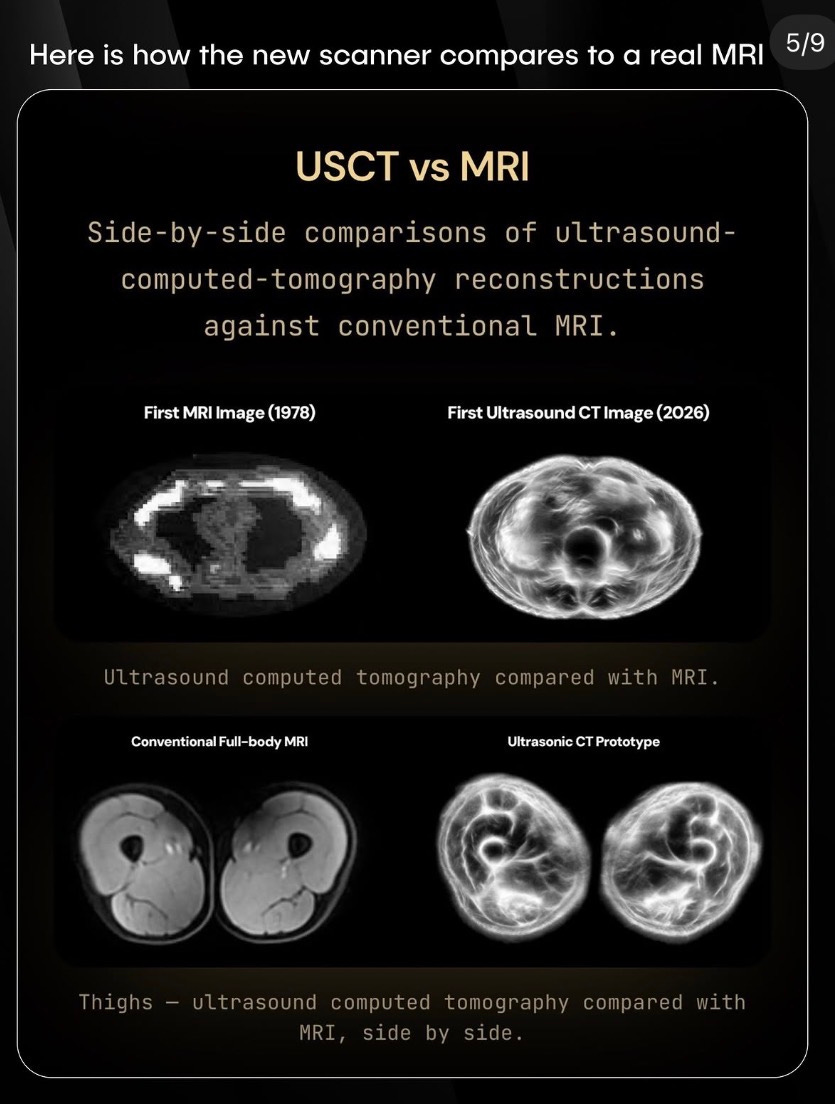
Now the reality the spa lighting was hiding. The current prototype takes about 20 minutes, not 60 seconds, because the system is bottlenecked on bandwidth, DSP, and basic data-transfer plumbing, exactly the unglamorous stuff that always gates these things. Roughly a dozen people have been scanned so far. The team building it is about nine people. The 60-second figure is a goal, the petaflops are a target architecture, and the comparison to MRI is the company’s own framing from a launch event, not an independently validated result. Holz also floated the bigger dream out loud, that enough early imaging could prevent something like 30% of deaths and cut maybe half of healthcare spend, which is a beautiful sentence and also a diagnostic claim wearing a wellness hat, a distinction that matters enormously and that the essay gets to in a minute. The honest one-liner is that this is a real, demonstrated, early-stage prototype with genuinely interesting bones and a launch deck written by people who know how to make a feed lose its composure.
The chip everyone skipped past, and the seventy-four-million-dollar tell
The single most important fact for anyone modeling this is that Midjourney did not invent the imaging. The scanner runs on Butterfly Network’s Ultrasound-on-Chip technology, 40 imaging modules per current prototype, licensed under a co-development agreement that Butterfly disclosed in a Form 8-K back on November 17, 2025. The structure is the tell. Midjourney pays a $15M one-time fee plus a $10M annual license over a five-year term, with up to roughly $9M more tied to milestones, plus revenue share and chip-purchase economics if hardware actually ships, summing to up to about $74M in expected payments to Butterfly. That deal runs through Butterfly Embedded, the unit formerly called Octiv, which is Butterfly’s whole strategic pivot toward licensing its chip and software to other people’s devices rather than only selling its own handheld probes. In other words, the headline-grabbing reveal this week was the consumer face of a B2B licensing thesis Butterfly has been quietly building for a while.
The market repriced Butterfly accordingly, which is the part the LinkedIn crowd actually got viscerally right even if they got the reason wrong. BFLY ripped roughly 52% to 56% on Thursday, opened around $7.48, printed an intraday high near $8.73, and closed around $8.90, a multi-year high, on roughly 59 million shares against normal volume that is a fraction of that. Short interest had been sitting near 12.6% of the float going in, so a chunk of that move is a squeeze on people who were betting against a company that just got handed a marquee design win and an Elon Musk one-word reply of cool on X for free distribution. TD Cowen’s Joshua Jennings framed the read correctly, that the deal validates the chip-licensing platform as a standalone revenue line, while William Blair did the adult thing and flagged the open questions, FDA, reimbursement, and whether routine whole-body scanning of healthy people is even clinically useful. Worth remembering what Butterfly is underneath the hype, a real medical device company that just posted Q1 2026 revenue of $26.5M against a $25.74M estimate and an EPS of negative three cents that beat by a penny, now on its third-generation iQ3 handheld. The headline said Midjourney. The business story is Butterfly finally getting paid for the chip.
Why Ultrasonic CT is a naming crime and a real idea at once
Let’s deal with the name, because a technical audience will twitch at it and they should. CT means computed tomography, which in normal usage means X-rays rotated around you and reconstructed into slices. There are no X-rays here. Calling an ultrasound device Ultrasonic CT is like calling a bicycle a pedal-powered Tesla. It is borrowing the prestige of one modality to describe another, and Midjourney knows it, which is why the long-form name buries computational tomography in the middle to do the legitimizing work. The annoying thing is that under the bad branding sits a genuinely real field. Ultrasound tomography, sometimes written USCT, is decades old as a research program. Instead of holding a probe against your skin and reading reflections from one angle, you surround the target with transducers in a water bath and capture transmission and reflection from many angles at once, then reconstruct a cross-section. It has mostly lived in breast imaging, where water-bath ultrasound tomography systems have spent years working through clinical study and clearance processes precisely because dense breast tissue is the case where this geometry shines. So the concept of a water-coupled, many-angle ultrasound reconstruction is not science fiction. Midjourney did not invent new physics, as the strategist on LinkedIn correctly insisted. What is genuinely new is the attempt to do it for the entire body, standing up, fast, and cheap, at consumer throughput.
That whole-body scale-up is exactly where the hard problems live, and they are not the problems a diffusion-model company has spent the last few years solving. Ultrasound does not love air or bone. Lungs are gas, bowel is gas, and dense bone reflects and scatters in ways that make clean reconstruction through the chest and pelvis legitimately difficult, which is part of why MRI and CT earn their keep there. Resolution, penetration depth, and acoustic coupling all fight each other. Getting MRI-comparable detail of soft tissue, organs, vasculature, and bone across a six-foot human in a single sweep is a real engineering frontier, not a settled result. The prototype taking 20 minutes and having imaged about a dozen people is the honest signal of where on that frontier this actually sits. The vision is plausible and the demo is pretty. The validation that would let anyone call it better than MRI does not exist yet, and pretending the gap is a rounding error is how you end up quoting a launch slide as if it were a peer-reviewed endpoint.
Where the AI lives, which right now is mostly nowhere
This is the detail that should embarrass half the feed. The post that claimed Midjourney’s image AI rebuilds the raw scan into something readable described a capability that, by the company’s own account, is not in the product yet. As of the announcement there is no neural network in the imaging reconstruction pipeline. The reconstruction is computational, classic signal processing and tomographic math, but the generative-AI layer that the brand name implies, and that the eventual scale story depends on, is a future tense thing, not a shipping thing. Holz said as much plainly. The irony writes itself, an AI image company’s first hardware product currently uses zero of the AI it is famous for, and the most-shared takes online inverted that into the opposite claim. If you were grading these posts like a diligence memo, the ones that said the AI rebuilds your scan would get a factual error flag on the single most load-bearing sentence.
Where AI is supposed to eventually matter is real and worth understanding, because it is the actual bet. The roadmap has a second-generation hardware design inside roughly twelve months and a third-generation scanner around 2028 built on fully custom silicon that Midjourney designs itself rather than licensing from Butterfly, at which point the volume of raw acoustic data, those tens of gigabytes per slice, becomes the thing that only learned reconstruction can plausibly turn into clean anatomy at a 60-second cadence and at the throughput the spa story needs. So the AI is the closing argument, not the opening one. The bull case is that Midjourney’s core competency, turning messy high-dimensional signals into images people find legible, transfers from photons to phonons. The bear case is that medical reconstruction has correctness constraints that aesthetic image generation simply does not, where a hallucinated vessel or a smoothed-over nodule is not a charming artifact but a missed cancer, and that the FDA, correctly, treats a model that invents plausible anatomy very differently from one that invents a plausible dragon. The transfer is a hypothesis with a great pedigree and no clinical evidence behind it on day one.
The regulatory two-step and the wellness lane everybody uses
Here is the move the physician on LinkedIn flagged and almost nobody else did, and it is the most strategically interesting part of the whole announcement. Midjourney is not launching a diagnostic device. It is launching, initially, a producer of detailed body-composition maps, how much muscle, fat, and bone you have and how those shift over time, which is structural data but not a diagnosis. That puts the product in the same broad non-diagnostic wellness posture that companies like Prenuvo and Ezra have used while building consumer whole-body scanning businesses, and it avoids the immediate burden of claiming it can find disease. The moment Midjourney says it can reliably detect cancer, aneurysms, liver lesions, pulmonary nodules, or anything else actionable, it is in a different regulatory world, one that requires evidence, performance data, and clearance that does not yet exist.
The overdiagnosis arithmetic nobody on the feed ran
Now for the math that turns the launch slide back into a health-system problem. The company’s own framing is about a billion scans a month at maturity. Whole-body imaging always creates incidental findings, and the rate is not trivial. Even a conservative incidental-finding rate of 20% on a billion scans means 200 million flagged scans a month; at 40%, it is 400 million. That is not a small downstream issue. It is an industrial-scale follow-up problem, with add-on imaging, biopsies, specialist visits, and anxiety all traveling behind it. None of that proves the scanner is bad; it proves the scanner is not just a scanner, because at scale every screening system becomes a triage engine for uncertainty. That is why the central question is not whether the demo looked cool. It is whether the device can materially improve outcomes without flooding the system with false positives and low-value follow-up.
That is also why the overclaimed line about “30% of deaths” and “50% of healthcare spend” should be treated as a hypothesis, not a finding. Early detection can absolutely matter for some diseases, but the leap from “we can see more” to “we save half the cost of care” is enormous, and there is no published evidence from Midjourney that supports that leap today. If the scanner ends up useful, it will probably be in targeted use cases with carefully defined populations, not as an every-body-every-month machine on the promise that seeing more always means helping more. The history of screening is much more complicated than that.
Follow the money, the moat, and what to actually watch
The real story here is not that Midjourney found religion. It is that a software company with elite image-making instincts has picked a hardware problem where the economics, the branding, and the data flywheel all point in the same direction, while Butterfly found a way to monetize a chip that was always better suited to being embedded in somebody else’s ambition than staying trapped inside its own device line. That is a serious strategic alignment, and it is why the market moved the way it did. But strategy is not validation. What matters now is whether the prototype gets materially faster, whether the reconstruction gets meaningfully better, whether the body-composition-only lane becomes clinically and commercially useful, and whether the company can turn a stunning demo into a workflow that physicians, payers, and regulators can tolerate.
Watch three things. First, whether the next prototype actually closes the gap to 60 seconds and whether the data path starts to look like something AI can realistically digest. Second, whether Midjourney publishes any reproducible performance data that compares the scanner against MRI, CT, or conventional ultrasound on pre-specified endpoints rather than launch-day rhetoric. Third, whether Butterfly’s licensing deal becomes the template for a broader embedded-silicon business, because that would matter even if Midjourney itself takes years to prove out. If the scanner ends up being real, useful, and reimbursable, the feed will claim it saw it coming. The rest of us should probably wait for the evidence
.
Nice follow through analysis of the story!