Video Preview
🎧 Part I Podcast free on Spotify.

🎧 Part II Podcast episode for paid subscribers only. Also available on Spotify.
To listen to paid episodes in Apple or Spotify, link your Substack subscription via the show settings on those platforms (instructions inside the Substack app under Subscriptions → Podcast).
Table of Contents
The short version, for the impatient
What got announced, minus the varnish
Why ownership is the actual headline
The data question, and the trick of de-identified but longitudinal
Superintelligence talk and the benchmark behind it
Azure Foundry, or how Microsoft gets paid while Mayo gets the credit
The healthcare AI announcement graveyard, and whether this dodges it
Regulation, liability, reimbursement, and what to watch
Abstract
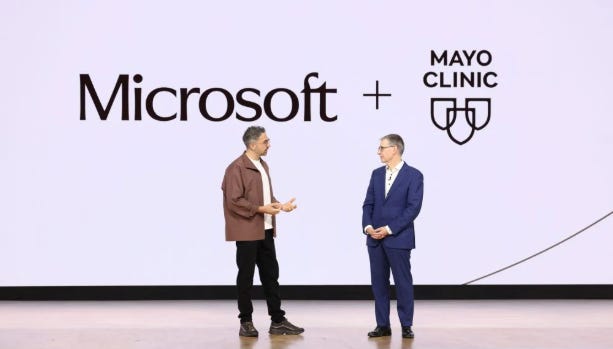
On June 2, 2026, Mayo Clinic and Microsoft announced a collaboration to build a frontier AI model purpose-built for healthcare, combining Mayo’s de-identified clinical data and longitudinal insights with Microsoft’s compute, engineering, and what the press release calls superintelligence capabilities. Two structural facts carry the whole thing: the model will be owned by Mayo, and Microsoft will distribute it through Azure Foundry APIs. Key figures worth holding in your head: 1) Mayo Clinic Platform has been cited at roughly 54 million de-identified patient records, with Discover alone listing 13.6M+ patients, 5.8B+ images, and 2.72B+ lab results. 2) Mercy added about 15.2M de-identified records in February 2026. 3) Microsoft’s MAI-DxO hit 85.5 percent diagnostic accuracy on 304 hard NEJM cases versus roughly 20 percent for the physicians it was tested against. 4) Mayo Clinic Platform is about seven years old, and Mayo previously signed a ten-year infrastructure deal with Google in 2019. The essay below walks through the ownership structure, the data underneath it, the benchmark fueling the superintelligence talk, the distribution economics, the long history of healthcare AI deals that died on contact with workflow, and the regulatory and reimbursement traps still sitting in the road.
The short version, for the impatient
Two very large organizations got on a press release together and said they are building a frontier model for healthcare. Mayo brings the data and the brand. Microsoft brings the compute, the engineers, and a CEO who likes the word superintelligence. The part that actually matters, and the part that got buried under the usual nouns, is that Mayo owns the model and Microsoft pipes it to the rest of the planet through Azure. Everything else flows from those two facts.
Skepticism is the correct default here, because healthcare has buried a lot of these announcements in shallow graves, and the word frontier is doing roughly the same load-bearing work that the word cognitive did for IBM a decade ago. But the assets in this one are genuinely real, which is more than you could say for most of the press releases that came before it. Mayo has a productized data foundation with years of operating history. Microsoft has been quietly building a medical AI team that put up some eye-popping benchmark numbers. So the right posture is not eye-roll and not hype. It is the posture of someone who has read enough term sheets to know that the interesting risk is never in the noun, it is in the ownership, the distribution, and the boring stuff that nobody tweets about.
What got announced, minus the varnish
The literal claims, from the announcement itself: a strategic collaboration to develop and deploy a frontier AI model designed specifically for healthcare. The model combines Mayo’s global clinical expertise, de-identified clinical health data, and longitudinal insights with Microsoft’s AI, cloud, engineering, and superintelligence capabilities. It is meant to synthesize diverse clinical data to support earlier diagnoses and more personalized treatment. The frontier AI model will be owned by Mayo Clinic, and Microsoft plans to make the model available through Azure Foundry APIs. It gets deployed inside Mayo’s own clinical environment first, where it can be tested and refined on real use before it goes anywhere else. Mayo’s CEO tied the whole thing back to Mayo Clinic Platform, which he framed as a roughly seven-year-old effort to move healthcare from a pipeline to a platform model. Mustafa Suleyman, who runs Microsoft AI, said frontier medical intelligence is around the corner.
Now the varnish you can scrape off. Superintelligence capabilities is a marketing phrase, not a spec sheet, and frontier medical intelligence has been around the corner for about as long as the self-driving car has been a year away. The substance underneath the adjectives is three concrete things: a very large pile of clinical data, an unusual choice about who owns the IP, and a distribution rail. One detail that the polite framing skips is the timing. This is the same Mayo that entered a ten-year partnership with Google in 2019 to build an enclave for the ethical secondary use of clinical data. That 2019 Google deal built the Mayo Clinic Cloud and the controlled de-identified enclave that became the Platform. That arrangement was plumbing. This one is product. The plumbing partner and the product partner are not the same company, which tells you something about how Mayo thinks about keeping its options open, and about how badly Microsoft wanted the most trusted brand in American medicine on its model card.
Why ownership is the actual headline
Health systems consume models. They almost never own the frontier ones, for the same reason a hospital does not own a fab or a launch vehicle. Training and maintaining a real foundation model is a capital sink, a talent war, and a permanent ML operations headache involving drift, retraining, evaluation, and safety review that never ends. So when a nonprofit clinic says it will own a frontier healthcare model rather than rent one, that is the genuinely strange and interesting move, and it deserves more attention than the word frontier.
Ownership does a few things at once. It puts Mayo’s brand on the box, which is the entire point, because the brand is the moat. It also puts Mayo’s name on the liability, which is the part nobody mentions at the announcement. And it lets Mayo behave like a model vendor, packaging Mayo’s clinical judgment as something other organizations can call on demand. For Microsoft, letting Mayo hold the IP is not generosity, it is risk transfer with a side of strategy. Microsoft is a three trillion dollar magnet for plaintiffs, and the last thing it wants is to be the named clinical decision-maker when a model in Tulsa suggests the wrong workup. Far better to be the cloud and the engineering shop while the doctor’s name is on the diploma. Microsoft eats the training compute, presumably, and gets paid on the back end through Azure consumption every time anyone uses the thing. That is a very old cloud playbook wearing a white coat. The catch for Mayo is that owning a flagship model puts it in quiet competition with the third-party developers it hosts on its own platform, which is an awkward thing to be when you are also the landlord.
The data question, and the trick of de-identified but longitudinal
The model is the cover band. The data is the catalog. Mayo Clinic Platform has been described as the largest portfolio of high-quality de-identified data in the world, built on a collection of around 54 million patient records. Its Discover offering alone has been listed at more than 13.6 million patients, over 5.8 billion images across CT, MRI, and PET, and over 2.72 billion lab results. The network keeps growing through partnerships. In February 2026, Mayo expanded its collaboration with Mercy, one of the fifteen largest U.S. systems with 55 hospitals, adding visibility into more than 15.2 million de-identified patient records. The global side, Mayo Clinic Platform_Connect, has pulled in Hospital Israelita Albert Einstein in Brazil, Sheba Medical Center in Israel, and University Health Network in Canada, alongside founding member Mercy. The whole arrangement runs on a Data Behind Glass model, where each organization’s de-identified data stays under its own control and is analyzed in place rather than shipped out.
Here is the part the data nerds will notice, because it is a genuinely clever piece of engineering hiding inside a bland phrase. The announcement says de-identified and longitudinal in the same breath. Those two words do not naturally get along. HIPAA Safe Harbor de-identification strips eighteen identifiers, and once you do that naively, you have shredded the thread that lets you follow one patient across years of encounters, which is exactly what longitudinal means. Keeping the thread while still being de-identified is not free. It takes privacy-preserving record linkage and tokenization, the unglamorous machinery that lets you say this de-identified encounter and that de-identified encounter belong to the same person without anyone ever learning who the person is. So the longitudinal insights claim is not fluff. It implies real linkage infrastructure under the hood, the kind that takes years and lawyers to build, and it is a meaningful part of why this data is worth more than a hundred random EHR dumps glued together.
The thing nobody on the announcement wants to dwell on is generalizability. Mayo’s own patients skew toward the tertiary and quaternary referral end of medicine, which is the polite way of saying complex, often wealthier, disproportionately Upper Midwest, and not especially representative of the country, let alone the world. A model that learns mostly from what walks into Rochester learns what walks into Rochester. That is not the same population that shows up at a Phoenix safety-net clinic or a rural emergency department at two in the morning. Mayo clearly knows this, which is the entire reason for Mercy and the global partners and the talk about depth, breadth, and spread of data. Whether bolting on Mercy and a handful of international centers actually fixes distribution shift is an empirical question that has not been answered yet, and that nobody can answer from a press release. There is also a quieter irony. Referral-grade complex cases make for spectacular diagnostic benchmarks and lousy training data for the boring eighty percent of medicine, which is sore throats, blood pressure, and people who forgot to take their meds.
Superintelligence talk and the benchmark behind it
The confidence in that superintelligence language did not come from nowhere. It came from a benchmark. Microsoft built a Sequential Diagnosis Benchmark from 304 complex New England Journal of Medicine clinicopathological cases and ran its MAI Diagnostic Orchestrator against 21 experienced physicians. The orchestrator reached the correct diagnosis 85.5 percent of the time, while the physicians averaged about 20 percent. The design is model-agnostic, splitting the work across several virtual doctors that argue with each other in a chain-of-debate style, one keeping a ranked differential, one choosing the next test, one playing skeptic, one watching the bill, and the best results came when the orchestrator was paired with OpenAI’s o3. Microsoft has a second tool aimed at rare disease called DxGPT, which runs in the Madrid regional health service, is available to about 6,000 doctors, has reportedly touched around 500,000 patients, and lands near 60 percent accuracy overall. All of this came out of a health unit Microsoft stood up quietly in late 2024 under Suleyman, the DeepMind co-founder, with Karen Simonyan as chief scientist and a new MAI Superintelligence Team, where Suleyman has talked about a line of sight to medical superintelligence in two to three years.
Now for the asterisk that is not an asterisk, because asterisks would mess up your copy and paste. In that famous test, the physicians were not allowed to look anything up. No colleagues, no reference tools, no point-of-care lookups, none of the scaffolding that every actual doctor leans on every single day. So four times better than doctors is more precisely four times better than doctors working blindfolded with both hands tied. The NEJM cases themselves are selected to be diagnostic puzzles, the medical equivalent of the hardest crossword in the paper, the zebras that get written up precisely because they are weird. Winning a benchmark built entirely out of zebras is real and genuinely impressive engineering, and it says something true about machine reasoning. It just does not say what the word superintelligence wants you to think it says, because roughly ninety-five percent of medicine is horses, paperwork, follow-up, and the much harder problem of getting a human being to actually act on the output. The benchmark measures the part that was already the most automatable. The road from there to bedside is mostly the unautomated part.
Azure Foundry, or how Microsoft gets paid while Mayo gets the credit
Distribution is where the money quietly lives. The plan is to expose the Mayo-owned model through Azure AI Foundry, which is Microsoft’s developer platform and model marketplace, so any organization already on Azure can call Mayo’s model the way it would call any other endpoint. Strip away the mission language and the engine is simple. Every single inference is Azure compute consumption. Microsoft monetizes the tokens and the cloud underneath them, Mayo monetizes the brand and the data and presumably some licensing, and the meter never stops running. It is a vending machine where Mayo’s logo is on the front and Microsoft owns the coin slot.
The strategic read is even cleaner. Microsoft already owns Nuance and its DAX ambient documentation product, a deal worth roughly twenty billion dollars, which means it already has a front door into the workflow of thousands of hospitals through the ambient scribe sitting in the exam room. A Mayo-branded reasoning model plugs into that funnel without much friction. This is Microsoft’s answer to Google, which has its own medical models and was Mayo’s original infrastructure partner, and to OpenAI, which is pushing into health on its own. Owning the distribution rail for the single most trusted brand name in American medicine is worth a great deal more than owning any individual model, because models are becoming commodities and trust is not. Mayo’s name on the box, Microsoft’s meter on the pipe. For the health-tech founders reading this, the uncomfortable wrinkle is the platform versus vendor tension, which is no longer theoretical. Mayo Clinic Platform hosts third-party developers and validates other people’s algorithms, and Mayo is now also shipping a flagship model of its own. Building your company on a landlord who just opened a competing storefront in the same building is a strategy, but it is the kind of strategy you want to have read the lease for.
The healthcare AI announcement graveyard, and whether this dodges it
It would be irresponsible to write any of this without visiting the cemetery. The headstone everyone knows reads IBM Watson and MD Anderson, a partnership that burned through something like sixty-two million dollars before it was scrapped around 2017, and that reportedly produced unsafe recommendations in testing. IBM eventually sold off Watson Health to Francisco Partners in 2022 for a figure reported around one billion dollars, which sounds like a lot until you remember how much went in and how much was promised. The pattern that killed it is the pattern that kills most of them. The demo is magic. Then comes EHR integration, then clinician trust, then workflow, then validation, then reimbursement, and somewhere in that gauntlet the magic quietly suffocates. Google Health got reorganized into other parts of the company. Babylon went from a multibillion dollar valuation to a fire sale. The graveyard is not small and it is not full of dumb people.
So the fair question is whether this one is built differently, and the honest answer is partly yes and partly the same trap with a nicer logo. On the yes side, the data foundation is real and already a product, not a slide, with years of operating history and even a validation arm meant to test models for bias across populations before they reach the clinic. Mayo owning the model means the incentives around clinical safety sit with the party whose name is on the door, which is a healthier alignment than a tech vendor optimizing for a demo. And deploying inside Mayo first means the thing gets beaten up on real cases before anyone tries to export it. On the same-trap side, the announcement describes a model meant for the broadest scope of clinical reasoning, and the broadest possible scope is exactly the scope that ate Watson alive. The wins in healthcare AI have been narrow and specific, the ambient scribe, the sepsis early warning, the imaging triage that flags the bleed. General clinical reasoning packaged as a product has a perfect, undefeated record of humbling the people who try to build it. Betting that this time the boss fight goes differently is a bet, not a conclusion.
Regulation, liability, reimbursement, and what to watch
Start with the regulator, because the regulator does not care about your benchmark. The FDA’s device framework was built for software that behaves predictably, a locked or change-controlled algorithm with a narrow intended use and a predetermined change control plan when it learns. A frontier model doing open-ended clinical reasoning fits inside that framework about as well as a whale fits inside a kiddie pool. The 21st Century Cures clinical decision support carve-out only rescues you if a clinician can independently review the basis for the recommendation, which is a tall order when the basis is a hundred billion parameters that cannot explain themselves in a way that survives a deposition. So the realistic near-term path is the one everyone uses, which is to ship it as informational and not as a medical device, a polite fiction that works right up until it does not.
Then the liability, which follows ownership like a shadow. Mayo owns the model, so Mayo owns the wrong answers. That is a brand the approximate size of a small country putting its name on probabilistic outputs. Inside Mayo’s own walls, with Mayo clinicians supervising and a malpractice posture Mayo already understands, that is manageable and even prudent. The moment it goes out through an Azure API to a hospital in another jurisdiction calling it for its own patients, the questions about standard of care, vicarious liability, and who exactly is practicing medicine get strange in a hurry, and the lawyers will get there well before the engineers do. Reimbursement is the quietest killer of the three. There is still no CPT code that reads frontier model reasoned thoughtfully about the patient. Fee-for-service pays for codes and procedures, not for cleverness, so the money has to come from brand licensing, from Azure consumption, from efficiency like fewer unnecessary referrals and faster diagnoses, and maybe from value-based contracts where a better diagnosis genuinely lowers total cost of care. That is a real business, but it is a slower and grindier business than the announcement’s energy suggests.
As for what to actually watch, keep an eye on a few specific things rather than the next round of adjectives. Watch whether the validation studies, when they appear, report performance on representative populations and not just the NEJM zebras, because that gap is where the generalizability problem either gets solved or gets quietly buried. Watch whether Azure Foundry pricing and the Mayo licensing terms ever see daylight, since the economics are the whole game and they are currently invisible. Watch whether Mayo Platform’s hosted developers start grumbling about competing with the house model, because that is the canary for the platform versus vendor conflict. Watch the FDA’s posture on generative clinical reasoning, which is the rail everything else runs on. And watch the simplest signal of all, which is whether anyone outside Rochester is running this in production within about eighteen months, or whether around the corner stays a corner. Frontier medical intelligence has been one corner away for a while now. The data here is real, the ownership structure is genuinely smart, and the distribution play is the best one in the building. The only thing left to prove is the part that has beaten everyone who came before, which is the short, brutal, unglamorous distance between the benchmark and the bedside.