🎧 Part I Podcast free on Apple Podcasts and Spotify.

🎧 Part II Podcast episode for paid subscribers only. Also available on Apple Podcasts and Spotify.
To listen to paid episodes in Apple or Spotify, link your Substack subscription via the show settings on those platforms (instructions inside the Substack app under Subscriptions → Podcast).
Abstract
Starting January 1, 2027, Original Medicare will pay separately for shared medical appointments. G0686 covers the first 60 minutes of a voluntary medical visit for 2 to 10 patients, billed once per patient. G0687 covers up to two additional 30-minute units when medically necessary. The business worth testing is a managed service that helps multisite practices run diabetes and hypertension groups using their own patients and clinicians. At an illustrative $100 allowed per patient, a session with six billable encounters generates $600 in gross allowed charges. Three generate $300 against much the same staffing cost. The real test is whether the practice can collect enough to make the session worthwhile and actually open up individual appointments. A full room can still fail the second test.
Table of Contents
The appointment Medicare is buying
Who belongs in the same room
What the practice would actually buy
The economics of an empty chair
Telehealth changes the math
How to tell whether the practice gained capacity
What would make this a business
The appointment Medicare is buying
A primary care practice with a six-week backlog already knows which patients are going to call next Tuesday. Somebody started a blood pressure medication and was supposed to send readings. Somebody else cut a diabetes prescription in half after seeing the refill price. A third patient brought a cuff to the last visit, but it stayed in the bag because the appointment went long on something else. Each of those patients needs a clinician. They also have questions worth hearing other people ask. A shared medical appointment gives the practice a way to handle some of that work in the same hour and gives Medicare a specific service to pay for. Until now, practices that ran these visits often relied on existing office evaluation and management codes for the individualized care they furnished. The new codes give the group encounter its own place on the fee schedule.
Beginning January first, twenty twenty-seven, a physician or other qualified health professional eligible to bill Medicare leads the visit for a group of two to ten patients with a common condition or set of conditions. The practice bills the first hour once for each patient who receives the service. Up to two medically necessary half-hour extensions can be billed per patient when supported, for a maximum session length of two hours. The visit combines individualized clinical assessment and care with group education, counseling, and peer discussion. A pharmacist, nurse, or dietitian can contribute within the applicable scope and supervision rules. The billing clinician still has to lead the session and the chart has to show what happened to each patient. If the dietitian’s discussion is part of the shared visit, its time and work belong to that service. A distinct, medically necessary individual visit on the same day can be separately payable when supported. The group and individual claims each need their own clinical work, time where relevant, and documentation.
Medicare also kept a gate that matters a great deal to anyone hoping to build a business around the code. The patient needs to have received a professional service in the preceding twelve months from the billing clinician or from an eligible clinician in the same group practice with the same specialty and subspecialty. A health system’s logo on both clinic doors tells the scheduler very little about whether that requirement is met. The beneficiary can decline and keep the option of individual care. Participation and confidentiality terms require consent, and the service is limited to one session per beneficiary per week. That limit applies to the patient, so separate diabetes and hypertension calendars within the same practice need to talk to each other. The clinical reason to bring somebody back determines the cadence. A weekly claim ceiling makes a lousy treatment protocol.
There is also a market boundary that could slip past someone reading only the telehealth announcement. Medicare clarified that a shared appointment does not meet the definition of a standalone visit under the rural health clinic or federally qualified health center payment systems, which require a qualifying one-on-one encounter. Those clinics may have outstanding reasons to run groups. A business selling them an encounter-level return under their usual payment systems needs a different financing case. A multisite practice already billing professional services under the physician fee schedule is a much cleaner first customer.
Who belongs in the same room
Type two diabetes and hypertension are good places to start because the practice can see a lot of the unresolved work before it makes a single call. There are home readings to review, medications to reconcile, lab orders still open, side effects patients never got around to reporting, and diagnoses that appear well controlled in the chart because the last measurement was taken during a surprisingly peaceful visit nine months ago. Both conditions give patients something practical to discuss together. One person may be worrying about an isolated high reading while another is taking measurements with a cuff that barely fits. Somebody has already figured out which local pharmacy reliably fills a particular prescription. That conversation can be worth real time in the appointment while the clinician works through why the same reading means different things for different people.
A useful hypertension group might bring together established patients who are due for a follow-up and have a mix of home readings and medication questions. The practice can teach measurement technique together, then the clinician reviews which readings are credible, which symptoms or drug effects matter, and what follow-up each person needs. A diabetes cohort might start with patients who have a recent hemoglobin A one c above their individualized goal and a documented need for follow-up. In the same session, one person might need an affordability problem addressed, another might have a pattern of low readings that warrants private discussion, and another might need a lab order and a concrete plan to get it done. A patient with a more urgent or complicated issue goes through the practice’s usual triage process. The presence of an empty seat on Thursday has very little to contribute to that decision.
Grouping people by the work they need is more useful than grouping them by diagnosis alone. A patient who wants help interpreting a continuous glucose monitor and somebody who is still deciding whether to start home monitoring can both have diabetes and spend most of an hour waiting for the relevant part. Cohort design can take clinical need, language, hearing, availability, and comfort with the format into account. It can also get too clever. A narrowly specified cohort may take three weeks to fill across four offices, especially once the practice accounts for prior-care eligibility, coverage, and who actually wants to come. The right degree of sorting is the one that gives the group a coherent discussion and gives the practice enough people to run it on a predictable schedule.
That sorting also changes who gets care. A program that requires a portal login, an uploaded log, and a working camera will recruit patients with functioning technology and enough time to troubleshoot it. Those can be perfectly appropriate patients, but the practice should watch who falls out at each step. Some people can read their blood pressures over the phone before a visit and have no idea how to attach a photograph of the log. A patient might prefer to give a clinician a medication history privately. A setup call and an in-person option can recover a meaningful portion of the eligible panel. Both take paid staff time. That time belongs in the model alongside the eventual clinical results.
What the practice would actually buy
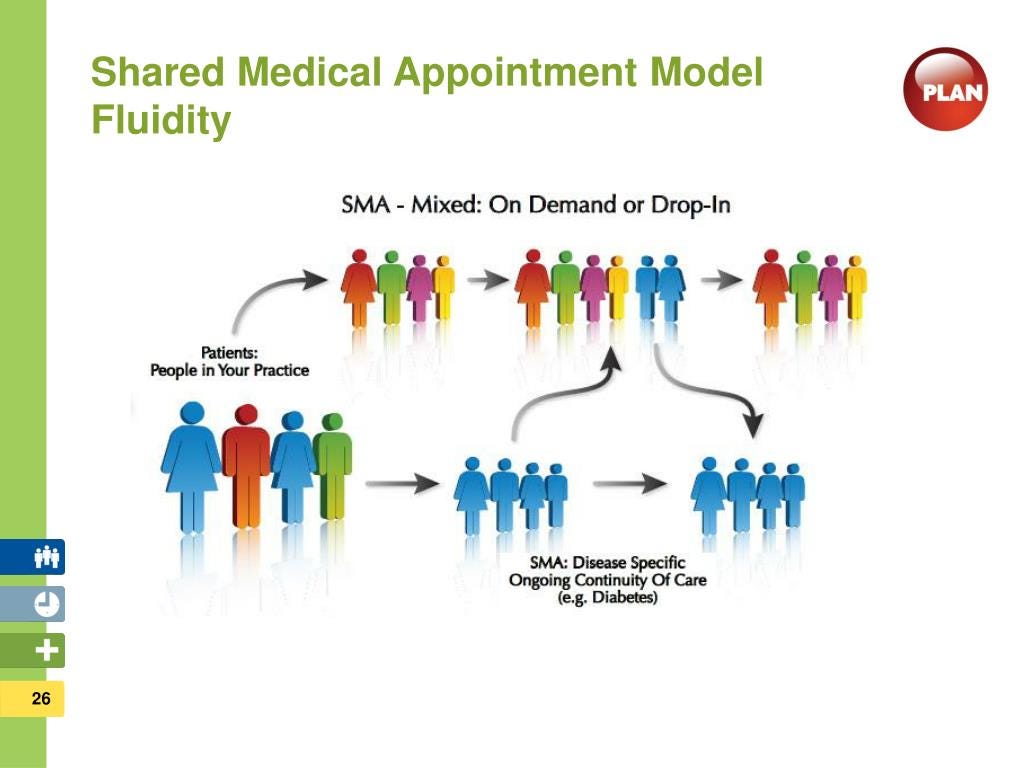
The first customer would be a multisite primary care group with a long follow-up queue, a centralized scheduling function, and a clinical leader willing to dedicate recurring blocks. The practice supplies the patient panel and the billing clinicians. It controls who is appropriate for the format, leads the visits, makes clinical decisions, signs the records, and submits the claims. The company runs the work around the encounters. It pulls candidate lists under the practice’s criteria, checks the prior-care relationship, contacts patients, assembles cohorts, captures consent, collects medications and readings, prepares the visit, fills cancellations, and follows through on what the clinician ordered. That is a managed service. A practice manager should be able to point to specific work that stopped landing in the clinic’s inbox after buying it.
Consider what has to happen before a Thursday afternoon group. The operator makes sure that eight confirmed names belong to eligible patients who understand the format and have heard what they might owe. One is away from home and plans to join from another state, which needs to be sorted out before the visit. One brings a spouse, so the practice needs a way to handle consent and confidentiality. Two have drug names in the chart that differ from the labels on the bottles they actually use. The intake summary identifies the discrepancies and puts the readings in front of the clinician with their dates, source, and relevant context. It also makes missing information obvious. Someone needs to notice that the latest blood pressure is six months old or that the same reading was entered three times. The record can carry that uncertainty forward so the clinician can resolve it.
During the visit, the practice needs an easy way to switch from the group discussion to a private conversation. It also needs a way to manage people arriving late, declining to discuss something in front of the group, or disconnecting before their individual care is complete. The operator can track attendance and draft the common portion of the note. The clinician documents the patient-specific assessment, decisions, and follow-up. A usable workflow puts both in the patient’s own chart without copying another participant’s information across records. An attendance log is handy when a claim is questioned. It proves a narrower fact than the note does. A timestamp showing a patient joined really only settles whether the patient joined.
The most valuable piece may be the day after the appointment. A clinician ordered a lab, another patient needs to bring a cuff in, and somebody needs an individual appointment before the next group. Those tasks need an owner, a due date, and a way to return to the clinical team when they go unresolved. The same applies to someone who missed the visit. An attendance recovery call should offer the next clinically appropriate option and surface anything that needs prompt escalation. Once a practice has enrolled several cohorts across multiple sites, that follow-up load is the difference between a service that makes primary care feel more manageable and a service that creates a new kind of backlog.
The economics of an empty chair
Take a one-hour base session at an illustrative hundred dollars allowed per patient. Six people attend and each receives a billable service. That is six hundred dollars in gross allowed charges. Three people do and it is three hundred. The practice reserved the same block, the clinician still reviewed the roster, and somebody made the reminder calls. A meaningful share of the coordination cost was incurred before anyone showed up. And if only one patient arrives, the minimum group size is missed. The clinician can evaluate whether an individual visit is appropriate and bill that encounter under the applicable rules. The group claim is off the table.
Allowed charges are the top line on a model that needs a few more rows. Original Medicare’s usual Part B deductible and coinsurance apply. After the deductible, the usual twenty percent coinsurance on an assigned hundred-dollar service would be twenty dollars, with the actual patient bill depending on supplemental coverage and applicable protections. Some patients will encounter cost sharing directly, some claims will cross over, and patients in the Qualified Medicare Beneficiary program cannot be billed for Medicare cost sharing. Quote the likely obligation before the visit and reconcile remittances after it. A four-visit series can sound like four afternoons of support to a practice and four separate bills to a patient. Both understandings affect whether the chair is occupied next month.
For a worked example, assume the practice ultimately collects ninety percent of allowed charges, spends two hundred sixty dollars in direct costs for the session, and incurs another fifteen dollars in variable costs per completed encounter. Suppose the fixed cost includes the reserved clinician block and its associated preparation and chart work, plus facilitation and coordination costs that the practice incurs whether three or six patients come. With six completed encounters, collections are five hundred forty dollars and direct costs are three hundred fifty, leaving one hundred ninety dollars of contribution. With three, collections are two hundred seventy and direct costs are three hundred five, leaving a loss of thirty-five dollars. Four completed visits are the break-even threshold in whole patients under those assumptions. If the clinician spent an hour and fifteen minutes including preparation and documentation, the six-patient session earned about one hundred fifty-two dollars of contribution per clinician hour. That is the figure to put next to the practice’s actual alternative use of that time, with the same treatment of clinician expense on both sides.
The average can hide a fairly nasty schedule. A string of groups with two patients and a string with ten both average six. All else equal, a perfectly linear spreadsheet will produce the same average contribution as a string of six-patient sessions. The clinic will experience those schedules very differently. Near the lower end, one cancellation can make the visit ineligible for group billing. Near the upper end, more complex patients can mean longer assessments, more private discussions, and charting that spills into lunch. Bad weather, a broken video link, or a vacation week can take out several patients together. A serious model tracks the distribution of completed encounters and the number of sessions that never ran. It also tracks the marginal labor it took to move a group from three completed visits to six. If that requires an hour of staff calls every time, put the hour in the spreadsheet. The clinic has already put it on somebody’s calendar.
Medicare assigned the base service 1.73 work relative value units per patient and the add-on 0.87 per unit. The work component is one input to the allowed amount. Practice expense, malpractice expense, geographic adjustments, and the applicable conversion factor also matter, and the facility and nonfacility amounts can differ. Look up the actual local fee schedule configuration for the practice and modality. Once the codes are live, follow real claims from submission through adjudication and collection, including denials and patient balances. Use the base case to see whether the service can stand on its own. The add-on is there when the extra clinical time is medically necessary and documented. A standard operating model that needs the add-on to keep the lights on is telling the founder something about the costs of the base visit.
Telehealth changes the math
Medicare added both codes to its telehealth list and explicitly allows a hybrid group with some patients in the office and others joining remotely. This can be especially attractive for a practice with enough patients spread across several locations and too few at any single office to fill a room reliably. It also means the same session can produce claims with different place-of-service configurations. The practice needs the actual patient location and modality for each encounter. Under ordinary Medicare telehealth rules, a patient at home generally maps to the nonfacility payment treatment. A telehealth patient elsewhere generally maps to the facility treatment. The clinician’s laptop sitting in a clinic is insufficient information to pick between those. The first remittance review should include both kinds of claims if the pilot uses both.
There is a separate wrinkle for a company selling the operating service with its own video platform. Starting in twenty twenty-seven, Medicare requires the applicable reporting modifier when the practitioner uses a qualifying contracted or paid virtual platform arrangement. Another modifier applies to qualifying telehealth services furnished incident to a practitioner’s professional service. Those reporting modifiers carry no payment adjustment themselves. They belong in the launch configuration review, especially if the vendor controls the platform and the practice controls billing. A hybrid visit also needs workable audio, a private way for remote participants to speak with the clinician, and a way to handle individual technology failures. The patient who cannot hear the room is still on the schedule, and the facilitator is going to spend time helping them.
The biggest telehealth assumption is the date. Under current law, broad at-home Medicare telehealth flexibility for these kinds of nonbehavioral services runs through the end of twenty twenty-seven. The codes’ addition to the telehealth list and the statutory flexibility to use them at home are separate facts. A multisite practice with viable in-person cohorts can use remote access to improve attendance and pool demand. A company built around an entirely remote national schedule is taking exposure to the next extension. Model a year in which home participation narrows, then see which practice markets can still fill groups in person or through eligible originating sites. That exercise is more revealing before someone signs a national sales plan.
How to tell whether the practice gained capacity
A six-patient shared visit can produce six completed encounters and open zero individual slots. Suppose four of those patients would otherwise have come in for follow-up, two would probably have gone without a timely visit, and the group occupies a block normally used for four individual appointments. The practice has improved access for the two people who were going to wait. It has yet to gain a slot on the individual schedule. If two people then need additional individual visits that the group could not handle, the effect on the calendar changes again. A revenue report can show a good afternoon while the scheduler is still looking at an identical backlog. That distinction is the whole reason to measure both throughput and capacity.
Before launch, capture how many comparable follow-ups the clinicians actually complete, their visit mix, the time to the third next available individual appointment, and how much preparation and chart work happens outside the schedule. During the pilot, identify whether the shared visit replaced a booked appointment, addressed a documented follow-up that had yet to be booked, or added care for a patient unlikely to be seen in the period. Measure how many released slots were made available and how many were filled. Track the individual appointments and extra staff work that the group generated afterward. If a group allows a practice to move four diabetes follow-ups out of separate slots and those openings get filled with new patients, that is visible in the schedule. A practice with largely empty afternoons may care more about improving follow-up completion and using available clinician time. The same program can solve different problems. The buyer needs to know which problem it paid to solve.
There is credible clinical evidence to justify trying the format, with a wide range of plausible results. An earlier review of diabetes shared appointments found an average reduction of about half a percentage point in hemoglobin A one c and about five millimeters of mercury in systolic blood pressure versus usual care, with substantial variation in the glucose results across studies. A later pragmatic trial across five Veterans Affairs health systems enrolled more than fifteen hundred adults with type two diabetes and elevated glucose levels. Patients scheduled for the group series improved by about a third of a percentage point more than controls at six months. The differences at twelve months were smaller and statistically inconclusive. A broader review of randomized primary care studies found little evidence of a consistent reduction in healthcare use. Those are different populations and different interventions. The Veterans Affairs program also involved a series totaling eight to nine hours. A practice offering a shorter series should measure what its own intervention does before putting an assumed effect into a payer deal.
A pilot can answer the first questions without pretending to be a clinical trial. Include everyone the practice invites in the operational analysis, report who accepts and who completes care, and track how often the practice obtains follow-up readings or labs. Look at changes in blood pressure and glucose alongside medication-related harms, unresolved escalations, and patient willingness to return. Where feasible, stagger the launch across comparable clinics or compare with a similar set of patients receiving usual follow-up. Recruiting patients after an unusually high reading and comparing that result with a later, more ordinary reading tends to flatter the program. So does dropping the people who never return for a lab. For an early practice sale, the most persuasive result may be a combination of more follow-up completed and more individual appointments available, with a clear account of which patients were reached and what the clinicians had to do to deliver it.
What would make this a business
The first contract should be small enough to reveal the economics of a routine Tuesday. One multisite practice, a couple of clinical champions, an established-patient panel with a measurable backlog, and recurring blocks for diabetes and hypertension are enough to learn a lot. A fixed managed-service fee tied to a defined amount of operational work makes it possible to see what the practice pays and what the company earns. The company needs its own contribution calculation after outreach labor, intake calls, facilitation, implementation, support, and the time it spends resolving exceptions. The practice’s healthy claim margin says little about the vendor’s margin if every office needs a different scheduling workflow and every roster needs a manual rebuild. Likewise, a profitable vendor contract is unlikely to renew if the clinician spends Friday catching up on notes.[Tool budget: round 1/1; 0 rounds remain afterward.]
For an investor, the interesting evidence is whether a second practice can launch with less work than the first while producing comparable completion rates. Some things should carry over, such as the roster workflow, the consent process, chart preparation, and the pattern for reviewing early remittances. Others will stay local, including the billing entity, the provider relationships that qualify patients, which staff can handle escalations, and what a slot is worth in that market. Start with the economics the practice can see on its own schedule and in its own bank account. Medicare Advantage contracts and shared-savings arrangements can add reasons to buy, but those rates, terms, and incentives belong in their own models. A practice that earns under fee-for-service and participates in shared savings may also want to know how much of the group volume replaced existing care and how much added claims for follow-up that previously went undone.
Six months in, the scenario worth paying attention to is a clinic manager asking to add another recurring block because the first one regularly fills, the claims pay as expected, and the newly available individual slots get booked. The same manager can tell you what happened the weeks when only three patients came, how often the group ran over, and whether the patients who needed private follow-up got it. That is a much more informative renewal conversation than a slide showing the size of the Medicare diabetes population. The addressable market on that slide can be enormous while Thursday at two still has three empty chairs.