🎧 Part I Podcast free on Apple Podcasts and Spotify.

🎧 Part II Podcast episode for paid subscribers only. Also available on Apple Podcasts and Spotify.
To listen to paid episodes in Apple or Spotify, link your Substack subscription via the show settings on those platforms (instructions inside the Substack app under Subscriptions → Podcast).
Table of Contents
Why a home health rule belongs on everyone’s desk
The payment increase and the reduction can both be true
Enrollment compliance becomes a historical revenue problem
Ownership changes make acquisition diligence less forgiving
Palliative care gets clarity, with the same eligibility gates
Home infusion coverage expands around very specific conditions
The savings calculation puts patients in the middle
Quality reporting gets faster, and documentation gets less forgiving
The businesses worth building around these changes
Abstract
Medicare’s home health rule for twenty twenty-seven combines a modest aggregate payment increase with continued recovery of historical payment differences, broader enrollment enforcement, faster quality reporting, and a narrowly defined expansion of home infusion coverage. Its consequences reach physician groups, acquisition platforms, equipment suppliers, specialty pharmacies, drug manufacturers, and health plans. Several distinctions determine whether a business reads the opportunity correctly. Retroactive revocation can put previously collected revenue at risk. Palliative care remains subject to existing home health eligibility requirements. The infusion expansion initially affects a much smaller population than its description might suggest, while some projected Medicare savings come from higher beneficiary cost sharing. The strongest commercial opportunities involve maintaining reliable enrollment histories, connecting clinical documentation to payment requirements, and making benefit eligibility and patient costs visible before care begins.
Why a home health rule belongs on everyone’s desk
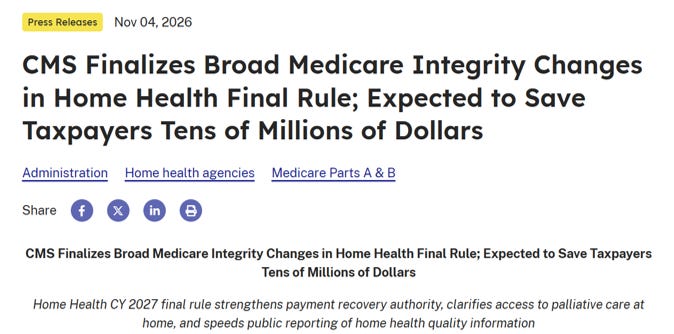
A physician group could reasonably skip a document called the home health prospective payment rule and still find itself dealing with the consequences. Released on November fourth, the final rule for twenty twenty-seven carries enrollment provisions that reach across Medicare provider and supplier types. That makes it relevant to the people managing physician practices, buying healthcare businesses, supplying medical equipment, and financing their receivables. The annual rate update is only part of the document. Medicare has also made it easier to reach backward into payments when enrollment requirements weren’t met, expanded several grounds for denying or revoking enrollment, and addressed services that sit awkwardly between existing benefits. Healthcare already has plenty of awkward benefit boundaries. This rule gives several of them fresh commercial importance.
The agency estimates roughly eighty-two million dollars in annual savings from the expanded integrity provisions. That number describes an estimated federal budgetary effect, not a software market or a measure of all fraud in Medicare. It also says little about the financial severity of an individual revocation. A modest national estimate can coexist with a devastating outcome for a particular practice. Conversely, a provider with an enrollment problem hasn’t necessarily fabricated treatment or harmed a patient. Enrollment compliance, medical necessity, and criminal fraud involve different questions. Those distinctions belong in board materials and investment memoranda, especially when the same presentation uses the word integrity to cover everything from missing documentation to an organized billing scheme.
The commercial interpretation therefore depends on what actually changes at the transaction level. An acquisition may require a more careful reconstruction of ownership history. An infusion referral may need a different benefit determination. A quality report may arrive earlier while still describing care delivered months ago. Each change creates a specific operating problem with an identifiable person responsible for fixing it. That’s a better starting point for a business than treating every paragraph of a federal rule as evidence of a giant new market. Regulatory enthusiasm is cheap. An implementation team, unfortunately, isn’t.
The payment increase and the reduction can both be true
Medicare projects aggregate home health payments will rise by approximately two point four percent, or about four hundred twenty million dollars, compared with twenty twenty-six. The components are a two point one percent payment update, or approximately three hundred seventy million dollars, and an estimated three-tenths of a percent increase associated with the updated fixed-dollar-loss amount, or approximately fifty million dollars. At the same time, the rule applies a three percent temporary reduction to the standardized thirty-day payment rate. Subtracting that reduction from the announced aggregate increase would produce the wrong answer. The prior year’s rate already carried a three percent temporary adjustment. In constructing the new rate, the agency removes that prior temporary factor before applying the new year’s adjustments and temporary reduction. The same reduction continues against the relevant baseline; it isn’t an additional three percentage points to deduct from the published year-over-year estimate.
The distinction between temporary and permanent adjustments is equally consequential. Permanent adjustments change the payment baseline going forward. Temporary adjustments recover historical payment differences associated with implementing the Patient-Driven Groupings Model and the thirty-day payment unit. The agency doesn’t impose another permanent adjustment for twenty twenty-seven, but earlier permanent reductions remain embedded in the system. Its cumulative calculation of historical payment differences through twenty twenty-five is approximately four point nine billion dollars, before distinguishing amounts already recovered through subsequent adjustments. That calculation is about statutory budget neutrality. It doesn’t establish that every agency receiving those payments committed fraud. A financial model that treats the temporary reduction as disappearing automatically after next year would need a much stronger justification than the word temporary.
Agency economics still depend heavily on the mix of patients and visits. The model has four hundred thirty-two payment groups, with updated case weights, functional impairment levels, comorbidity categories, and low-utilization thresholds. Medicare also lowers the fixed-dollar-loss ratio used in outlier calculations from zero point three seven to zero point two nine. That is a ratio, despite the percentage sign attached to the figure in the fact sheet. The lower threshold can help periods with unusually high estimated costs qualify for additional payment, within the program’s outlier constraints. It doesn’t promise full reimbursement for every expensive patient. An agency forecasting its own results should reprice actual periods using the new parameters and then apply its expected staffing, travel, and visit costs. Multiplying last year’s revenue by the national update is a quick way to produce a very tidy, very misleading budget.
There is also a reason policymakers remain comfortable scrutinizing payment adequacy. The Medicare Payment Advisory Commission reported a traditional Medicare margin of twenty-one point two percent for freestanding home health agencies in twenty twenty-four. The distribution was wide: five point seven percent at the twenty-fifth percentile and thirty-one percent at the seventy-fifth. Those are Medicare margins for a defined provider population, not interchangeable measures of company earnings across every payer and service line. The practical investment question is how a particular agency generates its margin. Referral mix, labor availability, travel density, and payer contracts deserve separate treatment. A national average can’t explain why one branch has a full nursing schedule while another spends half its afternoon driving.
Enrollment compliance becomes a historical revenue problem
The most consequential enrollment change concerns the effective date of revocation. The rule extends retroactive treatment to grounds that previously operated prospectively. However, the operative date still depends on the particular ground: it may relate to a conviction, a failure to meet a requirement, the last claim in a problematic billing pattern, or an agency determination. A software product cannot safely translate the entire rule into one field labeled first date of noncompliance. The underlying event and the applicable provision both matter. The agency also rejects the idea that otherwise medically necessary, properly furnished services automatically protect payments made during a period of enrollment noncompliance. That is the part likely to get a chief financial officer’s attention.
Consider an illustrative organization collecting a million dollars of Medicare revenue each month. If a revocation reaches back six months, six million dollars of receipts could become relevant to the exposure analysis, depending on the actual grounds, dates, and claims affected. That isn’t a prediction of the final recovery. It shows why treating enrollment as a small administrative expense can badly misstate the potential financial risk. The organization has already paid clinicians and rent. Cash collection provided reassurance that may turn out to have been premature. Buyers and lenders therefore need evidence of eligibility during the period when revenue was earned, alongside evidence that the claims were submitted and paid.
A useful technical response would preserve a history of entities, locations, licenses, owners, and people exercising operational control. Each event needs an effective date, a discovery date, the supporting source, and a record of how it was resolved. Keeping only the latest status loses information precisely when the historical question becomes important. An active license today doesn’t establish uninterrupted licensure last spring. A name match against a sanctions file doesn’t establish that the person in the file is the practice’s medical director. Reliable identity matching and human review belong inside the workflow. A language model can help extract dates and summarize documents, but it shouldn’t invent certainty where the underlying record is ambiguous.
The rule also compresses the deadline for submitting outstanding claims after revocation to fifteen calendar days from the date of the revocation letter, subject to the applicable provisions, including the distinct home health language. That creates an immediate operational requirement for handling notices, identifying affected claims, and coordinating billing with legal review. The broader design lesson is that monitoring only helps when someone can act on the result. An alert delivered to an abandoned mailbox has excellent uptime and no practical value. For a provider, the meaningful measures include time to investigate a verified issue, time to correct a reportable change, and the amount of revenue associated with an unresolved condition.
Ownership changes make acquisition diligence less forgiving
The ownership provisions deserve a place early in acquisition diligence. Existing rules can require home health agencies, hospices, and affected equipment suppliers undergoing certain changes in majority ownership within thirty-six months of initial enrollment or the last majority ownership change to enroll again, with applicable exceptions. The new rule adds denial or revocation authority when the required process isn’t followed. A transaction isn’t exempt merely because the operating team remains in place or the buyer describes it as a recapitalization. The ownership history, transaction structure, and applicable exception need to be established from the actual documents. A spreadsheet saying the provider number is active won’t resolve those questions.
The rule also broadens the relevance of adverse actions involving owners and managing parties, and introduces grounds involving certain sexual-assault or financial-misconduct misdemeanor convictions. Another provision permits a reapplication bar of up to ten years following denial regardless of the denial reason. That is discretionary authority, not an automatic decade-long ban after every unsuccessful application. Still, it changes the stakes of submitting an application with unresolved problems. For acquisition teams, the sensible inference is that diligence should connect enrollment records to management agreements, corporate records, and documented operating responsibilities. Someone can exercise substantial control without having the obvious title on the organization chart. Outsourcing a management function doesn’t make the relationship disappear.
Geographic concentration adds a different challenge. Medicare gains authority to act where an excessive concentration of providers within a limited area creates a high risk of fraud, waste, or abuse. The rule doesn’t establish a simple numerical density threshold. That makes a map useful for investigation but insufficient for a conclusion. A medical office building can contain many legitimate businesses. A more informative review would examine concentration alongside ownership links, staffing, referral relationships, and evidence that each organization operates as represented. From an investor’s perspective, those findings can inform closing conditions, reserves, and contractual protections, with counsel determining their legal effect. Paying a lower multiple doesn’t repair a broken enrollment history. It merely changes the price paid for the problem.
Palliative care gets clarity, with the same eligibility gates
The palliative care discussion addresses an access problem that has persisted partly because the benefit is misunderstood. Medicare confirms that eligible patients can receive skilled palliative services through the existing home health benefit, including pain and symptom management at home. The rule creates no separate palliative care benefit or general monthly payment for managing serious illness at home. Existing eligibility still requires homebound status, a qualifying skilled need, appropriate certification, and an established plan of care. A diagnosis of advanced cancer or heart failure doesn’t establish all of that by itself. The clinical service and the patient’s circumstances have to support coverage.
This fits the longstanding principle clarified through the Jimmo settlement: skilled care can be covered when necessary to maintain function or prevent or slow deterioration, even without an expectation of improvement, provided the other requirements are met. That principle is especially relevant to progressive illness. Consider a homebound patient whose symptoms require skilled assessment, medication management coordinated with the prescriber, and caregiver teaching. The documentation should explain the clinical problem, the professional judgment required, what happened during the visit, and how that work supports the plan. Repeatedly inserting the phrase palliative care into a note doesn’t do the job. Nor does a software-generated paragraph about complexity establish what the clinician actually observed.
For health systems and organizations bearing financial risk, the opportunity is to improve the referral and care process around patients who already qualify. A referral service could identify missing certification records, help the receiving agency understand the skilled need, and establish responsibility for symptom escalation. Clinical teams could agree on when to contact the treating specialist and how to avoid leaving a distressed family to call several offices. Those functions have practical value, but their costs need an explicit funding source. Existing home health payment doesn’t magically absorb an unlimited telephone service, extensive specialist involvement, and every social need that accompanies serious illness. An arrangement requiring those capabilities needs a realistic payment agreement and a clear account of which services are covered through which benefit.
Measurement will be tricky. Patients with progressive illness may deteriorate despite excellent care, while patients selected because they’re relatively stable may generate attractive utilization figures without much intervention. A credible evaluation would account for disease severity, functional status, prior utilization, and patient preferences. It would track symptom burden and continuity as well as emergency visits. The business case should explain which organization receives any financial benefit from better care and whether that organization is paying the team delivering it. Otherwise, a clinically useful program can become another unpaid favor between departments.
Home infusion coverage expands around very specific conditions
The infusion provision implements a statutory change taking effect on April first, twenty twenty-seven. It expands the durable medical equipment pathway for certain external infusion pumps, their associated drugs, and supplies that otherwise fail the requirement concerning suitability for home use. The relevant prescribing information must call for administration by or under a healthcare professional, and a qualified home infusion supplier must safely administer or supervise the therapy in the home. The final rule retains the requirement that the professional be physically present. Remote supervision doesn’t satisfy it. Professional eligibility follows applicable scope-of-practice requirements, rather than the narrower list of professions contemplated in the proposal.
The dosing language is a particularly useful detail for manufacturers and reimbursement teams. The final rule uses the statutory requirement of at least twelve infusions per year instead of equating it with an infusion every calendar month. Those schedules aren’t necessarily equivalent when treatment occurs in cycles. The agency also makes clear that the frequency criterion concerns the approved prescribing instructions, not simply how many infusions an individual patient happens to receive. A coverage engine therefore needs the relevant label and its version, along with the administration requirements and other applicable conditions. Counting paid claims until the patient reaches twelve would answer the wrong question.
There is a real opportunity here for benefit verification and coordination between specialty pharmacies, equipment suppliers, and clinical teams. The workflow needs to establish the covered drug and pump arrangement, the supplier’s qualifications, the patient’s location, the required professional presence, and the expected financial responsibility. Those details should be settled before an expensive dose is prepared and a nurse drives across town. Home infusion also has its own benefit requirements; the home health requirement that a patient be homebound doesn’t automatically carry over. An intake system that treats everything delivered inside a residence as one benefit will create unnecessary denials and missed referrals.
The starting market is much smaller than the phrase expanded home infusion coverage suggests. In its impact analysis, Medicare identifies patisiran as the only newly qualifying drug expected to have enough use to matter materially in its estimate. Its analysis counts sixty-nine beneficiaries receiving patisiran infusions in twenty twenty-five. That figure belongs to the agency’s claims analysis and shouldn’t be stretched into a general estimate of the disease population. Future drugs or formulations could broaden the opportunity, but the agency doesn’t quantify that possibility. For an existing infusion operator, a narrow addition can be worthwhile. For a new venture built around a large immediate migration of specialty drugs into the home, the forecast needs considerably more evidence.
The savings calculation puts patients in the middle
The patisiran example also complicates the familiar assumption that home treatment automatically lowers costs for everyone. Using its stated pricing and cost-sharing assumptions, Medicare estimates annual drug spending of roughly three hundred thirteen thousand dollars per beneficiary. At approximately seventeen infusions per year, its outpatient comparison produces annual beneficiary cost sharing of about twenty-nine thousand five hundred dollars, reflecting the applicable cap per infusion. The home infusion comparison produces roughly sixty-two thousand nine hundred dollars in annual cost sharing for the drug alone, plus additional service and equipment costs. These are the rule’s illustrative inputs, including the outpatient cost-sharing benchmark it uses, rather than a personalized benefit quote for twenty twenty-seven.
The agency estimates Medicare could save approximately thirty-one thousand dollars annually for a beneficiary moving through this example, while the beneficiary’s cost-sharing responsibility rises by roughly thirty-four thousand dollars. Higher home infusion costs partly offset the transfer. That means the federal savings calculation includes a substantial shift in who pays. It doesn’t establish a comparable reduction in the resources consumed delivering treatment. Supplemental insurance or Medicaid may absorb some liability, depending on coverage. The financial consequence then lands elsewhere, and a household’s actual bill may differ considerably from the gross coinsurance amount. The agency itself anticipates that the cost-sharing difference would discourage adoption without secondary coverage.
For a manufacturer, this makes patient affordability a central part of commercial planning. A clinically appropriate home setting can still be financially unattractive. For a health plan or pharmacy benefit manager involved in coordinating specialty treatment, the relevant analysis needs to follow the actual medical benefit, supplemental coverage, and contracted service arrangement. A drug’s presence in a pharmacy formulary doesn’t settle the economics of a pump-linked Medicare Part B claim. For investors, the revenue model needs separate views of federal payment, secondary payment, patient liability, and expected collection. Blending all four into one reimbursement assumption makes the spreadsheet look calm while hiding the difficult part of the transaction.
A useful product would return a reviewable coverage and cost assessment before scheduling, including the source and date of each determination and any unresolved conditions. Its performance could be measured through fewer abandoned starts, fewer preventable billing disputes, and less time spent correcting avoidable benefit errors. That is a concrete service an existing infusion business could buy. A generic promise to move care home for less money would need to survive this example first.
Quality reporting gets faster, and documentation gets less forgiving
The quality reporting change shortens the quarterly window for submitting and correcting assessment data from roughly one hundred thirty-five days to approximately forty-five days after quarter end. The operative schedule uses the fifteenth day of the second month after the quarter, with specified calendar adjustments. This is a quarterly reporting deadline, not a replacement for every assessment’s separate transmission requirements. Medicare expects the change to bring public quality information forward by as much as three months. The agency says about ninety-eight percent of agencies already submit within the shorter timeframe. That limits the case for selling a completely new product based solely on deadline panic.
The more useful operating change is earlier reconciliation. An agency should be able to trace an assessment through submission, acceptance, correction, and inclusion in the applicable reporting period. A vendor could help locate missing assessments, rejected submissions, and discrepancies between the clinical record and reported data while there is still time to investigate. Predictive quality reporting can support that process, provided the product distinguishes its own estimate from an official result. More timely public reporting still leaves a lag between the patient’s care and the information a referral partner sees. A hospital choosing an agency also needs current capacity and the ability to serve that patient’s needs.
There are separate financial mechanisms behind the quality discussion. Failure to meet quality reporting requirements can reduce the annual payment update by two percentage points. The existing expanded home health value-based purchasing model can adjust applicable payments upward or downward by as much as five percent based on performance. This rule doesn’t introduce a new set of model-specific purchasing changes. It also discusses potential future advance care planning measurement without making that concept a newly mandatory measure. Those distinctions should survive the trip from regulatory analysis into a vendor’s sales presentation. Otherwise, an agency can end up buying a solution to a requirement that hasn’t actually been adopted.
Equipment suppliers get a related documentation opportunity. For qualifying replacement equipment under the same billing code, the rule clarifies that another comprehensive face-to-face encounter isn’t required solely because the item is being replaced. The original encounter documentation can still be needed in an audit, and replacement orders and other coverage conditions remain relevant. Reducing a repeat examination makes preservation and retrieval of the original evidence more useful. A supplier needs to connect the replacement order, item history, ongoing need, and supporting records without confusing a replacement with a different item ordered after a clinical change. Separately, the country-of-origin reporting addition for competitive bidding lead items is moving through the information collection process. Suppliers should follow the eventual instructions, rather than assume the discussion creates an immediate new reimbursement preference.
The businesses worth building around these changes
The strongest near-term opportunity appears to be continuous enrollment monitoring with usable historical evidence. An acquisitive provider group is a plausible first customer because it already has a reason to examine multiple entities and reconcile inconsistent records. A focused service could begin with an acquisition review, establish a verified baseline, and continue monitoring changes after closing. The product would need to connect legal entities to operating locations and responsible people, retain original documents, and route unresolved matters to the right reviewer. Its commercial value would come from reducing manual work and finding consequential issues sooner. Claiming to guarantee compliant enrollment would go well beyond what the underlying data can support.
A second opportunity sits inside clinical and revenue operations. Agencies need to connect what happened during care with the assessment, certification, claim, and quality submission. Software that identifies missing or conflicting evidence while the clinician can still clarify the record has a useful job. The boundaries matter: clarification should preserve the original record and show who made a correction and why. Rewriting every note into confident reimbursement language could make the record less trustworthy. A sensible pilot would measure the time needed to resolve exceptions and the rate of preventable documentation failures, while checking whether staff simply move the work into another queue. Attractive automation statistics aren’t much comfort if nurses spend their evening repairing its output.
Infusion benefit navigation is another plausible business, especially as an extension of an established pharmacy or supplier service. The initial offering should be tied to therapies and coverage pathways the operator can actually support. Manufacturers may have a reason to fund accurate access support, while providers have a reason to buy help with scheduling and financial clearance. The service still needs to show whose problem it solves and who has the budget. The small modeled population under this expansion argues for cautious hiring and modest initial revenue assumptions. Further growth would require additional eligible therapies, demonstrated adoption, or a broader service that solves existing problems beyond this particular rule.
Across these opportunities, the most valuable information is often an ordinary fact with a reliable date attached: who controlled the entity, whether the professional was licensed, which drug label applied, whether the assessment was accepted, and what documentation supported the service. Those facts are expensive to reconstruct after money has changed hands. A business that keeps them accurate and accessible can earn its place in a provider’s operating budget. The sales conversation can stay specific: which recurring task becomes easier, which decision gets better evidence, and how the customer will know the service worked.