
🎧 Part I Podcast free on Apple Podcasts and Spotify.

🎧 Part II Podcast episode for paid subscribers only. Also available on Apple Podcasts and Spotify.
To listen to paid episodes in Apple or Spotify, link your Substack subscription via the show settings on those platforms (instructions inside the Substack app under Subscriptions → Podcast).
Abstract
Federal promotion of CHOICE arrangements, previously known as individual coverage health reimbursement arrangements, is giving an existing benefits model a much bigger sales platform. Employers fund a defined contribution, employees choose individual insurance, and a surprising amount of work appears between those two steps. Entrepreneurs can build businesses around employer evaluation, benefits administration, premium payments, insurance distribution, and clinical coverage matching. The economics deserve scrutiny, though. Employer savings can come from shifting costs to workers, individual insurance networks can disrupt treatment, and administrative revenue can disappear into support expenses. The strongest businesses will solve specific operational problems, demonstrate value through renewals, and establish distribution without spending every dollar of margin acquiring the next customer.
Table of Contents
Ohio’s announcement and the business underneath it
The savings claim needs a second spreadsheet
Compliance is part of the product
Sell the employer a decision it can defend
Build the machinery that keeps coverage active
Help employees buy coverage they can actually use
Distribution decides whether the business works
The consequences for insurers, providers, and pharma
What the revenue model has to survive
Where a founder should start
Ohio’s announcement and the business underneath it
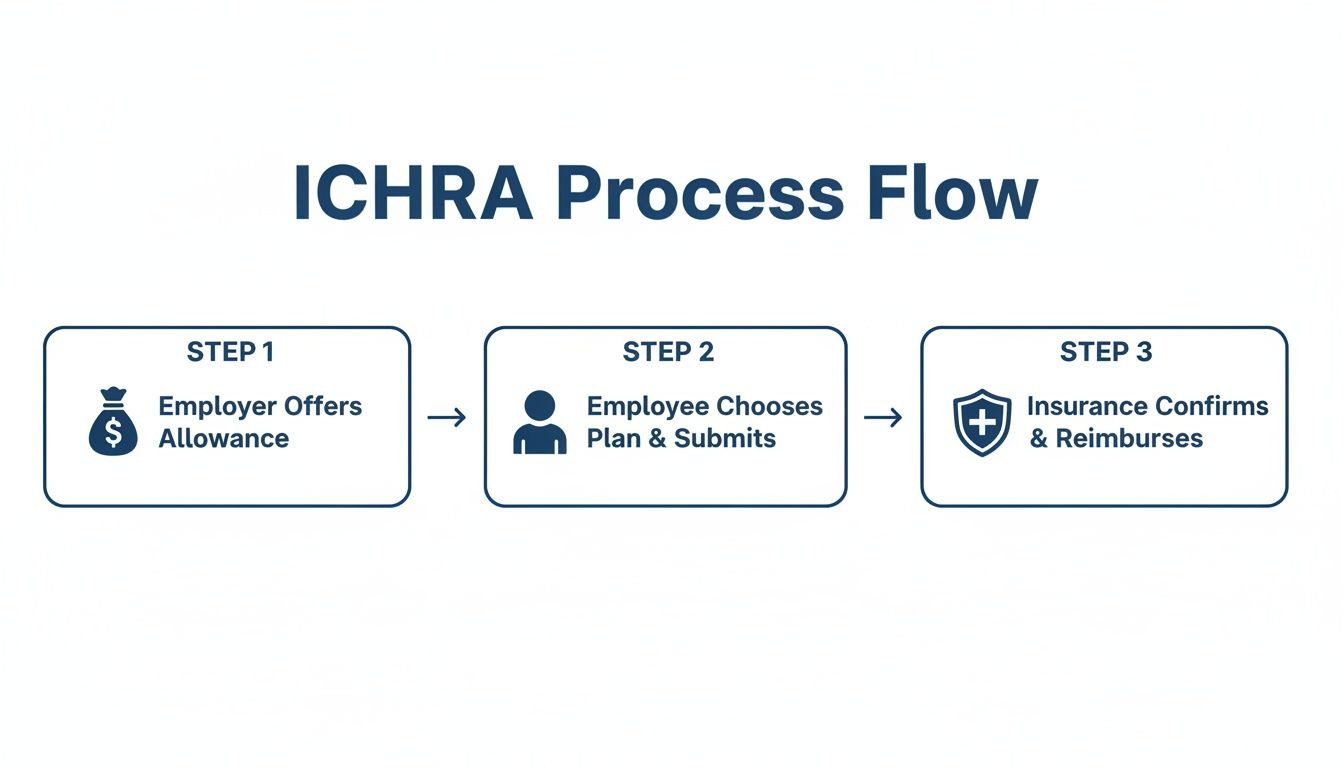
A home care company with several hundred employees has a fairly practical definition of healthcare innovation: something that makes next year’s benefits renewal less miserable without causing its best nurses to quit. That company probably doesn’t care whether the solution is called an individual coverage health reimbursement arrangement, an ICHRA, or a CHOICE arrangement. It cares about the monthly bill, whether employees can keep their doctors, and who answers the phone when somebody’s insurance disappears. Those concerns explain the entrepreneurial opportunity better than the branding does. Replacing a group insurance purchase with hundreds of individual insurance decisions creates work. Some of that work can become good software. Some will stubbornly remain people answering complicated questions during dinner.
The October Ohio event brought together CMS, the Small Business Administration, Take Command, employers, and other industry participants to promote CHOICE arrangements. The announcement describes a renamed version of the existing ICHRA structure. It doesn’t establish a separate Ohio insurance program or announce a new Ohio subsidy. Its commercial significance is federal attention and a more active effort to get employers considering the model. For a founder, that can help open conversations, although a government press conference has never completed a payroll integration. The underlying arrangement lets employers reimburse qualifying individual health insurance or Medicare coverage while employees select their coverage. An employee can generally keep the individual policy after leaving a job, provided the premiums keep getting paid. The employer’s contribution doesn’t automatically travel along.
There’s evidence of a growing market, with caveats that matter to anyone sizing a business. Industry reporting for twenty twenty-six identified more than twenty thousand employers offering either ICHRA or qualified small employer arrangements, and estimated ICHRA-covered lives alone exceeded five hundred thousand. The underlying HRA Council reporting identified 261,000 participating employees and 402,000 known covered lives as of January 2026, then estimated total ICHRA-covered lives above five hundred thousand after accounting for incomplete vendor coverage. Adoption among applicable large employers more than doubled on an aggregated basis, although the most conservative returning-provider comparison showed 34 percent year-over-year growth. Those findings aren’t a complete national census, and employer counts across different reimbursement arrangements shouldn’t be treated as interchangeable. A founder still needs to establish how many employers are reachable, how many employees will actually enroll, and which existing vendors already serve them. A growing category can support plenty of businesses. It can also support plenty of fundraising decks for businesses selling roughly the same thing.
The savings claim needs a second spreadsheet
The pressure behind employer interest is easy to understand. Average annual employer-sponsored premiums in twenty twenty-five reached nine thousand three hundred twenty-five dollars for single coverage and twenty-six thousand nine hundred ninety-three dollars for family coverage. Family premiums had increased six percent over the preceding year. Those are total premiums, including employer and worker contributions. Against that backdrop, a predictable employer contribution has obvious appeal. But predictable spending and cheaper healthcare are different economic outcomes. A company can make its benefits expense predictable by fixing its contribution while employees absorb future premium increases. Nothing about that arrangement, by itself, reduces the price of an infusion, a hospital admission, or a specialty prescription.
Consider an illustrative employer with three hundred participating workers, currently spending eight hundred dollars per worker each month. Suppose it replaces that expense with a six hundred fifty dollar monthly allowance and thirty-five dollars in administration fees. Assuming full allowance use and unchanged participation, the annual employer savings would be four hundred fourteen thousand dollars. That’s real budget arithmetic. Whether workers benefit requires another analysis. Their new premiums, deductibles, prescription costs, and access to care might improve, deteriorate, or vary sharply across households. A younger employee could get a better deal while an older colleague with family coverage faces a substantial increase. Excel is remarkably good at making someone else’s deductible disappear.
Ohio also illustrates why historical marketing claims need expiration dates. A widely circulated Ohio analysis published in August of twenty twenty-one described three hundred forty-four individual plans statewide and quoted reimbursement and premium figures from that period. Those numbers aren’t current underwriting inputs, and a statewide plan count doesn’t describe the choices available at a particular employee’s address. A useful employer comparison would use current local premiums and evaluate the actual workforce against the current group plan. It would also distinguish a company introducing benefits for the first time from one replacing established coverage. The former is buying an improvement over its existing benefit offering. The latter has employees with doctors, authorizations, accumulated expectations, and strong opinions about losing any of them.
Compliance is part of the product
An ICHRA isn’t an unrestricted cash allowance with a tax-friendly label. Employers have to design the arrangement within rules governing eligibility, employee classes, and reimbursement. They can offer traditional group coverage to one permitted class and an ICHRA to another, but can’t simply let employees within the same class choose between the two. Certain mixed arrangements trigger minimum class sizes. Contributions generally must follow consistent terms within a class, with permitted variation for age and family size; age-based variation is limited to a three-to-one ratio. The arrangement also carries notice and substantiation requirements, including generally providing written notice at least ninety days before the plan year begins. These details create a useful software problem because the answer depends on the employer’s configuration. A generic document generator won’t catch a class definition that becomes invalid after somebody changes eligibility in the payroll system.
The interaction with premium tax credits deserves especially careful engineering. An employee offered an affordable ICHRA generally can’t receive a marketplace premium tax credit. If the offer is unaffordable, the employee must decline the arrangement to pursue a credit, subject to the other eligibility rules. Accepting the reimbursement arrangement and adding a marketplace subsidy isn’t a clever funding strategy. It’s an eligibility error. For twenty twenty-six, the affordability calculation compares the employee’s cost of the applicable lowest-cost silver coverage after the employer allowance with nine point nine six percent of household income. Employer compliance safe harbors can use different permitted assumptions, including worksite location and specified premium lookback rules. Software should preserve the distinction between determining an employer’s compliance position and evaluating a particular household’s subsidy eligibility.
There are product opportunities in maintaining those distinctions over time. A worker changes address, gets married, moves between employment classes, or receives a different allowance. Each event can affect the next decision. The system should record the applicable rule, the data used, the employee’s election, and the effective date. It should also handle the difference between marketplace and off-exchange enrollment: pretax payroll deductions for an employee’s remaining individual premium generally require off-exchange coverage. This is work for explicit rules and auditable calculations. A language model can help read documents or explain an outcome, but the calculation itself needs to be reproducible. Nobody wants an affordability determination that changes because the chatbot felt more optimistic after lunch.
Sell the employer a decision it can defend
A promising entry point is helping brokers and employers decide whether to switch before trying to administer the resulting benefit. The product would ingest an employee census, the current contribution schedule, renewal pricing, and benefit information. It would then compare realistic contribution designs against the plans available where employees live. Public exchange data already cover premiums, benefits, and geographic availability, alongside lowest-cost silver lookup resources for ICHRA analysis. Access to those files isn’t much of a competitive advantage. Resolving messy employee records, distinguishing plan years, handling geography correctly, and showing a defensible comparison could be. The buyer needs to understand what the move does to the workforce, including the employees for whom the average result is misleading.
The output should expose the distribution of outcomes. An employer might accept modestly higher spending to protect employees who would otherwise face a large increase. It might exclude a proposed transition because available networks would disrupt too much care. It might discover that a different contribution design works for one permitted employee class while group coverage remains attractive elsewhere. A strong analysis would show household premium changes separately from expected medical spending and worst-case financial exposure. It would explain uncertainty where information is incomplete. That last part matters because small employers may lack usable claims history, and employee-reported healthcare needs are neither complete nor a license to promise precise spending forecasts.
Commercially, this could begin as paid implementation analysis and become an annual broker subscription or employer planning product. The renewal cycle creates repeated demand even when the employer stays with group coverage. That gives the business a reason to exist beyond convincing everyone to convert. It also creates an incentive question: an administrator paid only after migration may be tempted to produce optimistic recommendations. A broker-facing evaluation business can differentiate through comparisons that occasionally conclude the employer should stay put. Over time, its useful proprietary data would be the difference between projected and realized outcomes: which comparisons predicted enrollment, where employees needed assistance, and which employers regretted the switch.
Build the machinery that keeps coverage active
After the employer approves the change, the transaction problem arrives. Group administration lets an employer operate around a relatively consolidated insurance relationship. Individual coverage introduces separate applications, member identifiers, payment obligations, carrier systems, and household changes. An employee can select a plan without completing every step needed for active coverage. A payment can leave one account without being correctly applied to the intended policy. Those distinctions are easy to flatten into a single green status indicator, especially when a product team is trying to make the screen look reassuring. A useful operations business would preserve them. Application submitted, enrollment accepted, initial premium received, and coverage confirmed should be separate states with clear evidence behind each.
The product could give employers one consolidated funding workflow while maintaining a detailed ledger beneath it. Each employer contribution and employee deduction would reconcile to a policy, coverage period, and carrier receipt. Exceptions would have owners and deadlines. Returned payments, incorrect deductions, duplicate submissions, and retroactive adjustments would move through defined processes instead of disappearing into shared inboxes. The commercial buyer could be an administrator, broker platform, payroll provider, or insurer. Charging for reconciled enrollment or active employee months would tie revenue to ongoing work. The difficulty is integration: a founder can’t assume every carrier exposes reliable payment and coverage information through a convenient interface. The business needs a workable path for the carriers that still require manual follow-up.
Cash timing deserves its own design. If employees must pay the full premium before receiving reimbursement, the arrangement can create a real liquidity problem. Direct payment can reduce that burden, but someone still has to collect funds on time and handle a shortfall. Advancing premiums introduces financing and loss exposure that should be priced deliberately. Operational metrics should therefore include confirmed coverage, unresolved payment exceptions, reimbursement delays, and preventable lapses. This is also where defensibility could develop. An administrator is unlikely to replace a reliable reconciliation system casually once it handles thousands of policies and years of transaction history. Getting there requires patient operational work, including a lot of unglamorous carrier conversations.
Help employees buy coverage they can actually use
A plan comparison tool becomes much more valuable when it understands the difference between a cheap premium and usable coverage. Consider a hypothetical worker taking an infused biologic who wants to keep an established specialist. Checking the drug’s name against a pharmacy formulary won’t answer the whole question. The treatment may run through the medical benefit, depend on site-of-care rules, require a new authorization, and involve a facility whose network status differs from the physician’s. A useful recommendation needs to identify those uncertainties before enrollment. Similar problems arise with durable medical equipment, behavioral health appointments, specialty pharmacies, and scheduled procedures. A plan can look suitable in a summary and still create a nasty operational surprise.
There is already public infrastructure to build on. Provider and formulary data specifications connect qualified health plans with provider networks and covered drugs through machine-readable files. The entrepreneurial work would be validating, supplementing, and maintaining the information needed for specific decisions. Matching a physician’s name isn’t enough when participation depends on location or a particular product network. A formulary entry doesn’t settle every question about indication, utilization management, pharmacy restrictions, or patient cost. The product should distinguish verified information from an unresolved lookup and route consequential uncertainty to a person. A platform that can explain exactly what was checked, when it was checked, and what remains unknown has something worth selling.
This service could be embedded within an administrator’s enrollment experience, sold to brokers, or contracted through providers that regularly help patients navigate coverage changes. Medication and treatment details should remain separated from the employer’s ordinary management view; employers usually need aggregate information about disruption and benefit adequacy, not a searchable inventory of employees’ conditions. The recurring opportunity extends beyond enrollment. Plans change, clinicians leave networks, and workers develop new needs. A renewal review that detects a threatened treatment relationship could justify a continuing fee. Performance should be measured through resolved coverage problems, successful transitions, and useful verification, with appropriate limits on what the vendor can guarantee. The number of recommendations generated is mostly a measure of how often the software was asked a question.
Distribution decides whether the business works
There are already administrators and technology companies in this market, including Take Command, Thatch, Remodel Health, and Zorro. A new founder is entering an occupied category. A polished enrollment interface alone is unlikely to overcome incumbent relationships, established operations, and broker familiarity. Distribution deserves attention before a large product build. Brokers have employers approaching renewal, payroll providers have ongoing relationships and relevant workforce data, and industry-specific software vendors may already reach a concentrated customer base. Each channel has different incentives. A partner agreement that never produces a submitted employer census is essentially a very formal expression of mutual enthusiasm.
A focused industry strategy could improve the economics. Home care agencies, dental groups, restaurants, and regional service businesses have different staffing patterns and different operational systems. A founder serving one segment can build around its hiring practices, payroll schedules, employee communication needs, and renewal decisions. Healthcare services could be attractive because benefits affect recruitment while employers often have limited room to absorb higher expenses. But the workforce still needs individual evaluation. Lower-paid employees may already qualify for meaningful marketplace assistance, and an employer contribution can change that eligibility. A vertical sales pitch that ignores the household’s existing position can turn a well-intended benefit into a source of complaints.
The broker’s economics also need to work. A transition may change commission income, increase individual enrollment work, and create more support questions. Software that reduces that work can justify a fee, while an administrator that simply hands the broker a larger workload may struggle to retain the relationship. Compensation should be transparent, and plan recommendations should remain useful when carrier compensation differs. A practical launch would involve a small group of brokers and employers willing to work through actual renewals. The evidence to watch is conversion from evaluation to implementation, participation after rollout, support demand, and retention at the next renewal. Those results say much more than a long list of prospective channel partners.
The consequences for insurers, providers, and pharma
For insurers, employer-funded individual enrollment creates a different acquisition channel and potentially different retention patterns. Industry data for twenty twenty-six showed that more than half of observed enrollments, on and off exchange, involved employees younger than forty-five. That is an interesting demographic observation, not proof of superior underwriting profitability. A carrier still needs to evaluate morbidity, utilization, premiums, acquisition costs, and applicable risk adjustment transfers. A business could help insurers reconcile employer-originated enrollment, understand persistence, and forecast service demand. The proposition should be better operational and actuarial information. Assuming that employer affiliation automatically produces attractive medical margins would be a pretty expensive shortcut.
Providers face a different exposure. If a local employer moves workers into individual products, its employees may land in networks with different participating facilities and reimbursement arrangements. A health system could lose established patients despite those patients believing they kept the same insurance brand. A specialty practice might discover the problem only when it checks eligibility before treatment. Entrepreneurs could build coverage transition services that verify upcoming insurance, identify network conflicts, and help patients complete required steps. The business case would depend on fewer disrupted appointments and cleaner financial clearance. Provider-sponsored plans might also evaluate employer-funded individual coverage as a distribution channel, although concentrated enrollment would still require disciplined pricing and network design.
For pharma and pharmacy benefit businesses, the employer’s change in funding doesn’t automatically create a new right to control drug purchasing. Employees select individual policies with their own coverage arrangements. A startup can’t assume it can attach a separate pharmacy contract to every policy an employer helps fund. More practical opportunities involve treatment continuity, benefit verification, and assistance workflows during coverage transitions. A specialty pharmacy or manufacturer service provider could pay for fewer abandoned starts and fewer avoidable delays, provided the service demonstrates that value. Any plan-selection product funded by a manufacturer would need to make that relationship clear and protect the integrity of its recommendations. Otherwise, a coverage tool risks becoming a promotional channel wearing a benefits badge.
What the revenue model has to survive
Premium volume can make an administrative business look much larger than it is. Take an illustrative platform serving ten thousand employees at thirty-five dollars per employee per month. That produces four point two million dollars in annual administrative revenue. If six hundred fifty dollars per employee also passes through the platform each month, the annual premium flow is seventy-eight million dollars. Those funds aren’t automatically the platform’s revenue or margin. The commercial analysis should separate administration fees, insurance commissions, payment-related income, and any financing economics. It should also specify whether the vendor charges for eligible employees, enrolled employees, or active policies, because participation and turnover affect each model differently.[Tool budget: round 1/1; 0 rounds remain afterward.]
Support costs can eat through the apparent software economics. Using another hypothetical assumption, twelve dollars per employee each month for service labor plus five dollars for payments, data, and infrastructure would leave eighteen dollars from the thirty-five dollar fee. That’s roughly fifty-one percent gross margin before corporate overhead, assuming all those costs are classified consistently. Broker payments or heavier support demand could reduce it further. Automation helps when it resolves repeatable work accurately. If every exception requires a specialist and each carrier connection needs custom maintenance, the business may operate more like an administrative service company than its presentation suggests. That can still be a good business. It just needs pricing, staffing, and a valuation that acknowledge the work.[Tool budget: round 1/1; 0 rounds remain afterward.]
Where a founder should start
The best starting point is not a broad promise to modernize employer health insurance. It is a narrow operational failure with a measurable consequence. A founder might begin with contribution and plan analysis for a specific employer segment, coverage reconciliation for a defined administrator workflow, or treatment-continuity support during enrollment. The first customers should be willing to expose the real exceptions, not just admire a clean demonstration. A product that cannot show what happened to an employee’s application, payment, network question, or unresolved case will struggle to earn trust when the benefit becomes personal.
The market is now large enough to attract serious competition, but not mature enough to remove the basic execution problems. More than twenty thousand businesses reportedly offered ICHRA or QSEHRA arrangements in 2026, while ICHRA-covered lives exceeded five hundred thousand; those figures describe momentum, not guaranteed customer demand or profitability. The federal rebranding of ICHRA as CHOICE may increase awareness, but awareness will not reconcile a failed payment or preserve a disrupted specialist relationship. The durable opportunity belongs to companies that make the defined-contribution model work in practice, price the human support honestly, and prove at renewal that the benefit helped more than it merely shifted risk.
Renewal is the real test. Employees age, contributions change, carriers reprice products, and employers reconsider budgets. A business dependent on a favorable comparison in its first year needs to show what happens when that comparison deteriorates. Data rights also deserve scrutiny: an administrator shouldn’t assume it can obtain comprehensive clinical claims data merely because it helps fund premiums. The product has to work with information it can legitimately access and maintain. Investors should examine retention by employer cohort, actual enrolled months, service costs through open enrollment, carrier concentration, and the gap between forecast and realized savings. Growth that requires increasingly expensive cleanup is a warning about the operating model, even when the enrollment chart looks excellent.
Where a founder should start
A founder with limited capital has a reasonable path through a narrow employer segment and an existing administrator. The initial offer could be paid feasibility analysis, implementation support, and a specific ongoing service such as coverage verification or payroll reconciliation. That approach generates access to real problems before committing to a full platform. The repeated work should determine what gets automated. A team with deep payment and carrier integration experience might instead build infrastructure for several administrators. A team with pharmacy or provider data expertise could focus on treatment continuity and coverage matching. These businesses require different capabilities and should be evaluated on their own economics, even though they all benefit from the same policy structure.
Early validation should involve a complete operating cycle. Employers need to move from evaluation through employee enrollment, premium payment, ordinary support, and renewal. The founder should know which tasks required manual intervention, why employees declined participation, and whether the original financial comparison held up. A provider-matching company needs evidence that its verification changes decisions or prevents disruption. A payments company needs proof that it can resolve exceptions reliably. An employer analysis product needs buyers willing to pay for an honest recommendation, including an inconvenient one. Those are concrete tests of willingness to pay and delivery cost. They are much harder to fake than interest in a webinar.
Ohio’s promotion of CHOICE arrangements gives entrepreneurs a timely reason to approach employers and distribution partners. The work available beneath that announcement is substantial: employers need sound comparisons, employees need suitable coverage, and somebody has to make the money arrive at the right insurer every month. The strongest starting point is a problem for which a buyer already spends time, loses money, or receives angry calls. Solve that problem for a defined customer group, charge enough to handle the difficult cases, and use the resulting operating history to improve the product. A business that makes the next benefits renewal less painful and keeps employees’ coverage working has a credible reason to be renewed itself
.