🎧 Part I Podcast free on Apple Podcasts and Spotify.

🎧 Part II Podcast episode for paid subscribers only. Also available on Apple Podcasts and Spotify.
To listen to paid episodes in Apple or Spotify, link your Substack subscription via the show settings on those platforms (instructions inside the Substack app under Subscriptions → Podcast).
Trey Rawles provides fractional chief business development, revenue, corporate leadership, corporate development, strategy and product leadership, along with overall management consulting, for companies with more than ten million dollars in revenue or at the post Series B stage. Engagements require cash compensation and a retainer. Success-based-only and equity-only arrangements are not accepted. To explore an engagement, reply directly to this article.
Table of Contents
What Sanofi is paying for
The gap between a diagnosis and a patient who can be treated
Who would pay to fix the referral
The work that starts after a prescription
What a health plan would actually underwrite
Where the deal helps a founder and where it hurts
Abstract
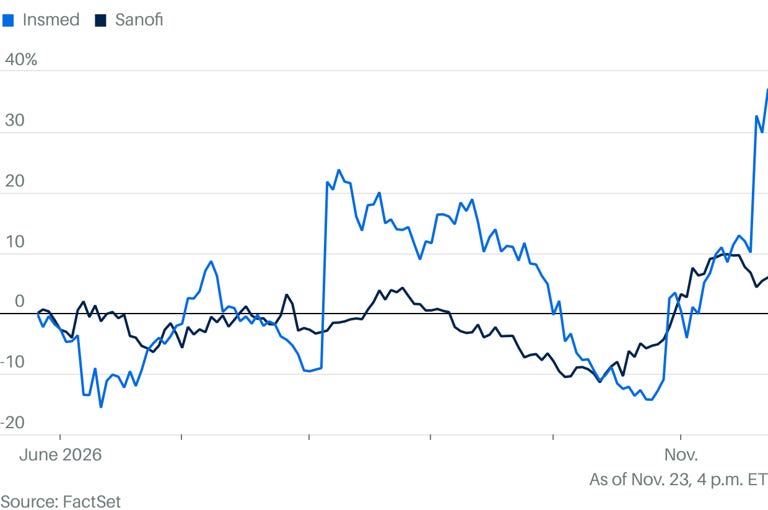
On November 24, 2026, Sanofi announced an agreement to acquire Insmed for $175 per share in cash, valuing the company’s equity at about $41 billion. Insmed’s Brinsupri generated $400.1 million in third-quarter net product revenue and surpassed $1 billion in its first four full quarters on the market for non-cystic fibrosis bronchiectasis. The deal also includes Arikayce and a phase three inhaled treprostinil program. The businesses beside those drugs have different economics. Pulmonary practices might pay to recover specialist capacity and complete referrals, manufacturers can fund patient services and evidence generation, and risk-bearing organizations can buy longitudinal care when they can measure its effect on total spending. The opportunity is to fix a specific clinical handoff with a budget attached. A prevalence estimate and a blockbuster launch are useful context, but neither establishes demand for an independent vendor.
What Sanofi is paying for
Sanofi announced its agreement to buy Insmed on November 24. The offer is one hundred seventy-five dollars per share in cash, or roughly forty-one billion dollars in fully diluted equity value. The companies expect the transaction to close in the first half of two thousand twenty-seven, subject to shareholder and regulatory approvals and other conditions. Insmed has two marketed products, Brinsupri and Arikayce, and a phase three inhaled treprostinil program. The striking part is how much of the commercial evidence arrived in the past year. Brinsupri generated $400.1 million in third-quarter revenue, up 29% sequentially, and surpassed $1 billion in its first four full quarters on the market. Almost all of that quarter’s Brinsupri revenue came from the United States.
There is a useful sanity check on what the buyer is underwriting. Insmed reported about five hundred twenty-four million dollars in third-quarter net product revenue across both drugs. Multiplying that quarter by four yields about two billion one hundred million dollars. Against forty-one billion dollars in announced equity value, the transaction price is roughly twenty times that annualized quarter’s sales. That is crude arithmetic. It uses equity value rather than enterprise value and a single quarter rather than a full-year revenue measure. It still makes clear how much future growth matters. Sanofi’s presentation projects more than ten billion dollars in peak sales from acquired medicines and more than five hundred million dollars in annual cost synergies. Those are management estimates. The purchase price can look very different under slower Brinsupri growth, a narrower Arikayce expansion, a delayed pipeline or a change in what payers are willing to cover.
Insmed separately reported about nine hundred seventeen million dollars in Brinsupri net product revenue in the first nine months of two thousand twenty-six. Sanofi’s roughly one billion ninety million dollar figure through the end of September starts at launch and includes sales in the prior year. Both figures are useful, as long as the periods are kept straight. The filings also identify specialty pharmacies and a specialty distributor as US customers and describe net revenue after estimated rebates, chargebacks and other deductions. Those are booked drug sales. They do not disclose how many prescriptions were rejected, how long patients took to start, what any particular plan paid or how many patients remained on therapy. Those are exactly the questions a company selling services into this market needs to answer before it starts multiplying people by monthly fees.
The services implication is that a new treatment can raise the value of work that previously looked like a nuisance on a clinic’s expense report. Finding the outside CT report, documenting prior exacerbations, getting the patient to a practice that can manage the disease and confirming that a prescription reached the right pharmacy all become worth more attention when clinicians have another useful treatment option. Some of that work will be absorbed by existing practices, specialty pharmacies and manufacturer programs. A standalone company has a chance where those organizations leave a recurring handoff unresolved and the same problem appears at enough sites. The merger supplies evidence of a large drug market. It does not allocate a software budget to anyone.
The gap between a diagnosis and a patient who can be treated
Sanofi’s investor deck estimates that about half a million US adults fall within the broad labeled bronchiectasis population and shows roughly thirty-two thousand treated. There are several different denominators between those numbers. An older US claims study estimated that between three hundred forty thousand and five hundred twenty-two thousand adults received care for bronchiectasis in two thousand thirteen, depending on how the researchers identified cases. Those estimates tell a buyer how sensitive the headcount is to the case definition. They are poor inputs for deciding how many patients a new service can enroll this year. A CT report can describe bronchiectasis in a person whose immediate clinical priorities lie elsewhere. An insurance claim can carry the diagnosis without documenting current disease activity. A patient can meet the label and still have no clinical reason to start a particular drug at that visit.
The clinical evidence puts a useful boundary around the business case. Brinsupri’s US label covers non-cystic fibrosis bronchiectasis in adults and children aged twelve and older. In the pivotal ASPEN trial, adults had CT-confirmed disease and at least two documented pulmonary exacerbations in the prior year. Across about seventeen hundred randomized participants, annualized exacerbations were one point twenty-nine with placebo and about one point zero two and one point zero four with the two brensocatib doses. The relative reduction was around one fifth. The absolute difference was roughly a quarter of an exacerbation per patient-year in that study population. Estimates for severe exacerbations were less precise, with confidence intervals that included no difference. A plan model that counts every avoided exacerbation as an avoided admission can turn solid trial evidence into an entirely fictional hospital budget.
This is where actual patient history matters. A pulmonologist may have an outside scan, a hospital discharge note and a series of outpatient encounters all describing what turns out to be one prolonged episode. A claims-based count might treat the visits as separate exacerbations. Another patient may have been treated outside the local system, leaving the specialist with an incomplete history. A useful product would assemble the evidence, make its provenance visible and let a clinician determine how it applies. It could help distinguish an incomplete record from one that fails to support a referral or benefit request. A diagnosis code, a qualifying trial history and a payer’s coverage criteria serve different purposes. Conflating them introduces errors at every step from population sizing to billing.
There is a second distinction between an indication and a care plan. Bronchiectasis care can involve airway clearance training, microbiology, identifying underlying causes and managing other respiratory disease. A patient who needs follow-up for possible infection should move through that pathway whether or not a branded prescription results. Arikayce, for example, has a limited US indication for certain adults with refractory Mycobacterium avium complex lung disease who have limited or no alternatives and remain culture positive after at least six consecutive months of a multidrug regimen. FDA accepted an application for broader use for priority review, and Sanofi’s transaction presentation lists January twenty-eighth, two thousand twenty-seven as the target action date. The decision and the eventual label, if expanded, are separate events. A vendor can build the ability to track microbiology, referrals and treatment history now while basing its near-term forecast on the existing indication.
Who would pay to fix the referral
A pulmonary group with a long waiting list is a better first buyer than a national data owner with a prevalence slide. The practice manager can tell you how long it takes staff to gather a patient’s outside records, how many new visits start without the required imaging and how often nobody knows whether a referred patient was ever seen. The lung service line can compare those problems with appointment capacity and the cost of hiring another coordinator. An initial service could take referrals from a defined group of primary care and pulmonary sites, obtain records through authorized routes, assemble the relevant history and help schedule the patient with the appropriate team. A case stays open until the receiving practice accepts the referral, asks for something specific or returns a documented disposition. An electronic message marked “sent” is a very inexpensive way to claim delivery.
The clinical responsibility has to be explicit. Staff can collect imaging reports and reconcile prior encounters. The clinician decides which findings require workup and which patients need specialized care. A practice may already have built-in EHR referral queues and central scheduling. An entrant earns a sale by handling cases that those tools repeatedly leave incomplete, especially referrals crossing organizations with limited access to each other’s records. The software should send the disposition back to the referring practice and leave a clear record of staff actions. The contract should make clear who contacts the patient, who owns unresolved cases and who responds when a referral is urgent. Those details are more useful in a proposal than a promise to add a big new clinical dashboard.
The economics can be tested with a small, paid deployment. Suppose a pulmonary network handles eight hundred relevant referrals a year and staff spend an average of half an hour assembling each file. At a fully loaded cost of forty dollars an hour, that is sixteen thousand dollars of annual preparation labor. Even eliminating half the work releases only eight thousand dollars in staff capacity at that rate. A forty-thousand-dollar annual contract would need to earn the rest through something measurable, such as specialist slots put back into service, reduced outsourced expense or measurable improvements in timely care that a funded program already values. If the practice cannot reuse the time or fill the slots, the labor math tells you where to stop. A vendor should not need a heroic assumption about hospitalizations to sell a referral service to a clinic that has never borne hospitalization risk.
A practical distribution route is through groups that manage the workflow for several practices. An independent pulmonary group with multiple locations, an academic program coordinating community referrals or a specialty organization managing a regional network can concentrate volume under one contract. Each can also tell the vendor which patients it has room to see. A health system may prefer to do the work internally once the volume justifies staffing it. A startup can make the service harder to replace by consistently resolving outside records and coordinating handoffs across smaller practices that a single system’s standard workflow does not reach. Give the customer a baseline for time to complete referral and the share of appointments with the necessary records. Improve both and the practice has a reason to keep paying when the drug launch stops being new.
The work that starts after a prescription
A manufacturer’s commercial operations team has a different window into the problem. A prescription can sit with a specialty pharmacy while someone checks benefits, seeks missing documentation, resolves a network issue or learns that the patient cannot afford the amount owed. Sometimes the patient or clinician chooses a different course. Some of these cases are resolvable administrative failures. Others represent appropriate decisions, including a decision to wait. The company worth hiring can distinguish those paths and help get an answer to the patient and prescriber. An aggregate report showing more forms processed will be less useful than a reliable account of where each unresolved referral went, who owns it and what action can legitimately move it along.
A vendor can start with a narrow service for specialty pharmacies or manufacturer patient services teams. Take responsibility for identifying missing evidence on a specified set of referrals, retrieving it from the appropriate practice where authorized and sending back a usable result. A direct manufacturer contract can fund a defined workstream, but it may also expose the vendor to a single brand’s budget and channel choices. Selling through a pharmacy or incumbent services provider trades some margin for existing distribution, data access and operations. In either route, payment terms should correspond to actual services performed and should go through the appropriate compliance review. Clinical choice, authorization decisions and manufacturer-sponsored assistance each have their own rules. The work gets harder when the vendor’s incentive is based on a drug start regardless of how appropriate the start was.
Longitudinal follow-up adds a separate opportunity for a provider or risk-bearing buyer. Brinsupri’s label includes skin and dental or periodontal precautions. Arikayce uses a designated nebulizer system and its label carries a boxed warning for increased respiratory adverse reactions. That is enough to make a generic medication reminder feel rather limited. A care team needs to know who is responsible for educating the patient, where reported symptoms go, how a clinical escalation reaches the prescriber and who follows up if the patient cannot use the equipment. An outside service can provide trained staff and the systems to track those handoffs under an agreed operating protocol. The clinician remains responsible for treatment decisions. Paying for this service makes sense when its staffing and access improve care the buyer already needs to deliver.
There is also an evidence business, though it already has competition. The Bronchiectasis and NTM Research Registry collects longitudinal clinical data with participant permission and supports research and trial recruitment. An entrant would need to explain what gap remains. A reasonable opportunity might be to help community sites contribute verified clinical histories, relate those records to permitted claims data, or collect outcomes consistently outside an academic trial center. The buyers could include a study sponsor, a contract research organization or a provider network that wants to participate in research without hiring a separate chart abstraction team. Price a defined study or data collection service and specify the data rights. Access to a record for one purpose does not make it available for the next. It also helps to explain what result can be reproduced rather than advertise a large number of patients whose outcomes cannot be measured.
What a health plan would actually underwrite
A health plan has to separate the economics of a drug decision from the economics of a care service. A particular treatment can improve a clinical outcome and increase near-term total spending. Both can be true without making either the clinical evidence or the budget analysis wrong. For a plan, the relevant model starts with the incremental net drug cost, likely persistence and the mix of events the treatment plausibly affects. For a separate bronchiectasis care service, the starting point is the incremental cost of the service and what it adds to existing specialist care. It cannot take credit for the drug’s trial result. A manufacturer’s reported revenue is also a poor proxy for what a specific employer or plan pays after its own arrangements. Use the customer’s actual accounting perspective and a horizon consistent with how long it expects to cover the patients.
Suppose a plan has five hundred clinician-confirmed members in a higher-risk group and considers a care service priced at sixty dollars per enrolled member per month. At full-year enrollment for all five hundred, the fee is three hundred sixty thousand dollars. At an illustrative fifteen thousand dollars in attributable net savings per avoided admission, the program would need the equivalent of twenty-four avoided admissions to cover the service fee through admissions alone. That is a break-even calculation, not a prediction of the service’s effect. It excludes other changes in spending and assumes the plan retains the savings. Some programs would increase spending on visits, diagnostics or drugs, which can be appropriate and should still appear in the analysis. A founder can work with the plan to determine which costs count and whether the required effect is even plausible before taking a financial guarantee.
The trial data give another check. Take the roughly quarter-event annual difference in total pulmonary exacerbations observed in ASPEN. The trial population had meaningful recent disease activity, and the severe-event analysis was less conclusive than the primary outcome. An observational comparison between service participants and members who did not enroll can look favorable simply because the groups differ in access or because enrollment occurred near a spike in utilization. A serious buyer would agree in advance how it defines qualifying episodes, handles patients who change coverage, measures emergency and inpatient events and adjusts for baseline severity. Small populations may make a savings guarantee impractical. A pilot can still show whether a program delivers earlier follow-up, faster referral completion or better retention, with a separate design for estimating clinical and cost effects.
Risk-bearing pulmonary networks or health systems can sometimes move sooner than a plan because they can change actual clinical workflows. Their budget also has limits. If a purchaser captures only part of the savings, the service must clear a higher threshold in gross savings to pay for itself. If the company cannot reach the people most likely to benefit, high theoretical savings per participant will not compensate for expensive outreach. Start with a narrowly defined group that has a route into care and enough baseline volume to measure operational effects. Set a cap on the initial exposure for both sides. A plan willing to fund the next cohort after seeing actual data is better evidence than a broad letter of intent with no assumption about who pays once the pilot funds run out.
Where the deal helps a founder and where it hurts
Sanofi’s acquisition could increase budgets for launching and supporting respiratory drugs if it closes and the portfolio performs. It could also concentrate purchasing in a larger organization that can use preferred vendors and negotiate harder. The two forces matter differently depending on where a business sits. An existing program with local relationships and an ability to complete difficult referrals could become more useful as demand expands. A narrow single-brand administrative supplier could find its contract reviewed alongside overlapping suppliers. An investor looking at a vendor should examine contract duration, minimum commitments, the right to work with other sponsors and who controls the core data and relationships. A growing therapeutic market does not guarantee a good renewal for a vendor with one customer and interchangeable labor.
There is a competitive reason to build around the disease rather than one prescription. Boehringer Ingelheim has registered a phase three bronchiectasis trial for another drug in the same general target class. The trial does not establish approval or equivalent results, but it gives a founder another reason to avoid baking one brand’s paperwork into the product architecture. The same patient can need imaging records assembled, airway clearance training arranged or microbiology tracked regardless of which manufacturer gains share. A service that can move between those tasks with the same trusted clinical relationships has more paths to revenue. A service whose only advantage is knowing the current questions on one authorization form can lose its edge when an incumbent updates its template.
For the investor tracking Insmed itself, the cleanest scenarios separate the assets and dates. Underwrite Brinsupri on actual net revenue, on how much the launch depends on an early group of highly motivated practices and on the cost of obtaining broader access. Value an Arikayce label expansion separately from the currently marketed indication. Give the inhaled treprostinil program its own trial, regulatory and launch assumptions. Sanofi’s commercial reach can help distribution. It cannot replace a favorable clinical result or turn management’s peak sales estimate into cash available for debt service. The analogous test for a services acquisition is to remove the largest manufacturer contract from the forecast and ask which practices or plans would still buy the service. A buyer that cannot answer that question may be acquiring a project team with a very large customer.
A founder can start next week with a much smaller calculation. Find a pulmonary practice willing to review a set of incomplete referrals and a specialty pharmacy willing to explain its unresolved cases through authorized channels. Sort the friction by who can fix it and who would pay for the fix. If the practice has available appointment capacity and can verify that the service gets suitable patients into it sooner, sell that result. If the real delay is a coverage decision the vendor cannot influence, narrow the promise or walk away. Sanofi’s price describes what it is willing to pay for Insmed’s drugs, pipeline and growth prospects. The price for a new business beside those drugs starts with the cost of getting one patient from a referral that has stalled to a care plan someone can actually deliver.