Welcome to Healthcare Markets & Technology.
Rigorous analysis of AI, policy, capital, technology, and clinical operations across U.S. healthcare — written for the people who build, invest in, and lead it.
Free subscribers get 2 public articles per week. Upgrade to paid → for the full 7 articles/week, paid podcast episodes, deal breakdowns, and the complete 538-deep-dive archive.
Subscribe or upgrade here →
One thing to bookmark: the searchable Knowledge Base at kb.onhealthcare.tech isn’t in Substack’s menu. Save it now — on mobile, tap share → “Add to Home Screen.”
Reply to any email with questions. I read every one.
— Trey
ABSTRACT
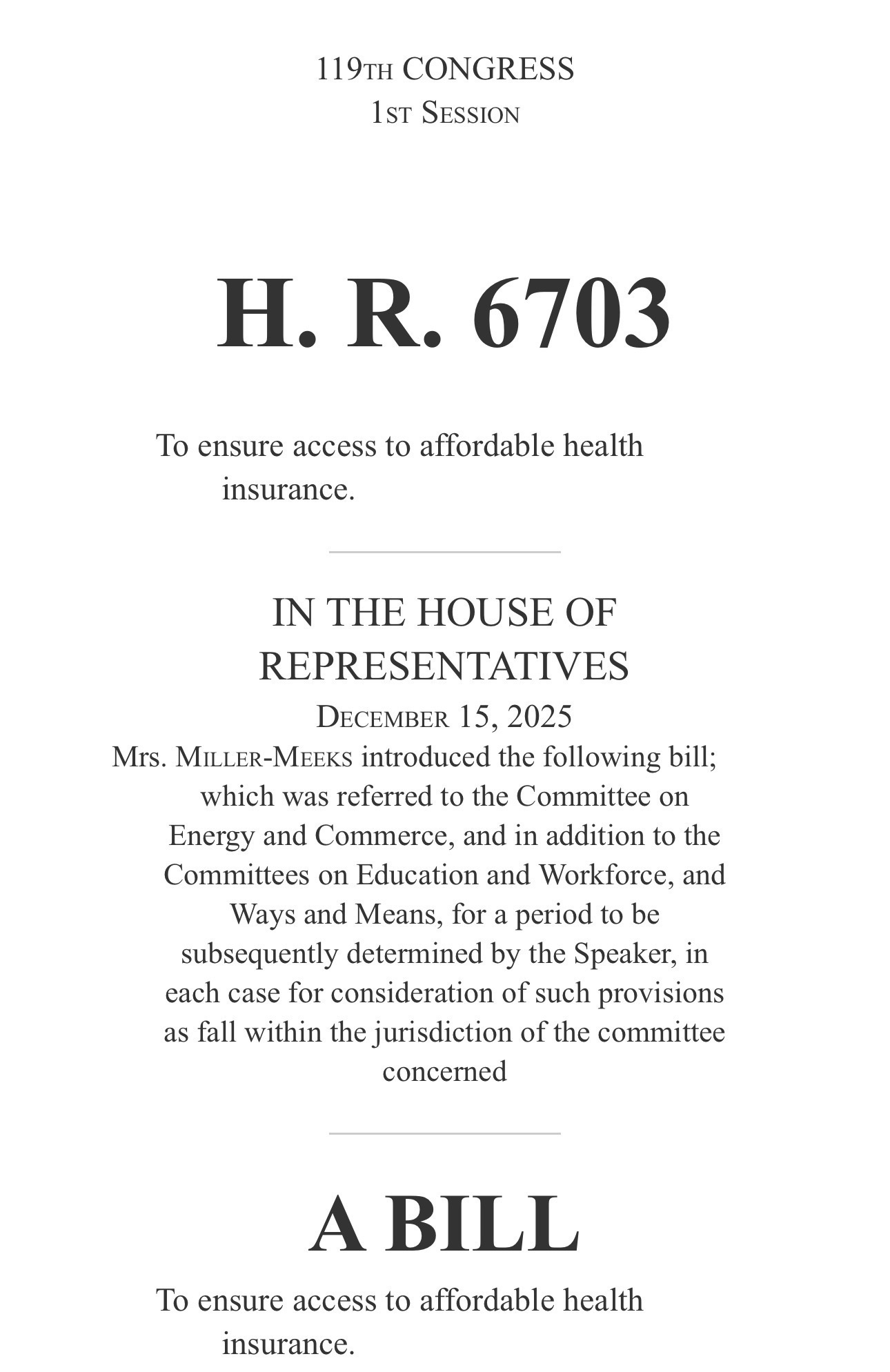
H.R. 6703, the Lower Health Care Premiums for All Americans Act, passed the House on December 17, 2025, creating immediate opportunities in healthcare technology and services despite uncertain Senate prospects. The bill expands Association Health Plans (AHPs), codifies CHOICE arrangements (employer-funded individual coverage), appropriates cost-sharing reduction payments starting in 2027, and mandates extensive pharmacy benefit manager (PBM) transparency. While positioned as an alternative to extending enhanced ACA subsidies, the legislation creates distinct market opportunities in: AHP administration and technology platforms, PBM transparency and analytics software, employer benefits administration tools, health plan comparison and enrollment platforms, and stop-loss insurance infrastructure. This essay analyzes the specific mechanisms of H.R. 6703, identifies five business model opportunities, evaluates competitive dynamics and timing considerations, and provides an investment framework for health tech angels.
TABLE OF CONTENTS
- The Political and Economic Context: Why This Bill Matters Now
- Breaking Down H.R. 6703: What Actually Changes
- Business Model One: Association Health Plan Administration Platforms
- Business Model Two: PBM Transparency and Analytics Software
- Business Model Three: CHOICE Arrangement Infrastructure
- Business Model Four: Health Plan Navigation and Enrollment Tools
- Business Model Five: Stop-Loss Insurance Technology and Underwriting
- Market Dynamics and Competitive Advantages
- Implementation Timeline and Regulatory Risks
- Investment Framework for Early-Stage Opportunities
The Political and Economic Context: Why This Bill Matters Now
The politics around H.R. 6703 are absolutely wild and you need to understand them to grasp why this creates investable opportunities even though the bill probably won’t pass the Senate in its current form. Enhanced ACA subsidies that were put in place during COVID are expiring December 31, 2025, which means roughly 20 million people are about to see their health insurance premiums double starting January 1. This is a massive political problem for Republicans who control both chambers of Congress and the White House, because voters really hate it when their healthcare costs suddenly spike.
House Speaker Mike Johnson refused to extend the subsidies because he views them as wasteful spending that primarily benefits insurance companies rather than consumers. Instead, he rushed H.R. 6703 to the floor as an alternative approach that focuses on what Republicans call structural reforms rather than just throwing more subsidy money at the problem. The bill passed 216-211 in an incredibly tense vote where four moderate Republicans actually signed a discharge petition with Democrats to force a vote on a clean three-year subsidy extension, directly defying their leadership.
The Senate isn’t going to touch this bill before they leave for holiday recess, which means the subsidies will expire and millions of people will face higher premiums in early January. Senate Majority Leader John Thune has been pretty clear that he wants a broader healthcare overhaul rather than piecemeal fixes, and the abortion language in the bill (which prohibits cost-sharing reduction payments to any plan covering abortion) is a complete non-starter for Democrats and probably some Senate Republicans too.
So why does any of this matter for investors if the bill is basically dead on arrival in the Senate? Because the core policy ideas in H.R. 6703 are actually pretty durable Republican healthcare priorities that have been kicking around since the first attempt to repeal Obamacare in 2017. Association health plans, PBM transparency, cost-sharing reduction payments, and employer-directed coverage arrangements all have bipartisan support in various forms. The specific package might not pass, but pieces of it will almost certainly show up in whatever compromise eventually emerges, whether that’s in January when Congress comes back or later in 2026 as part of broader healthcare legislation.
The Congressional Budget Office scored the bill as reducing the deficit by $35.6 billion over ten years while lowering silver plan premiums by 11% starting in 2027. The premium reduction comes mostly from appropriating cost-sharing reduction payments, which would end the practice of silver loading where insurers inflated premiums to compensate for the lack of CSR funding. CBO also estimates the bill would reduce the number of insured people by about 100,000 per year, which Republicans argue is a feature not a bug because it means less wasteful government spending.
What makes this interesting from an investment perspective is that multiple provisions of the bill create genuine friction points in the healthcare system that technology can address. Association health plans have been tried before during the first Trump administration but got blocked in court, and the infrastructure to make them work efficiently never really developed. PBM transparency requirements create a massive data aggregation and analysis opportunity. CHOICE arrangements (basically a rebranding of ICHRAs) need better administration tools. Each of these represents a wedge where startups can build products that solve real problems regardless of whether this specific bill passes.
Breaking Down H.R. 6703: What Actually Changes
The bill has four main components and understanding the mechanics of each is critical to identifying where the business opportunities are. Section 101 expands Association Health Plans by amending ERISA to explicitly allow groups or associations of employers from different industries to band together and offer health insurance to their employees as if they were a single large employer. The key changes from previous attempts are that associations must have existed for at least two years before offering coverage (to prevent fly-by-night operations), must be controlled by employer members rather than insurance companies, and can include self-employed individuals with no employees.
The way AHPs work is they let small businesses pool together to negotiate with insurers as if they were a large employer, which theoretically gets them better rates because insurers like the predictability of large groups. The challenge historically has been adverse selection where healthier small businesses join AHPs while sicker ones stay in the individual or small group market, which causes premiums in the remaining pools to spike. H.R. 6703 tries to address this by requiring AHPs to follow modified community rating rules and prohibiting medical underwriting at the employer level.
Section 102 deals with pharmacy benefit managers and requires them to provide extensive disclosure to plan sponsors about drug costs, rebates, spread pricing, formulary decisions, and utilization management. Specifically, PBMs would need to report within 18 months of enactment the total amount of rebates and fees received from drug manufacturers, the percentage of those rebates passed through to plan sponsors, any spread pricing arrangements where the PBM charges the plan sponsor more than they pay the pharmacy, and detailed information about formulary placement decisions including any payments received from manufacturers.
The PBM stuff is probably the most bipartisan piece of the bill because everyone across the political spectrum hates PBMs and thinks they’re driving up drug costs through opaque pricing practices. The challenge is that transparency requirements alone don’t necessarily change PBM behavior if plan sponsors don’t have good alternatives or if the disclosed information is too complex to be actionable. There’s a huge opportunity for software that aggregates PBM performance data and actually tells employers whether they’re getting ripped off.
Section 103 codifies and expands CHOICE arrangements, which is a rebranding of Individual Coverage Health Reimbursement Arrangements (ICHRAs). The way this works is instead of an employer offering a group health plan, they give employees a defined contribution amount that employees use to purchase individual coverage on the ACA marketplace or directly from insurers. The bill clarifies that employees can pay premiums pre-tax from these contributions and creates a tax credit for small employers who set up CHOICE arrangements.
This is actually a pretty big deal because it shifts the health insurance model for small employers from defined benefit (we offer you this specific plan) to defined contribution (here’s money, go buy coverage yourself). Advocates argue this gives employees more choice and portability, critics say it exposes employees to more risk and complexity. Either way, there’s a massive administrative burden in helping employees navigate plan options and enrollment that creates clear software opportunities.
Section 202 appropriates funding for cost-sharing reduction payments starting in plan year 2027, but only for plans that don’t cover abortion except in cases of rape, incest, or life endangerment. CSR payments reimburse insurers for reducing deductibles, copays, and coinsurance for low-income ACA enrollees (100-250% of federal poverty level). The Trump administration stopped making these payments in 2017, which led insurers to engage in silver loading where they raised silver plan premiums to compensate, which paradoxically increased federal subsidy spending because subsidies are based on benchmark silver plan costs.
Appropriating CSRs would reverse silver loading and according to CBO would lower silver plan premiums by 11-12%. The abortion restriction is the poison pill that makes this section unpassable in the Senate, but the core idea of appropriating CSRs has pretty broad support including from many Democrats who opposed the Trump administration’s decision to stop the payments in the first place. The restriction could easily get stripped out in any eventual compromise.
Business Model One: Association Health Plan Administration Platforms
The most obvious opportunity created by H.R. 6703 is building the infrastructure layer that lets associations actually form and administer health plans. Right now there’s basically no good software for this because AHPs have been in legal limbo since the Trump-era expansion got struck down in court. If the bill passes or if similar AHP expansion happens through other legislation or regulatory action, you’re going to see thousands of associations trying to figure out how to set up compliant health plans.
The core problem is that running a group health plan requires a ton of administrative work including eligibility verification, premium billing and collection, COBRA administration, claims adjudication if it’s self-insured, compliance with ERISA and state insurance regulations, and ongoing reporting to DOL and other regulators. Large employers have entire HR departments or third-party administrators to handle this, but associations made up of tiny employers don’t have that infrastructure and can’t afford to build it from scratch.
The business model is SaaS for association health plan administration that handles eligibility, billing, compliance, and reporting in one platform. You sell it to associations at something like $5-10 per member per month which sounds expensive but is way cheaper than hiring staff or engaging a traditional TPA. An association with 2,000 covered lives would pay $120k-240k annually which is a rounding error compared to total healthcare costs but solves a massive headache.
The unit economics work because the marginal cost of adding new associations is low once you’ve built the core platform. The hard part is building the compliance engine that keeps track of all the ERISA requirements and state insurance regulations that apply to AHPs, because getting this wrong creates enormous liability for the associations. You need people who really understand ERISA and employee benefits law, not just engineers who can build a billing system.
The market size depends entirely on how many associations actually form AHPs if the legislation passes. CBO doesn’t give specific estimates on AHP uptake but based on the overall coverage impacts (100k fewer insured) it’s probably not massive in year one. The Paragon Health Institute estimates that AHPs could cover 1-2 million people eventually, which at $10 PMPM would be a $120-240 million annual market. That’s decent but not venture-scale unless you can expand into related services.
The expansion opportunity is probably more valuable than the core administration revenue. Once you have associations using your platform, you can offer ancillary services like benefits consulting, stop-loss insurance placement, wellness programs, and potentially even operating as the TPA yourself for self-insured AHPs. The platform becomes the operating system for small business health benefits, which is a much bigger vision than just AHP administration software.
Competitive dynamics favor whoever moves first and builds relationships with the most likely associations to form AHPs. These are probably industry trade groups, chamber of commerce affiliates, professional associations, and franchise systems. The key is identifying which associations already have the organizational capacity and membership density to make an AHP viable, rather than trying to start from scratch recruiting individual small businesses.
The main risk is that AHPs don’t actually take off because of adverse selection problems, regulatory barriers at the state level, or lack of insurer participation. Multiple states have laws that would make it difficult for AHPs to operate even if federal law changes, and insurers might not want to participate if they think the risk pool will be unhealthy. That suggests you want a business model that works even if AHP volume is lower than expected, maybe by also serving traditional group plans or PEOs.
Business Model Two: PBM Transparency and Analytics Software
The PBM transparency requirements in Section 102 create an immediate opportunity for software that helps employers actually make sense of all the data PBMs will be required to disclose. Right now most employers have basically no idea whether their PBM is delivering value or extracting rents, because the pricing is so opaque and there’s no good benchmarking data. The disclosure requirements will generate tons of data but without tools to analyze it, employers still won’t know what to do.
The core product is analytics software that ingests PBM contract terms and performance data, compares it to benchmarks from other employers, and identifies opportunities to negotiate better terms or switch PBMs. Think of it like a performance monitoring tool for PBM contracts that tells you in plain English whether you’re getting screwed and by how much. The interface needs to be super simple because HR directors at small companies aren’t pharmacy benefits experts.
The business model is selling this as SaaS to employers, brokers, and benefits consultants. Pricing would probably be based on covered lives, something like $2-5 PMPM which for a 500-employee company works out to $18k-45k annually if you assume two covered lives per employee. That’s expensive relative to typical SaaS but cheap relative to potential savings if you identify that your PBM is pocketing an extra $100 per member per year in spread pricing.
What makes this particularly valuable is that PBM contracts are typically 3-5 years and the switching costs are high, so there’s a narrow window during contract negotiations where employers actually have leverage. A tool that arms them with data during that window is worth a lot because even a small improvement in contract terms compounds over the life of the contract. If you save an employer $50 PMPM on their pharmacy spend, that’s $600k annually for a 1,000-person company.
The challenge is getting access to good benchmark data so you can tell employers whether their contract terms are competitive. In the early days you’d probably need to manually collect this from public sources, RFP responses, and your own customer data. Over time as you sign up more employers you get a proprietary dataset that becomes a huge competitive moat. The companies with the most data can provide the best benchmarks, which attracts more customers, which gets you more data in a virtuous cycle.
The other piece is you probably need to integrate with the major PBMs (CVS Caremark, Express Scripts, OptumRx) to automatically ingest performance data rather than making employers manually upload reports. This is actually in the PBMs’ interest if transparency requirements pass because it reduces their administrative burden. You become the standardized interface layer that employers use to monitor all their PBMs regardless of which one they work with.
Adjacent opportunities include connecting employers with alternative PBM models like pass-through pricing or transparent spread arrangements, offering RFP management services when employers want to switch PBMs, and potentially building marketplace features where PBMs can bid on employer contracts. Each of these adds revenue streams beyond the core analytics product and helps lock in customers by becoming their end-to-end PBM management solution.
The timing on this is actually pretty good because even if H.R. 6703 doesn’t pass, PBM transparency is one of the few truly bipartisan healthcare issues. Multiple states have already passed transparency laws, and there are several other federal bills floating around with PBM reform provisions. The trend is clearly toward more disclosure regardless of this specific legislation, which means the market opportunity exists even if this bill dies.
Business Model Three: CHOICE Arrangement Infrastructure
CHOICE arrangements (the rebranded ICHRAs) create a massive opportunity in employer benefits administration because they shift complexity from the employer to individual employees who now need to navigate shopping for and enrolling in individual health insurance. Most employees have no idea how to do this, and employers offering CHOICE arrangements need tools to help their employees through the process or they’ll face massive confusion and dissatisfaction.
The way CHOICE is supposed to work is the employer determines a contribution amount based on employee class (you can tier by age and family size), employees take that money and shop for coverage, the employer reimburses premium payments on a monthly basis, and everyone files the appropriate tax forms. In practice it’s way more complicated because employees need to understand plan options, estimate their healthcare utilization, compare dozens of plans with different networks and cost-sharing, and enroll during the right window.
The core product is an end-to-end platform that handles the employer side (contribution management, reimbursement processing, compliance documentation) and the employee side (decision support, plan comparison, enrollment assistance). For employers it needs to integrate with payroll systems and generate required tax forms. For employees it needs to make plan shopping not completely overwhelming, which is really hard because there are like 50 plans in most markets with different premiums, deductibles, networks, and formularies.
The business model is selling to employers on a PEPM basis, probably $8-15 per employee per month which sounds expensive but is way cheaper than the administrative cost of offering a traditional group plan. A 100-person company would pay $12k-18k annually which is less than they’d spend on broker commissions and HR time for traditional group coverage. The value proposition to employers is that CHOICE arrangements let them offer competitive benefits at a fixed, predictable cost without taking on the risk of a self-insured plan.
Unit economics are great once you have scale because the marginal cost of adding new employers is low. The hard part is the upfront investment in building really good plan comparison tools that actually help employees make informed decisions. Most existing individual health insurance shopping tools are terrible and just show you a list of plans sorted by premium, which is useless because it doesn’t account for how much you’ll actually spend based on your utilization.
The market size is potentially huge if CHOICE arrangements take off among small employers. Right now ICHRAs cover maybe 500k people total because they’re relatively new and haven’t been widely adopted. The tax credit in H.R. 6703 would make them more attractive financially, and codifying them into statute rather than just having them be a regulatory creation would give employers more confidence. If 10% of small employers (under 50 employees) switched to CHOICE arrangements over five years, you’re talking about 5-6 million covered lives.
The competitive landscape has a few existing players like Take Command Health and Remodel Health who’ve been building ICHRA administration tools, but the market is still really early and there’s room for multiple winners especially if the market expands significantly. The key differentiator is having the best employee experience because if employees hate using CHOICE and complain to their employers, employers will switch providers or go back to traditional group coverage.
The expansion opportunity is becoming the full-stack individual health insurance distribution platform. You start with CHOICE administration but then add direct-to-consumer plan sales, Medicare enrollment services, ancillary product sales (dental, vision, life insurance), and potentially even building your own insurance products or network arrangements. The platform becomes how individuals interact with health insurance, which is an enormous market if you can build a brand that people trust.
The main risk is that CHOICE arrangements don’t achieve broad adoption because employees prefer the simplicity of employer group coverage even if it’s more expensive or less flexible. There’s also regulatory risk that states could restrict CHOICE arrangements or that future federal policy changes could make them less attractive. You’d want to make sure the business model works even with slower adoption than the most optimistic projections.
Business Model Four: Health Plan Navigation and Enrollment Tools
Whether or not CHOICE arrangements take off, there’s a broader opportunity in building better consumer-facing tools for health insurance shopping and enrollment. The ACA marketplaces have been around for over a decade and the shopping experience still mostly sucks. With 20 million people potentially facing much higher premiums because of expiring subsidies, there’s going to be massive churn and people desperately trying to figure out how to find affordable coverage.
The core problem is that comparing health insurance plans requires understanding concepts like deductibles, coinsurance, out-of-pocket maximums, and provider networks, and then estimating your own healthcare utilization to figure out which plan will actually be cheapest for you. Most people have no idea how to do this and just pick based on premium, which often leads to terrible outcomes when they actually need care and discover their plan has a $8,000 deductible.
The product is decision support software that asks consumers simple questions about their healthcare needs (what medications do you take, what doctors do you see, are you planning any procedures), pulls in plan data from the marketplaces or directly from insurers, and recommends specific plans with an explanation of expected total costs. The key is making it genuinely easy to use without requiring health insurance expertise, which means the underlying logic needs to be really sophisticated even though the interface is simple.
The business model is probably lead generation where you get paid by insurance brokers or directly by insurers for qualified enrollments. Typical broker commissions on individual health plans are around $15-30 per month for the first year and $5-10 for renewals, so if you can drive enrollments you can make decent money. Alternative model is charging consumers directly for the decision support as a subscription or one-time fee, but that’s a harder sell when there are free broker services available.
What makes this tricky is you need to be genuinely unbiased in your plan recommendations or consumers will catch on and stop trusting you. If insurers or brokers are paying you, there’s always going to be suspicion that you’re recommending plans that maximize your revenue rather than what’s actually best for the consumer. The way to thread this needle is being very transparent about how you make money and building a reputation for honest recommendations even when they’re not the most lucrative for you.
The market timing is actually pretty good right now because of the chaos around expiring subsidies. Millions of people are going to be looking for cheaper plans in January and February when they get their new premium notices, which creates a surge of demand for tools that help them navigate options. If you can capture even a small percentage of that traffic and convert it to enrollments, you can bootstrap significant revenue pretty quickly.
The competitive landscape has some existing players like Policygenius and eHealth but the market is nowhere near saturated especially if you focus on specific underserved segments. For example, people transitioning off Medicaid or CHIP, people aging into Medicare, people who’ve been on employer coverage and are buying individual for the first time. Each of these has unique needs and most existing tools don’t serve them well.
The expansion path is becoming a full-stack insurance marketplace that sells not just health insurance but also dental, vision, life, disability, and property and casualty. The consumer relationship is the valuable asset, and once you have someone trusting you for health insurance recommendations you can cross-sell other products. This is the Oscar Health strategy of owning the consumer relationship and then building or partnering for the underlying insurance products.
The risk is that insurance distribution is a pretty low-margin business and the big incumbents like eHealth have struggled to be profitable. Consumers are also really price-sensitive and will comparison shop across multiple sites, which makes it hard to capture value. You probably need some differentiation beyond just a better comparison tool, whether that’s exclusive plan offerings, unique member services, or integration with other parts of the healthcare experience.
Business Model Five: Stop-Loss Insurance Technology and Underwriting
This one is a bit more niche but H.R. 6703 explicitly clarifies that stop-loss insurance is not health insurance under federal law, which removes regulatory ambiguity and should make it easier for employers and associations to self-insure with stop-loss protection. Stop-loss is basically reinsurance where the insurance company covers claims above a certain threshold (the attachment point), protecting self-insured employers from catastrophic losses.
The way self-insurance works for health benefits is the employer pays claims directly rather than paying premiums to an insurance company, which lets them keep the savings if claims are lower than expected but exposes them to risk if claims are higher. Stop-loss insurance limits that risk by covering any individual claim above the specific attachment point (like $50k) and total claims above the aggregate attachment point (like 120% of expected claims).
Small employers and associations have historically been hesitant to self-insure because of the perceived risk and complexity, but if stop-loss is cheaper or more widely available because of regulatory clarity from H.R. 6703, you could see more movement toward self-insurance. This creates opportunities in the technology and services that make self-insurance viable for smaller groups.
The core product is software for managing self-insured health plans including claims processing, stop-loss policy administration, cash flow forecasting, and compliance reporting. This is traditionally the domain of third-party administrators (TPAs) but there’s room for technology-forward approaches that use better data and automation to reduce costs and improve the employer experience. You sell it as SaaS to employers or TPAs at something like $3-5 PMPM.
What makes this particularly interesting is the underwriting side where there’s potential to use better data and models to price stop-loss insurance more accurately. Traditional stop-loss underwriting relies heavily on historical claims data and crude demographic factors, but there’s opportunity to incorporate clinical data, prescription claims, social determinants, and other signals to predict which groups will have high-cost claimants. Better underwriting lets you offer lower prices to good risks while still maintaining profitability.
The business model on the underwriting side would be actually becoming a stop-loss carrier or MGA rather than just selling software to existing carriers. This requires significant capital and insurance licensing but the margins are much better than software if you can underwrite profitably. You start by getting reinsurance to back your initial policies until you have enough data to prove your models work, then potentially keep more risk over time.
The market size is tied to how much growth there is in self-insurance among small groups. Right now the self-insured market is about 65% of covered workers but that’s heavily skewed toward large employers. If H.R. 6703 or similar policy changes make it viable for groups under 100 employees to self-insure, you could see significant expansion. Even capturing 1% of the small group market would be hundreds of thousands of covered lives.
Competitive dynamics favor companies with deep expertise in health insurance actuarial work and stop-loss underwriting. This is not an area where a bunch of generalist engineers can just build a better product without domain knowledge. You need actuaries who understand how to model health risk and underwriters who know what they’re looking at when they review a group’s claims history. The technology is important but it’s in service of better underwriting rather than being the whole story.
The expansion opportunity is potentially building a full-stack solution for self-insured employers that includes not just stop-loss but also the TPA services, network access, care management, and other components they need. You become a one-stop shop for self-insurance, which is a much stickier and higher-value relationship than just selling software or stop-loss policies separately.
Market Dynamics and Competitive Advantages
Across all five business models, timing and regulatory risk are the dominant considerations for investors. H.R. 6703 passed the House but faces very long odds in the Senate, and even if something similar eventually passes, implementation timelines mean the full market opportunities won’t materialize until 2026 or 2027. That’s actually fine for venture timelines because it takes years to build products and get customer traction anyway, but it means you can’t underwrite investments based on immediate revenue.
The companies that will win are the ones building now in anticipation of regulatory changes rather than waiting to see what happens. There’s probably a 12-18 month window where you can build product, recruit early customers, and establish market position before the opportunities become obvious to everyone. Once a bill like this passes or looks likely to pass, you’ll see a rush of capital into the space and competition will intensify quickly.
Competitive moats in healthcare are typically regulatory complexity, customer switching costs, and data network effects rather than pure technology advantages. The association health plan administration business has regulatory moat because you need deep ERISA expertise. The PBM analytics business has data moat because benchmark quality improves with scale. The CHOICE arrangement business has switching cost moat because employers don’t want to change benefits platforms mid-year. Stop-loss underwriting has capital and actuarial expertise moat.
Distribution is probably the hardest problem across all these opportunities. Most small employers work with insurance brokers for their benefits decisions, and brokers are notoriously resistant to technology that threatens their commissions or changes how they do business. You either need to work through brokers (which means lower margins but faster distribution) or go direct to employers (which means higher margins but slower sales cycles and more customer education required).
The smartest approach is probably starting with a narrow wedge product that solves an immediate pain point and can get adopted quickly, then expanding from there. For example, start with PBM analytics as a point solution that brokers can white-label and offer to their clients, then expand into full benefits administration once you have the relationships. Or start with CHOICE administration for companies already offering ICHRAs, then expand to helping traditional group plan sponsors consider switching to CHOICE.
Platform risk is real in the healthcare benefits space because so much activity runs through a few large intermediaries like brokers, TPAs, and benefits administration platforms. If you’re building software that depends on integrations with these players, you’re vulnerable to them deciding to compete with you or cut off your access. The mitigation is either being so clearly better that they have to work with you, or building direct relationships with end customers so you don’t need the intermediaries.
Implementation p and Regulatory Risks
Even in the most optimistic scenario where the Senate passes something similar to H.R. 6703 and it gets signed into law in early 2026, most provisions wouldn’t take effect immediately. Association health plans would need at least two years after enactment to get stood up based on the bill’s requirements. PBM transparency reporting wouldn’t start until 18 months after enactment. Cost-sharing reduction payments don’t start until plan year 2027. CHOICE arrangements could happen faster but still require rulemaking and plan design.
What this means practically is you’re looking at 2027-2028 before these markets are really functional at scale. That actually maps pretty well to venture timelines if you’re investing in 2025-2026, because the companies would use their first 18-24 months to build product and get early traction with design partners, then scale in years 3-4 as the regulatory environment fully takes effect and the markets mature. The question is whether you can identify the right teams and opportunities before it becomes obvious to everyone.
The regulatory risks are substantial and cut both ways. On one hand, many provisions of H.R. 6703 could end up in future legislation even if this specific bill doesn’t pass because they’re longstanding Republican priorities with some bipartisan support. PBM transparency in particular seems likely to happen in some form regardless. On the other hand, the political dynamics around ACA subsidies and healthcare reform generally are so toxic that major legislation might be impossible until after the 2026 midterms.
State-level regulatory risk is probably underappreciated by most investors looking at these opportunities. Even if federal law changes to allow association health plans or clarify stop-loss treatment, states have significant regulatory authority over insurance and could make it difficult to operate in their markets. California and New York in particular have been hostile to association health plans in the past and would likely remain so even with new federal legislation. Any business model needs to work even if some large states don’t participate.
The implementation question is also whether there will be enough insurance carrier participation to make these markets viable. Association health plans need insurers willing to underwrite them, CHOICE arrangements need robust individual market offerings, PBM transparency needs PBMs to actually provide data in usable formats. If carriers and PBMs resist or slow-roll implementation, the market opportunities could be significantly smaller than the legislation contemplates.
My best guess on probability-weighted outcomes is maybe 40% chance that something substantively similar to H.R. 6703 passes in the next 18 months, 70% chance that PBM transparency provisions specifically become law in some form, 30% chance that association health plan expansion happens, and 50% chance that CHOICE arrangements get codified with some kind of tax incentive. These are gut estimates not rigorous forecasting, but they give you a sense of which pieces are most likely to create actual markets.
Investment Framework for Early-Stage Opportunities
For angel investors evaluating opportunities in this space, the key questions are about team composition, regulatory strategy, customer development, and capital efficiency. Does the founding team have actual expertise in health insurance, employee benefits, ERISA compliance, or insurance underwriting? This is not a space where pure consumer tech folks can just parachute in and figure it out, you really need domain knowledge to navigate the complexity.
On regulatory strategy, has the team thought through what happens if H.R. 6703 doesn’t pass versus if it does? Do they have a viable business under current law that would just be accelerated by new legislation, or are they entirely dependent on regulatory change? The best companies are building toward an opportunity that already exists in some form but would dramatically expand with supportive policy changes.
Customer development questions are whether the team has real relationships with potential customers and understands their buying process. Who specifically would buy this product, what’s their budget authority, how long are sales cycles, what compliance or procurement requirements do they have? Saying you’ll sell to small businesses or brokers is not a go-to-market strategy, you need specifics on which types of companies, what size, what triggers a buying decision.
Capital efficiency matters because these are not software businesses where you can scale to $100M ARR on $10M of venture funding. Healthcare businesses typically require more capital because of longer sales cycles, regulatory overhead, and the need for operational infrastructure beyond just software. You want teams that are realistic about how much capital they’ll need to get to breakeven and have a plan for achieving customer economics that actually work.
The valuation discipline is tough right now because on one hand these are super early opportunities where you’re investing before the market really exists, but on other hand healthcare angels have been burned a lot by companies that promised regulatory tailwinds would create huge markets but never materialized. I’d probably want to see $3-5M pre-money valuations for pre-product companies with great teams in this space, $8-12M for companies with product and early customers, not the crazy $20-30M seed rounds you see in consumer AI.
The portfolio construction approach that makes sense is taking small positions in multiple companies attacking different aspects of the opportunity. Write $25-50k checks into four or five teams going after association health plans, PBM transparency, CHOICE administration, enrollment tools, and stop-loss tech. They’re not competing directly with each other and there’s room for multiple winners, but you’re diversifying regulatory risk across different provisions that have different probabilities of becoming law.
Due diligence should focus heavily on regulatory feasibility and competitive positioning. Get lawyers who specialize in ERISA and health insurance to review whether the proposed business model actually works under current and proposed regulations. Talk to potential customers about whether they’d actually buy this product and what they’d pay. Check whether there are incumbents who could easily replicate the offering once they decide it’s a priority. This is not a winner-take-all market in most cases, so barriers to entry really matter.
The exit question is probably acquisition by insurance carriers, TPAs, benefits administration platforms, or possibly PE-backed rollups rather than IPO. None of these business models are likely to scale to the multi-billion dollar valuations that justify going public, but they could definitely build to $50-100M ARR businesses that are attractive acquisition targets for strategics looking to expand their capabilities. You’re underwriting to 5-10x MOIC in 7-10 years through M&A, not 50x through IPO.
The contrarian take is that the best opportunities might actually be in the businesses that work regardless of whether H.R. 6703 passes because they’re solving problems that exist under current law. PBM transparency tools, health plan navigation, and benefits administration are all viable even without new legislation. The regulatory changes would be jet fuel but not strictly necessary for the business to work. Those might actually be better risk-adjusted investments than businesses that are entirely dependent on new policy.
Overall I think this is a fascinating moment where legislative chaos is creating real market opportunities for health tech companies that can execute quickly and navigate regulatory complexity. The politics are absolutely insane with Republicans fighting each other over whether to extend ACA subsidies while 20 million people face premium shocks, but underneath all that noise there are genuine structural opportunities in association health plans, PBM transparency, and employer benefits administration. The teams that build now while everyone else is distracted by the subsidy fight will be positioned to capture significant value when the dust settles and new markets open up.