
🎧 Part I (free podcast)

🎧 Part II (paid podcast)
Abstract
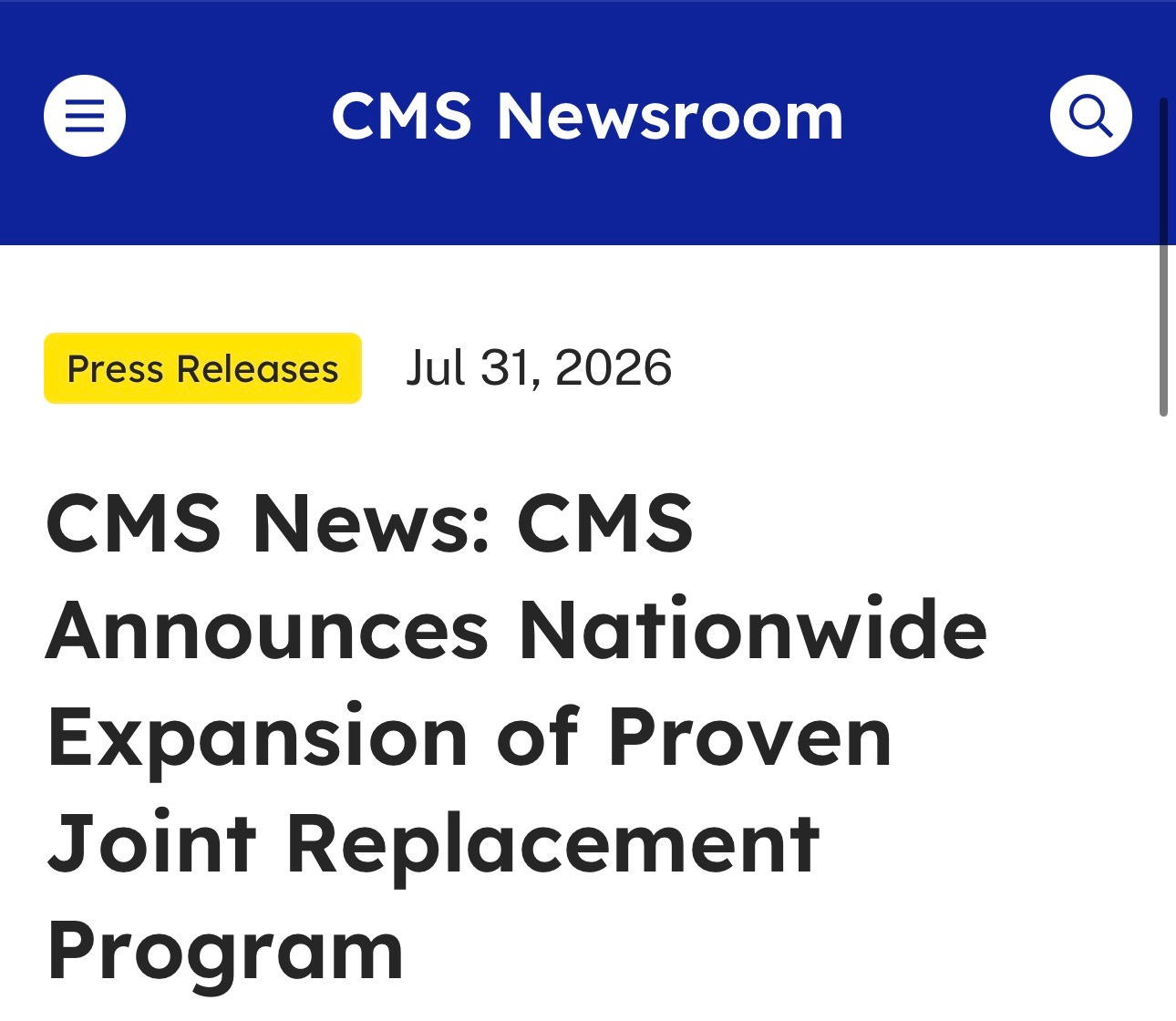
- CMS finalized the Comprehensive Care for Joint Replacement Expanded (CJR-X) Model on July 31, 2026, w/ a go-live of Jan 1, 2028.
- Largest mandatory episode-based payment expansion in Medicare history, roping in ~2,000+ non-exempt acute care hospitals.
- 90-day episodes covering hip, knee, and ankle replacements, w/ two-sided risk, regional target pricing, and 29 risk adjusters.
- Baseline 2% discount factor, modulated by a Composite Quality Score (CQS) that can drop it to 1% or 0% (or DQ a hospital entirely from reconciliation).
- 20% stop-loss/stop-gain for most, 5% for rural + safety-net.
- Gainsharing w/ surgeons + post-acute providers explicitly permitted under an AKS safe harbor.
- CMS projects ~$725M in net savings over 5 yrs; $128M yr one.
- TKA + THA volumes: 1.6M in 2022 → ~2.8M by 2040. Market: $11.13B (2025) → $16.87B (2035).
- Opportunity zones: episode analytics, post-acute network mgmt, gainsharing SaaS, ortho-specific RPM, PROM capture tooling.
- The tl;dr: hospitals now have a regulatory gun to their heads to control 90 days of ortho spend, and they mostly don’t have the infrastructure. That’s the wedge.
Table of Contents
One. Why This Rule Matters More Than the Average CMS Drop
Two. The Mechanics: What a 90-Day Episode Actually Looks Like
Three. Target Pricing, the Discount Factor, and Why Quality Scores Are the Whole Ballgame
Four. Stop-Loss, Gainsharing, and the Surgeon Alignment Problem
Five. Sizing the Prize: Volumes, Dollars, and Where the Fat Is
Six. Episode Analytics: The Boring Layer That Prints Money
Seven. Post-Acute Network Mgmt: Where 40 Cents of Every Episode Dollar Goes
Eight. Gainsharing Software and the Compliance Moat
Nine. Remote Patient Monitoring, But Actually Useful This Time
Ten. PROMs: The Unsexy Data Play That Gates Reconciliation
Eleven. Risks, Landmines, and Reasons the Whole Thing Could Wobble
Twelve. Closing Thoughts for Operators and Investors
Why This Rule Matters More Than the Average CMS Drop
Every yr CMS drops a stack of rules that nobody outside of a handful of DC policy shops actually reads. Most of them are noise. This one isn’t. On July 31, 2026, CMS finalized CJR-X as part of the FY2027 IPPS Final Rule, and unlike the voluntary alphabet soup of BPCI-A, ACO REACH, and the rest, this one is mandatory for basically every non-exempt acute care hospital in the country. When something goes from voluntary to mandatory, the buyer psychology shifts overnight. Hospitals stop asking whether they should invest in the infrastructure and start asking how fast they can stand it up before Jan 1, 2028.
For context, the original CJR model that ran from 2016 onward covered about 465 hospitals in 67 metro areas. CJR-X pulls in more than 2,000. That is roughly a fourfold expansion of the participant base, plus a lengthening of the episode window from what TEAM tested at 30 days to a full 90 days post-discharge. So the surface area of financial risk that hospitals now own is dramatically larger, and the number of orgs that have to solve for it just multiplied. If you’re an operator or investor in the value-based care tooling space, this is the kind of demand catalyst you build a thesis around. Regulatory-forced adoption curves are the cleanest ones there are, and they don’t come around often.
The other thing worth flagging up top is that CMS is basically telegraphing where the rest of Medicare payment reform is heading. Joint replacement is the test bed bc it’s high volume, relatively standardized, and has clean outcomes measures. If CJR-X works, the same architecture (regional target pricing, quality-modulated discount, 90-day episodes, mandatory participation) gets copy-pasted onto cardiac, spine, oncology, and a bunch of other service lines over the back half of the decade. So the tooling built for CJR-X isn’t a one-trick pony. It’s a beachhead.
The Mechanics: What a 90-Day Episode Actually Looks Like
Here’s the play-by-play. A patient shows up at a participating hospital and gets a hip, knee, or ankle replacement, either inpatient or outpatient. The moment that anchor procedure happens, the clock starts on a 90-day episode. For those 90 days, the hospital is on the hook for every Medicare Part A and Part B dollar that gets spent on anything related to that patient’s recovery. That means the surgery itself, the anesthesia, the implant, the hospital stay if it’s inpatient, the SNF stay if the patient gets discharged to one, the home health visits, the outpatient PT, and any readmission that happens to be related.
Ninety days is a long time in ortho recovery. Most of the surgical cost is front-loaded in the first few days, but the post-acute tail is where the money hemorrhages. A patient who gets discharged home w/ home health and walks into outpatient PT looks financially very different from a patient who ends up in a SNF for three weeks and then gets readmitted for a wound infection. Same DRG, wildly different episode economics. This is why the 90-day window matters so much more than the 30-day TEAM window. Thirty days barely captures the SNF stay. Ninety days captures the whole recovery arc, including the readmissions that tend to cluster in the 45-to-75 day range.
The episodes are risk-adjusted using 29 distinct adjusters, which is a serious upgrade from the original CJR model’s clinical severity buckets. This matters bc it means hospitals serving sicker, more complex Medicare pops aren’t getting hosed on their targets. But it also means that accurately modeling your own case mix against the regional benchmark is now a much more technical exercise than it used to be. If you’re a hospital finance team trying to do this in Excel, good luck.
Target Pricing, the Discount Factor, and Why Quality Scores Are the Whole Ballgame
Here’s where the finance nerds start paying attention. CMS builds regional target prices using three years of baseline data, trends it forward for inflation and utilization, and applies the 29 risk adjusters based on the hospital’s actual case mix. Then, and this is the important part, CMS shaves 2% off the top. That 2% is Medicare’s cut. It’s the built-in savings that CMS is guaranteed to keep regardless of how the hospital performs on cost.
So the hospital’s actual episode spending gets compared against a target that’s already been discounted by 2%. Come in below the discounted target and you get a reconciliation payment for the difference. Come in above and you’re writing a check back to CMS. Simple in concept, brutal in practice.
The twist is that the 2% discount isn’t fixed. It’s a function of your Composite Quality Score, which pulls from five measures including complication rates, readmission rates, and PROMs. Score “Good” and your discount factor drops to 1%. Score “Excellent” and it drops to 0%, meaning you’re playing against your full regional target w/ no house rake. Score “Below Acceptable” and it doesn’t matter how cheap you ran your episodes, you get zero reconciliation. That last one is the ballgame. You can crush cost, run the tightest ortho service line in your region, and still get zero upside bc your PROM capture rate was 40%.
This is why the quality reporting infrastructure ends up being more strategically important than the cost analytics infrastructure. Cost mgmt is table stakes. Quality scoring is the gate that determines whether the cost mgmt actually pays out. Any investor evaluating startups in this space should be spending disproportionate time on the quality reporting and PROM capture side, bc that’s where the ROI math for the hospital actually closes.
Stop-Loss, Gainsharing, and the Surgeon Alignment Problem
CMS isn’t trying to bankrupt anyone, so there are guardrails. Most hospitals get a 20% stop-loss and stop-gain, meaning your downside (and upside) is capped at 20% of the target price. Rural and safety-net facilities get a more protective 5% stop-loss, which reflects the political reality that CMS can’t be seen forcing critical access hospitals into insolvency over knee replacements.
The more interesting mechanic is the gainsharing provision. CMS knows perfectly well that hospitals can’t hit these targets w/o surgeon buy-in. Surgeons pick the implants, drive the discharge disposition decisions, and largely determine whether the patient goes home or to a SNF. If the hospital eats all the downside risk and the surgeons see none of the upside, nothing changes. So CJR-X explicitly allows hospitals to share reconciliation payments w/ surgeons, PT groups, SNFs, and other collaborators, and provides an AKS safe harbor for these arrangements.
This sounds simple. It is not simple. Designing a gainsharing program that actually changes surgeon behavior, tracks individual performance fairly, distributes payments defensibly, and stays on the right side of Stark and AKS is genuinely hard work. Most hospitals don’t have the internal capability to build these programs from scratch. Most law firms will charge a fortune to design one. This is a very obvious gap in the market and one of the cleanest B2B opportunities in the whole rule.
Sizing the Prize: Volumes, Dollars, and Where the Fat Is
The volume numbers are what make this an actual market rather than a niche. Traditional Medicare beneficiaries received 1.6M+ TKA and THA procedures in 2022, and that’s projected to hit nearly 2.8M annually by 2040. The overall US joint replacement market was $11.13B in 2025 and is on track for $16.87B by 2035. So you’re layering a mandatory financial accountability structure on top of a market that’s already growing at a healthy clip, driven by demographic tailwinds that aren’t going away.
CMS projects $725M in net savings over the first five performance yrs and $128M in yr one alone. Worth noting that CMS is historically conservative in these projections. The original CJR generated $112.7M in net savings across performance yrs six and seven (2021-2023) alone, and that was a much smaller program in scope. The real savings number for CJR-X is probably meaningfully larger than the projection.
But savings for CMS is spend redirection for hospitals. The $128M that Medicare saves in yr one is $128M that hospitals either capture as reconciliation payments (if they perform well) or eat as clawbacks (if they don’t). The delta between the winners and losers is the entire addressable market for the tooling ecosystem. Ballpark, if you assume even 10% of hospitals are willing to pay $100K-$500K/yr for infrastructure that keeps them on the winning side, that’s a $200M-$1B annual TAM just for CJR-X tooling. And that’s before the model gets extended to other service lines.
Where’s the fat in the episode? Post-acute spending accounts for north of 40% of total episode dollars. That’s the single biggest lever. Implant costs are the next biggest lever, and one that surgeons directly control. Readmissions are the third, and they’re driven by a mix of surgical quality, post-acute monitoring, and patient selection. Any tool that meaningfully moves any of those three levers has a story to tell hospital CFOs.
Episode Analytics: The Boring Layer That Prints Money
Every value-based care play starts w/ the analytics layer. It’s boring, it’s infrastructural, and it’s absolutely mandatory. Hospitals need to know, in near real-time, where they stand vs their regional target for every active episode. They need to know which patients are trending toward SNF discharge when they should be trending toward home. They need to know which surgeons are running expensive episodes and why. They need to be able to project their reconciliation payment (or clawback) before the yr closes, bc you cannot manage what you cannot see.
The technical bar for this is nontrivial. You need to ingest Medicare claims data (which comes w/ a lag), integrate it w/ real-time EHR data (which is a mess), apply the 29 CJR-X risk adjusters correctly, model against the regional benchmark, and present it in a way that a hospital VP of ortho can actually use. Do it well and you’re selling enterprise SaaS at $200K-$500K/yr per hospital system. Do it poorly and you’re just another dashboard nobody logs into.
Competitive landscape here is real but not saturated. Cedar Gate Technologies, which was recently absorbed by IQVIA, is a legit player in bundled payment analytics. Avant-garde Health has been doing TDABC work in ortho for yrs and knows the space cold. There are a handful of others chipping away. But nobody has run away w/ this market, and the mandatory expansion of CJR-X to 2,000+ hospitals means the pie is about to get a lot bigger than the incumbents can eat alone. New entrants w/ better UX, faster claims ingestion pipelines, or tighter EHR integrations have room to win share.
The interesting strategic Q for a new entrant is whether to go horizontal (episode analytics for all bundled payment models) or vertical (ortho-only, deeply specialized). Horizontal is the bigger TAM but more competitive. Vertical is a smaller wedge but easier to win, and once you’re embedded in the ortho service line, cross-selling into cardiac or spine when those models get mandated is a natural expansion.
Post-Acute Network Mgmt: Where 40 Cents of Every Episode Dollar Goes
If post-acute is 40%+ of the episode spend, then post-acute is where the game is won or lost. The problem is that most hospitals have terrible visibility into how their local SNFs, home health agencies, and IRFs actually perform. Discharge planners tend to default to the same handful of facilities based on habit, geography, and patient preference, not on data. That’s a huge inefficiency, and CJR-X is going to force it to change.
The opportunity is to build a platform that scores every post-acute provider in a hospital’s catchment area on cost, length of stay, readmission rate, and functional outcome. Give discharge planners a ranked list at the point of decision. Build preferred networks around the top performers. Track the results. This is not conceptually new (SHP’s CareStat has been doing versions of this for yrs), but the incentive structure to actually use it has never been stronger. Under fee-for-service, a hospital had zero financial reason to care where a patient went after discharge. Under CJR-X, they have millions of reasons.
Business model options: subscription pricing per hospital, performance-based pricing tied to actual reductions in post-acute spend, or a hybrid. Performance-based pricing is a harder sell to procurement but a much stickier product once it lands, bc you’re aligned w/ the customer’s outcome rather than just billing them for software.
One nuance worth noting: patient choice rules under Medicare mean hospitals can’t force a patient to go to a preferred SNF. They can strongly recommend, they can provide info about quality and outcomes, but the patient ultimately picks. So the tooling has to work w/in that constraint, which means it also has to be a patient-facing tool, not just a discharge planner tool. That’s a design consideration that a lot of the current incumbents haven’t really solved.
Gainsharing Software and the Compliance Moat
Gainsharing is where the alignment happens and where the compliance risk lives. A hospital that wants to share reconciliation payments w/ its surgeons needs to (a) define the performance metrics that trigger a payout, (b) track those metrics fairly at the individual surgeon level, (c) calculate the distributions transparently, and (d) document the whole thing well enough to survive an OIG audit. Most hospitals cannot do this in-house w/o burning through six figures of legal spend.
The startup opportunity here is a SaaS + services combo. The software automates the metric tracking (implant cost per case, discharge-to-home rate, ERAS pathway adherence, complication rate, readmission rate) and the payment calculation. The services piece is the program design and legal compliance work, ideally productized enough that you’re not just a boutique consulting firm w/ a login page.
The moat here is regulatory. Anti-Kickback Statute compliance in gainsharing arrangements is a specialized area of healthcare law, and getting it wrong is existentially bad for the hospital. A vendor who can credibly say “our program has been reviewed by X, Y, Z counsel and is designed to fit w/in the CJR-X safe harbor” has a real advantage over a generic analytics vendor bolting on a gainsharing module.
Pricing here can be aggressive bc the alternative for the hospital (custom legal + custom software) is expensive and slow. $250K-$750K/yr per health system is defensible if the product is actually enabling millions in reconciliation upside.
Remote Patient Monitoring, But Actually Useful This Time
RPM has been overhyped and underdelivered for a decade. Most RPM deployments are basically a fancy version of a weight scale that dings a nurse when a CHF patient gains three pounds. That’s fine but it’s not transformative. Ortho RPM under CJR-X can actually be different, bc the use case is much more concrete: keep the patient home, keep them moving, catch complications early, and avoid the readmission.
What “actually useful” ortho RPM looks like: wearable sensors that track ambulation, range of motion, and gait quality. Patient-reported symptom check-ins. Wound photo uploads for infection surveillance. PT adherence tracking. Automated triggers when a patient’s mobility trajectory falls behind the recovery curve, so a care mgr can intervene before the patient ends up in the ED. Integrations w/ the PT provider so the care team is actually coordinated.
The macro tailwind is real. The global RPM services market is projected to grow at 30.1% CAGR to $142B by 2033. Ortho is a natural sub-vertical bc the recovery arc is well-defined, the outcomes are measurable, and the reimbursement pathway exists through existing RPM CPT codes. That last part matters bc it means the hospital can bill for the RPM service on top of whatever savings it drives through readmission avoidance. Two revenue streams, one product.
Business model is per-patient, per-episode. Something like $200-$500 per 90-day episode, w/ the hospital either paying directly or the vendor billing through RPM codes and revenue-sharing w/ the hospital. Either works, and the choice depends on how the hospital’s ortho service line is set up financially.
PROMs: The Unsexy Data Play That Gates Reconciliation
Patient-reported outcome measures are the single most underappreciated piece of the CJR-X quality architecture. The CJR-X Composite Quality Score explicitly includes a THA/TKA PRO performance measure, and PROM capture has historically been a disaster in orthopedic practices. Response rates of 20-40% are common. Getting to the 80%+ capture rate that meaningfully impacts the CQS is a real operational lift.
Why is this so hard? Bc the traditional PROM collection workflow is a paper form handed to the patient at their pre-op visit, another one at their six-week follow-up, and a third mailed to their house at one yr. Half get lost, half get filled out incorrectly, and the ones that come back have to be manually entered into some registry. It’s a mess.
The startup opportunity is to make PROM capture frictionless. Mobile-first surveys, delivered by text w/ a one-click response flow. Auto-reminders. EHR integration so the data flows back into Epic or Cerner w/o manual entry. Multi-language support. Voice-based response options for older patients who don’t want to tap on a phone. This is not a technically hard product to build. The hard part is the last-mile integration w/ every EHR and the operational discipline to actually get response rates above 80%.
Pricing here is a straightforward B2B SaaS: $50K-$200K/yr per hospital, depending on volume. The pitch to the hospital CFO is very direct: “Your reconciliation payment eligibility is gated on this quality score, this quality score is gated on PROM capture, and your current PROM capture rate is 35%. Here’s how we get you to 85%.” That’s a spreadsheet the CFO can build in five minutes and it always says yes.
Risks, Landmines, and Reasons the Whole Thing Could Wobble
No thesis is complete w/o the pushback section. A few reasons to hold this with an appropriate amount of skepticism.
First, CMS models get delayed. Constantly. The original CJR was delayed, TEAM was delayed, ACO REACH got restructured. There is a nonzero chance that CJR-X gets pushed from Jan 2028 to Jan 2029 for some combination of political, technical, or operational reasons. If you’re a startup selling into this, your revenue ramp has to account for slippage.
Second, the hospital procurement cycle is slow. Even w/ a mandatory Jan 2028 go-live, hospitals will not necessarily be ready buyers in 2026 or early 2027. They tend to wake up about 6-9 months before a mandatory deadline. So the revenue curve is likely back-weighted into late 2027, which is fine if you have runway but painful if you don’t.
Third, the big EHR incumbents (Epic mainly) will eventually build a lot of this natively. Epic already has bundled payment modules and PROM tools. They’re not great, but they’re free (functionally) if you’re already on Epic. Any startup in this space has to have a real answer to “why not just use Epic.” The best answers are usually depth of specialization, faster iteration, and better UX, but you need all three.
Fourth, the model itself could underperform its projections. If the yr one savings come in materially below $128M, CMS will get pressure to redesign, and hospitals will get pressure to demand relief. Rulemaking is not fixed in stone. The design of CJR-X could look different by yr three.
Fifth, the ortho surgeons themselves are a variable. If the AKS safe harbor for gainsharing gets narrowed by future OIG guidance, or if a high-profile enforcement action spooks the market, hospitals could pull back on the aggressive alignment programs that make the whole thing work. That’s an unlikely tail risk but not a zero-probability one.
Closing Thoughts for Operators and Investors
The CJR-X mandate is one of the cleaner regulatory catalysts in the healthcare tooling space in a while. Mandatory participation, hard deadline, well-defined pain points, and a clear ROI story for the buyer. Startups that can credibly help hospitals win under this model have a very obvious pitch and a very obvious buyer.
For operators building in this space, the advice is to pick a wedge and go deep rather than trying to be a horizontal platform on day one. Post-acute network mgmt, gainsharing SaaS, ortho RPM, and PROM capture are all viable standalone products, and any of them can expand outward over time. The horizontal analytics play is bigger but more contested, and the incumbents have a real head start.
For investors, the framing should be: this is a regulatory forcing function that creates a ~24-month buying window into 2,000+ hospitals, w/ downstream expansion into other bundled payment models over the following 5+ yrs. The winners will be the companies that get embedded in the first wave of buyers, bc switching costs in enterprise health tech are absurdly high and switching costs in enterprise health tech are absurdly high and nobody rips out a working reconciliation engine in the middle of a performance yr. Land a hospital in 2027 and help it clear its first reconciliation cycle in 2029, and that logo is effectively yours through the entire back half of the decade. Miss the first wave and you are selling against an incumbent whose data already lives inside the customer’s finance workflow, which is a much worse place to be pitching from.
Diligence questions that actually separate the real companies from the deck-ware are fairly boring, which is usually a good sign. Ask how the vendor ingests claims and how stale the data is at the point the hospital sees it, bc a 90-day episode reconciled off claims that run 45 to 60 days behind is a fundamentally different product than one that stitches claims to real-time EHR events. Ask whether they have implemented all 29 risk adjusters or whether they are approximating w/ a simplified severity model and calling it close enough. Ask how many live EHR integrations they have in production, not in a signed LOI. Ask whether anyone on the team has ever sat through an OIG audit of a gainsharing program, bc the ones who have build very different products than the ones who have only read about it. And ask what the renewal math looks like, since a tool that produces one good reconciliation report and then sits idle is a consulting engagement wearing a SaaS costume.
The timing is the part most people will get wrong in both directions. The pessimists will look at a Jan 2028 go-live and conclude there is nothing to do until 2027, which is how you end up w/ no reference customers and no EHR integrations at the exact moment 2,000 hospitals start writing checks. The optimists will assume hospitals are buying today, burn eighteen months of runway on a sales motion that has no urgency behind it, and run out of money six months before the demand actually shows up. The right posture is to spend 2026 and early 2027 building integrations and landing a handful of design partners cheap or free, in exchange for data access and the right to publish results, then flip to full commercial motion once CFOs start seeing the deadline in their own budget cycles. The design partner data is worth more than the ARR at this stage anyway, bc the pitch that closes deals in 2027 is not “our software is good,” it is “here is what happened to episode spend at three hospitals that ran your exact case mix.”
The broader read is that CMS just told the market what the next decade of Medicare payment design looks like, and gave everyone roughly eighteen months of lead time to prepare for it. Mandatory participation, regional benchmarks, quality-gated upside, and long episodes are not a joint replacement thing. They are the template. Ortho is simply the service line w/ clean enough outcomes and high enough volume to be the proving ground. Whoever builds the analytics, the network mgmt, the gainsharing plumbing, and the outcomes capture for CJR-X is building the chassis for cardiac, spine, and whatever else lands in 2030 and beyond.
Hospitals, meanwhile, have been told they are now financially responsible for what happens to a patient for three months after that patient walks out the door, in a system that historically stopped caring at the moment of discharge. Most of them have no idea where those patients go, what happens to them, or what it costs. That gap between the accountability they now own and the visibility they currently have is the entire opportunity, and it closes fast once somebody good starts selling into it
.