
Welcome to Healthcare Markets & Technology.
Rigorous analysis of AI, policy, capital, technology, and clinical operations across U.S. healthcare — written for the people who build, invest in, and lead it.
Free subscribers get 2 public articles per week. Upgrade to paid → for the full 7 articles/week, paid podcast episodes, deal breakdowns, and the complete 538-deep-dive archive.
Subscribe or upgrade here →
One thing to bookmark: the searchable Knowledge Base at kb.onhealthcare.tech isn’t in Substack’s menu. Save it now — on mobile, tap share → “Add to Home Screen.”
Reply to any email with questions. I read every one.
— Trey
Abstract
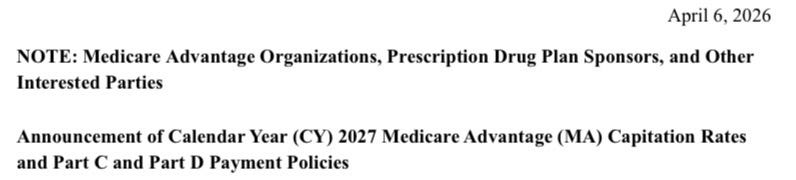
The CMS CY 2027 Medicare Advantage and Part D Rate Announcement dropped April 6, 2026. It finalizes a net average payment increase of 2.48 percent, or roughly 13 billion dollars in additional MA payments. But the real story for health tech builders and investors is not the topline number. It is the collection of new operational mandates, data architecture changes, and program integrity crackdowns that will force payers to either build or buy entirely new capabilities over the next 12 to 24 months. This essay reads the Rate Announcement through the lens of a venture incubator asking one question: what companies need to exist because of what CMS just did?
Key themes:
Unlinked chart review record exclusion creates a massive encounter data remediation market
Audio-only diagnosis exclusion forces telehealth workflow retooling
Separate PDP and MA-PD normalization opens a wedge for Part D analytics startups
Star Ratings measure set overhaul, including new depression screening, creates HEDIS/quality reporting buildout demand
Skin substitute repricing aftermath continues to scramble risk adjustment economics
The BALANCE Model and GLP-1 utilization create pharmacy benefit uncertainty that favors risk analytics tooling
ESRD payment adequacy concerns open a door for kidney care cost management platforms
Puerto Rico-specific adjustments signal a niche but real market for territory-focused plan services
Table of Contents
The Topline Numbers and Why They Lie
Unlinked Chart Reviews: The Biggest Startup Catalyst in the Document
Audio-Only Telehealth Gets Kneecapped for Risk Adjustment
Separate Worlds: PDP vs MA-PD Normalization and What It Means for Part D Startups
Star Ratings Overhaul: Depression Screening, Measure Removals, and Quality Tech
Skin Substitutes, Risk Model Freeze, and the Coding Economy
GLP-1s, BALANCE, and the Part D Pharmacy Benefit Chaos
ESRD and the Kidney Care Opportunity
Puerto Rico as a Micro-Market
What to Build
The Topline Numbers and Why They Lie
CMS finalized a 2.48 percent net average increase in MA plan payments for CY 2027. That is about 13 billion dollars more than 2026. When the Advance Notice came out in January projecting a 0.09 percent increase, the industry basically had a collective panic attack, so 2.48 percent feels like a relief. But relief is not the same as generosity. When you add in the estimated 2.50 percent risk score trend from underlying coding changes and population shifts, the effective growth is closer to 4.98 percent. Sounds decent until you factor in what the plans themselves say they are seeing in utilization trend. Nearly every large MA organization commented that inpatient utilization, Part B drug spending, post-acute volumes, and behavioral health costs are all running hotter than what CMS projects. The commenters are not subtle about this. The public comment section of the Rate Announcement reads like a 50-page group therapy session for actuaries who feel gaslit by the Office of the Actuary.
What matters for builders is that 2.48 percent is a number designed to keep the lights on for plans, not to let them print money. The margin environment stays compressed. Plans that cannot operationally adapt to the new risk adjustment rules, the new quality measures, and the new encounter data requirements will be the ones who exit markets or cut benefits. And the ones who can adapt will need vendors to help them do it, because the operational changes CMS is requiring are not trivial.
Unlinked Chart Reviews: The Biggest Startup Catalyst in the Document
This is the single most consequential policy change in the Rate Announcement for health tech entrepreneurs, and it barely got any press. CMS is finalizing the exclusion of diagnoses from unlinked chart review records from risk score calculation starting in CY 2027. The only exception is for beneficiaries who switch from one MA organization to another.
To understand why this matters, you need to understand how chart reviews work in the MA risk adjustment ecosystem. MA plans submit encounter data records, which are basically electronic claims documenting the services provided to enrollees. Separately, plans can submit chart review records, which add diagnoses found during retrospective medical record reviews. When a chart review record is “linked,” it is tied to a specific encounter data record and says “we found an additional diagnosis in the chart from this visit.” When it is “unlinked,” it floats free with no connection to any documented service encounter.
CMS found that roughly 85 percent of the 88.8 million unlinked chart review records submitted in 2023 for 2024 payment could not be matched to any encounter data record even when they tried matching on beneficiary, billing provider, and dates of service within three days. That is a staggering number. CMS is essentially saying: if you cannot tie a diagnosis to a real clinical encounter, it does not count for payment.
The average payment impact of this exclusion is negative 1.24 percent. Without the switcher exception, it would be negative 1.78 percent. But the average masks enormous variation. Plans that have relied heavily on in-home health risk assessments, third-party chart review vendors, and retrospective coding operations to generate unlinked chart review records are going to get hit much harder. Some of the largest national MA plans have built entire revenue lines around this practice.
So what needs to be built? First, encounter data remediation platforms. Every MA plan in America now needs to audit its encounter data submission infrastructure and figure out how to make sure every diagnosis that matters is either submitted on an encounter data record or on a chart review record that links to one. That is a workflow and data engineering problem. The plans that have been lazy about encounter data submissions (and many have, because unlinked chart reviews were an easy workaround) need to fix their pipelines fast. Second, prospective risk adjustment tools that capture diagnoses at the point of care rather than retrospectively through chart review. CMS has been pushing this direction for years, and the unlinked chart review exclusion is the final shove. Tools that integrate with EHR workflows to ensure accurate, complete diagnosis capture during clinical visits are now table stakes, not nice-to-haves. Third, chart review linking services. For plans that still do retrospective chart review (and many will, it is not going away), the ability to reliably link chart review findings to existing encounter data records becomes a critical compliance function. This is a data matching and reconciliation problem that screams for a purpose-built SaaS product.
The market here is not small. Risk adjustment revenue for the MA program is hundreds of billions of dollars. A 1 to 2 percent payment impact across 34 million MA enrollees translates to billions of dollars at risk. Even capturing a small slice of the remediation and tooling market around this policy change is a venture-scale opportunity.
Audio-Only Telehealth Gets Kneecapped for Risk Adjustment
CMS is finalizing the exclusion of diagnoses from audio-only telehealth encounters from risk score calculation. If the only service lines on a claim have audio-only modifiers (modifier 93 or FQ), the diagnoses from that encounter are out for risk adjustment purposes. The average payment impact is zero, which tells you something about how few plans were actually submitting these diagnoses. But the policy signal is loud: CMS wants diagnoses tied to face-to-face encounters, period.
For telehealth companies, this is a clarification that has been a long time coming. Audio-only visits were never supposed to generate risk-adjustment-eligible diagnoses under existing CMS guidance, but the operational enforcement was spotty. Now it is explicit. Companies building telehealth platforms for MA plans need to make sure their visit type routing clearly distinguishes between audio-video visits (which do support risk adjustment) and audio-only visits (which do not). This is a feature, not a product, but it matters for any company selling into the MA risk adjustment workflow. Plans will want reporting dashboards that show what percentage of their telehealth volume is audio-only versus audio-video, broken down by provider and condition, so they can coach their networks accordingly.
Separate Worlds: PDP vs MA-PD Normalization and What It Means for Part D Startups
CMS finalized separate normalization factors for standalone prescription drug plans and MA prescription drug plans, plus separate continuing enrollee model segments in the RxHCC risk adjustment model. This is a technical change that has big strategic implications.
The background: MA-PD plans have historically had higher risk scores than standalone PDPs because MA organizations can affect the submission of diagnoses through their Part C encounter data. PDPs cannot. The old single normalization factor basically split the difference, which overpaid MA-PD plans and underpaid PDPs. CMS has been moving toward separate normalization for a couple of years, and the CY 2027 finalization locks it in with a methodology that assumes equal underlying risk between the two sectors.
Why does this matter for startups? The PDP market has been under enormous stress since the IRA Part D redesign. Plan liability went up, the catastrophic phase cost sharing structure changed, and the premium stabilization demonstration is year-to-year. Several large PDP sponsors commented that they need narrowed risk corridors or other stabilization mechanisms to keep offering standalone drug plans. CMS basically punted on all of that, saying it cannot decide whether to continue the premium stabilization demonstration until it sees 2027 bids.
The investment thesis here is that PDPs need better Part D analytics, utilization management, and formulary optimization tools, and they need them from vendors who understand the PDP-specific economics, not just the MA-PD economics. The separate normalization creates a distinct financial environment for PDPs that is different from MA-PDs in terms of how risk is predicted and paid. Any company building Part D risk adjustment, bidding support, or pharmacy benefit analytics tools should be building for both segments now and pricing the products accordingly. There is also an opening for companies that help PDP sponsors improve their diagnosis data. CMS acknowledged that PDPs have a structural disadvantage in diagnosis submission because they do not control the medical encounter. Tools that help PDP sponsors get better diagnosis data from FFS claims, or that help them partner with provider organizations for data sharing, could be valuable in this new normalization environment.
Star Ratings Overhaul: Depression Screening, Measure Removals, and Quality Tech
The Star Ratings changes in the CY 2027 Rate Announcement and the companion final rule are the kind of thing that sounds boring until you realize how much money is on the line. MA quality bonus payments are tied to Star Ratings, and a contract’s Star Rating determines whether it gets a 5 percentage point benchmark bonus, a 3.5 point bonus, or nothing. For a large MA contract, the difference between 3.5 stars and 4 stars can be hundreds of millions of dollars.
CMS is removing 11 measures from the Star Ratings, adding a Depression Screening and Follow-Up measure starting with the 2027 measurement year (for 2029 Star Ratings), keeping the historical reward factor instead of implementing the Health Equity Index reward that the prior administration had developed, and adding or updating four measures for the 2027 Star Ratings cycle including Colorectal Cancer Screening (respecified), Care for Older Adults Functional Status Assessment (returning after spec change), Concurrent Use of Opioids and Benzodiazepines, and Polypharmacy with Multiple Anticholinergic Medications in Older Adults.
The Depression Screening measure is the one to watch from a venture perspective. Behavioral health measurement in MA has been a gap forever. Adding a Part C depression screening measure creates demand for clinical workflow tools, member engagement platforms, and data capture systems specifically designed to ensure that plans can document depression screening at scale across their enrolled populations. This is not a small operational lift. Plans need to screen millions of members, document the screening, and ensure follow-up if the screen is positive. That is a care coordination problem, a data capture problem, and a member engagement problem all wrapped into one quality measure.
The polypharmacy and opioid-benzodiazepine measures create similar demand for medication management platforms. These are clinical pharmacy measures that require plans to have visibility into their members’ full medication profiles and the ability to intervene when dangerous combinations are detected. Companies building medication therapy management tools, pharmacist intervention platforms, or prescriber alert systems are well-positioned here.
The removal of 11 measures focused on administrative processes is also worth noting. CMS is explicitly saying it wants Star Ratings to focus on clinical outcomes and patient experience, not on administrative checkbox compliance. For quality improvement vendors, this means the sales pitch needs to shift from “we help you check boxes” to “we help you move clinical outcomes.” That is a harder product to build but a stickier one.
Skin Substitutes, Risk Model Freeze, and the Coding Economy
CMS decided not to finalize the proposed 2027 CMS-HCC risk adjustment model recalibration and will instead continue using the 2024 model for CY 2027. This was the single biggest change from the Advance Notice to the final Rate Announcement and is the main reason the payment increase jumped from 0.09 percent to 2.48 percent. The proposed model would have used 2023 diagnoses and 2024 expenditure data, which included the anomalous skin substitute spending that inflated certain condition coefficients while deflating others.
The skin substitute story is worth understanding because it illustrates how FFS payment policy changes ripple through MA in unexpected ways. Spending on physician-administered drugs, which includes skin substitutes, went from 9.66 dollars per member per month in 2023 to 22.26 in 2024 to 40.04 in 2025, and then CMS projects it crashes to 1.53 in 2026 because of the CY 2026 Physician Fee Schedule rule that reclassified skin substitutes from biologicals to incident-to supplies. That reclassification cut payment by roughly 90 percent. CMS tested what would happen if they reduced skin substitute prices in the proposed model and found that raw MA risk scores would have been only 0.1 percent lower, meaning the skin substitute distortion was real but small in aggregate. But the condition-level impacts were all over the place. Skin condition relative factors went up 42.9 percent in the proposed model versus the 2024 model, while lung conditions went down 14.3 percent, kidney went down 14.3 percent, and metabolic went down 8 percent.
By freezing the model at the 2024 version, CMS avoided this mess for now. But they have signaled clearly that they will recalibrate in a future year. For startups in the risk adjustment space, this creates a window of relative stability in the HCC coefficient structure. But it also means that when the recalibration does come, it will be a bigger jump than if it had been done incrementally. Companies that help plans model the financial impact of risk adjustment model changes, stress-test their revenue under different coefficient scenarios, and optimize their coding and documentation strategies around the specific HCCs that are most likely to move are going to be in high demand when CMS proposes the next recalibration.
The normalization factors for 2027 are also worth noting. The 2024 CMS-HCC model normalization factor is 1.079, up from where it has been. Normalization is CMS’s mechanism for keeping the average MA risk score anchored to 1.0 in FFS, and the factor trends upward as coding intensity in FFS increases. The 5.90 percent coding pattern difference adjustment, which is the statutory minimum, continues to be a blunt instrument that some commenters argue should be higher and others argue should be lower. For risk adjustment vendors, the normalization and coding pattern dynamics are the bread and butter of their value proposition, and nothing in this Rate Announcement changes that.
GLP-1s, BALANCE, and the Part D Pharmacy Benefit Chaos
The Part D sections of the Rate Announcement are a masterclass in reading between the lines. CMS finalized updated RxHCC models using 2023 diagnoses and 2024 expenditure data, reflecting IRA benefit changes for 2027 including the increased manufacturer discount for specified small manufacturers. The deductible for the defined standard benefit goes from 615 dollars to 700 dollars, and the out-of-pocket threshold goes from 2,100 to 2,400. The annual percentage increase driving these parameter updates is 13.65 percent, which reflects a 9.37 percent annual drug spending trend plus 3.92 percent in prior year revisions. That 9.37 percent trend tells you everything about what is happening in Part D drug spending.
Multiple commenters raised concerns about the BALANCE Model, which is the CMS Innovation Center model focused on GLP-1 receptor agonists scheduled to start in CY 2027. CMS basically said that the design of Innovation Center models is outside the scope of the Rate Announcement. But the anxiety is real. GLP-1 utilization is accelerating, and the Part D benefit redesign has increased plan liability in the catastrophic phase. Plans are simultaneously dealing with higher drug costs, higher plan liability, and uncertainty about whether CMS will negotiate prices on additional drugs.
The startup opportunities in this space are obvious and large. Part D actuarial and bidding support tools that can model the interaction between GLP-1 utilization projections, IRA benefit changes, risk corridor parameters, and premium stabilization scenarios. Specialty pharmacy management platforms that help plans manage high-cost drug categories while maintaining Star Ratings performance on medication adherence measures. Prior authorization and utilization management tools specifically calibrated for the post-IRA Part D benefit structure. And formulary optimization engines that can account for maximum fair prices on negotiated drugs, manufacturer discounts under the redesigned benefit, and the new separate PDP/MA-PD normalization dynamics.
ESRD and the Kidney Care Opportunity
The ESRD payment sections got a lot of comment activity. Several commenters argued that state-level ESRD rate setting masks within-state variation in kidney care costs and that the MOOP limit creates an implicit cross-subsidy from non-ESRD to ESRD enrollees. CMS acknowledged the concerns but did not change the methodology. The agency pointed to prior analyses showing that moving to sub-state (CBSA-level) ESRD rates would actually reduce payments in areas with higher deprivation indices, which is why they have not pulled the trigger.
For kidney care startups, the signal is that CMS is aware of the ESRD payment adequacy problem but is constrained by the statute (Section 1853(a)(1)(H)) from making dramatic changes. Plans are going to have to manage ESRD costs within the existing rate structure, which means they need better tools for kidney care management, transplant coordination, dialysis utilization management, and functioning graft monitoring. The ESRD risk adjustment models (2023 ESRD CMS-HCC models) are separate from the regular HCC model and have their own normalization factors and coefficient structures. Companies that build ESRD-specific analytics and care management tools have a niche but defensible market because the payment mechanics are genuinely different from the rest of MA.
Puerto Rico as a Micro-Market
CMS continues its longstanding adjustments for Puerto Rico, basing MA county rates on beneficiaries with both Part A and Part B (unlike the mainland, where Part A-only and Part B-only beneficiaries are included) and adjusting for the higher proportion of zero-claims beneficiaries. The adjusted FFS costs in Puerto Rico get a 4.4 percent uplift from the zero-claims adjustment. Multiple commenters, including plans operating on the island, argued that rates are still inadequate given the extremely high MA penetration (far higher than any state), the high proportion of dual-eligible beneficiaries, provider infrastructure challenges, and the ongoing movement of both providers and beneficiaries to the mainland.
This is a small market but a real one. Companies that can serve the specific operational needs of MA plans in Puerto Rico, including bilingual member engagement, provider network management in a strained delivery system, and D-SNP operations for the heavily dual-eligible population, have limited competition and genuine demand. The political dynamics also make it likely that CMS will eventually do something more substantial for Puerto Rico rates, whether through demonstration authority or legislative action, which would expand the market further.
What to Build
Reading this Rate Announcement as a venture thesis, the highest-conviction opportunities cluster around a few themes. Encounter data infrastructure and chart review linking tools are the most urgent, because the unlinked chart review exclusion takes effect for CY 2027 and plans need to adapt now. Point-of-care risk adjustment capture tools that reduce dependence on retrospective chart review are the medium-term play. Part D bidding, analytics, and formulary optimization platforms that account for the separate PDP/MA-PD normalization and the IRA benefit redesign are underfunded relative to the complexity of the problem. Depression screening and behavioral health quality measurement tools are a new category created by the Star Ratings changes. Medication management platforms targeting the new polypharmacy and opioid safety measures have a clear regulatory catalyst. And ESRD-specific care management platforms address a payment adequacy problem that CMS has acknowledged but not solved.
The common thread is that CMS is simultaneously tightening the rules on how plans get paid (chart review exclusions, audio-only exclusions, coding pattern adjustments) while increasing the operational complexity of what plans need to do (new quality measures, IRA benefit changes, separate Part D normalization). That gap between tighter payment rules and higher operational demands is where startups live. Plans do not have the internal capability to build all of this themselves, and the timeline is too short for them to try. They need to buy.
For angel investors and seed-stage builders in health tech, the Rate Announcement is basically a procurement forecast disguised as a regulatory document. Every mandate CMS finalizes is a purchase order that has not been written yet. The plans know they need to comply. The question is just who builds the tools they will buy to do it.
Hey — I came across your writing and really liked how you think.
I’m exploring something similar from a different angle — writing about human behavior through a system design lens (like debugging internal patterns).
Just started publishing on Substack. If you ever get a moment to read, I’d genuinely value your perspective.
Also happy to support your work — feels like there’s an interesting overlap here.