Welcome to Healthcare Markets & Technology.
Rigorous analysis of AI, policy, capital, technology, and clinical operations across U.S. healthcare — written for the people who build, invest in, and lead it.
Free subscribers get 2 public articles per week. Upgrade to paid → for the full 7 articles/week, paid podcast episodes, deal breakdowns, and the complete 538-deep-dive archive.
Subscribe or upgrade here →
One thing to bookmark: the searchable Knowledge Base at kb.onhealthcare.tech isn’t in Substack’s menu. Save it now — on mobile, tap share → “Add to Home Screen.”
Reply to any email with questions. I read every one.
— Trey
Table of Contents
Background: How We Got Here
Star Ratings Overhaul: The $18.56B Question
Part D Redesign Codification: Locking In the IRA Changes
Supplemental Benefits and Debit Card Guardrails
Regulatory Rollbacks: The Deregulation Layer
Health Equity in Retreat
Investment Signals and Opportunity Map
Abstract
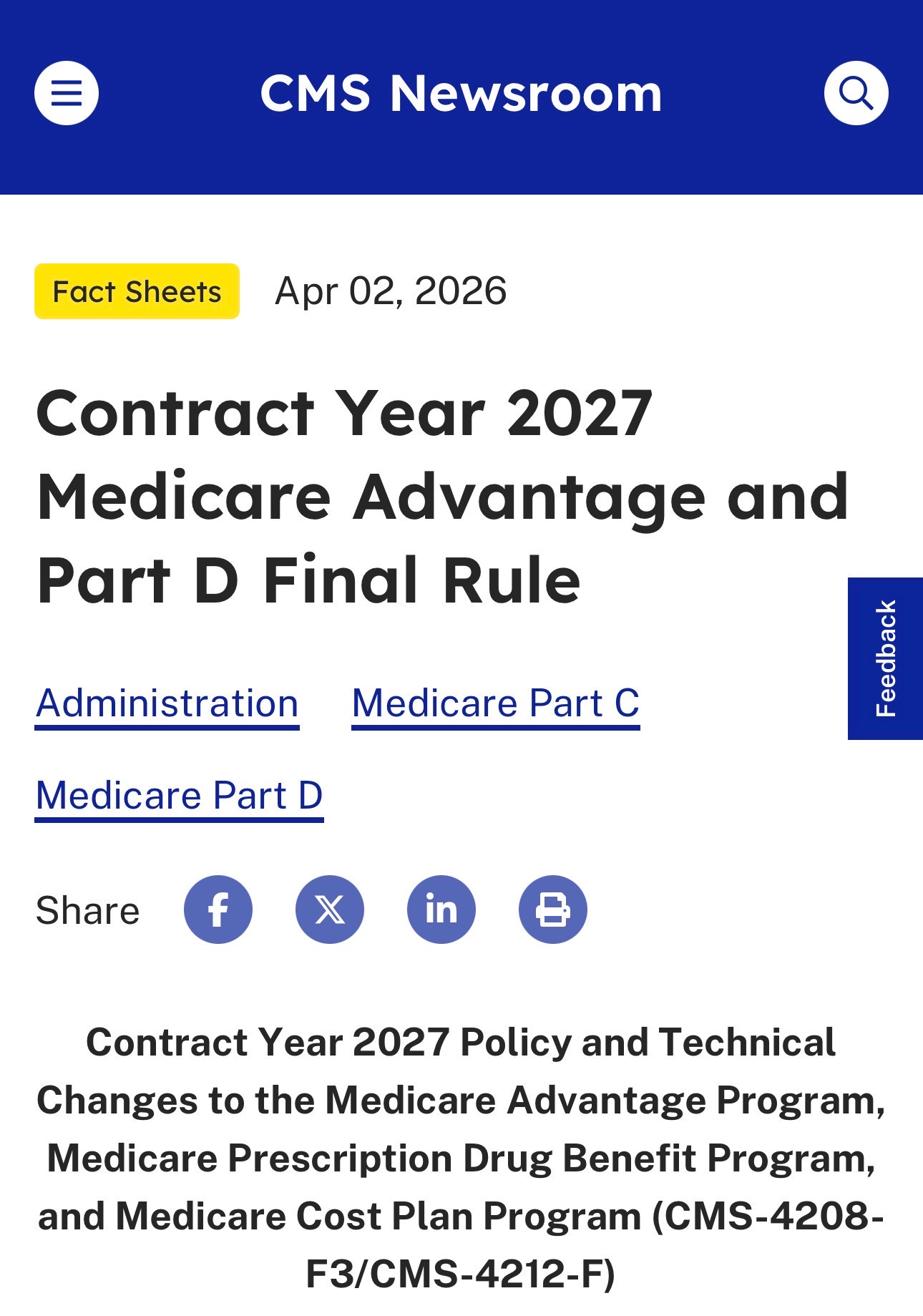
Published April 2, 2026; effective June 1, 2026; applicable to coverage starting Jan 1, 2027
Covers Medicare Advantage (Part C), Part D, and Medicare Cost Plan regulations
Key moves: 11 Star Rating measures cut, Health Equity Index reward scrapped, IRA Part D redesign codified into permanent reg, debit card supplemental benefit guardrails added, significant deregulatory measures finalized under EO 14192
Financial impact: Star Ratings changes estimated at $18.56B net to Medicare Trust Fund over 10 years (2027-2036)
~42,632 public comments received on the proposed rule
MA enrollment is roughly 33M+ beneficiaries; program represents ~$500B+ in annual federal spending
Biggest investor signals: quality measurement contraction favors scaled incumbents, debit card benefit infrastructure gets formalized, health equity tech demand softens near-term, Part D data infrastructure plays get a longer runway
Background: How We Got Here
Anyone who has been tracking Medicare Advantage closely knows the program has been under sustained pressure since 2023. Medical loss ratios spiked, several large insurers (UnitedHealth, Humana, CVS/Aetna) took significant earnings hits, and CMS started signaling that the decade-long era of generous benchmark rates and flexible quality bonuses needed recalibration. The CY2027 final rule, dropped April 2, lands against that backdrop. This is not a massive structural reform. It reads more like a careful tightening – some policy housekeeping, some politically-motivated deregulation, and a consequential set of decisions about the Star Ratings architecture that will ripple through plan economics for the next decade.
To understand why this rule matters, worth remembering what the Star Ratings system actually does. Plans scoring 4 stars or above receive Quality Bonus Payments from CMS, which in turn generate additional rebate dollars that plans use to fund supplemental benefits, reduce premiums, or pocket margin. The difference between a 3.5-star and 4-star contract can easily translate to hundreds of millions of dollars annually for a large plan. CMS has been tinkering with this system for years, but the changes finalized here are among the more significant structural adjustments since the program matured. Eleven measures are getting cut, the Health Equity Index reward is getting shelved, and a new depression screening measure is being added. None of these are cosmetic.
The Part D side of this rule is in some ways more technically dense but less surprising. The Inflation Reduction Act of 2022 made sweeping changes to the Part D benefit structure – eliminating the coverage gap, capping out-of-pocket at $2,000 for 2025 (now $2,100 for 2026, indexed forward), replacing the Coverage Gap Discount Program with the Manufacturer Discount Program – and CMS implemented most of those changes via program instruction because the IRA gave them specific authority to do so through 2026. That authority expires. This rule codifies all of it into permanent reg text. For investors and builders in the PBM, specialty pharmacy, and drug pricing analytics space, that formalization matters because program instructions can be walked back; regs are harder to unwind.
Star Ratings Overhaul: The $18.56B Question
The headline number here is $18.56 billion. That is CMS’s estimate of the net impact to the Medicare Trust Fund from the Star Ratings changes, spread over 2027 through 2036. For context, that works out to roughly 0.21 percent of Medicare payments to private health plans during that period. On a per-year basis, you are talking somewhere in the range of $1.5 to $2B annually depending on enrollment growth. That is a real number with real consequences for plan financials, and therefore real consequences for the vendor and technology ecosystem that serves those plans.
The 11 measures being removed are targeted at what CMS describes as administrative processes and areas where plan performance has converged to the point where beneficiaries cannot meaningfully distinguish between plans. A few of the notable cuts include the Call Center foreign language interpreter and TTY availability measures (applicable starting with 2028 Star Ratings), and the Statin Therapy for Cardiovascular Disease measure on the Part C side. The Depression Screening and Follow-Up measure is being added for the 2027 measurement year, flowing into 2029 Star Ratings. That addition is worth paying attention to – it signals that behavioral health integration into primary care workflows remains a CMS priority, even as the agency trims the broader measure set.
The Health Equity Index (HEI) reward decision is probably the most politically loaded piece. CMS had developed the HEI as a mechanism to reward plans that showed better performance specifically for historically underserved subpopulations – dual eligibles, low-income subsidy recipients, people with disabilities. The concept was that plans gaming overall averages by performing well for healthier, wealthier enrollees while underserving higher-need populations should not receive the same quality bonuses. The HEI was supposed to correct for that. CMS is now shelving the HEI entirely and sticking with the “historical reward factor,” which rewards consistent high overall performance across all measures over time. The administrative record cites ongoing concerns about the methodology, but the political context here matters: this administration has been explicitly rolling back DEI-related initiatives across federal agencies, and the HEI sits squarely in that crosshairs. Worth watching whether a future administration revives something like it.
For investors in health equity analytics, SDOH-focused platforms, and disparity measurement companies, this is a setback. Not a fatal one – Medicaid managed care and commercial value-based arrangements still create real demand for equity measurement – but the MA-specific revenue thesis just got softer. Companies that positioned specifically around the HEI compliance market are going to need to pivot. Companies with broader equity measurement value propositions (risk stratification, SDOH data aggregation, language services) are more insulated because the underlying clinical and operational demand does not disappear just because CMS removed a specific Star Ratings incentive.
The practical implication of cutting 11 measures while adding 1 is that the overall measure set gets smaller and thus each remaining measure carries more relative weight. From an actuarial standpoint, this concentrates risk. Plans that are strong on the surviving measures benefit disproportionately. Plans with weaknesses in surviving measure domains – CAHPS scores, medication adherence, chronic disease management outcomes – face more concentrated downside. Any tech company operating in those surviving measure domains (medication adherence platforms, patient experience survey infrastructure, chronic condition monitoring tools) should be reframing their value prop accordingly.
Part D Redesign Codification: Locking In the IRA Changes
The codification of the IRA Part D changes is in some ways the least dramatic piece of this rule from a market-impact standpoint because the benefit changes were already in effect. Beneficiaries have been living the new Part D world since 2025. What this rule does is convert temporary program instruction authority into permanent regulation, which has a few important downstream effects.
First, it removes ambiguity about durability. The IRA’s program instruction authority to implement the Part D redesign was time-limited. Converting to reg means these policies – no coverage gap, $2,000 OOP cap (now indexed at $2,100 for 2026 and going forward), zero cost sharing in catastrophic, Manufacturer Discount Program replacing the Coverage Gap Discount Program – are now in the regulatory fabric. Reversing them would require new notice-and-comment rulemaking, which is a much higher bar than simply issuing revised program guidance. For any investor or operator trying to model Part D economics over a multi-year horizon, this codification meaningfully reduces regulatory tail risk.
Second, it formalizes the Manufacturer Discount Program at scale. Under the old Coverage Gap Discount Program, manufacturers provided discounts only in the coverage gap phase. Under the Manufacturer Discount Program, discounts apply in both the initial coverage phase and the catastrophic phase for applicable drugs. Manufacturers who participate provide discounts of 10 percent in initial coverage and 20 percent in catastrophic. This is a fundamentally different economics structure for branded drug manufacturers, and it creates a different set of data and analytics needs. Who is responsible for tracking discount obligations at the NDC level across phases? How do plan sponsors and PBMs reconcile manufacturer discount payments? This is a non-trivial operational problem that has already spawned a cottage industry of Part D reconciliation and discount program management tooling. Codification makes that market more durable.
Third, the Selected Drug Subsidy piece is worth flagging for the data analytics crowd. For drugs that CMS has negotiated a Maximum Fair Price under the Inflation Reduction Act’s Drug Price Negotiation Program, the cost-sharing and subsidy structure in Part D is different. CMS now pays a 10 percent subsidy in initial coverage for selected drugs, and 40 percent reinsurance in catastrophic (compared to different rates for non-selected drugs). Tracking which drugs are “selected drugs” during which “price applicability periods,” and applying the correct liability attribution logic for each drug, is exactly the kind of problem that requires real-time reference data infrastructure. The codification of these rules creates a durable, reg-anchored market for companies providing that data layer.
The out-of-pocket cap dynamics deserve a closer look from an investment thesis standpoint. The $2,000 OOP cap for 2025 (indexed to $2,100 for 2026) fundamentally changes the risk profile of high-cost specialty drug users in Part D. Before the IRA, beneficiaries with specialty drug needs could face thousands of dollars in out-of-pocket costs annually. Now they hit a hard cap. This changes the financial calculus for medication adherence – when a patient’s cost sharing is capped at $2,100 regardless, the financial friction to starting or continuing a specialty drug is dramatically reduced compared to the old benefit structure. For companies in the medication access, patient affordability, and specialty pharmacy support space, this is a tailwind that the codification now makes permanent.
Supplemental Benefits and Debit Card Guardrails
The supplemental benefits section of this rule is where MA’s evolution as a consumer product runs directly into CMS’s concern about program integrity. MA plans have increasingly competed on supplemental benefits – dental, vision, hearing, over-the-counter (OTC) allowances, transportation, meal delivery, fitness memberships, and a host of other services beyond traditional medical coverage. The debit card mechanism became a popular administrative vehicle because it gave plans flexibility to offer dollar allowances across multiple benefit categories, and it gave beneficiaries flexibility in how they used those dollars. The problem is that flexibility created real and documented program integrity gaps: allowances used outside of covered benefit categories, funds used for non-health-related purchases, inconsistent point-of-sale verification, and confusion about what the benefit actually covers.
CMS is finalizing a set of debit card guardrails that address the most obvious integrity gaps. The key requirements are that debit cards must be electronically linked to covered items through a real-time verification mechanism at the point of sale, and debit card benefits must be limited to the specific plan year (no carryover). CMS is also requiring enhanced disclosure for beneficiaries about what the card covers and what it does not. Notably, CMS walked back the proposed prohibition on marketing the dollar value of supplemental benefits, which had generated substantial industry pushback. Plans can still advertise “up to $X in OTC benefits” in their marketing materials.
For the health tech ecosystem, the real-time point-of-sale verification requirement is the operationally meaty piece. This essentially requires that the debit card infrastructure be connected to a benefit eligibility determination engine that can validate at checkout whether a specific product or service is a covered benefit for the member. This is harder than it sounds. Product catalogs for OTC benefits are enormous (tens of thousands of SKUs), benefit definitions vary by plan and geography, and the verification needs to happen fast enough not to disrupt the retail checkout experience. There are already vendors operating in this space – companies that provide eligible item catalogs, pharmacy benefit processors, and specialized OTC card program administrators – but the codification of the real-time verification requirement creates a regulatory mandate for capability that was previously more of a best-practice.
Worth noting that CMS is also finalizing the SSBCI (Special Supplemental Benefits for the Chronically Ill) transparency requirements from the CY2026 proposed rule. Plans must now post their SSBCI eligibility criteria publicly on their websites. SSBCI is the bucket that allows plans to provide non-primarily health-related benefits (things like air conditioning units, pest control, home modifications) to members with chronic conditions. The eligibility criteria for these benefits have been notoriously opaque, and this transparency requirement at least creates a reference point for advocates, regulators, and researchers trying to understand who is actually accessing these benefits and who is not.
The cannabis product clarification in this rule is also worth a sentence. CMS is amending the SSBCI regulations to specify that cannabis products illegal under applicable state or federal law are not allowable SSBCI benefits. This is largely defensive – a clarification designed to prevent plans from inadvertently including cannabis products in benefit designs, particularly as state-level legalization continues to expand. It does not open any door for cannabis in MA benefits; it closes off the ambiguity that some might have tried to exploit.
Regulatory Rollbacks: The Deregulation Layer
This is where the current administration’s footprint on this rule is most visible. Under Executive Order 14192, CMS is rolling back a set of requirements across MA and Part D. Some of these are genuinely sensible deregulation removing requirements that generated compliance costs without meaningful beneficiary benefit. Others are more consequential reductions in consumer protection infrastructure.
On the genuinely sensible side: exempting health reimbursement arrangements and HSA-linked plans from creditable coverage disclosure requirements is a reasonable administrative streamlining. The mid-year notice requirement about unused supplemental benefits is also being rescinded. CMS’s logic here is that plans voluntarily communicate this information anyway, and mandating a specific notice format generates cost without clear evidence of improved utilization. These are modest changes.
On the more consequential side: removing the restrictions on when and how licensed agents and brokers can have conversations with beneficiaries is a meaningful rollback. Previous rules had tightened the conditions under which agents could contact beneficiaries, partly in response to documented cases of high-pressure sales tactics and inappropriate switching behavior that increased insurer costs and destabilized plan enrollment. The removal of these restrictions does not eliminate the underlying prohibition on unsolicited contacts, but it loosens the guardrails in ways that could increase aggressive marketing activity heading into the 2027 Annual Enrollment Period.
The elimination of health equity requirements from MA Utilization Management Committees deserves particular attention. Under the CY2024 rule, CMS had required UM committees to include a health equity expert and to conduct annual health equity analyses of coverage criteria, prior authorization decisions, and formulary designs. Plans were required to post those analyses publicly. These requirements were designed to address documented disparities in prior auth denial rates by race and income. CMS is eliminating all of this: no health equity expert requirement, no annual analysis, no public posting. For companies that had built consulting or analytics products specifically around MA UM health equity compliance, this is a direct revenue headwind.
The LINETS (Limited Income Newly Eligible Transition) call center hour waiver is a smaller but symbolically loaded rollback. LINETS is the program that auto-enrolls low-income beneficiaries who age into Medicare into Part D plans. These beneficiaries are disproportionately lower-income and have less digital literacy, meaning they are more dependent on telephone support to understand their coverage. Waiving the requirement that LINETS plans maintain toll-free call centers accessible from 8 AM to 8 PM across all regions reduces cost for plans but at potential access cost for a vulnerable population.
Health Equity in Retreat
It is worth taking a step back and naming the aggregate pattern here because the individual provisions are easier to rationalize in isolation than as a whole. In this single rule, CMS has shelved the HEI reward, eliminated health equity expertise requirements from UM committees, eliminated the annual health equity analyses requirement, eliminated the public posting requirement for those analyses, and waived extended call center access for low-income auto-enrollees. Each of these can be individually justified on administrative efficiency or methodological grounds. Taken together, they represent a significant reduction in CMS’s formal commitment to measuring and incentivizing equity within MA.
For investors in health equity tech, the near-term investment thesis in MA-specific equity work just got materially weaker. The honest framing is that the regulatory tailwind driving plan spending on equity technology was substantially MA-dependent, and that tailwind has reversed. The more durable equity tech plays are in Medicaid (where federal equity requirements are more entrenched and state-level variation creates persistent demand), in value-based care arrangements with progressive health systems, and in employer-sponsored insurance where DEI commitments from large self-funded employers still create demand for equity analytics infrastructure.
That said, the clinical reality that equity gaps produce worse outcomes and higher costs does not disappear because CMS stops measuring it. Risk-adjustment models that ignore SDOH systematically underestimate costs for high-need populations, and that creates actuarial exposure for plans regardless of whether CMS rewards equity performance. The smarter equity tech companies understand that their core value proposition is cost and risk prediction accuracy, not compliance. Companies that positioned primarily as compliance plays are going to struggle; companies that positioned as actuarial accuracy and population health effectiveness plays have a more durable thesis even in this environment.
Investment Signals and Opportunity Map
Pulling all of this together, the CY2027 rule produces a fairly clear set of investment signals for the health tech ecosystem. The Star Ratings measure contraction is net-negative for quality measure infrastructure vendors that built revenue around the 11 eliminated measures, and net-positive for companies focused on surviving measure domains, particularly CAHPS and medication adherence. The Part D codification is net-positive for anyone in the drug pricing data, specialty pharmacy analytics, or Manufacturer Discount Program reconciliation space. The debit card guardrails create a formal regulatory mandate for real-time eligible item verification infrastructure. The health equity rollbacks create near-term headwinds for MA equity compliance tech but do not eliminate the broader actuarial and population health case for SDOH analytics.
Two categories worth highlighting for angel investors and early-stage funds specifically: Part D reconciliation and Selected Drug tracking infrastructure, and OTC benefit eligibility verification technology. Both of these are unsexy, plumbing-layer problems that generate real, recurring revenue from large plan sponsors and PBMs. The codification of the IRA changes and the debit card guardrails respectively create long-duration regulatory underpinning for both categories. These are not moonshot opportunities. They are the kind of B2B infrastructure plays that generate predictable SaaS-style contracts with MA plans and PBMs at scale.
The request for information section of this rule is also worth monitoring even though CMS does not respond to RFI comments in the final rule text. CMS asked for input on future directions for the MA program, modernizing agent/broker oversight, the dramatic growth in dual-eligible enrollment in chronic condition SNPs (C-SNPs), and nutrition policy in MA. The C-SNP enrollment question is particularly interesting – dual eligibles are the highest-cost, highest-complexity population in Medicare, and the rapid growth of C-SNP enrollment suggests plans are competing aggressively for what they presumably view as an attractive risk cohort. Whether the actual risk profiles and actuarial assumptions underlying that competition are sound is an open question, but the growth trajectory makes C-SNP-focused care models, navigation tools, and complex care management platforms a logical area to watch.
The MA market in 2026 is not the same market it was in 2021. Plan exits, benefit reductions, and premium increases have changed the competitive dynamics. The CY2027 rule does not reverse those dynamics but it does lock in a new set of operational and financial parameters within which the market will evolve. For investors and operators trying to read the regulatory tea leaves, the summary version is this: quality measurement is consolidating around fewer, more clinically meaningful metrics; Part D economics are permanently restructured by the IRA; supplemental benefit integrity requirements are tightening; and CMS under the current administration is explicitly prioritizing deregulation and beneficiary choice over health equity measurement. Position accordingly.