🎧 Part I Podcast free on Apple Podcasts and Spotify

🎧 Part II Podcast episode for paid subscribers only. Also available on Apple Podcasts and Spotify.
To listen to paid episodes in Apple or Spotify, link your Substack subscription via the show settings on those platforms (instructions inside the Substack app under Subscriptions → Podcast).
Abstract
Employer family premiums crossed $28,000 in 2026, and workers’ contributions rose faster than the premiums themselves. UnitedHealth thinks the next employer plan will use artificial intelligence to make it easier to find care, know the price, and steer toward better options. Its Surest plan already shows what part of that future looks like. The deductible goes away, and copays can vary by provider or facility. That can save an employee money and lower the employer’s claims bill in the same transaction. It can also make the only practical provider more expensive, leave a patient sorting through a pharmacy exception, or give an administrator a new way to steer volume toward its own businesses. The economics turn on three questions that rarely make it into the demo. Which care actually moves? What does it cost once the claims settle? And who gets to keep the difference?
Table of Contents
The renewal was ugly before anybody opened a chatbot
What a variable copay actually buys
The difference between a network and an appointment
Where artificial intelligence earns its keep
The pharmacy benefit has its own math
Who takes the risk and who gets paid
What employers and investors should buy
The renewal was ugly before anybody opened a chatbot
Picture a worker whose orthopedist orders a knee scan. One facility is attached to the hospital where the doctor practices. The other is an imaging center across town. Under a conventional plan, the worker may know that both are in network and still have no idea what either will cost. The deductible balance is moving as other claims come in. The facility and the radiologist may bill separately. The scheduler has an appointment on Tuesday and a remarkably limited interest in discussing the negotiated rate. A variable copay plan can show a specific member price for each location before the worker books. If the lower copay comes with an appointment that works and a lower total claim, the worker and the employer can both save. If the cheaper facility is booked out for weeks or can’t perform the ordered protocol, the employer has put a price on taking the available appointment. Same app. Very different benefit.
The renewal explains why employers are willing to try this. In twenty twenty-six, the average annual premium for employer-sponsored family coverage reached twenty-eight thousand three hundred three dollars, up five percent. Workers paid seven thousand four hundred seventy-one dollars on average toward that premium, up nine percent, before paying for a single visit or prescription. Among covered workers with a general annual deductible, the average for single coverage was one thousand nine hundred fifty-five dollars. Meanwhile, Mercer’s preliminary survey put expected growth in total health benefit cost per employee at eight point two percent for twenty twenty-seven after planned cost reductions. Employers estimated eleven percent if they kept their existing plans and took no action. The family premium measures what coverage costs today. The Mercer figure forecasts what employers expect their benefits to cost next year. Put both in front of a finance chief and the benefits team will get asked what it can change besides the employee contribution. Put them in front of an employee and the immediate question is how much more is coming out of Friday’s check.
Dan Kueter, UnitedHealth Group’s chief commercial officer, discussed a generational shift in employer insurance with Julie Yoo on Raising Health in November. He sees artificial intelligence changing how plans are underwritten, sold, and used, alongside the spread of self-funding to smaller employers. UnitedHealth has a reason to get out in front of that shift. At the end of September, UnitedHealthcare reported about twenty-two million people in fee-based commercial arrangements and roughly seven and a half million in risk-based commercial arrangements. Its business already depends heavily on employers continuing to hire it to administer benefits when those employers bear the claims risk. If a customer wants to move away from the conventional plan, UnitedHealth can offer a different design while keeping the network and administration. Its leverage comes from being able to change what shows up on a member’s screen and what happens to the claim after the member acts on it.
What a variable copay actually buys
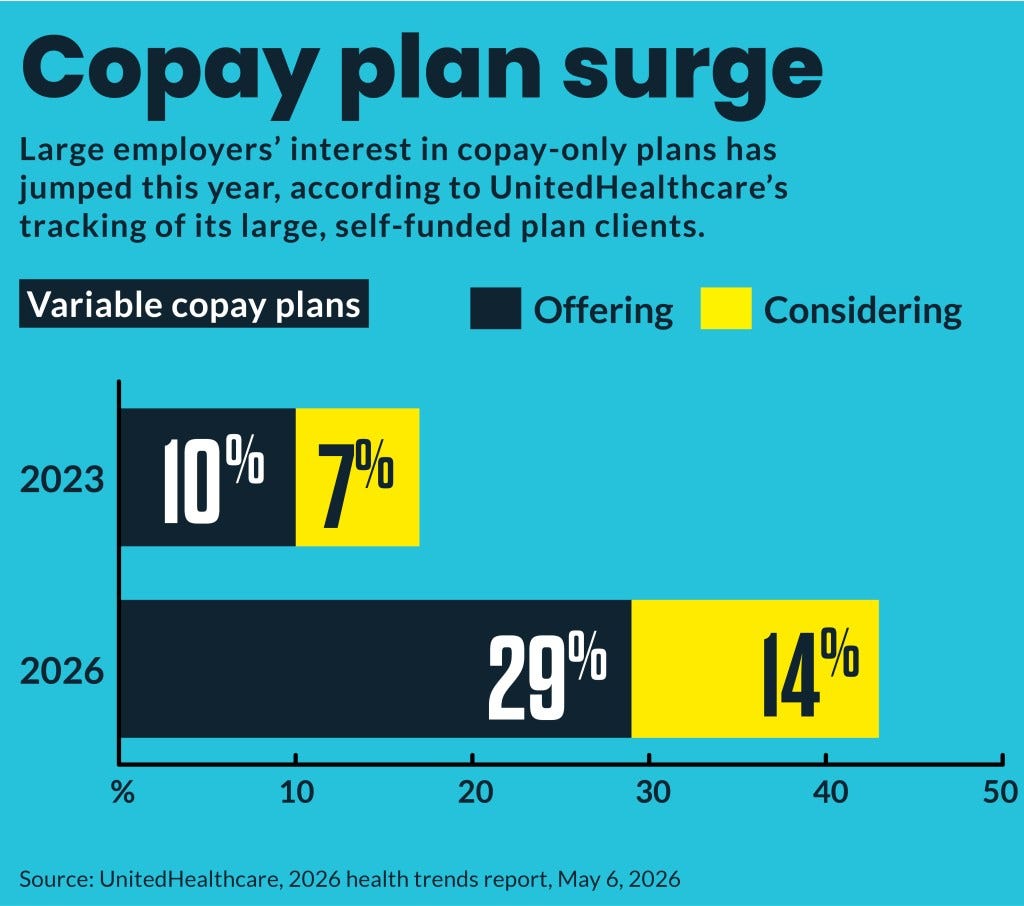
Surest is the easiest way to see what UnitedHealthcare is selling. The plan uses copays in place of a deductible and coinsurance. Members can look up what they’ll pay before getting care, and copays for the same service can differ by practitioner or location within a broad network. Surest describes using claims-based episodes and machine learning to assess aspects of provider quality, efficiency, and downstream care. Those assessments help inform what patients see. The provider-specific copay is the part an employer is buying. It makes the price difference relevant to a worker who already met a deductible, a worker who hasn’t, and a worker who would otherwise need to learn what coinsurance means while sitting in a parking lot.
There’s a reason to think changing the price at the point of choice can do more than publishing a price list. A study of two large employers found that roughly one in ten employees offered an online price tool used it in the first year, and offering it was associated with no reduction in outpatient spending. In a different study, the California Public Employees’ Retirement System used reference pricing for colonoscopies. Patients who chose certain higher-priced facilities could owe more, with exceptions for circumstances such as clinical need. Researchers estimated that the change increased use of lower-priced facilities by about eighteen percentage points and reduced the price paid by about twenty-one percent. The deductible literature tells a third story. When one large employer moved workers from free care to a high-deductible plan, spending fell by roughly twelve to fourteen percent. The researchers attributed the reduction to people using fewer services, including some potentially valuable care. All three approaches can make a patient think about price. The design determines whether the easiest response is to switch facilities, skip the visit, or close the browser tab.
UnitedHealthcare reports that continuously enrolled Surest members had fifteen percent fewer surgeries and eight percent fewer emergency department visits in a matched analysis against members in traditional plans. Those figures describe the company’s comparison. To interpret them, an employer needs to know what people enrolled in, which members stayed, and what happened after a surgery or emergency visit failed to materialize. Fewer back surgeries alongside more effective conservative treatment would be a result worth buying. Fewer surgeries after the workers most likely to need them chose a different option at enrollment would say something about who picked which plan. A drop in emergency visits means more when primary care and urgent care use explain where patients went. A renewal report that gives the employer surgery counts and app logins leaves the employer guessing about the mechanism.
Then there’s the size of the opportunity. Take a hypothetical employer with one hundred twenty million dollars in annual allowed claims. Suppose twelve million is in outpatient episodes that can realistically move between facilities. If a quarter of those episodes shift and the alternatives cost forty percent less, the gross reduction in allowed claims is one million two hundred thousand dollars, or one percent of total allowed spending. That can fund a meaningful benefit improvement. It also puts a ceiling on what a site-of-care program can deliver in that population before fees, richer copays, and any increase in utilization. A claim that the same program will cut total costs by five percent needs another source of savings. It might have one. The employer should be able to see it in the claims.
The difference between a network and an appointment
Network breadth is normally sold as a count. The family trying to get its kid into a developmental pediatrician experiences it as a wait. A hospital can participate in a network while its outpatient department sits in an expensive copay tier. The less expensive clinician may have stopped taking new patients. A worker can technically reach the preferred facility and still need to take an unpaid afternoon off. These details matter more as the copay gap widens. A broad network with meaningful price differences can steer care without cutting providers out entirely. It can also charge a premium for the only appointment a member can use. A plan that measures access by matching a home address to a directory will count both situations as success.
Centivo illustrates another way to go after the same employer budget. Its design emphasizes free primary care, and an employer option such as JetBlue’s Partnership plan uses referrals for much specialist care. That changes who helps make the choice and when it happens. A primary care team with a functioning referral network can place the order, send records, and get a patient into an appropriate specialist before the patient opens a directory. The arrangement is only as good as the primary care capacity behind it. A patient in active cancer treatment, a family with a child receiving ongoing therapy, and a worker referred for a routine scan have very different costs of switching. An employer can measure those differences by checking new-patient appointment availability, looking at what happens to existing courses of treatment, and tracking how often a lower copay is available only after an exception. An exception policy does very little for a patient who finds out about it after the bill arrives.
Provider rankings bring a second problem. A hospital outpatient department and an ambulatory surgery center can perform the same procedure while treating different patients. A tertiary center may look expensive because its cases are genuinely more complex, because its contracts are richer, or because both are true. Claims can tell a plan a lot about repeat procedures, complications that generate bills, and the services that follow an episode. A claims-based score will have thinner evidence for a surgeon with low volume, limited visibility into functional recovery, and an incomplete view of care received after someone leaves the plan. For a routine procedure with enough volume, those limitations can be manageable. For complex care, the plan needs a way to account for case mix and act on clinical exceptions. The employee looking at the higher copay deserves to know whether it reflects an expensive facility, a meaningful difference in expected care, or a ranking with very little evidence behind it.
Where artificial intelligence earns its keep
Start with the scan. An order written in clinical language needs to map to a billable service, including the correct body part, whether contrast is involved, and the site that can perform it. The provider record needs to match the address where the patient will actually go and the entity that will bill. Then the system has to apply the right benefit for the member, the date, the service, and the facility. October’s federal Transparency in Coverage rules should make some of the public inputs easier to use. They move in-network rate reporting to the provider-network level, require plans to filter out certain implausible provider and service combinations, and shift updates for key medical rate files from monthly to quarterly. A negotiated rate in a public file still answers a different question from what an employee owes. The quote needs the plan’s live eligibility and benefit data, and sometimes the claim needs multiple rates because the episode has several bills. A language model can translate the order and explain the result. The benefit and claims systems have to supply the amount.
The product gets more interesting when it can do something with the answer. If the preferred site can perform the scan, the tool can check availability, help move the order, and give the patient a price tied to the intended service and location. When the claim arrives, the administrator can compare the member’s responsibility with what the patient was shown. Differences will happen. The ordered service can change, the facility can submit a different code, or a professional claim can come in separately. A plan that keeps the quote and reconciles those differences can figure out which errors it owns and correct recurring problems. A plan that sends a polite chatbot response explaining that all estimates are subject to change has saved some typing. The employer should price those products differently.
Prior authorization makes the same distinction visible. UnitedHealthcare announced a goal of removing about thirty percent of its existing authorization volume by the end of twenty twenty-six, with changes covering selected outpatient procedures, tests, and therapies. Removing a requirement spares a clinic the submission entirely. For requirements that remain, software can pull the relevant documentation from the chart and approve requests that clearly meet the policy. A useful operating report follows the request through to care. It counts how often a clinic has to resubmit, how long an approved patient waits to be scheduled, and how often a denial gets reversed. A decline in the time spent reviewing each request can coexist with more requests getting stuck before submission. The payer may record an efficiency gain while the clinic hires somebody to call about the cases the software couldn’t resolve.
The pharmacy benefit has its own math
A lower medical copay gets attention at enrollment. The pharmacy contract can quietly determine whether the whole plan gets more expensive. Take a specialty drug with a high list price and a large rebate. The sponsor can receive money months after the fill while the member’s coinsurance was calculated from a much higher price at the pharmacy counter. A competing drug with a smaller rebate can have a lower net cost, depending on acquisition cost, dispensing fees, and what happens to rebates elsewhere in the class if the formulary changes. There may also be margin at an affiliated specialty pharmacy. Federal Trade Commission staff estimated that the three largest pharmacy benefit managers’ affiliated pharmacies generated more than seven billion dollars in dispensing revenue above estimated acquisition costs on the specialty generics studied from twenty seventeen through twenty twenty-two. That measure is before other operating costs and covers the drugs studied. It gives a purchaser a concrete reason to ask about the amount paid to the dispensing pharmacy alongside the rebate.
The new federal disclosure requirements will give some purchasers more to work with. The Labor Department’s November final rule applies to plan years beginning on or after July first, twenty twenty-seven, and sets out detailed compensation disclosures for pharmacy benefit managers and certain affiliated brokers and consultants serving large self-insured plans. It requires disclosures before entering, extending, or renewing covered service agreements and recurring disclosures of actual compensation during the agreement. A separate law requires pass-through of covered rebates and other remuneration for plan years beginning on or after August third, twenty twenty-eight, which means January twenty twenty-nine for calendar-year plans. The plan receiving a rebate and the member seeing a lower price on the day of the fill are separate transactions. The benefit still decides what the member pays. An employer evaluating a drug switch needs the net plan cost after all remuneration, the amount the patient pays, and the terms that apply if the patient needs to stay on the existing therapy.
Obesity drugs are making the distinction hard to ignore. In the twenty twenty-six employer survey, eighteen percent of firms with at least two hundred workers that offered health benefits covered glucagon-like peptide-one drugs primarily for weight loss in their largest plan. The figure was thirty-three percent among firms with at least five thousand workers. Meanwhile, Lilly has opened employer purchasing channels for its obesity medicines, including the oral drug orforglipron, and GoodRx launched an employer offering in October with access to pricing from both Lilly and Novo Nordisk. A lower acquisition price can make a new benefit feasible and still raise total spending if many more workers start treatment or stay on it longer. The forecast turns on how many people qualify, how many fill, how long they stay on treatment, and which doses they reach. The clinical value also depends on who gets treated. In the trial that supported injectable semaglutide’s cardiovascular indication, major cardiovascular events occurred in six and a half percent of participants on the drug versus eight percent on placebo. Those patients already had cardiovascular disease and overweight or obesity. An employer modeling its entire workforce will get a peculiar answer if it gives everybody the same baseline risk and books the trial benefit as next year’s claims savings. For manufacturers, the opportunity is to make the cost of treating a defined population predictable enough that an employer can actually say yes.
Who takes the risk and who gets paid
Level funding is a big part of Kueter’s argument because it changes who gets to buy a more customizable plan. In the twenty twenty-six survey, thirty-eight percent of covered workers at firms with ten to one hundred ninety-nine workers were enrolled in level-funded plans. The employer typically pays a fixed monthly amount that combines a claims allowance, administration, and stop-loss insurance. The monthly bill looks familiar to a small business that has always bought insurance. The contract underneath it matters quite a bit more than the bill. The stop-loss attachment points determine how much risk the employer keeps, and the contract determines what happens to a claims surplus, how claims paid after termination are handled, and what happens at renewal after a large claim. Better underwriting can make the initial quote more accurate. It can also make it easier to attract employers with healthier groups, leaving the traditional small-group pool with a different mix. For the owner shopping a renewal, the plan’s year-two price after a rough year can be more revealing than the first-year discount.
At a large self-funded employer, the company generally bears the claims cost subject to its stop-loss arrangements, which makes a lower allowed amount immediately relevant. A fully insured employer sees the benefit through the carrier’s pricing and renewal process. In either case, the entity steering the patient can have several ways to earn money. A company can administer the medical plan, own or affiliate with a provider group, and manage the pharmacy benefit. A steer to an affiliated clinic could genuinely save the employer money and increase the parent company’s earnings. The employer needs enough information to see how that happened. Did the clinic deliver a less expensive episode? Was the member copay lower? Did an administrative fee rise or an affiliate receive revenue that would have gone to an independent provider? All of those can be true at once. Federal gag-clause rules protect certain access to de-identified claims and encounter data. An employer still has to secure timely, usable files and enough contract detail to reconcile fees and payments with the claims. A legal right to the data is a poor substitute for knowing what will show up in the first extract.
Who gets the savings is also a question of which employees get them. A family that uses primary care frequently may do well with predictable copays from the start of the year. A family with a child in ongoing specialty care could pay more if the existing clinic lands in the highest tier. An employee who rarely uses care could come out behind if the richer point-of-care benefit is financed through higher paycheck deductions. Averages hide these transfers with impressive efficiency. A benefits team can take last year’s claims and run them through the proposed plan, then add payroll contributions and any employer account funding to estimate what different households would have paid. That gives a first look at how the design redistributes costs before assuming anyone changes behavior. Running a second analysis with realistic steering assumptions tells the employer how much depends on members actually changing where they get care.
What employers and investors should buy
The best opening for entrepreneurs is where an employer can change a transaction and independently verify the result. Imaging and ambulatory surgery are sensible starting points in markets with real price variation and available capacity. A company could contract for an episode, confirm which services the price includes, work with the referring practice to move the order, and reconcile the claims against the quote. A device maker selling into those settings may find itself negotiating over an implant-inclusive episode with a buyer who cares about revisions and recovery as well as acquisition price. An independent pharmacy company has a similar opening if it can reconcile the member’s charge and the sponsor’s net cost across the conventional pharmacy benefit and a manufacturer-direct channel. Each business needs access to the actual transaction. If the incumbent administrator controls enrollment data, benefit configuration, and claims settlement, an entrepreneur with a good recommendation engine may still need that administrator’s cooperation to deliver any savings.
At renewal, the employer should be able to trace a sample of episodes from the old allowed amount through the new claim and see what the worker paid. The aggregate report should account for employer-paid claims, worker cost sharing, pharmacy rebates, program fees, and stop-loss premiums and recoveries where relevant, with payroll contributions tracked so changes in financing are visible. Comparisons need to account for who chose the new plan, how much claims runout is available, and whether unusually expensive cases explain the year-over-year change. The access report should show how many people could book the preferred option, how long they waited, and what happened to members who needed an exception. An investor can ask the same questions across customers. A vendor that reproduces the result in different labor markets and with different administrators has something harder to copy than a slick search interface.
Go back to the worker who needs the scan. The orthopedist sends the order. The worker gets a usable appointment, sees a copay that holds when the claim comes through, and gets the result back to the doctor without calling three offices. The employer can see that the episode cost less, and the worker keeps some of the difference. If the hospital is the right place for that particular scan, the plan has a way to recognize it before the patient pays extra. That is a redesign people might notice in February, when they actually need the insurance they picked in November.