
🎧 Podcast episode for paid subscribers only. Also available on Apple Podcasts and Spotify.

To listen to paid episodes in Apple or Spotify, link your Substack subscription via the show settings on those platforms (instructions inside the Substack app under Subscriptions → Podcast).
Table of Contents
Why this and why now
The mandate with the abandoned supply
What the business actually does
Sizing it without lying
Who pays and why they pay
The preseed: five million dollars and twelve months
Weeks one through eight
Months three through six
Months seven through twelve
The milestones that unlock the mega seed
What the twenty five million buys
Where it breaks
Abstract
Starting January 1, 2027, all states that have adopted the ACA Medicaid expansion (or equivalent expansion coverage) must condition Medicaid coverage for applicable expansion adults on 80 hours per month of qualifying community engagement activity or a documented exemption, with some states, including Nebraska, authorized to implement earlier at state option.
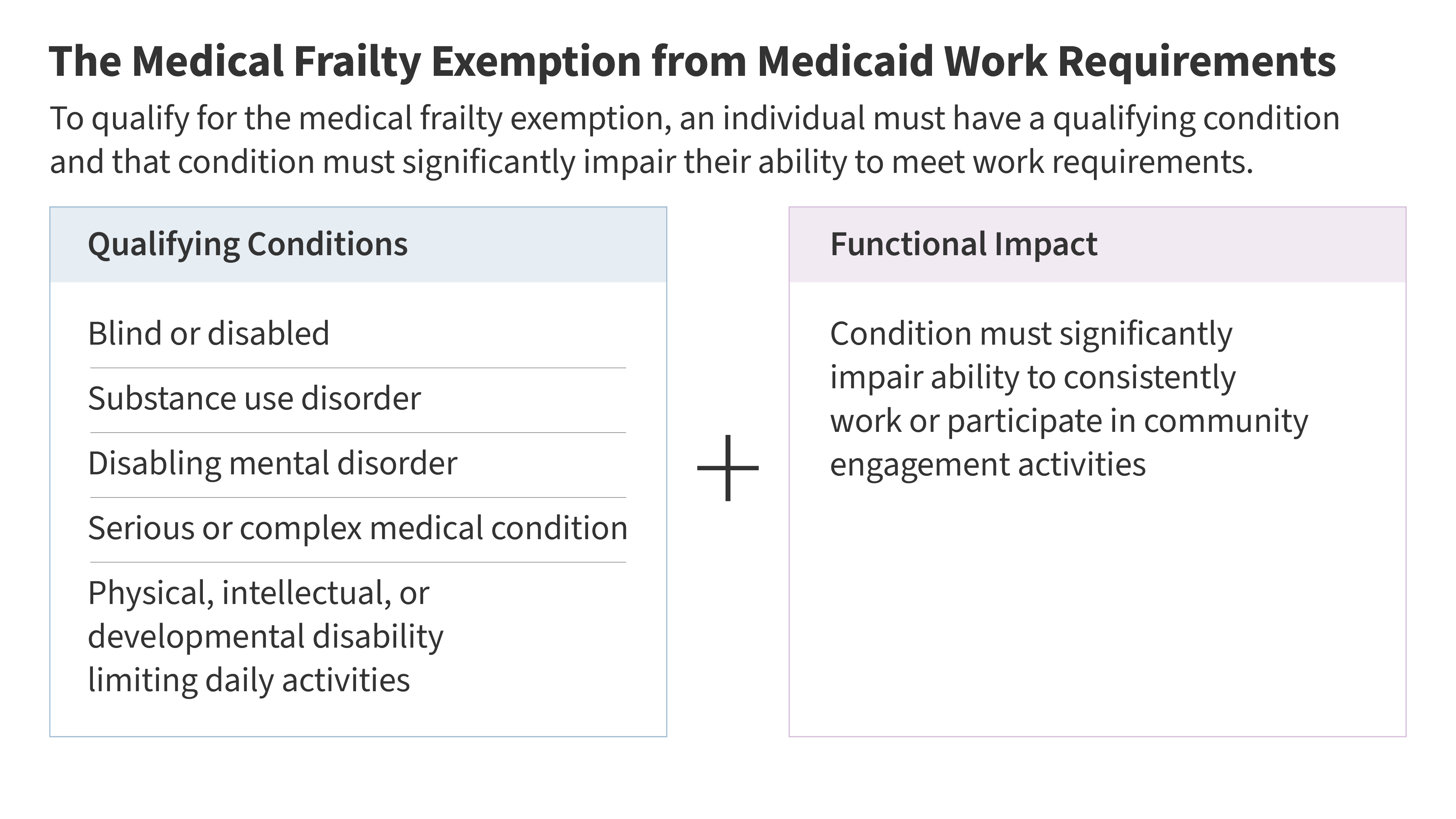
The interim final rule interprets the medical frailty exemption as a clinical determination tied to functional impairment rather than a simple diagnosis code lookup, and no organization in the ecosystem is currently staffed to produce those determinations at the required scale.
The business is a tech enabled clinical exemption and reinstatement service sold on contingency to FQHCs, community behavioral health providers, hospitals, and managed care plans, structurally modeled on the SSDI advocacy and hospital eligibility vendor industries.
The addressable pool is roughly 18.5 million subject enrollees, several million of whom have qualifying conditions, with a per member value to the payer of roughly $6,000 to $8,000 a year in capitation and a per member value to providers measured in avoided bad debt.
A $5 million preseed should buy three early state beachheads, twenty thousand completed determinations, a measured exemption rate, a reinstatement win rate, and signed contingency contracts with a dozen provider organizations and one plan before the national go live date.
The $25 million seed funds the expansion to all applicable expansion states in the first half of 2027, when the disenrollment wave actually hits and every plan and health system finance chief is suddenly reading the rule.
Why this and why now
There is a recurring pattern in healthcare services venture that almost never fails when the timing is right: a federal mandate lands, the mandate creates a new administrative act that has to happen millions of times a year, the entities who have to make it happen are not built for it, and whoever shows up with a licensed workforce, a rules engine, and a contingency contract gets to be the organized supply. The hospital eligibility vendor industry was born this way. The SSDI advocacy industry was born this way. The prior auth vendors, the RAC audit appeal shops, the 340B TPAs, the MIPS reporting registries. None of them invented demand. They noticed a government created chore that nobody had staffed.
The Medicaid work requirement is the largest such chore created in a generation, and the clock is loud. Nebraska has enacted work reporting requirements for expansion adults and is positioned as one of the earliest implementing states, but as of late August 2026 its detailed enforcement timeline and operational approach are still being aligned with the June interim final rule, and other potential early adopters like Montana and Arkansas have authority to implement early but, as of August 2026, have not put earlier‑than‑2027 go‑live dates into effect. No state has announced July 1, 2026 work requirement enforcement for ACA expansion adults. Iowa has not adopted an earlier implementation date and is currently tracking the federal January 1, 2027 deadline rather than a December 1, 2026 go‑live.
The federal framework requires that states implementing the ACA expansion (or an equivalent expansion pathway) condition continued Medicaid eligibility for most adults in that group on meeting an 80‑hours‑per‑month community engagement standard or qualifying for an exemption, with full implementation required no later than January 1, 2027 and earlier dates permitted at state option.
CMS and independent analysts estimate that millions of adults in the expansion group will be subject to the new requirement, and that a significant share of disenrollment will result from failure to document compliance or exemptions rather than increased employment. In multiple budget and regulatory analyses, federal agencies and the Congressional Budget Office project cumulative disenrollment in the millions over the first several years of implementation out of a subject population of roughly 18.5 million expansion adults. Those are not forecasts of people who got jobs. They are forecasts of people who failed paperwork, and a large minority of them are the sickest adults in the program.
So the question for a founder is not whether this creates a market. It obviously does. The question is which part of the market has nobody standing in it. The consumer navigation layer has a well funded occupant. The state eligibility system layer belongs to Deloitte, Gainwell, and Maximus, who have held it for decades and will hold it through this. The verification data layer belongs to Equifax, which is already getting paid per transaction. What is left is the part that requires a clinician’s signature, and that part is empty.
The mandate with the abandoned supply
The statute said medically frail people are exempt and listed categories: disability, serious or complex medical conditions, substance use disorders, and a few others. States spent the first ten months after passage assuming they could run a claims sweep against a code list, flag the people with qualifying diagnoses, and exempt them ex parte. Nebraska began building a large index of diagnosis and procedure codes for this purpose. That is a clean, automatable process and it would have been a software product, not a services company.
Then the June interim final rule changed the practical definition. Under the rule, having a qualifying condition is necessary but not sufficient. The condition must significantly impair the person’s ability to complete 80 hours a month of community engagement. That is a functional determination. It is the same conceptual move that separates a diagnosis from a disability rating, and everyone who has worked adjacent to SSDI knows what that move does to volume: it converts a database lookup into a clinical workflow with an assessment, documentation, a determination, an appeal path, and a reconsideration cycle. The IFR interprets medically frail or having special medical needs to require a condition that significantly impairs the ability to comply with the work requirement, aligning the exemption with functional impairment rather than just diagnostic codes. The rule also requires states to disclose the lookback period that will be used at renewal, and H.R. 1 tightens redetermination intervals for expansion adults so that most will be checked at least annually and states may choose to redetermine more frequently, which means the chore recurs for each enrollee on a regular schedule.
Now inventory who can do a functional impairment determination for a Medicaid expansion adult. The state eligibility worker cannot; they are not licensed and their systems were designed for income verification. The Deloitte and Gainwell platforms cannot; they will ingest a determination, they will not produce one. The managed care plan has case managers, but plans have been told repeatedly by CMS that they cannot be the ones adjudicating their own members’ eligibility, and their care management staff is already underwater on HEDIS and risk adjustment. The consumer navigation apps produce affidavits, activity logs, and templates, which is useful for the working population but does not carry a clinical signature. The provider who actually knows the patient, the FQHC physician or the CCBHC psychiatrist, has zero capacity and zero reimbursement for a thirty minute functional assessment that produces a state specific attestation, and their revenue cycle staff has never seen this form.
That is abandoned supply. Millions of determinations that require a licensed clinician, a state specific rules engine, and a filing process, and no one is staffed to do them. The doctrine that has held up across every incubation thesis reviewed in this newsletter is that mandates with organized supply are incumbent revenue and mandates with abandoned supply are startups. This is the second kind.
What the business actually does
Call it the Exemption Machine for now, because the real name will be picked by whoever raises the money. It is a tech enabled clinical service with three products that share a workforce and a rules engine.
The first product is proactive exemption determination. The company contracts with a provider organization or plan, ingests their claims and clinical data under a business associate agreement, runs the panel against a state specific version of the frailty criteria to identify members who plausibly qualify, and then schedules a telehealth functional assessment with a licensed clinician on the company’s staff. The clinician documents against the specific impairment standard the state has adopted, produces the attestation in the format that state’s eligibility system accepts, files it, and tracks it to a decision. When the state’s ex parte process would have caught the person anyway, the system says so and skips them, because the customer is paying for outcomes and nobody wants to pay for redundant paperwork.
The second product is reinstatement and appeal. Every state has a fair hearing process and the rule preserves reinstatement rights for people who were improperly terminated. Starting in late 2026 and exploding in the first quarter of 2027, there will be hundreds of thousands of terminations that were procedurally wrong, and the provider who sees that patient in the ED three weeks later has a strong financial reason to get the coverage restored retroactively. The company runs that process the way a denials management shop runs payer appeals: intake, documentation, filing, hearing representation where the state allows non attorney representatives, and a tracked win rate.
The third product is the compliance layer, which is the software that customers keep after the wave passes. It is the state by state library of exemption definitions, lookback rules, code lists, form specifications, filing endpoints, and hearing procedures, maintained continuously, with an API that a plan or a health system can hit to ask a simple question about any member: is this person subject, are they likely exempt, what is their next deadline, and what is the cheapest action that keeps them enrolled. This is the part that Deloitte will eventually want to buy.
The company is not a consumer app and it should refuse to become one. Consumers do not pay, consumer acquisition in Medicaid is brutal, and the consumer wedge is already occupied. The company sells to institutions that lose money when a specific human loses coverage, and it prices on the money.
Sizing it without lying
The subject population is roughly 18.5 million expansion adults across the states where the ACA Medicaid expansion is in effect and the federal work requirement applies. Survey work over the past decade has consistently found that somewhere around ten to twelve percent of non working expansion adults report illness or disability as the reason, and that the working population has substantial overlap with chronic conditions that would meet the frailty definition on a bad month. Layer in substance use disorder, which the statute explicitly names and which is dramatically underdiagnosed in claims, and caregiver exemptions, and the pool of people who are plausibly exempt but will not be caught by a state’s automated sweep is in the range of three to five million. CMS’s own projection that roughly a couple of million adults drop in the early years is consistent with that; most of that number is administrative attrition, and a meaningful fraction of it is people who should have been exempt.
Now price the determination. The reference points are public. Equifax and other employment verification vendors routinely bid triple digit dollar amounts per verification transaction on state human services RFPs for an automated data pull. Deloitte’s state contracts work out to roughly a low hundreds of dollars per beneficiary per year for running the whole eligibility system in some procurements. A managed care plan receives capitation for an expansion adult that in most states falls between $500 and $700 per member per month, which means each retained member is worth $6,000 to $8,000 of annual revenue to the plan, and a medically frail member is also a member the plan would rather have on the books at a properly risk adjusted rate than off the books and showing up in the ER as somebody’s uncompensated care. For a hospital, a disenrolled frail adult is a reliable source of bad debt: the average expansion adult with a serious chronic condition generates several thousand dollars a year in facility charges, and once uninsured the collection rate on that is single digits.
A contingency fee of $400 to $800 per successful determination or reinstatement is therefore defensible from every buyer’s perspective, and it is directly comparable to what hospital eligibility vendors have charged for Medicaid enrollment conversions for twenty years. Multiply two million successful determinations and reinstatements a year, which is a serious but not heroic share of the plausible pool, by $500 and the annual revenue opportunity is a billion dollars before the compliance software is counted. Even at a quarter of that penetration the business supports a $25 million seed with a straight face. And the second act, the regular redetermination cycle for all 18.5 million subject adults, is a recurring volume of tens of millions of eligibility events a year that the same workforce and rules engine can process for the same buyers at a lower per event price. That is the number a Series A investor writes on the whiteboard.
Who pays and why they pay
The first buyer is the federally qualified health center and the certified community behavioral health clinic, and the reason is arithmetic. Medicaid is the majority payer for most FQHCs and the near exclusive payer for CCBHCs. Their expansion adult panels are exactly the population the rule targets and their patients skew heavily toward the conditions the exemption covers. A health center with twelve thousand expansion adults on its panel and a forty percent exposure rate is looking at nearly five thousand people at risk, and it has no staff to assess any of them. The contingency model means the health center pays nothing until a patient is exempted or reinstated, and the money it pays comes out of revenue it would have lost. There is no budget cycle to survive. The CEO can sign it in a week.
The second buyer is the hospital and health system with a large Medicaid expansion footprint, especially safety net systems in early implementing states. Hospitals already outsource Medicaid enrollment and SSI conversion to contingency vendors, so the contract form exists and the legal department has seen it. The company shows up with a slightly different scope on a familiar paper.
The third buyer is the managed care plan, and plans are the highest value customer with the slowest sales cycle. The interim final rule leans on plans for outreach and gives them room to help members comply, but it does not let them adjudicate. A plan can pay a third party to run clinical determinations and file them, and the plan’s finance team can calculate the retained capitation to the dollar. Plans will want a per member per month fee on the compliance software plus a per outcome fee on determinations, and they will want it for the entire subject population, not just the frail slice. The first plan contract is the one that makes the seed round easy.
The fourth buyer is the state, and the state should not be a preseed target at all. State procurement takes a year, the incumbents own the relationships, and the earliest a startup can realistically win state work is as a subcontractor to Deloitte or Gainwell when their fair hearing backlogs become a news story in the spring of 2027. Plan for that as a seed stage channel and not a preseed milestone.
The preseed: $5 million and twelve months
$5 million is enough to build the rules engine for three states, hire a clinical workforce of roughly twenty nurse practitioners and licensed clinical social workers on a mix of W2 and contract, hire a medical director who has done disability determination work, hire two people who have sold to FQHCs and two who have sold to plans, hire an engineering team of six, and retain a Medicaid eligibility lawyer in each launch state. It is also enough to eat the working capital gap that contingency pricing creates, because the company will be doing assessments in October and getting paid for them in January.
The critical constraint on the preseed is not money, it is calendar. The states that opt for early implementation, including Nebraska and any others that lock in pre‑2027 dates, are the only places on earth where the rule is generating real determinations, real terminations, and real appeals before January 1, 2027. A company that spends the preseed anywhere else is building on speculation. A company that spends it in Nebraska and any other early adopter states that finalize work requirement implementation before 2027 is building on production data, and production data is what the seed investor is paying $25 million for. If and when other specific states set pre‑2027 go‑live dates, those become additional beachheads alongside Nebraska.
Weeks one through eight
The first two months are about getting a licensed clinician to sign a compliant attestation for a real patient in a live state and having the state accept it. Everything else is downstream of that.
Week one, hire the medical director before anyone else, ideally someone who has spent years doing SSDI consultative examinations or state disability determination services work, because the functional impairment framework in the rule reads like a first cousin of the Social Security listings and the people who know how to document against a functional standard are the people who have been doing it for the SSA. Week one is also when the company files its Nebraska entity registrations and starts the clinician licensure process in that state, which for nurse practitioners under the compact is fast and for social workers is slower. As additional early implementation states are confirmed, the same entity and licensure work repeats there.
Week two, build the Nebraska rules engine. Nebraska has published its code list and its process, it has established work requirement enforcement for expansion adults, and it has already been told by CMS that it may need to revise its approach to match the interim final rule, which means the state itself is in flux and will welcome a partner who understands the new standard. Encode the statutory categories, the CMS functional impairment test, the state’s code index, the lookback rule, and the exact form and submission channel. This is a two week job for two engineers and a lawyer who reads the state’s manual line by line.
Weeks two through four, sign the first three FQHCs and one CCBHC in Nebraska on contingency. The pitch is short: send us your expansion adult roster, we will tell you within a week how many are at risk, we will assess them, we will file the exemptions, you pay us $500 for each one that sticks and nothing otherwise. Every one of those organizations has a chief executive who has been losing sleep about this since July of last year. The company needs a business associate agreement template, a contingency services agreement, and a data ingestion process that accepts a flat file, because nobody at a health center is going to integrate an API in week three.
Weeks four through eight, run the first thousand assessments. Do them by telehealth with a clinician who has the patient’s claims and problem list in front of them, document against the functional standard, file the attestation, and log every response from the state. The company will learn in these four weeks that some fraction of its determinations are being rejected for reasons that have nothing to do with the patient and everything to do with a form field, and that learning is the product. By week eight the company should have a Nebraska acceptance rate, a cost per determination, and a median time from assessment to state decision. Those three numbers are the first slide of the seed deck.
Months three through six
Month three is about adding additional early adopter states as they finalize implementation, starting with any that, like Nebraska, have concrete go‑live timelines before January 2027. The rules engine is now a framework with a Nebraska instance, and standing up a second and third state is a two week exercise per state rather than a two month one. The sales team repeats the FQHC and CCBHC motion in those states, targeting a dozen provider organizations across the early adopters and a combined at risk roster of forty to fifty thousand expansion adults. The clinical workforce grows to twenty and the company adds a scheduling and outreach operation, because the hardest part of assessing Medicaid expansion adults is not the assessment, it is getting them on the phone. Text first, phone second, in person at the health center third. The health centers will help with the third because they have the same problem every day.
Month four is when the first terminations start landing in Nebraska and any other early adopter state and the reinstatement product gets built in anger. Some of the company’s own determinations will be denied and will need to be appealed, which is the cheapest possible way to learn the fair hearing process. Some of the health centers’ patients will be terminated without ever having been assessed, and the company should take those on contingency too, because a reinstatement with retroactive coverage is worth more to the provider than a prospective exemption. Hire a fair hearing lead from a legal aid organization that has done Medicaid appeals for years. They exist in every state and they are underpaid.
Month five is the first hospital. A safety net hospital in Omaha with an existing eligibility vendor relationship, sold as a supplement to that vendor rather than a replacement, scoped to the frailty exemption and reinstatement work the vendor is not doing. The hospital contract validates the buyer type and produces an ED based reinstatement volume that the FQHC channel cannot.
Month six is the first plan conversation, not the first plan contract. By now the company has thousands of completed determinations, an acceptance rate, a reinstatement win rate, and a cost per outcome across its early adopter states. It can walk into a Medicaid plan in Nebraska or another early state and show that its members are being disenrolled and that a third party clinical determination process is retaining them. The plan’s actuarial team will want a retained capitation calculation, and the company should hand them one built on their own data, member by member.
Months seven through twelve
Month seven through nine, the next wave of states approaching the January 1, 2027 federal deadline. As states finalize their own implementation details on staggered timelines, the company should be operating in each new state as close to day one as licensing and contracting allow, with provider contracts signed and rosters ingested ahead of go-live wherever possible. The first such state where the company arrives before the rule does is the dress rehearsal for the national launch, because it is the first place where the company arrives before the rule rather than after, and it will learn what pre implementation outreach looks like when there is no termination data yet.
Month eight is when the plan contract closes, if it is going to close. The company should be willing to take a modest per member per month fee on the compliance software for the plan’s entire expansion population plus a per outcome fee on determinations, and it should structure the contract so the plan’s own outreach obligations under the rule are partially discharged through the company’s workflow. A single regional plan contract covering one hundred thousand expansion adults is enough. It does not need to be a national carrier.
Months nine through twelve are the national build. The rules engine framework gets instantiated for the ten largest expansion states by enrollment, which together cover more than half the subject population. The lawyer network expands. The clinical workforce hiring plan for the first quarter of 2027 gets written, because on January 1 the company needs to be able to complete determinations in all applicable expansion states and it will be recruiting clinicians against every telehealth company in the country. Provider organizations in the big states start signing in November and December on the strength of the early state results, and the pipeline for January looks like a hockey stick because it is one.
The milestones that unlock the mega seed
A twenty five million dollar seed in tech enabled services gets written when the investor can see contracts, throughput, unit economics, and a wave about to break. By the end of the preseed the company needs to show all four.
Contracts: at least fifteen signed provider organizations across multiple early adopter and large expansion states, at least one hospital system, and one managed care plan, with combined at risk roster above one hundred thousand expansion adults and a pipeline of signed letters of intent in the large states covering another five hundred thousand.
Throughput: twenty thousand completed clinical determinations and two thousand reinstatement filings, with a state acceptance rate above seventy percent on determinations and a reinstatement win rate above fifty percent. Those numbers are achievable because the denominator is a population that has already been screened as plausibly qualifying.
Unit economics: a fully loaded cost per completed determination under one hundred dollars, driven by twenty five minutes of clinician time plus outreach and filing, against a blended realized fee above four hundred dollars, producing a gross margin in the seventy percent range on the services line with the compliance software layered on top at higher margin.
The wave: forty four states going live on the same day, a six month redetermination cycle beginning immediately after, and CMS’s own projection of millions of disenrollments in the first fiscal year. The company does not have to argue the market exists. The Federal Register did that.
Revenue at the end of twelve months should be in the range of eight to twelve million dollars of contracted annualized run rate, most of it contingency, some of it recognized, and the seed investor’s model should show the company processing a million determinations and reinstatements in calendar 2027.
What the twenty five million buys
It buys the workforce. The company will need several hundred clinicians in the first half of 2027 and the money goes to recruiting, licensing, and the working capital that contingency pricing demands when volume goes vertical. It buys the forty four state rules engine and the compliance software that the plans and systems keep paying for after the initial wave. It buys the plan sales team that turns one regional contract into ten. It buys the state subcontracting relationship with the eligibility incumbents when their fair hearing backlogs become the story, which is the channel that turns this from a wave business into an infrastructure business. And it buys the redetermination product, which reuses everything the company built for exemptions to process the six month renewal cycle for every subject adult, at scale, for years, long after the political conversation has moved on.
Where it breaks
The first way this breaks is litigation. The interim final rule is already the target of comment letters that read like complaints, and a court could stay the frailty definition or the whole rule. That would delay the wave, not eliminate it, because the statute is law and the deadline is statutory. A company built on the early states has production revenue that survives a delay, which is another argument for spending the preseed where the rule is live.
The second way it breaks is the fraud line, and this deserves to be said plainly because CMS is in an enforcement mood and everyone in the industry knows it. A clinical determination that overstates impairment to secure an exemption is a false statement to a government program, and a company that does it at scale is a False Claims Act case waiting for a relator. The medical director must own the standard and the company must be willing to tell a customer that most of its at risk roster does not qualify. The good news is that the business model does not need to cheat. There are millions of legitimately qualifying people and the value is in finding and documenting them, not in inventing them. A company that publishes its acceptance rate and its denial rate has an asset that a company hiding them does not.
The third way it breaks is the incumbents waking up. The hospital eligibility vendors will add frailty work to their scope, and they have the hospital relationships. They are also slow, retrospective, and staffed with financial counselors rather than clinicians, and they have never built a rules engine anyone would describe as software. The realistic outcome is that one of them buys the company in 2028, which is a fine outcome for a seed investor and a better one for the patients who kept their coverage.
The fourth way it breaks is that the consumer navigation player moves up the stack into clinical determinations. It is possible. It also requires building a licensed workforce, a medical director, and a provider sales motion that the consumer product was not designed for, and the two companies would more likely be partners than competitors, one producing the affidavits and activity logs for the working population and the other producing the clinical attestations for the sick one.
The last way it breaks is the founder picking the wrong first state, hiring engineers before clinicians, or pitching a plan before having data. The plan is in the essay. The rule is in the Federal Register. The deadline is in the statute. What is missing is the company
.