Welcome to Healthcare Markets & Technology.
Rigorous analysis of AI, policy, capital, technology, and clinical operations across U.S. healthcare — written for the people who build, invest in, and lead it.
Free subscribers get 2 public articles per week. Upgrade to paid → for the full 7 articles/week, paid podcast episodes, deal breakdowns, and the complete 538-deep-dive archive.
Subscribe or upgrade here →
One thing to bookmark: the searchable Knowledge Base at kb.onhealthcare.tech isn’t in Substack’s menu. Save it now — on mobile, tap share → “Add to Home Screen.”
Reply to any email with questions. I read every one.
— Trey
Welcome to Healthcare Markets & Technology.
Rigorous analysis of AI, policy, capital, technology, and clinical operations across U.S. healthcare — written for the people who build, invest in, and lead it.
Free subscribers get 2 public articles per week. Upgrade to paid → for the full 7 articles/week, paid podcast episodes, deal breakdowns, and the complete 538-deep-dive archive.
Subscribe or upgrade here →
One thing to bookmark: the searchable Knowledge Base at kb.onhealthcare.tech isn’t in Substack’s menu. Save it now — on mobile, tap share → “Add to Home Screen.”
Reply to any email with questions. I read every one.
— Trey
Podcast Part I (Free Teaser)
Video Teaser (Free Preview)
Abstract
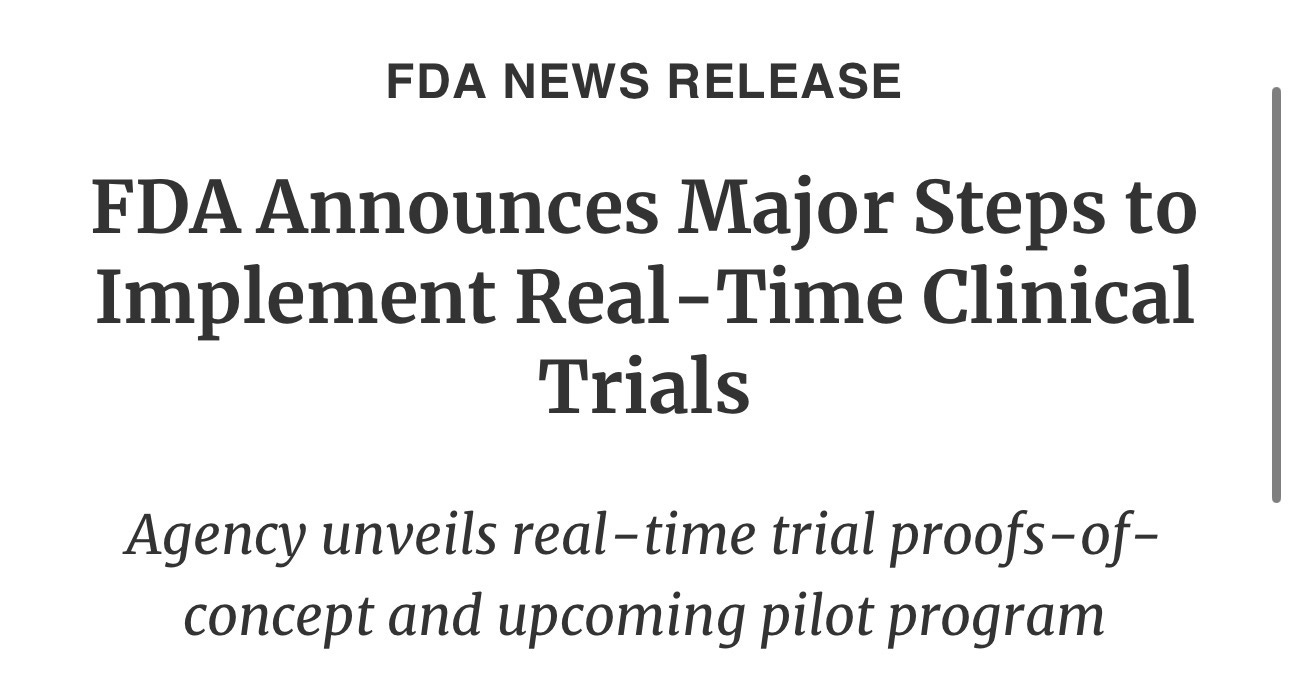
- April 28, 2026 FDA press release: two RTCTs already live (AstraZeneca Phase 2 lymphoma, Amgen Phase 1b SCLC), Paradigm Health validated as ingestion layer, RFI open through May 29, pilot selection by summer, stated long term goal is continuous trials across all phases.
- Surface coverage: 20 to 40 percent timeline compression, AI in regulatory review, global competitive framing vs China.
- Real read: phase 1, 2, 3 were never properties of biology. They are properties of how long a paper based regulator took to review batched submissions. ~45 percent of drug development time is administrative dead time per FDA estimates surfaced in Reuters coverage.
- Knock on effects: tranched venture financing breaks, milestone licensing structures break, real options pricing of biotech assets breaks, catalyst calendar trading on the buy side breaks.
- Founder sized holes: continuous reg affairs OS, signal schema and aggregation layer, real time biostatistics, automated DSMB tooling, native streaming CRO, signal aware patient recruitment, regulator grade audit trail, streaming intelligence for the buy side, parametric trial insurance.
- Incumbent risk: large CROs and EDC platforms (IQVIA, Medidata, ICON, Veeva) make money on the latency they are about to lose. Retrofit loses to native architecture.
- Watch list: RFI responses May 29, pilot cohort August, first non pilot sponsor opt in early 2027, first big CRO M&A targeting a streaming native player.
Table of contents
The setup nobody is pricing in
Phase gates as latency artifacts, not biology
What actually breaks when streaming becomes default
The new control plane and where the value migrates
Companies that should exist and probably will
The CRO incumbent problem and why retrofit loses
The financing primitive rebuild
What to watch for in the next eighteen months
The setup nobody is pricing in
The FDA dropped a press release on April 28 that read like incremental modernization and was actually a quiet detonation of the phase gate construct that biotech has been trading around for forty years. Two real time clinical trials are already live. AstraZeneca’s Phase 2 lymphoma study and Amgen’s Phase 1b small cell lung program are streaming signals to the agency through Paradigm Health’s platform. The RFI is open through May 29. Pilot cohort selection is targeted for summer. The stated long term goal, written in the press release in plain English, is continuous trials across all phases. Most of the coverage led with the AI angle and the 20 to 40 percent timeline compression numbers, which is the surface read and also the wrong read. The deeper thing, the one that breaks valuation models and licensing deal templates and the entire muscle memory of how biotech finance works, is that phase 1, phase 2, and phase 3 were never properties of biology. They were properties of how long it took to clean and lock and ship batched data to a regulator who reviewed it as a document. Strip the latency out and the phases stop being a natural unit. That is what is actually being announced here, even though nobody on the FDA side has said it out loud yet.
Podcast Episode Part II
Phase gates as latency artifacts, not biology
The clinical trial phase structure is one of those things that everyone treats like it descended from physics. It did not. Phase 1 came out of post thalidomide rulemaking in the early 1960s as a way to gate dose escalation when the only feedback loop available was a paper case report form mailed back to the sponsor. Phase 2 emerged as a separate construct because nobody had a way to look at signal of efficacy in real time, so you needed to stop, breathe, write a report, hand it to a reviewer, wait, and then decide whether to spend Phase 3 money. Phase 3 was the pivotal because that is what a regulator could plausibly review on a reasonable timeline given a stack of paper. Each transition point existed because the data flow between site and regulator had a six to twelve month round trip. Phases were the round trip made visible. They are the architectural shadow of latency.
This is the thing that gets buried under the AI framing. About forty five percent of drug development time is administrative dead time. That number, which the FDA has been quoting and Reuters surfaced again last week, is the gap between when biology actually answered the question and when the regulator and sponsor finished serializing the answer. Forty five percent. The drug worked or did not work months before anyone in the system officially knew. Phases are the institutional artifact that lets that latency feel acceptable, because if you call the gap a phase transition you can charge a milestone payment for it and put a step up in the cap table. If you call it dead time you have to admit you wasted nine months of patent life waiting for someone to send a TIFF.
Continuous data flow does to phases what email did to the post office’s first class mail business. The boundaries do not get faster. They stop existing as boundaries. If the FDA can see efficacy and safety signals as they accumulate, on a near real time cadence with aggregated daily or weekly cuts, then the question of what phase a trial is in becomes a labeling exercise rather than a structural one. You are not in Phase 2 because the data you are collecting is structurally different from Phase 3 data. You are in Phase 2 because someone wrote Phase 2 on the protocol cover page. The agency’s stated long term direction, continuous trials across all phases, is the endgame where that label stops carrying weight.
What actually breaks when streaming becomes default
The interesting destruction is downstream. Biotech finance, at every level, is built on the assumption that there are a small number of discrete information events per asset, separated by long periods of no new data, and that each event is binary enough to support a step function in implied value. Series A funds the IND and Phase 1 readout. Series B funds Phase 2 readout. Series C and the public market window sit around Phase 3. Licensing deal economics use upfront plus milestones plus royalties, and the milestones almost always trigger off phase transitions because phase transitions are clean, dated, observable events that two parties can agree happened. Real options pricing for biotech assets uses phase conditional probabilities of advancement, the famous Phase 1 to 2 around sixty percent, Phase 2 to 3 around thirty, Phase 3 to approval around fifty eight, that get plugged into rNPV calcs in every BD model on every laptop in every pharma corp dev shop. Comps tables organize companies by phase of lead asset. Analyst coverage is structured around catalyst calendars built on phase readouts.
Replace the discrete event with a continuous stream and every one of those structures stops working in its current form. The question is no longer when the Phase 2 readout drops, because there is no readout, there is a curve, and the curve has been visible to the regulator and probably leaked in some form to the market for months. Milestone payments for phase transition become harder to define when the transition is a regulatory decision made on a rolling basis rather than a discrete checkpoint. The clean step function valuation lift that funds get to mark up between rounds becomes a smoother, harder to game accumulation. Investor day decks that have lived for decades on the phrase Phase 2 data expected H2 26 lose their shape. None of this is hypothetical. This is what continuous regulatory ingestion does to the information architecture of the entire sector if it actually scales.
The new control plane and where the value migrates
The FDA’s announcement does not just compress timelines. It rewrites the control plane of where data flows in clinical trials. The traditional architecture is well known to anyone who has ever sat through an EDC vendor pitch. Site collects on case report forms and source documents, sponsor or CRO ingests through an EDC platform, monitors clean and query, biostats locks the database at the end of the study, medical writing assembles the CSR, regulatory affairs packages and submits through eCTD, FDA reviews on its own clock. Latency between any two adjacent layers can be days for the cleanest stages and months for the messy ones. Total round trip site to regulator on a meaningful answer, frequently north of a year.
The RTCT architecture, as described in the press release and the trade coverage, replaces the back half of that flow with a direct streaming path. Site or trial platform pushes signals into an aggregation layer that lives at Paradigm Health or whatever schema the FDA eventually standardizes on. The agency consumes those signals as a continuous feed, looking at adverse event rates, efficacy endpoints, trajectory trends, recruitment health, protocol deviations, on whatever cadence makes sense. Crucially, and this is the detail that gets glossed over, the FDA is not ingesting raw patient level data. It is consuming aggregated signals. Privacy is preserved by aggregation upstream, not by some opaque promise from a CRO that the data has been suitably anonymized. That puts a substantial chunk of value in the layer that sits between sponsor systems and regulator ingestion, because that layer is where standardization happens. Whoever defines the schema for an adverse event aggregation, an efficacy curve at week four, a protocol deviation rate, owns the most valuable real estate in the new stack.
The historical analog here is FIX in equity trading. Before FIX, every broker dealer had its own messaging format for trade orders, and integrating any new counterparty was a custom engineering project. FIX standardized the messaging primitives and effectively created a public utility layer that everyone built on top of. The thing that captured value was not FIX itself, which is just a protocol. It was the platforms that became the most reliable and feature rich implementations of FIX, and the data products that aggregated across the now standardized flow. Bloomberg ate that opportunity in market data. The various ATSs ate it in trading. There is a comparable opening here for whoever ends up controlling the canonical clinical signal schema between sponsors and FDA, and the analytics products built on top of it.
Companies that should exist and probably will
This is where it gets interesting for founders, because a regulatory announcement of this scale generates a fairly predictable cluster of company shaped holes that someone will fill in the next three to five years. The trick is identifying the holes with enough precision to actually go build, rather than waving at AI and claiming a category.
The first obvious one is the continuous regulatory affairs operating system. Today’s regulatory affairs function is built around batched submissions. eCTD publishing tools, gateway management, document version control, all of it assumes you are assembling a snapshot at a point in time and shipping it. Continuous regulatory affairs looks completely different. You need a system that maintains a live view of what the agency is currently seeing on each of your assets, manages exception flags when signals diverge from expected, surfaces draft protocol amendments with simulated regulatory impact, and gives the head of reg affairs at a sponsor a dashboard that looks more like a trading desk than a Sharepoint folder. None of the current incumbents in regulatory information management are remotely architected for this. There is room for a venture scale company built natively for streaming reg ops, with the right design partners and a reasonable shot at being acquired by a Veeva or a Certara within a decade.
The second is the signal schema and aggregation layer itself. The FDA is not going to write the schema by itself. It will issue guidance, standardize on the most credible reference implementation, and let the market converge. Paradigm Health is currently the visible incumbent because they got the proof of concept contract, but that does not lock them in and the historical pattern in healthcare standards is that the first mover almost never wins long term. The opportunity is a company that builds the canonical translation layer between every major EDC, ePRO, eCOA, and lab system on one side, and the FDA’s emerging signal schema on the other, with native support for the privacy preserving aggregation primitives the agency cares about. Differential privacy, k anonymity, secure aggregation across sites. Treat this like the Plaid moment for clinical trial data. Plaid did not win on banking UX. They won by sitting in the integration seam and making the whole connected fintech stack work. Same shape of opportunity here.
The third is real time biostatistics as a productized service. Traditional biostats was structured around interim analyses and final database lock. You did your sample size calc upfront, ran your blinded review at a pre specified point, locked the database, and ran your final analysis. Continuous data flow makes this look quaint. The natural mathematical framework for streaming signals is Bayesian, with posterior updates as data arrives, predictive probability of success, continuous monitoring boundaries that adjust for repeated looks. Frequentist trial design under a streaming regulator is going to feel as anachronistic as paper CRFs do today. There is a company to be built that productizes Bayesian adaptive design with a regulatory ready interface, that any sponsor biostats team can plug in without hiring a Frank Harrell tier consultant. The total spend on biostats consulting in industry is large, the vendor market is fragmented, and the regulatory tailwind is now explicit.
The fourth is the automated data safety monitoring board. DSMBs in their current form meet quarterly, look at safety summaries, and write a memo. That cadence becomes farcical when the FDA itself is seeing signals on a daily or weekly basis. The new DSMB looks like an always on system that flags safety signals against pre specified thresholds, escalates to a human committee when needed, and produces an audit trail the agency can rely on. There is a real product here, plausibly sold as a service to sponsors with an embedded committee of clinical experts, that replaces the current cottage industry of DSMB consulting firms. Expect a few academics to start it.
The fifth, and this is where it gets fun, is a CRO 2.0 built natively for streaming. The traditional CRO business model makes most of its margin on data management, monitoring, and clinical operations. Streaming data flow with automated query resolution and continuous regulator visibility takes a hatchet to all three. The natural founder for this is a senior ops person from one of the big five CROs who looks at the org chart, sees how much of it is people doing latency arbitrage, and goes off to build a thirty person company that does the same throughput on a tenth of the headcount. The economics for the sponsor are obvious. The economics for the founder are also obvious if they do it right. Expect to see at least three of these in seed or Series A within twelve months of pilot selection.
The sixth is patient recruitment with signal aware matching. Recruitment is currently slow because it relies on site networks pushing patients into trials that may or may not actually be enrolling at the right pace. With real time visibility into trial status, including which arms are filling, which sites are underperforming, which inclusion criteria are turning out to be the binding constraint, you can build a recruitment engine that looks much more like programmatic ad bidding. Patient match scores update against trials whose status is visible in near real time. There are existing players in this space. None of them are architected for streaming trial state.
The seventh is a regulator grade audit trail. If the FDA is consuming continuous signals, every signal needs cryptographic provenance. Who computed it, when, on what version of the data, with what algorithm. This is the kind of problem that historically blockchain people kept trying to solve and never had a real customer for. The customer just showed up. Append only logs with regulator readable attestations, signed at the trial site or sponsor level, with a chain of custody back to the underlying patient encounter. Boring infrastructure, real durable demand, defensible over time because once it is in the FDA’s expected stack, switching is a regulatory submission rather than a commercial decision.
The eighth is streaming intelligence for the buy side. If the structure of biotech market events changes from discrete catalyst readouts to continuous accumulation, the analyst workflow changes. Today’s tools, the FactSets and the various biotech specific platforms, are organized around catalyst calendars and event windows. The new tool looks more like a Bloomberg terminal for clinical signal flow, with sponsor and asset level views into what trial trajectories are doing. There are obvious privacy and disclosure issues to navigate, since the FDA explicitly is not making this data public, but second order signals like trial registration updates, site activation patterns, recruitment velocity, and IRB filings will all get more rich in the streaming world. Someone will build the data product. The buy side will pay for it because they always do.
The ninth is parametric insurance for clinical trials. Trial failure risk is currently underwritten in opaque, deal by deal ways through milestone structures and contingent value rights. Continuous signal flow makes parametric structures feasible. Insurance that pays out if a pre specified efficacy curve falls below a threshold by a given week. Reinsurance for sponsors against specific safety signal triggers. This is the kind of product that did not have a data substrate before. Now it does. Expect the first version to come from a Lloyds syndicate or a specialty reinsurer, and the venture version to follow.
That is nine company shaped holes, and there are more. Continuous IRB review tooling. Site network operating systems built for streaming compliance. Synthetic control arm products that use streaming external data. Decentralized trial primitives that finally have a regulatory partner who can actually consume the data they generate. The list compounds.
The CRO incumbent problem and why retrofit loses
The standard objection to all of this is that the incumbents will simply add streaming features and crush the new entrants on distribution. This objection is reasonable in most enterprise software categories and wrong in this one for a specific structural reason. The big CROs and EDC platforms make their money on the latency they are about to lose. IQVIA’s clinical operations business, Medidata’s monitoring tooling, ICON’s data management line items, all of these are priced on the assumption that data flow is a multi step human in the loop process. When the FDA asks for streaming, those revenue lines compress. The natural response from an incumbent CFO is to slow walk the transition, charge customers a premium for streaming features, and protect the existing book. That is exactly the playbook that lets new entrants take the category.
The historical comparison is straightforward. When cloud arrived, the on prem incumbents added cloud features and called themselves cloud companies. Some of them survived. Most of the value capture went to the natively cloud players who did not have an on prem book to protect. AWS and Snowflake did not win on marketing. They won because they did not have to defend a prior architecture. Veeva itself is the canonical example in life sciences, having taken the entire content management category in pharma from incumbents who tried to retrofit. The same dynamic repeats here. The companies that win the streaming clinical trial stack will be the ones that look at a blank whiteboard and design for the streaming case from day one, not the ones bolting a Kafka topic onto a fifteen year old monolith.
The other objection is that pharma is too conservative and will simply not adopt. This is the reasonable take from anyone who has actually worked in pharma and watched how long it takes to get a vendor approved. It is also wrong here, again for a structural reason. The FDA itself is creating the demand. When the agency runs a pilot and starts publishing what the participating sponsors learned, every other sponsor gets nervous about being left behind on review timelines. AstraZeneca and Amgen are not in the pilot because they lost a coin flip. They are in it because their corp dev teams figured out that being the first to learn what the new regulatory game looks like is worth more than the cost of being a guinea pig. Once the second wave of sponsors signs up, the holdouts will look like the pharma companies that refused to adopt risk based monitoring in 2013. They will get there eventually and will pay more on the way.
The financing primitive rebuild
The other domain of opportunity, more abstract but plausibly larger, is the financing primitive layer. Biotech capital structure is built on phase gates. Tranched financing in venture, milestone payments in licensing, real options pricing in BD, catalyst event trading in the public markets, all of it. If phase gates dissolve into curves, somebody has to build the new primitives.
The simplest version is rolling milestone structures. Instead of a phase 2 milestone, a licensing deal triggers payments based on accumulating evidence against pre specified signal thresholds. This sounds like a small change. It is not. It requires legal templates, agreed signal definitions, dispute resolution mechanisms when sponsors and partners disagree about whether a threshold was hit, escrow infrastructure that releases funds as signals confirm. There is a firm to be built that becomes the canonical drafter of streaming era licensing deals, the way certain firms became the canonical drafters of biotech option pools or SAFEs. Cooley, Goodwin, Pillsbury are all positioned to lead but are also conservative and will probably hire boutique experts rather than build it natively.
A more interesting version is signal indexed venture financing. Rather than tranches gated on phase transitions, a Series B might commit a fixed amount of capital that releases on a curve indexed to a pre specified efficacy or safety trajectory. This is closer to revenue based financing in software, where the capital release is tied to actual performance rather than discrete events. The math is harder. The legal structures do not exist yet. The first fund that figures this out captures a meaningful structural advantage in deal flow because they can offer founders smoother capital access than the traditional tranche model.
The most ambitious version is a public market product. ETFs and indices today track biotech by phase composition, which is going to age poorly. There is a product to be built that tracks signal velocity across a basket of assets, weighted by something like the predictive probability of success implied by the streamed data. This is the equivalent of moving from dividend yield to total return as the organizing principle for biotech indexing. The first credible version of this index will become the benchmark and the rest of the industry will be quoted relative to it. Whether this comes from a buy side firm, a dedicated startup, or an exchange remains open.
What to watch for in the next eighteen months
The thesis here is real and also fragile. There are several specific things that, if they happen, validate the bigger picture, and several specific things that, if they happen, suggest the announcement was more incremental than it appears.
The validating signals to watch for include the volume and quality of the RFI responses by May 29, particularly whether large sponsors beyond AstraZeneca and Amgen file substantive comments rather than safe consensus position papers. The pilot selection cohort by August matters less for who is in than for whether the FDA names a defined signal schema as part of the pilot conditions. The first non pilot sponsor to voluntarily opt in to streaming oversight, probably in early 2027, is the moment the dynamic shifts from FDA push to industry pull. M&A activity in the CRO space, particularly anything that looks like a big five CRO acquiring a small streaming native player, signals the incumbents agree the threat is real.
The signals that would suggest the announcement was overhyped are also clear. If the pilot stays at two sponsors for more than a year. If the RFI responses come back loaded with privacy and operational objections that the FDA chooses to accommodate rather than overrule. If Paradigm Health stays the only ingestion option and no schema standardization happens. If the next FDA Commissioner walks the initiative back. Any of these is plausible. None of them individually kills the long term direction, because the underlying physics of cheap data flow and AI assisted review are not going to reverse. They could slow it by years.
The honest read is that the most likely scenario is a messy, partial implementation that takes longer than the optimistic case and shorter than the pessimistic case. Two pilots becomes ten by 2028. Continuous trials across all phases happens in oncology first, where the Phase 1 to 2 to 3 distinction was already the most artificial, and rolls into other therapeutic areas more slowly. The financing primitive rebuild happens in fits and starts as the first big licensing deal blows up over a streaming era milestone definition and forces the lawyers to actually write new templates. The CRO disintermediation happens in slow motion as new entrants take share at the margin and incumbents retrench around their stickiest customers.
Through all of that, the founders who started building in 2026 against the streaming clinical trial stack will be the ones in position when the architecture actually scales. The phase gate construct has been dying since the first wearable shipped data continuously. The FDA just gave it a date.