
Video Preview
🎧 Part I Podcast free on Apple Podcasts and Spotify.

🎧 Part II Podcast episode for paid subscribers only. Also available on Apple Podcasts and Spotify.
To listen to paid episodes in Apple or Spotify, link your Substack subscription via the show settings on those platforms (instructions inside the Substack app under Subscriptions → Podcast).
Table of contents
The plumbing everyone pretends to understand
What the bill actually broke, with dates
The cash flow hole is the product
A lender for supplemental payments
The thirty five dollar copay nobody has ever collected
Churn as an asset class
Why banks will not do this and PE-backed RCM will do it badly
How it dies
What to fund
Abstract
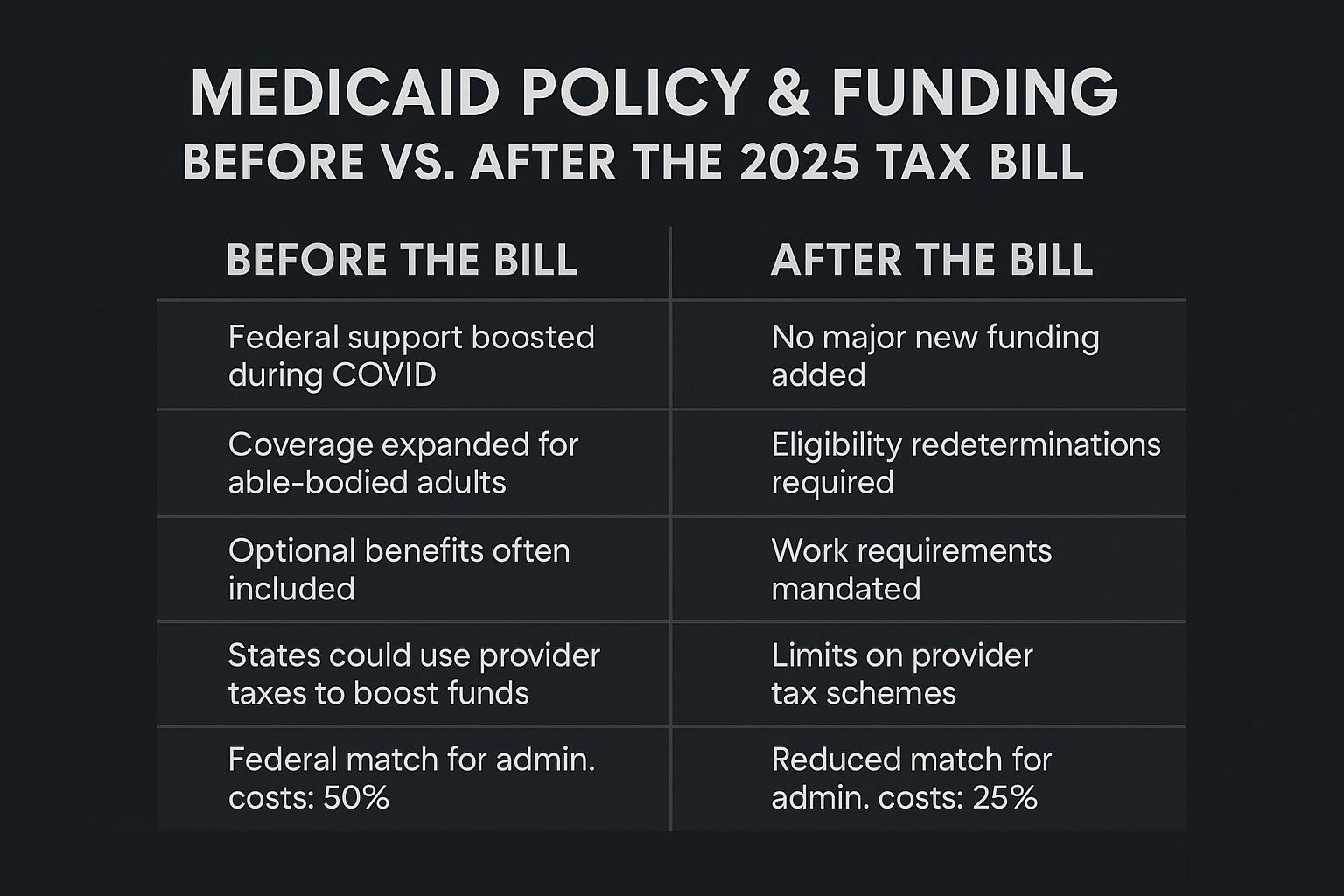
OBBBA (P.L. 119-21, signed July 4, 2025) rewires the nonfederal share of Medicaid: provider tax safe harbor steps down from 6% to 3.5% of net patient revenue in expansion states between FY2028 and FY2032, new taxes are frozen at enactment, uniformity waivers for MCO taxes are gutted, and state directed payments get capped at Medicare rates with legacy programs stepping down 10 points a year starting in 2028.
Layered on top: work requirements by Jan 2027, six-month redeterminations for expansion adults, retroactive coverage cut to one month for that population, and up to $35 per-service cost sharing on expansion adults above 100% FPL starting Oct 2028.
CBO scores roughly $0.99T in federal Medicaid and CHIP reductions over ten years and about 8-10M more people losing Medicaid or CHIP coverage by 2034, translating into millions more uninsured. Hospitals do not lose that money evenly; they lose it in specific, dated, lumpy chunks tied to supplemental payment programs that already pay 6 to 18 months late.
Three fintech shapes fall out of that: (1) a specialty lender advancing against supplemental payment receivables through the 2028 to 2031 transition, (2) a point-of-service and payment plan layer for a Medicaid population that has never received a bill, and (3) a coverage-churn recovery business that buys or finances self-pay AR contingent on re-enrollment inside the new shortened retro window.
The first is the real venture, mostly because commercial banks find hospital supplementals too strange to underwrite and the people who understand them are actuaries and Medicaid finance directors, not lenders. The other two are adjacent and defensible but sit closer to turf PE-backed RCM already circles.
Main risks: Congress stretching the schedule, states backfilling with general fund money, and the asset class literally shrinking on purpose. Underwrite it as a transition product with a hard sunset and a pivot into general safety-net liquidity.
The plumbing everyone pretends to understand
Start with the thing that is technically public knowledge and yet somehow only about four hundred people in the country actually get: the nonfederal share of Medicaid is not mostly state general fund money. A big slice of it, something in the range of a sixth to a fifth nationally and way more in some states, comes from taxes levied on the providers who then receive the Medicaid payments. The hospital pays the state, the state books that as its match, the feds send down FMAP on top of it, and the state hands most of the pile back to hospitals as supplemental payments. Everybody in the loop is better off except the federal treasury, which is why Washington has been trying to strangle this arrangement since roughly the Bush administration and why it never quite dies.
Forty nine states plus DC run at least one provider tax. Alaska is the holdout and Alaska is the holdout on most things. The rules that kept this from being an unlimited money printer were the safe harbor and the uniformity requirement. Safe harbor said if your tax stays under 6% of a provider class’s net patient revenue, CMS will assume you are not just laundering federal dollars and will not make you prove a hold harmless test. Uniformity said you have to tax the whole class the same way and cannot, say, tax Medicaid managed care plans at ten times the rate you tax commercial plans, which is exactly what California did with its MCO tax and which exactly what several other states copied once they saw it work.
The money comes back through three main pipes. Upper payment limit programs for fee for service, which top hospitals up to what Medicare would have paid. Disproportionate share payments, which have their own separate drama and were not touched here. And state directed payments, which are the managed care version of UPL and which ballooned from a rounding error in 2017 to over $110B in annual approved spend by 2024 according to MACPAC’s count. SDPs are the one to watch, because SDPs are where the provider tax dollars mostly go now, and SDPs are what the bill went after hardest.
One more piece of plumbing before the fun part. None of this money shows up when the service happens. A hospital treats a Medicaid patient in January. The base capitation payment from the MCO shows up on a normal claims timeline. The SDP uplift for that encounter gets calculated after the quarter or the year closes, flows through the MCO on whatever schedule the state contract says, and is subject to CMS having approved the preprint for that rating period, which itself often happens retroactively. UPL payments are typically annual. So a meaningful share of a safety-net hospital’s Medicaid revenue is a receivable with a twelve to eighteen month tail, a counterparty that is a state government, and an approval dependency on a federal agency. If that does not sound like a fintech asset, keep reading anyway, because it is about to become a fintech asset with a countdown clock.
What the bill actually broke, with dates
The One Big Beautiful Bill Act is a very long document that does a lot of things, and the Medicaid section is a very long chapter that does a lot of things, so the exercise here is to pull out the provisions that change hospital cash flow and pin each one to a date. Dates matter because the whole thesis rests on the losses being predictable.
Provider taxes first. As of enactment, no new provider taxes and no increases to existing ones. If you were below the ceiling, you are stuck there. Then the ceiling itself moves, but only in expansion states. Starting in federal fiscal year 2028, meaning October 1, 2027, the safe harbor for expansion states drops half a point per year: 5.5% in FY2028, 5% in FY2029, 4.5% in FY2030, 4% in FY2031, and 3.5% in FY2032 and forever after. Nursing facilities and intermediate care facilities are carved out of the phase-down, which tells you who had the better lobbyists in June 2025. Non-expansion states keep 6% but cannot touch anything. So the map now has a hard split: Texas and Florida hospitals keep their tax revenue frozen in amber, while California, New York, Michigan, Ohio and the rest of the expansion world watch it step down on a schedule you could put in a spreadsheet today.
Uniformity second. The bill codifies what CMS had already been signaling in rulemaking, which is that the MCO tax trick of taxing Medicaid plans far more heavily than commercial plans no longer qualifies as uniform. States that already had these taxes get a transition window, up to three fiscal years at the Secretary’s discretion, but the direction is one way. California’s MCO tax alone was moving something on the order of $7B to $8B a year through the system. That is not a rounding error for a state budget or for the hospitals and physician groups the state promised it to.
State directed payments third, and this is the one that hits hospital P&Ls the hardest. New SDPs submitted after enactment are capped at 100% of the Medicare rate in expansion states and 110% in non-expansion states. Programs approved before enactment that pay above that cap, and there are plenty paying at average commercial rate, step down 10 percentage points per rating period starting January 1, 2028 until they hit the cap. Rural hospitals got a slightly kinder grandfather date. The practical effect is that a hospital in an expansion state currently receiving an SDP at, say, 180% of Medicare will see that uplift shaved to 170, 160, 150 and so on each year until it lands at 100. Depending on its starting level, that is a multi-year glide path for the most generous programs and a much shorter one for the middling ones.
Now the enrollment side, because it drives volume and payer mix, which drives the base against which all of the above is calculated. Work requirements for expansion adults ages 19 to 64, 80 hours a month of work, school, or community engagement, must be live by January 1, 2027, with hardship extensions available to December 31, 2028 for states that can show a good faith effort. Redeterminations for expansion adults go from annual to every six months for renewals after December 31, 2026. Retroactive coverage drops from 90 days to 30 days for expansion adults and 60 days for everyone else as of January 1, 2027. And starting October 1, 2028, states must impose cost sharing of up to $35 per service on expansion adults with income above 100% of the federal poverty level, capped at 5% of family income, with primary care, mental health, substance use, and FQHC and rural health clinic services exempt.
CBO’s read on all of this, give or take a revision, is roughly a trillion dollars less federal Medicaid and CHIP spending over the ten year window and on the order of 8-10 million fewer people enrolled in Medicaid or CHIP by 2034, many of whom will end up uninsured at least part of the time. The provider tax provision on its own was scored around $190B. SDP limits around $150B. Work requirements and associated eligibility tightening around $320-330B, mostly through people falling off the rolls rather than through anyone actually going to work. The point is not the total. The point is that every one of those numbers has a start date and a slope.
The cash flow hole is the product
Here is where the mental model needs to shift from policy analysis to balance sheet. A hospital does not experience the OBBBA Medicaid provisions as a policy. It experiences them as a series of holes in a fourteen month cash flow forecast, each hole a different size and shape and each arriving on a different date.
Consider a mid-sized safety-net system in an expansion state. Call it $2B in net patient revenue, 35% Medicaid by volume, running a hospital tax at 5.8% of net patient revenue and receiving SDP uplift that brings Medicaid managed care rates to roughly 150% of Medicare. In FY2028, the tax cap drops to 5.5%, so the state either cuts the tax and shrinks the pool or backfills with general fund money it does not have. The SDP starts stepping down in January 2028, so the uplift drops to 140% of Medicare. Meanwhile, six month redeterminations started a year earlier and the expansion adult population is churning, so a chunk of what used to be Medicaid volume is now self-pay volume with a 30 day retro window instead of 90. By October 2028 that system is also supposed to collect $35 copays from patients who have never seen a bill from a hospital in their lives.
Each of these lands on a different line of the forecast. The tax cut hits the supplemental payment receivable. The SDP step-down hits the same receivable but on a different clock. The churn hits gross revenue and bad debt simultaneously. The copay creates a new receivable category from scratch. None of them are fatal individually. Together they compress operating cash in a way that the hospital’s existing credit facility was not sized for, and the bank that provided that facility is going to look at a Medicaid supplemental payment schedule and ask what a preprint is.
This is the opportunity. Not the losses themselves, which are just losses, but the timing mismatch between when the losses are known and when the cash actually moves. A hospital CFO in an expansion state can tell you today, with unusual precision, how much supplemental revenue will disappear in each of the next five years. That precision is rare in healthcare and it is the raw material of a lending business. Fintech, at its core, is the business of pricing predictable cash flows that traditional lenders find too weird to touch. Medicaid supplementals are about as weird as it gets, and they just became predictable.
A lender for supplemental payments
The core company is a specialty finance shop that advances cash against expected supplemental payments, structured somewhere between receivables factoring and a revolving facility, sold to safety-net and rural hospitals in expansion states during the 2028 to 2031 transition.
The mechanics look like this. The lender builds a model of each state’s SDP, UPL, and provider tax programs, including the approved preprints, the rating periods, the MCO pass-through schedules, and the statutory step-down. For each hospital client, the lender estimates the supplemental receivable for the next four to six quarters, applies a haircut for state payment timing risk and federal approval risk, and advances a percentage against it. The hospital gets cash in month one instead of month fourteen. The lender takes a spread that reflects the counterparty being a state government, which is not nothing, but is a very different credit than a commercial payer or a patient. When the supplemental actually arrives, it pays down the advance. Rinse and repeat, with the advance amounts shrinking each year on the statutory schedule.
Why does this work as a product and not just as a slightly exotic bank loan? Three reasons, and none of them are secrets, they are just things banks have decided not to learn.
First, the underwriting is program-specific, not hospital-specific. A regional bank underwrites a hospital by looking at days cash on hand, EBITDA margin, and the general obligation of the system. A supplemental payment lender underwrites the state program. Is the preprint approved through the rating period? Has the state historically paid on time? Did the legislature fund the state share in the budget that just passed? Is the MCO contract clear about pass-through timing? This is Medicaid finance expertise, the kind that lives in state Medicaid agencies, in a few actuarial firms, and in the finance departments of hospital associations. It does not live in commercial lending. A company that hires that expertise and turns it into a credit model has a moat that looks a lot like the moat a specialty pharma royalty lender has: everyone could in principle do it, nobody else has bothered to build the models.
Second, the client cannot get this money anywhere else at a reasonable price. Safety-net hospitals are exactly the systems with the weakest credit profiles, the thinnest margins, and the highest dependence on supplementals. The muni bond market is closed or expensive to a lot of them. Their bank lines are sized to normal operations. Private credit has mostly not touched them because the story was too complicated. The bill just made the story simple: here is a dated cash flow, here is a dated loss, bridge the gap.
Third, the asset shrinks on a known schedule, which is bad for the total addressable market and great for the credit risk. A lender can size each facility knowing that next year’s supplemental will be smaller by a statutorily defined amount. That is a rare luxury. Most receivables lending has to model the counterparty’s business going sideways in ways nobody predicted. This one has the going-sideways written into federal law with a start date.
The numbers are large enough to matter. If SDPs alone were running north of $124B a year in approved spend by 2025, and the bill compresses the above-Medicare portion over several years, the pool of supplemental receivables outstanding at any moment is tens of billions of dollars. Even a small share of that flowing through a specialty lender with a few hundred basis points of spread is a real business. Add UPL and the tax-funded FFS supplementals, and the addressable receivable base is comfortably big enough for a venture-scale credit company, at least through the phase-down period.
The obvious objection is that this is a melting ice cube. Correct. The statutory glide path means the supplemental receivable base in expansion states is smaller every year, and by the time the SDP step-downs finish, the business is advancing against a fraction of what it started with. The honest response is to build it that way on purpose. Structure the company as a transition-period lender with a hard sunset on the supplemental product and a plan to migrate the client base into general safety-net liquidity products by year four. The relationships built by being the only lender who understood a hospital’s Medicaid finance in 2028 are the relationships that get you the working capital line, the equipment financing, and the receivables factoring on commercial and Medicare AR in 2033. The supplemental product is the wedge. The wedge does not need to last forever, it needs to last long enough to build a book of hospital clients that nobody else bothered to court.
The thirty five dollar copay nobody has ever collected
Second idea, smaller, adjacent, and weirder. Starting October 1, 2028, expansion adults with income above 100% of FPL owe up to $35 per service for a lot of non-exempt care, and the hospital is the one who has to collect it.
Think about what this population looks like from a billing office’s perspective. They have never received a hospital bill. They do not have a card on file. A meaningful share do not have a bank account, and a larger share do not have a credit history that any of the standard propensity-to-pay models can read. The hospital’s existing patient financial services stack was built for commercially insured patients with deductibles and for uninsured patients being screened for charity care. Neither workflow fits someone who is technically insured, technically owes $35, and is technically capped at 5% of an income the hospital does not know.
The natural instinct is to say the hospital will just eat it. Some will, and the bill does not let states drop providers for refusing to collect. But the copay is real revenue, the volume is enormous, and a system treating hundreds of thousands of expansion adults a year is looking at seven or eight figures of new patient responsibility that its current tools cannot touch. It is not the size of the copay that matters, it is that no infrastructure exists for it.
A fintech here is a point-of-service and post-service collection layer purpose-built for the Medicaid copay. Card-on-file at registration with a hard cap logic that knows the 5% of income ceiling and stops charging when it hits it. Payment plans denominated in amounts that make sense for someone earning $16,000 a year, which means single digit dollars a month, not the $50 minimums built into commercial tools. Integration with the state’s eligibility data so the tool knows whether this patient is above or below 100% of FPL and whether this service is exempt, because primary care, behavioral health, and SUD visits carry no copay and the last thing a hospital wants is to bill a copay it was legally barred from collecting. A bad debt module that sorts uncollectible copays into a bucket that can be reported for uncompensated care purposes. And, because this is a fintech and not a billing utility, a financing product that lets the hospital sell the copay receivable at a discount to a buyer who has better data on this population than the hospital does.
The unit economics are thin. Thirty five dollars, minus whatever the tool charges, minus collection cost, is not a lot of money per transaction. What makes it interesting is that the volume is the entire expansion adult population above 100% of FPL in every state that expanded, and that there is a clear regulatory date after which every hospital in those states needs the tool on the same morning. That kind of synchronized, regulatorily mandated demand is what lets a thin margin business get to scale fast enough to matter.
The competition is the existing patient payments vendors, and they will absolutely try to bolt this on. Their problem is that their propensity-to-pay models were trained on commercial patients and their workflows assume a patient who understands what a deductible is. Building for Medicaid patients means starting from cash, prepaid cards, and payment plans measured in dollars, which is a different product with a different data spine. The incumbents can build it. Whether they build it before October 2028 and whether they build it well are open questions, and open questions are where startups live.
Churn as an asset class
Third idea, and the one that sits closest to the data-heavy end of the health tech world. The combination of six month redeterminations, work requirements, and a 30 day retro window is going to produce a very large population of people who lose Medicaid coverage for procedural reasons, show up at a hospital while uncovered, and are in fact eligible if someone bothers to re-enroll them.
The experience with work requirements in Arkansas in 2018 and with the post-pandemic unwinding in 2023 and 2024 both showed the same pattern: the majority of disenrollments were procedural, not substantive. People did not fail the eligibility test, they failed to return a form, or did not know there was a form, or moved and never got the form. Under the old rules, a hospital that treated one of these patients had 90 days of retroactive coverage to get them re-enrolled and bill Medicaid for the visit. Under OBBBA, expansion adults get 30 days. That window is now short enough that a hospital’s existing eligibility vendor, which typically works a self-pay account weeks after discharge, will miss it routinely.
The fintech shape here is a company that buys or finances self-pay accounts from expansion adults at a discount, contingent on the company’s ability to get the patient re-enrolled inside the retro window and convert the self-pay account into a Medicaid claim. The hospital gets cash now for an account it was going to write off. The company takes the enrollment risk and the timing risk and keeps the spread between what it paid for the account and what Medicaid reimburses. Think of it as receivables factoring where the receivable does not technically exist yet and the factoring firm’s job is to create it.
The data spine is what makes this a health tech company rather than a collections agency. The company needs to know, at the moment of registration or ideally before, that this patient was on Medicaid six months ago, that they fell off for a procedural reason, that they are likely still eligible, and that the state’s re-enrollment process can be completed inside 30 days. That means real-time eligibility data, historical enrollment data, work requirement exemption logic, and a workflow that starts at the front desk rather than in the business office. It is the kind of thing that a company with deep access to provider data and state eligibility systems could build faster than anyone else, which is a not-so-subtle observation about who the natural founders are.
The competition is the existing eligibility and enrollment vendors, several of which are owned by private equity and bolted onto larger RCM platforms. They will point out, correctly, that they already do Medicaid enrollment for hospitals. What they do not do is take balance sheet risk on the outcome. They charge a contingency fee when they succeed and walk away when they do not. A company willing to buy the account outright and eat the failures is offering the hospital something different: certainty, today, in exchange for a discount. Whether the discount is attractive depends on how good the company’s eligibility prediction is, which is exactly the kind of model that gets better with scale and worse in the hands of a vendor that treats it as a side business.
Why banks will not do this and PE-backed RCM will do it badly
It is worth being clear-eyed about who else could build each of these, because the answer shapes what kind of company to fund.
Commercial banks are the natural lenders to hospitals and they will not build the supplemental payment product. Not because it is unprofitable but because it requires a credit committee to understand Medicaid financing at a level that no regional bank has ever needed. Bank hospital lending is asset-based and covenant-based. It looks at the whole system. A supplemental payment facility looks at a single state program and prices the state’s likelihood of funding and paying it on schedule. Getting a bank credit committee comfortable with that would require the committee to learn what a preprint is, what a rating period is, why the CMS approval letter sometimes shows up after the payment, and why the state legislature’s budget process affects the receivable. That is a year of education for a product line that shrinks by statute. Banks will let a specialty lender do it and then buy the specialty lender in 2031, which is a perfectly fine exit.
Private credit funds have the appetite and the sophistication and lack the origination. A fund could absolutely buy a book of supplemental payment advances. What it cannot do is call two hundred safety-net CFOs, explain the product, model each state’s program, and paper the deals. Origination in this market is a relationship business run by people who have sat in hospital association finance committee meetings and know which state Medicaid directors actually pay on time. Private credit is the capital, not the company.
PE-backed RCM platforms are the competitor for the copay and churn businesses and they will try both. The problem is structural. RCM platforms make money on contingency fees against collected dollars, and their whole operating model is optimized for maximizing collections on accounts that already exist. Taking balance sheet risk on accounts that do not exist yet, or building a payment tool for a population whose average balance is $35, is off-strategy for a business that measures itself in percent of net collections on commercial AR. They will build something, it will be a bolt-on, it will be priced like everything else they sell, and it will be run by people whose bonuses depend on the commercial book. That is not a knock on the platforms, it is a description of why the copay and churn products can be built by a focused company and sold or partnered into those platforms later.
The founders who can actually build these are a specific type. They have worked in Medicaid finance at a state agency or a hospital association, or have run a supplemental payment program at a large safety-net system, or have built eligibility and enrollment products and understand the state data plumbing. They are not, in general, fintech people. Fintech people can be hired. The Medicaid finance knowledge is the scarce input, and it is scarce in a way that does not show up on a resume search, because the people who have it mostly do not think of themselves as founders and have never talked to a venture investor. Finding them is the actual work.
How it dies
Every thesis needs a section on how it fails, and this one has several plausible deaths, some of which have already been rehearsed in Congress.
The first is delay. The provider tax phase-down does not begin until October 2027 and the SDP step-downs do not begin until January 2028. That is more than a year from the date of this essay, and it spans a midterm election and the start of a new Congress. Hospital lobbies have already made noise about stretching the schedule, and there are members on both sides who represent rural districts full of hospitals that live on supplementals. A two year delay does not kill the lending business, it just pushes the origination window out. A permanent repeal of the phase-down does kill it, at least in the form described here. The odds of full repeal look low given the deficit math and the fact that the provisions are the pay-fors for other things the majority wanted, but low is not zero and the company needs to be structured to survive a delay.
The second is state backfill. When the safe harbor drops, a state has a choice: shrink the supplemental pool or replace the lost tax revenue with general fund dollars. Most states will not have the general fund dollars, which is the whole point of the provision, but a few will, and those states’ hospitals will not need bridge financing. California and New York are the obvious candidates to backfill some portion. That reduces the addressable market in exactly the states with the most supplemental dollars. The counterargument is that even in backfilling states, the timing lag on supplementals does not go away, and a lender that advances against the receivable still has a product. It is just a smaller product.
The third is that the ice cube melts faster than expected. If states respond to the tax cap by restructuring their supplementals more aggressively than the statutory minimum, the receivable base could shrink ahead of the schedule the company modeled. This is a modeling risk rather than an existential one, and the mitigation is conservative advance rates and short tenors. Nobody should be writing a three year facility against a supplemental payment in 2029.
The fourth is specific to the churn business: states get better at redeterminations. If ex parte renewal rates climb and procedural disenrollments fall, there are fewer people falling off the rolls and fewer accounts to buy. This would be good for everyone except the company. The unwinding experience suggests states are not going to get good at this quickly, and the six month cadence roughly doubles the number of opportunities to mess it up, but a company built on administrative failure is a company with a ceiling.
The fifth is boring: regulatory scrutiny of the lending itself. A specialty lender advancing against Medicaid supplementals is, in effect, arbitraging federal matching dollars, and there are people at CMS who would not love that framing. The mitigation is that the lender never touches the Medicaid dollars directly. It advances against a hospital’s expected receivable, the same way any receivables lender does, and the state pays the hospital exactly as before. Nothing about the flow of funds changes. But a public story about hedge funds profiting from Medicaid cuts writes itself, and a company in this space should have its communications strategy figured out before the first story runs, not after.
What to fund
Stripped down, the recommendation is this. The supplemental payment lender is the venture. It has a defensible moat built on expertise nobody else has bothered to acquire, a client base nobody else is courting, a receivable base measured in tens of billions, and a credit profile that is unusually predictable because Congress wrote the loss curve into the law. It is a transition product with a sunset, and it should be built and funded as one, with a clear plan to migrate the client relationships into general safety-net liquidity products before the supplemental book winds down. The exit is a bank or a private credit platform buying the origination engine and the book sometime around 2030 or 2031, at which point the founders will have built something that looked impossible to underwrite in 2026 and looked obvious in hindsight.
The copay product and the churn product are real but smaller and closer to incumbent turf. They make sense as products inside a company that already has deep provider data and state eligibility access, or as focused startups that plan to sell into the RCM platforms within a few years. The churn business in particular is a data company wearing a factoring company’s clothes, and the right founding team is one that starts from the eligibility data and adds the balance sheet, not the other way around.
The common thread is that OBBBA did not just cut Medicaid. It turned a set of vague, politically contingent, slow-moving cash flows into a set of dated, sloped, statutorily defined ones. Predictability is the raw material of finance. Healthcare has never had much of it on the Medicaid side, and now, for a five year window in expansion states, it does. The window closes in 2032. The companies that get built before it closes will own the safety-net hospital relationships that everyone else ignored while they were busy building yet another prior auth tool. That is not a bad place to be standing when the ice cube finally melts
.