Welcome to Healthcare Markets & Technology.
Rigorous analysis of AI, policy, capital, technology, and clinical operations across U.S. healthcare — written for the people who build, invest in, and lead it.
Free subscribers get 2 public articles per week. Upgrade to paid → for the full 7 articles/week, paid podcast episodes, deal breakdowns, and the complete 538-deep-dive archive.
Subscribe or upgrade here →
One thing to bookmark: the searchable Knowledge Base at kb.onhealthcare.tech isn’t in Substack’s menu. Save it now — on mobile, tap share → “Add to Home Screen.”
Reply to any email with questions. I read every one.
— Trey
Table of Contents
The Timing Is Not a Coincidence
The 2.4% Update and What the Numbers Look Like
The Non-Hospice Spending Crisis Nobody Talks About
Operation Never Say Die: When the Data Becomes a Mugshot
SSVI: CMS Finally Gets a Fraud Scorecard
Making the Election Addendum Mandatory
The Wage Index Problem and the BLS RFI
MAID, Palliative Care, and the Policy Frontier
Quality Reporting Gets a Shaming Mechanism
So What Does This Mean for Investors and Builders
Abstract
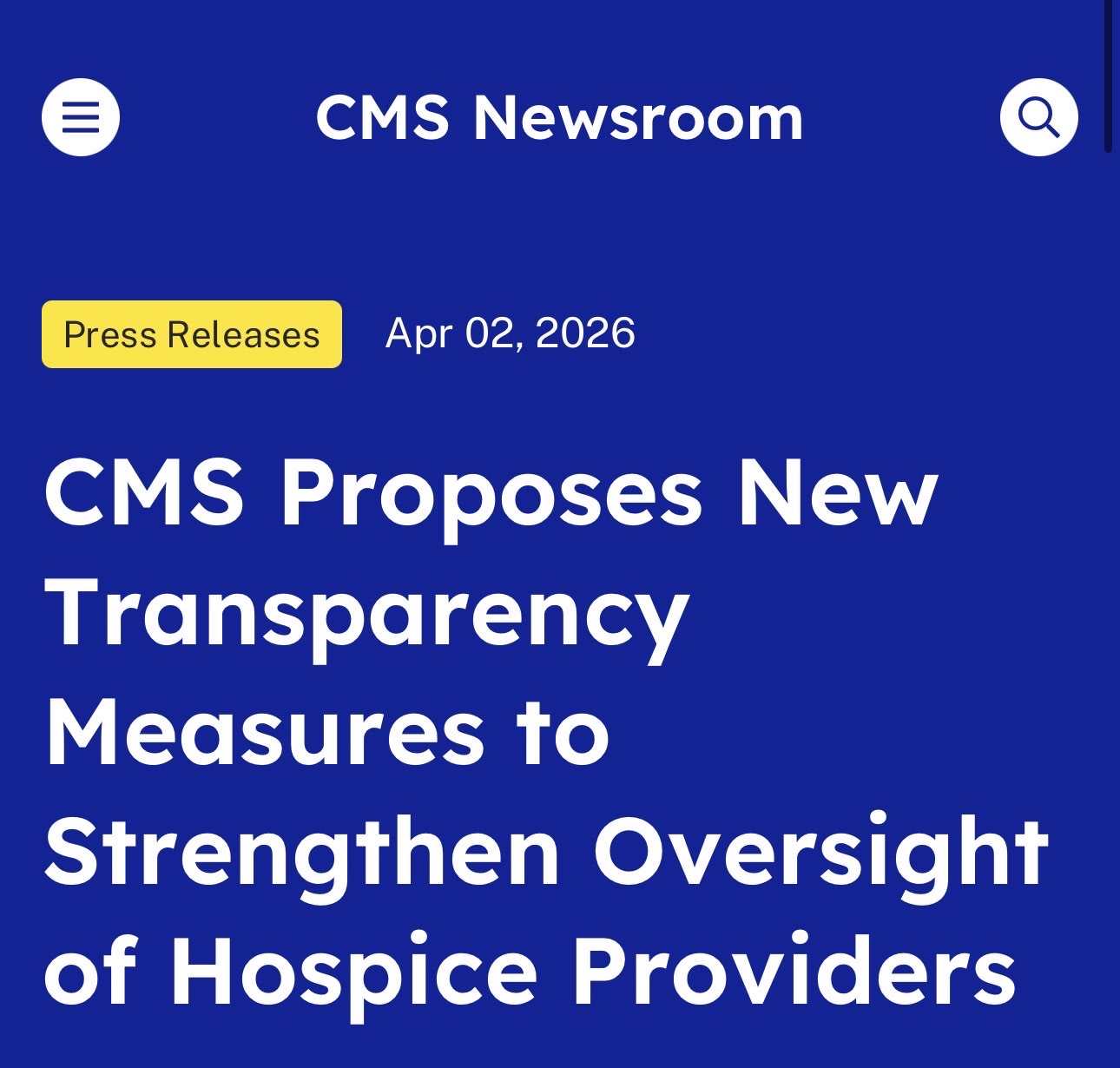
CMS published its FY 2027 Hospice Wage Index and Payment Rate Update as a proposed rule (CMS-1851-P) on April 6, 2026, two days after Operation Never Say Die arrests in LA
Operation Never Say Die: 15 defendants charged, 8 arrested, $60M in alleged Medicare fraud across LA County; one nurse had an 85% non-death discharge rate, nearly 5x the national average
More than 700 of approximately 1,800 hospice providers in LA County alone have triggered multiple fraud red flags; CMS Administrator Dr. Oz stated in April 2026 that he believes roughly half of LA’s hospices are fraudulent
CMS has revoked 220 hospice approvals in California in 10 weeks; suspended 221 providers in a single week (up from 70 the prior week)
Estimated $3.5B in fraudulent Medicare reimbursements from LA County alone per House Oversight Committee
Total estimated financial impact of FY 2027 rule: $785M in increased payments to hospices
Proposed payment update: 2.4% (hospital market basket 3.2% minus 0.8% productivity adjustment)
New payment rates: RHC days 1-60 rises from $230.83 to $236.56; RHC days 61+ from $181.94 to $186.53; GIP from $1,199.86 to $1,232.71; hospice cap to $36,210.11
Non-hospice spending during a hospice election hit $2.8B+ in FY 2024 across Parts A, B, and D, up from $1.3B in FY 2020
Skin substitute billing during hospice stays went from $18M to $714M in four years
For-profit hospices averaged 167% higher non-hospice spending per day vs. non-profits in FY 2024, up from 60% in FY 2022
CMS introduces SSVI (Service and Spending Variation Index), a 0-16 score across nine metrics for each hospice, scoring 6,642 to 6,735 providers; published for FY 2024 and FY 2025
Election statement addendum proposed to become mandatory for all elections, not just on request
RFI on BLS-based hospice-specific wage index to replace the IPPS hospital wage index
RFI on MAID, currently legal in 11 states and DC
Care Compare tool to get a non-compliance icon for quality reporting failures, no earlier than FY 2028
Non-compliance with quality reporting was 23.53% of hospices in FY 2025, despite a 4-point APU penalty
Enhanced CMS oversight already active in AZ, CA, NV, TX, GA, and OH; more than 200 Medicare enrollment revocations in the four original states alone
The Timing Is Not a Coincidence
On April 2, 2026, FBI agents in Los Angeles fanned out across Covina, Anaheim, Glendale, and Lakewood before 6 a.m., executing arrest warrants on doctors, nurses, a chiropractor, and a psychologist. By the time the press conference wrapped downtown, federal prosecutors had charged 15 people in a scheme they called Operation Never Say Die, a $60 million Medicare hospice fraud ring spanning nine separate investigations across Southern California.
The same day, CMS published its FY 2027 Hospice Wage Index and Payment Rate Update proposed rule. That timing was not accidental. CMS Administrator Dr. Oz stood at the Operation Never Say Die press conference alongside FBI and DOJ officials and said publicly that he believes roughly half of the hospice providers operating in Los Angeles County are fraudulent. For context, LA County has somewhere around 1,800 hospice providers. Nationwide there are about 6,600. That means roughly one-third of all hospices in the entire country are concentrated in a single county, which Dr. Oz called out by name as immediately suspicious. One building in Van Nuys had 197 registered hospice companies on a single address. Another plaza housed 89.
The proposed rule and the enforcement action are best read as companion documents. The rule codifies the measurement infrastructure and transparency mechanisms. The arrests show what the measurement infrastructure is meant to catch.
The suspects in Operation Never Say Die follow a pattern that is by now disturbingly familiar to anyone tracking hospice fraud enforcement. Recruiters approach people at grocery stores, offering them $300 a month to pose as dying patients. A nurse named Lolita Minerd ran a hospice in Artesia that submitted over $9.1 million in fraudulent Medicare claims, collecting $8.5 million. Her hospice had a survival rate of 85%, which is approximately five times the national average for a population supposed to have a six-month prognosis. A couple named Gladwin and Amelou Gill, both of whom had prior tax evasion convictions that should have barred them from operating a hospice, opened one using their daughter’s name and collected over $4 million in Medicare payments. A 76-year-old woman named Nita Palma allegedly ran three fraudulent hospice operations while simultaneously incarcerated in a federal prison in Seattle and free on bond for a separate prior fraud case. A single dermatologist was associated with 63 different hospice facilities across California and billed Medicare more than $35 million in 2025 alone.
The House Oversight Committee estimates that Medicare was defrauded roughly $3.5 billion in LA County alone from fraudulent hospice reimbursements. JD Vance’s Anti-Fraud Task Force, which led the Operation Never Say Die coordination, has suspended 221 hospice providers in a single week, up from 70 the prior week. Federal authorities have said they expect clusters of similar takedowns every few months as the 2026 enforcement initiative continues to audit high-billing hospice agencies nationwide. CMS has already revoked 220 hospice approvals in California in just 10 weeks, a pace Dr. Oz noted was approaching what the Newsom administration accomplished in four years.
All of that is the fire. The FY 2027 proposed rule is the sprinkler system. Neither one alone is sufficient.
The 2.4% Update and What the Numbers Look Like
The proposed payment update of 2.4% is the hospital inpatient market basket increase of 3.2% reduced by a 0.8 percentage point productivity adjustment. CMS uses IGI’s fourth quarter 2025 forecast and reserves the right to revise if better data arrives before the final rule, which typically lands in August. The total financial impact is estimated at $785 million in increased payments over FY 2026.
Broken out by level of care: RHC days 1 through 60 moves from $230.83 to $236.56. RHC days 61 and above goes from $181.94 to $186.53. Continuous home care at a 24-hour full rate moves from $1,674.29 to $1,728.02, or about $72 per hour. Inpatient respite care goes from $532.48 to $546.46. General inpatient care, which is the acute symptom management level, goes from $1,199.86 to $1,232.71.
Hospices that do not meet quality data submission requirements get the inverse: a -1.6% update instead, which is the 2.4% payment increase minus the 4-point APU penalty. Non-compliant RHC day 1-60 rate drops to $227.32. Non-compliant GIP drops to $1,184.56. This penalty structure was increased from 2 to 4 percentage points beginning in FY 2024, and as discussed later, it has not moved the needle on compliance rates.
The aggregate cap, which limits total annual Medicare payments per patient, is proposed at $36,210.11, up from $35,361.44. The Consolidated Appropriations Act of 2026, signed in February 2026, extended the market basket-based cap update methodology through 2035, meaning the CPI-U approach that originally governed cap increases will not return until at least then.
The Service Intensity Add-On budget neutrality factors for FY 2027 are proposed at 0.9999 for both RHC categories, meaning SIA utilization is essentially flat year over year. SIA pays for direct RN or social worker care in the last seven days of a patient’s life under RHC conditions, capped at four hours per day at the CHC hourly rate. Budget neutrality requires that SIA payments be offset by a slight reduction in the base RHC rate to keep total RHC spending constant.
The Non-Hospice Spending Crisis Nobody Talks About
Buried inside the same proposed rule is a data story that is frankly remarkable in how bluntly CMS tells it. Non-hospice Medicare spending for beneficiaries already enrolled in hospice grew from $790 million in FY 2020 to over $2 billion in Parts A and B alone in FY 2024, a 160% increase in four years. Adding Part D drugs brings the combined FY 2024 total above $2.8 billion. The single-year jump from FY 2023 to FY 2024 was $770 million, or 60 percent growth in one year.
This matters because the hospice per diem is explicitly designed to be all-inclusive. When a patient elects hospice, they waive Medicare payment for services related to their terminal illness outside the hospice benefit. The hospice receives a daily rate covering essentially everything. Every dollar billed outside the hospice benefit during a hospice election is, at minimum, a compliance question and, at worst, a fraud signal.
The driver that stands out most aggressively in the CMS data is carrier and physician supply claims. Those grew 317.5% from FY 2020 to FY 2024. The largest single diagnosis within that category is pressure ulcers, almost entirely from skin substitutes, which went from $18 million to $714 million, a roughly 4,000% increase over four years. CMS made major changes to skin substitute reimbursement effective January 1, 2026, transitioning most products to a national unified rate of approximately $127.14 per square centimeter under a new incident-to classification designed to end the ASP-plus-6-percent billing model that created this runaway incentive. The problem is that the 2020 through 2024 data shows the escalation in full and CMS is not pretending it was accidental.
The breakdown by diagnosis is even more pointed. For patients with neurological and degenerative conditions like Alzheimer’s and Parkinson’s, there was roughly $576 million in non-hospice DME and carrier claims in FY 2024, plus $205 million in Part D. For circulatory and cerebrovascular patients, about $590 million in non-hospice DME and carrier claims plus $276 million in Part D. CMS asks directly in the rule: why are bronchodilators being billed to Part D for a respiratory hospice patient? Why is oxygen being billed separately when the hospice per diem is supposed to cover it? Why are anticoagulants, beta blockers, and vasodilators appearing as outside claims for heart failure patients in hospice?
The for-profit versus non-profit split is the most politically damaging data point. Beneficiaries receiving hospice services from for-profit providers averaged 167% higher non-hospice spending per day compared to patients in non-profit hospice care in FY 2024. That same gap was 60% in FY 2022, meaning it nearly tripled in two years. And 67% of all non-hospice spending occurred after election day 60, meaning this is not a phenomenon concentrated in the enrollment adjustment period. It is chronic and systematic.
Operation Never Say Die: When the Data Becomes a Mugshot
The $2.8 billion non-hospice spending figure and the 167% for-profit premium on outside billing are aggregate statistics. Operation Never Say Die translates that aggregate into individual criminal defendants.
The structural pattern is consistent across the LA cases: open a hospice using someone else’s name or credentials if your own history makes you ineligible, recruit non-dying patients via cash kickbacks paid to referral agents and directly to beneficiaries, submit claims to Medicare for services that are either medically unnecessary or never happened, and collect reimbursements until you get caught or go out of business. The beneficiaries collecting $300 a month from Lolita Minerd are the supply side of a demand driven entirely by Medicare’s per diem payment structure.
The per diem pays whether or not any service is rendered on a given day. Under the routine home care level, which is the dominant billing category, a hospice can collect $236 per day for a patient who is visited once a week for 20 minutes. The incentive to enroll ineligible, relatively healthy patients who do not require intensive services and to keep them enrolled as long as possible is not subtle. An 85% survival rate at one of the defendant hospices, when the eligibility standard is a six-month terminal prognosis, is not a statistical outlier. It is business model documentation.
The clustering patterns CMS and DOJ identified in LA County make this worse. When 197 hospices share a single address in Van Nuys or 89 share a single commercial plaza, what you are looking at is a systematic exploitation of CMS’s enrollment processes. California instituted a moratorium on new hospice licenses in 2021, but the enforcement gap between when fraud begins and when licenses get revoked gave existing fraudulent operators years to run at scale. Authorities found that initial fraudulent activity in the Operation Never Say Die cases goes back as early as 2018, with some cases not reaching arrest stage until April 2026, an eight-year window.
Federal authorities have explicitly said they expect this to become a rolling national enforcement campaign, with clusters of similar takedowns across high-billing hospice markets every few months. CMS has already expanded enhanced oversight beyond the original four states, Arizona, California, Nevada, and Texas, into Georgia and Ohio. The pattern recognition work CMS is doing at the aggregate level in the proposed rule, particularly the SSVI, is designed to create the targeting infrastructure for that campaign nationally.
SSVI: CMS Finally Gets a Fraud Scorecard
The SSVI, or Service and Spending Variation Index, is a new scoring system published for the first time in this proposed rule. Each of the roughly 6,600 active hospices gets a score between 0 and 16, calculated from nine claims-based metrics. CMS is publishing FY 2024 and FY 2025 SSVI data alongside the proposed rule, covering 148 million and 156.5 million hospice days respectively.
The nine metrics are: providing no CHC and no GIP service at all, which gets 1 point; percentage of RHC days delivered in a nursing home or skilled nursing facility at 40% or above, 1 point; percentage of last two RHC days of life with visits at or below the 25th percentile (which was 85.7% in FY 2025), 1 point; live discharge rate at or above the 75th percentile (47.5% in FY 2025), 1 point; percentage of discharges with length of stay over 180 days at or above the 75th percentile (33.2% in FY 2025), 1 point; average skilled nursing minutes per RHC day at or below the 25th percentile (9.8 minutes per day in FY 2025), 1 point; weekend RHC days with a skilled visit at or below the 25th percentile (4.8% in FY 2025), 1 point; live discharges where the beneficiary returns to the same hospice within 7 days at or above the 75th percentile (15% in FY 2025), 1 point; and total non-hospice spending, scored on an 8-tier scale worth up to 8 points.
The non-hospice spending scoring structure is where the index gets most of its discriminatory power. The tiers run from 1 point for any non-hospice spending below $6,352 per year up to 8 points for the highest-spending eighth of hospices, which starts above $517,204. Because this single component can contribute up to 8 of the 16 possible points, SSVI scores are heavily loaded toward the non-hospice spending signal. That design is not accidental. The other metrics capture operational patterns like thin visit volumes, high live discharge rates, and long stays, which are the utilization signatures that federal investigators found in every Operation Never Say Die defendant’s claims history.
The SSVI was clearly not designed as a quality improvement instrument, despite CMS framing it carefully that way. CMS says directly in the rule that a high score signals a hospice that may require additional targeted education or oversight, including medical review, education, and investigations that could result in payment suspension and revocation if fraud, waste, or abuse is identified. That is law enforcement language dressed in program integrity clothing. The SSVI is the data infrastructure that gives CMS a ranked list of providers to hand to enforcement teams for prioritization.
For context, the defendant hospice with an 85% non-death discharge rate would score near the maximum on at least two or three SSVI metrics immediately: the live discharge rate metric, almost certainly the length of stay distribution metric, and potentially the non-hospice spending metric depending on how much outside billing accompanied the phantom care. That kind of multi-metric clustering is exactly what CMS says it is looking for.
For health tech investors, the SSVI is a new public data asset that creates an entire product category. Provider benchmarking, competitor quality intelligence, referral network risk assessment, post-acute analytics, and M&A diligence for hospice operators all now have a publicly available claims-derived 0-to-16 score updated annually. Companies that can contextualize that score alongside payer mix, staffing ratios, length of stay distributions, and operational benchmarks have a product with obvious buyers across payers, IDNs, referral platforms, and PE-backed hospice roll-ups trying to distinguish clean assets from liability-laden ones.
Making the Election Addendum Mandatory
The hospice election statement addendum explains to patients in plain language what the hospice benefit covers, what it does not cover, and what happens to their Medicare coverage for outside services once they elect hospice. Since the FY 2020 rule created it, hospices have only been required to provide it upon patient request. That provision is remarkably toothless given the information asymmetry between a patient enrolling in hospice during a medical crisis and a provider who knows exactly what the benefit covers and what they intend to bill elsewhere.
CMS is now proposing to make it mandatory at the time of every hospice election. This is procedurally straightforward but operationally significant at scale. Every intake workflow across 6,600 providers needs to be updated to include delivery, documentation, and patient or representative acknowledgment of the addendum. The connection to the fraud backdrop is direct: an informed patient who understands that her hospice is supposed to be covering wound care is better positioned to ask uncomfortable questions when that same care suddenly appears as a separate Medicare charge.
For technology vendors operating in hospice intake, documentation, and compliance, this is a clear new workflow requirement. The implementation window before the FY 2027 effective date of October 1, 2026 is short enough that any provider without a streamlined addendum delivery and documentation process is already late.
The Wage Index Problem and the BLS RFI
The hospice wage index has used the pre-floor, pre-reclassified hospital inpatient wage index as its base since the mid-1990s. The problem with this proxy is that hospital labor cost data is built around acute inpatient staffing, primarily physicians, specialists, and inpatient nurses, while hospice labor is predominantly hospice aides, registered nurses working in community settings, and social workers. The occupational mix is fundamentally different, and in many labor markets, especially rural ones, the divergence between hospital wages and community home-based care wages is substantial.
CMS convened a Technical Expert Panel in September 2025 and is now formally soliciting comment on a potential hospice-specific wage index using Bureau of Labor Statistics Occupational Employment and Wage Statistics data. The proposed methodology is detailed: calculate CBSA-level wage estimates for 10 occupational categories, weight them by a national occupational mix derived from freestanding hospice cost report expense data and claims-based minutes of care, divide by the national aggregate to produce an index value, then apply the existing hospice floor and 5% cap on decreases.
The proposed occupational mix from that methodology is revealing. Hospice aides at 38.11% of the mix and registered nurses at 28.46% account for nearly two-thirds of the weighting. That is a very different picture from what drives hospital wage indexes, where physician compensation and specialty nursing play much larger roles. The remaining 10 occupational categories cover nursing administration, physician services, LPNs, medical social services, nurse practitioners, and therapists.
A shift to BLS-based hospice-specific wage indexing would produce winners and losers across markets. Rural areas where hospice labor costs diverge significantly from hospital labor costs stand to see payment rate changes that could run into the millions of dollars annually for larger operators. The transition policy question CMS is explicitly soliciting input on matters enormously for anyone modeling long-run operating economics in the hospice space.
This is a multi-year policy signal rather than a one-year action. But the combination of a completed TEP, a detailed methodology document, and structured public comment questions covering data sources, occupational mix, geographic delineation, and transition design suggests this is moving toward implementation within a few rulemaking cycles. Anyone doing capital allocation in hospice operations, whether as an operator, a PE sponsor, or an early investor, needs this uncertainty in their underwriting assumptions.
MAID, Palliative Care, and the Policy Frontier
Two RFIs in this rule are genuinely forward-looking in ways that are easy to overlook given the fraud enforcement drama surrounding it. The medical aid in dying section and the community palliative care section both signal a CMS that is actively mapping the policy edges of end-of-life care.
On MAID: the Assisted Suicide Funding Restriction Act of 1997 prohibits federal funds from paying for any service intended to cause or assist in causing death. That law has not changed. What has changed is the number of states legalizing MAID, currently 11 states plus Washington DC, with more moving in that direction. The eligibility requirement in most state MAID laws is a six-month terminal prognosis, which is identical to the Medicare hospice eligibility standard. That means a meaningful and growing population of hospice-enrolled patients in MAID-legal states are simultaneously eligible for both programs.
CMS wants to understand what actually happens in practice. Do hospices continue providing clinical care while a patient pursues MAID qualification? Do patients remain on service until natural death or revoke election to pursue MAID? What happens with unused lethal medications? The questions are operational rather than philosophical, and the underlying policy concern is making sure federal hospice payments are not directly or indirectly subsidizing MAID services, which the 1997 law explicitly prohibits. CMS is also asking whether additional oversight mechanisms are needed to enforce that prohibition more reliably.
The community palliative care RFI is the longer-term signal. Medicare does not have a standalone palliative care benefit. Patients who need serious illness support but have not yet elected or are not eligible for hospice fall into a patchwork of Part B evaluation and management codes, advance care planning CPT codes 99497 and 99498, chronic care management codes, and limited home health coverage. CMS is asking whether these existing pathways can be optimized to produce more seamless community palliative care without requiring new legislation or a new benefit category.
For investors and founders building in the serious illness population management, advance care planning, or community-based palliative care delivery spaces, this RFI is a material signal. CMS is explicitly naming the pre-hospice transition zone as a policy priority and asking for detailed input on billing practices, care gaps, documentation burdens, and staffing barriers. The infrastructure built on top of the existing billing code landscape today will be positioned as the natural foundation if a more formal palliative care pathway emerges in future rulemaking.
Quality Reporting Gets a Shaming Mechanism
The HQRP section of this rule continues the transition from the old Hospice Item Set to the newer HOPE assessment tool with the iQIES platform. The novel proposal is the Care Compare icon.
Roughly 20 to 24 percent of hospices have been non-compliant with quality reporting requirements in recent fiscal years. In FY 2023 the rate was 20.07%. In FY 2024, the first year of the 4-point APU penalty, it rose to 22.06%. In FY 2025 it peaked at 23.53% before settling to 20.37% in FY 2026. The doubling of the financial penalty from 2 to 4 percentage points has produced essentially zero improvement, and the non-compliance rate has never dropped below 20%.
The proposed response is a consumer-facing icon on the Medicare.gov Care Compare tool identifying hospices that failed the 90% HOPE submission threshold. The icon would appear on both the provider search page and individual hospice profile pages, similar to how penalty flags appear for nursing homes and hospitals. It is proposed to go live no earlier than FY 2028, based on CY 2026 submission data.
The logic of public shaming outperforming financial penalties in this setting is actually defensible. The APU penalty hits cash flows that a financially distressed or fraudulent operator may not care about. A visible compliance failure flag on the primary consumer-facing comparison platform hits something different: referrals. Hospices depend heavily on physician referrals and on family choices made during acute medical transitions. A red flag on Care Compare, visible to any family member running a quick search, creates reputational exposure that financial penalties do not. For fraudulent operators, CMS non-compliance flags are also input data for enforcement prioritization, which makes the icon a dual-purpose tool.
For health IT vendors in the hospice documentation and quality reporting space, this creates a hard deadline and a clear value proposition. Getting clients above the 90% submission threshold before October 2027 is now a competitive differentiator, because the CY 2026 data used for the FY 2028 icon is being generated right now.
So What Does This Mean for Investors and Builders
The FY 2027 hospice proposed rule and Operation Never Say Die land in the same week for a reason. CMS is simultaneously writing the infrastructure rules and executing the enforcement actions, and both are accelerating. Dr. Oz’s statement that he believes roughly half of LA’s hospices are fraudulent, if anything close to that is accurate nationally even at a fraction of the LA intensity, represents one of the largest active fraud situations in any Medicare sector.
For investors, there are a few distinct opportunity signals here. The SSVI creates a new public data asset for the post-acute analytics market. Provider benchmarking, referral network quality scoring, and M&A diligence for hospice operators now have a claims-derived 0-to-16 annual scorecard that did not exist before. Analytics companies that can layer SSVI data against operational benchmarks, payer mix, staffing ratios, and length of stay distributions have obvious buyers across payers, IDNs, referral platforms, and PE sponsors managing hospice roll-ups.
The compliance urgency around the mandatory election addendum and the Care Compare icon creates near-term workflow and documentation demand. These are administrative problems that affect thousands of sites simultaneously, and a significant share of the hospice market, particularly smaller independent providers, lack the internal infrastructure to handle them cleanly. That is repeatable revenue for documentation platforms, compliance software, and quality reporting tools already embedded in hospice operations.
The non-hospice spending enforcement trajectory and the SSVI together create genuine demand for care coordination technology that helps hospices manage patients comprehensively within the per diem. The 167% higher outside spending rate at for-profit hospices is not sustainable under the new transparency and enforcement environment. Hospices that can demonstrate comprehensive care delivery and low non-hospice spend ratios will have a competitive advantage in both referral networks and enforcement priority ranking. Technology that helps document, coordinate, and optimize within-benefit care delivery is building into a regulatory tailwind that is only getting stronger.
The BLS wage index transition is a multi-year underwriting risk factor. If finalized, it would change payment rates in specific markets by amounts that could be material to operating margins, particularly in rural and high-wage urban markets where the divergence from hospital labor costs is largest. Anyone deploying capital into hospice operations in markets that diverge significantly from their hospital wage index peers should be modeling this exposure explicitly.
The palliative care pre-hospice transition zone is a medium-term market formation signal. CMS is clearly interested in formalizing community palliative care pathways, is asking detailed questions about billing and delivery gaps, and has named this as a policy priority. Infrastructure built on the existing code landscape today, spanning serious illness population identification, ACP documentation, and community-based care coordination, is well-positioned for the eventual formalization of that pathway.
None of this is an argument that hospice is a sector to avoid. End-of-life care is a demographic inevitability. The need is growing, not shrinking. But the regulatory sophistication required to operate and invest in this space just stepped up significantly. CMS is building real measurement capability, publishing provider-level scores, designing consumer-facing enforcement mechanisms, and coordinating with DOJ on criminal prosecutions at a pace and scale the hospice industry has not seen before. The operators and technology vendors who understand that this is not a temporary crackdown but a permanent infrastructure shift will find themselves on the right side of where this market is going.