Welcome to Healthcare Markets & Technology.
Rigorous analysis of AI, policy, capital, technology, and clinical operations across U.S. healthcare — written for the people who build, invest in, and lead it.
Free subscribers get 2 public articles per week. Upgrade to paid → for the full 7 articles/week, paid podcast episodes, deal breakdowns, and the complete 538-deep-dive archive.
Subscribe or upgrade here →
One thing to bookmark: the searchable Knowledge Base at kb.onhealthcare.tech isn’t in Substack’s menu. Save it now — on mobile, tap share → “Add to Home Screen.”
Reply to any email with questions. I read every one.
— Trey
Abstract
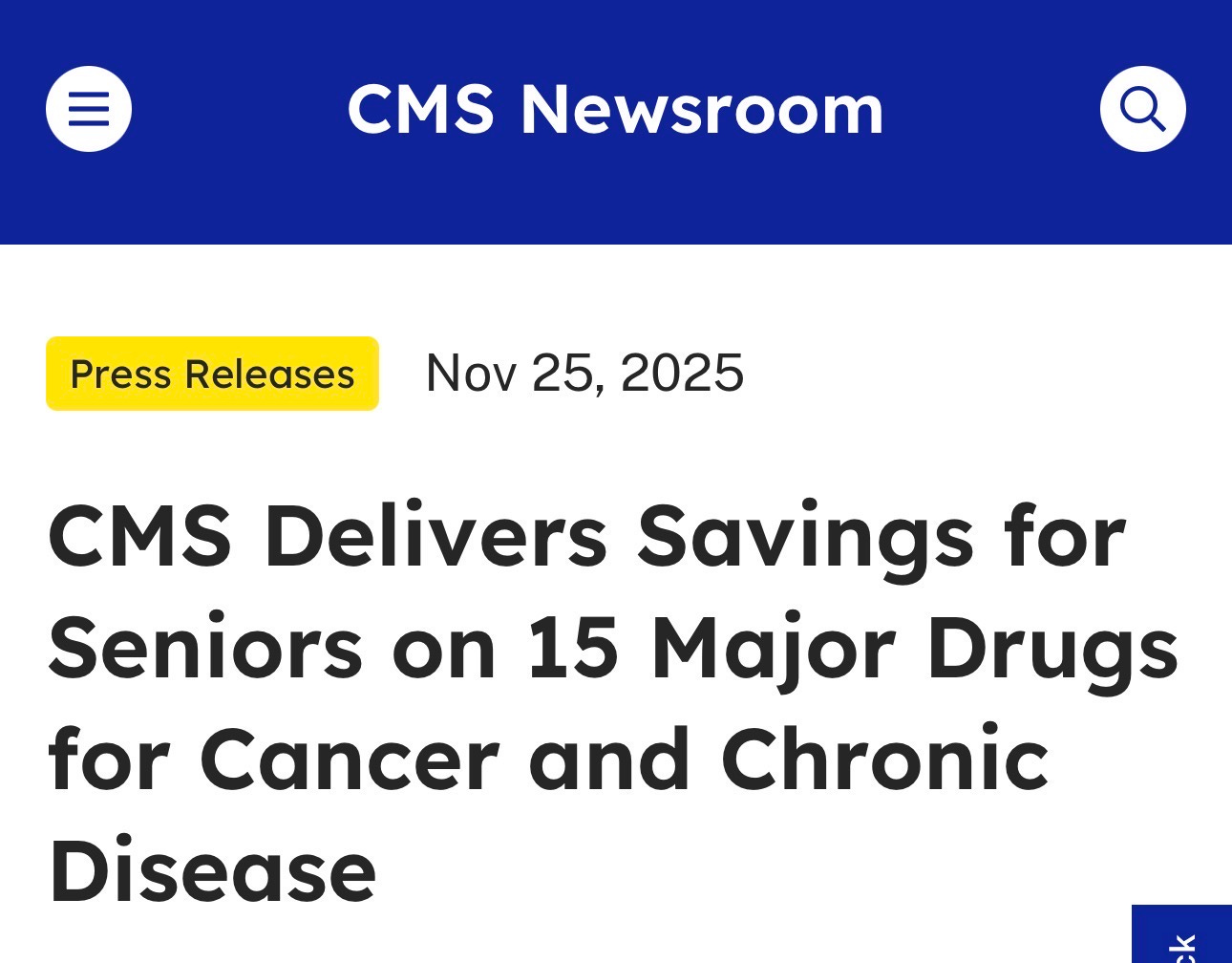
1. CMS reported roughly forty four percent net savings on fifteen high spend drugs after the first cycle of Inflation Reduction Act price negotiations, amounting to about twelve billion dollars in expected federal savings.
2. The Federal Trade Commission moved forward with an action involving Caremark and Zinc Health Services around insulin business practices, marking another step in a broader pattern of enforcement against pharmacy benefit managers and the insulin supply chain.
3. The Inflation Reduction Act’s maximum fair price process is finally producing actual numbers instead of theoretical debate, which lets us map real budget impacts into formularies, low income subsidy programs, and plan bids for twenty twenty seven.
4. The same logic can be projected forward to future negotiation cycles, which gives investors a sense of how specialty pharmacy margins and drug launch strategies might shift under repeated price compression.
5. The insulin enforcement wave is acting like a secondary form of price regulation because it narrows the corridor in which pharmacy benefit manager rebate tactics can operate, independent of the Inflation Reduction Act’s official price caps.
6. Put together, these two developments show how federal pricing policy is evolving into an active control system rather than a symbolic lever, which makes it essential reading for anyone investing in health tech infrastructure, drug benefit optimization, pharmacy tooling, or alternative care delivery.
Table of contents
1. Why this moment in drug pricing is different
2. How CMS reached forty four percent savings on fifteen drugs
3. What those savings actually mean for formularies and plan bids
4. How the maximum fair price logic applies to the next wave of high spend drugs
5. The insulin mess and why the Federal Trade Commission is suddenly part of drug pricing
6. How enforcement pressure reshapes pharmacy benefit manager behavior
7. Why this combination behaves like a federal price control system
8. The practical impact for health tech founders and the investors backing them
9. Where the real investment opportunities sit in a world of shrinking drug price corridors
Why this moment in drug pricing is different
Every few years Washington announces some sweeping drug pricing reform that sounds dramatic but mostly ends up as a bargaining chip in the next budget cycle. The Inflation Reduction Act originally looked like another one of these because the early conversation was almost entirely theoretical. There were charts about maximum fair prices, negotiation timelines, manufacturer fees, and all the usual rhetoric about balancing innovation with affordability. It was all very clean and bloodless and conceptually tidy in a way that made you suspect the real thing would end up endlessly delayed, watered down, or tied up in litigation.
But then CMS released the first actual numbers from the negotiation cycle. Not projections, not models, not political messaging. Actual negotiated price changes on fifteen drugs and an estimate of twelve billion dollars in federal savings that could be traced directly to those negotiations. That snapped everyone back into reality, because it showed the program was not only alive but capable of extracting meaningful concessions from manufacturers. For policymakers, that was validation. For plans and pharmacy benefit managers, it was a warning shot. For investors, it was the first concrete feedback signal that future drug pricing scenarios are going to be shaped by a real, functioning negotiation process rather than a hypothetical one.
At the exact same moment, the Federal Trade Commission escalated an action involving Caremark and Zinc Health Services related to insulin distribution practices. This sounds like a narrow case, but it plugs directly into the entire rebate driven insulin economy. Insulin pricing has been propped up for years by opaque rebate structures, accumulator adjustment programs, spread pricing, list price inflation, and a whole series of tactics that depend on having a wide corridor between the manufacturer list price and the net price paid by plans. When the Federal Trade Commission steps into that world and says some of those flows look like anticompetitive conduct, it implicitly narrows the ability of pharmacy benefit managers to play the margin game.
Now place these two developments next to each other. On the left you have Medicare extracting large, quantifiable savings through maximum fair price negotiations. On the right you have the Federal Trade Commission kneecapping some of the pricing tactics that make insulin and similar drugs profitable for pharmacy benefit managers. Together they create something new, which is a two sided pressure system that works on both the manufacturer side and the intermediary side. Instead of relying on a single policy mechanism, the federal government is now acting through multiple coordinated paths to compress drug pricing from both directions. It is the closest the United States has come to a functional drug price control system, even if nobody wants to call it that out loud.
How CMS reached forty four percent savings on fifteen drugs
To understand why the savings number is so large, you have to unpack how the maximum fair price system actually works. The public narrative makes it sound like a haggling exercise over a conference table, but it is closer to a formula driven budgeting mechanism that takes advantage of the United States market structure.
The baseline for most of these drugs was an average gross price that had been climbing steadily for years. Manufacturers tend to raise list prices annually, often by mid single digits or higher, not because net prices necessarily rise but because the entire supply chain is built on the spread between list price and the various rebates, fees, and discounts. These fifteen drugs include several oncology agents, autoimmune therapies, and chronic disease drugs with large Medicare populations. They have durable demand, limited generic competition, and long pricing histories.
The maximum fair price calculation incorporates international reference points, clinical value assessments, comparative effectiveness, and net price data across public programs. It is not a formula in the rigid sense, but it produces a range that CMS can justify. The negotiation then tends to land near the lower end of that range because CMS has more leverage than any individual plan. When you take a drug with a gross price that has grown for a decade and compress it toward a lower internationally informed benchmark, the net savings for the federal government can be dramatic because the volumes are so high.
Another factor that helps produce that forty four percent savings rate is the structure of Medicare Part D. Part D plans have historically allowed manufacturers to raise list prices in exchange for larger rebates, which lowered net prices but created a huge gap between what Medicare spent and what patients paid. The Inflation Reduction Act’s out of pocket caps, combined with the ability to negotiate prices, reduces the need for high list prices as a rebate optimization strategy. Once CMS pushes the negotiated price down, plans do not gain much from keeping list prices inflated. That reduces the entire rebate stack and directly feeds into lower spending.
This is how you get to twelve billion dollars in savings on fifteen drugs. It is the compound effect of large historical prices, high utilization, and a negotiation process that finally has enough authority to force meaningful price reductions. The significance for investors is that future cycles will likely follow similar dynamics. High spend drugs with long price histories and vulnerable international comparisons are now at the front of the line for enforced price compression.
What those savings actually mean for formularies and plan bids
The interesting part is not just that Medicare saves money. The real action is how these savings ripple through the plan design and bidding ecosystem. Medicare Part D plans bid every year based on projected drug spending, risk scores, reinsurance levels, and competitive market positioning. When the federal government pulls billions out of the top of the drug spending stack, plans have to recalibrate everything downstream.
Formularies are no longer optimized around maximizing rebate flows. They now need to reflect the negotiated maximum fair prices, which changes the relative pricing of therapeutic alternatives. A drug that used to sit on a preferred tier because it generated strong rebates might lose its position if its new negotiated price changes the economics. This produces unusual competitive effects for manufacturers who did not expect their drug to get repositioned late in its lifecycle.
The low income subsidy population also behaves differently when out of pocket costs are capped and when price negotiation reduces net spending. Plans that target the low income subsidy population tend to rely heavily on the difference between low listed premiums and back end reinsurance payments for catastrophic spending. If catastrophic spending falls because negotiated pricing reduces the size of catastrophic claims, the entire subsidy model shifts. Plans will have to rethink how they price bids for twenty twenty seven and beyond because their ability to arbitrage the catastrophic phase becomes limited.
For investors, this matters because the pharmacy benefit segment of the health tech ecosystem often assumes that formulary management and utilization optimization will continue to be shaped by rebates and historical pricing patterns. Now those assumptions are unstable. Tools that help plans recalculate optimal formularies under the new negotiated pricing environment could become essential infrastructure for plan bidding. Companies that rely on optimizing around legacy rebate flows might find their value proposition eroding quickly.
How the maximum fair price logic applies to the next wave of high spend drugs
One of the most important and least appreciated aspects of the Inflation Reduction Act is that the first wave of drug negotiations sets a precedent for the remaining waves. Manufacturers have been trying to argue that the first cycle is a trial run that will be revised after lawsuits and operational challenges. But once CMS demonstrates its ability to extract substantial price reductions on fifteen drugs, it establishes a reference point for future cycles.
Future negotiation cycles will target drugs that have similar characteristics to the first cohort. These include high gross prices, heavy Medicare utilization, limited generic alternatives, and long market durations. Specialty drugs for oncology, immunology, and rare diseases fit this profile. Once these drugs hit their negotiation year, the same logic that produced forty four percent savings the first time will apply with minor adjustments. Even if the actual savings percentage is lower in later cycles, the direction is clear.
Manufacturers are already modeling how maximum fair price logic will affect their revenue curves for drugs launched today. If a drug enters the market with a high price and strong early uptake, it will likely face negotiation pressure once it meets the eligibility criteria. This forces manufacturers to consider earlier price declines than they would have faced in the past. It also weakens the historical strategy of launching at a very high price and relying on annual price increases to maintain margin.
For investors who focus on pharmacy benefit optimization, this is a big shift. It means the specialty pharmacy margin pool may shrink more quickly than expected. It also means that companies whose business models depend on arbitraging high price specialty drugs will need to adapt quickly. The winners will be companies that help plans and providers adapt to compressed pricing and optimize care pathways based on net clinical value instead of rebate economics.
The insulin mess and why the Federal Trade Commission is suddenly part of drug pricing
Insulin is one of the strangest pricing stories in American healthcare. It is over a century old, has stable production processes, and is essential for millions of people. By every intuitive logic, insulin should be cheap. Instead it became one of the most notorious examples of a drug with spiraling list prices, massive rebate flows, opaque supply chain arrangements, and patient cost burdens that made no sense.
This happened because insulin became the perfect substrate for pharmacy benefit manager pricing tactics. Pharmacy benefit managers make money on the spread between the list price and the net price. The larger that spread is, the more room they have to negotiate rebates and fees with manufacturers, which they can retain a portion of. Insulin became a high spread drug because manufacturers kept raising list prices and pharmacy benefit managers kept demanding higher rebates. Patients paid based on list prices, so they were stuck with the worst part of the system.
The Federal Trade Commission’s action involving Caremark and Zinc Health Services emerged from this ecosystem. At a high level, the Commission appears to be arguing that some of the business practices around insulin distribution and rebate structures distort competition and inflate prices. This is not just a legal fight over one company’s behavior. It is a signal that the Commission is willing to treat pharmacy benefit manager pricing tactics as anticompetitive conduct when they produce outcomes that harm consumers.
If the Commission continues down this slope, it becomes an enforcement regime that compresses the pricing corridor available to pharmacy benefit managers. They will not have the same freedom to sustain high list price, high rebate models that defined the insulin economy for years. Even if the Commission does not establish formal rules, the chilling effect alone reduces the maneuvering room.
How enforcement pressure reshapes pharmacy benefit manager behavior
If pharmacy benefit managers face real antitrust scrutiny for spread pricing, rebate structures, and accumulator programs, they will have to rethink how they generate margin. Historically they have relied on the rebate stack because it is dependable and can be optimized algorithmically. But if that corridor narrows, they will look for margin in other parts of the system. This might include administrative fees, preferred network arrangements, white bagging programs, specialty pharmacy dispensing, and utilization management.
There is also the possibility that pharmacy benefit managers will shift more aggressively into integrated benefit designs where they control both the medical benefit and the pharmacy benefit. That allows them to convert some pharmacy savings into medical savings and claim shared value. The downside is that integrated benefit structures are more complex to manage and require deeper coordination with providers.
For investors, this means the entire pharmacy benefit manager enablement ecosystem is about to change. Companies that help pharmacy benefit managers maximize rebate economics will become less relevant. Companies that help pharmacy benefit managers manage integrated medical and pharmacy benefits, model care pathways, and handle prior authorization may gain new relevance. But the overall margin pool will be tighter, and the competition for revenue will be more intense.
Why this combination behaves like a federal price control system
The Inflation Reduction Act on its own is a blunt instrument. The maximum fair price mechanism is powerful, but it only applies to certain drugs and only after they meet eligibility criteria. It does not touch the entire drug market. The Federal Trade Commission on its own is also limited. It can target specific business practices but cannot set prices.
When these two forces operate at the same time, however, they create something closer to a coordinated price control system. The Inflation Reduction Act compresses the manufacturer side of the price curve for drugs that meet negotiation criteria. The Federal Trade Commission compresses the intermediary side of the price curve by making rebate spread tactics more dangerous. Together they reduce the ability of both manufacturers and pharmacy benefit managers to sustain high prices.
This does not mean we have a European style price control regime. But it does mean the United States is moving in the direction of active federal management of drug pricing, even if the mechanisms are indirect. For investors and founders, this means the drug pricing landscape is no longer a free form negotiation space. It has guardrails now, and those guardrails are getting tighter.
The practical impact for health tech founders and the investors backing them
Founders building products that rely on pharmacy economics need to assume that the old world of steady price inflation and robust rebate pools is fading. They need to design for a world where drug prices face structural downward pressure and where intermediaries are more cautious about aggressive pricing tactics.
This means products built on optimizing rebate flows are going to have a shorter half life. Products built on modeling net clinical value, optimizing care pathways, or coordinating benefit structures will be more durable. It also means founders should build tools that help plans adapt to the changing pricing environment rather than trying to preserve legacy rebate driven practices.
For investors, the question is where the margin will go. Price compression at the drug level means margin has to shift somewhere. It will not disappear. It might show up in new integrated benefit structures, new care delivery models, or new operational layers that help plans and providers navigate more complex pricing systems.
Where the real investment opportunities sit in a world of shrinking drug price corridors
There are a few clear opportunity zones for angels and early stage investors. Tools that help plans and providers recalculate formularies under negotiated pricing rules are going to be essential. Companies that help pharmacy benefit managers coordinate with medical benefit structures will find new demand as existing pharmacy benefit manager revenue models get squeezed. Products that help providers manage high cost patients under compressed drug pricing will also be valuable, because providers are increasingly responsible for outcomes and total cost of care.
There is also a growing opportunity in patient level affordability tools. When list prices come down and out of pocket caps stabilize, patients still need help navigating formulary tiers, pharmacy networks, and prior authorization requirements. A new generation of tools that simplify the patient experience while also optimizing plan economics could become indispensable.
The most interesting opportunity might be in modeling and pricing infrastructure. Plans need better forecasting because the Inflation Reduction Act and Federal Trade Commission actions create price volatility and uncertainty. Accurate modeling tools could become the backbone of drug benefit strategy.
The drug pricing landscape is no longer a theoretical policy debate. It is a functioning system with measurable impacts, and the combination of Inflation Reduction Act negotiation and Federal Trade Commission enforcement is pushing the industry into a new equilibrium. Investors who understand how these forces interact will be better positioned to back the next wave of companies that operate in the drug benefit universe.