Welcome to Healthcare Markets & Technology.
Rigorous analysis of AI, policy, capital, technology, and clinical operations across U.S. healthcare — written for the people who build, invest in, and lead it.
Free subscribers get 2 public articles per week. Upgrade to paid → for the full 7 articles/week, paid podcast episodes, deal breakdowns, and the complete 538-deep-dive archive.
Subscribe or upgrade here →
One thing to bookmark: the searchable Knowledge Base at kb.onhealthcare.tech isn’t in Substack’s menu. Save it now — on mobile, tap share → “Add to Home Screen.”
Reply to any email with questions. I read every one.
— Trey
Abstract
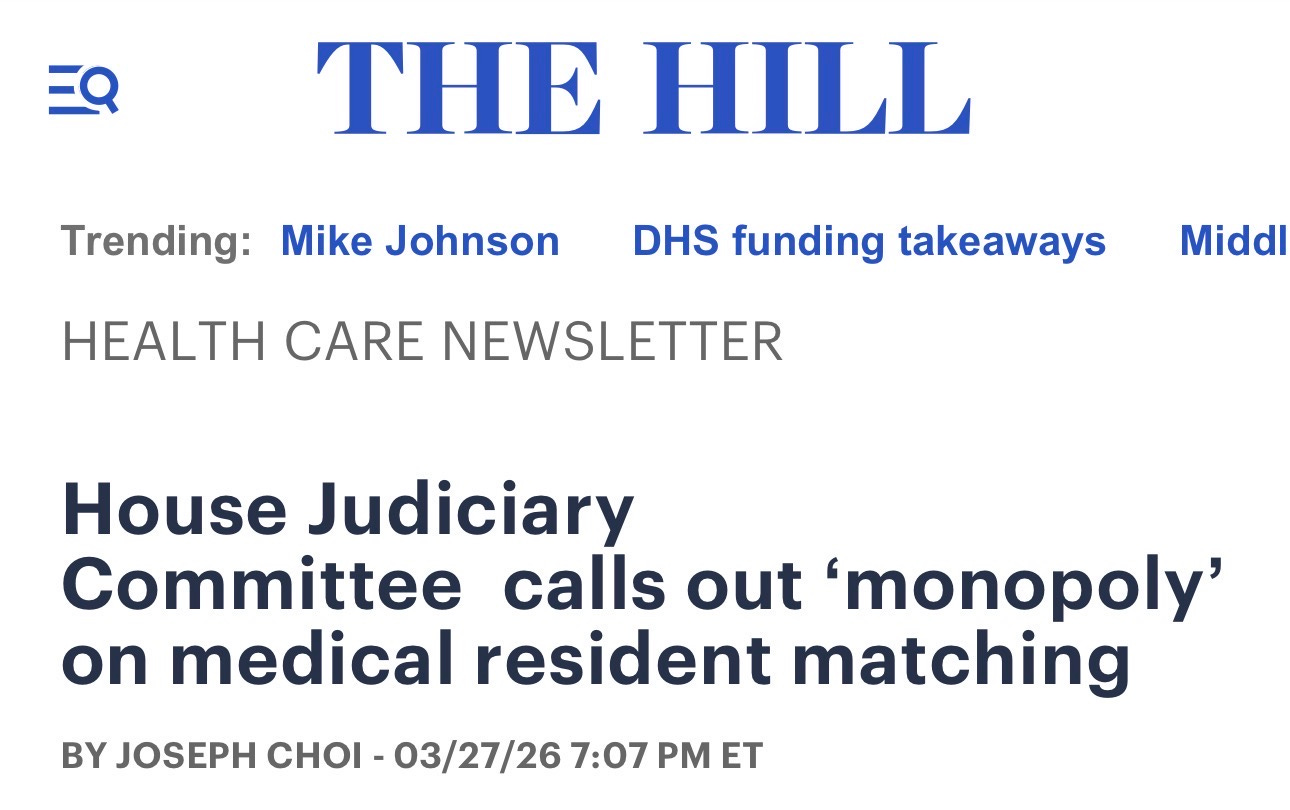
The House Judiciary Subcommittee’s investigation into the National Resident Matching Program (NRMP) antitrust exemption and its downstream effects on the physician workforce, health system economics, and health tech investment.
Key facts:
- NRMP established 1952; congressional antitrust exemption passed 2004 (15 U.S.C. 37b)
- In 2025, 52,498 medical students applied for 43,237 residency positions; ~9,000 went unmatched
- Average PGY1 resident salary: ~$68,166 in 2025; Medscape reports average across all years ~$75k
- Resident pay 2020-2024 did not keep pace with inflation; over 70% of residents say they need at least a 26% raise
- AAMC projects a US physician shortage of up to 86,000 by 2036
- Resident Physician Shortage Reduction Act of 2025 proposes 14,000 new Medicare-funded GME slots over 7 years
- House Judiciary Subcommittee convened formal hearing May 14, 2025 titled “The MATCH Monopoly: Evaluating the Medical Residency Antitrust Exemption”
- Repealing the exemption would not condemn the NRMP but would open it to antitrust scrutiny under Sherman Act Section 1
Why health tech investors should care:
- Physician supply directly constrains addressable markets for telehealth, AI clinical tools, and virtual-first care models
- GME funding reform and workforce disruption create real enterprise software and infrastructure opportunities
- Wage suppression dynamics and resident workflow are underexplored verticals for health tech founders
Table of Contents
The Setup: What the MATCH Actually Is
The 2004 Exemption and Why Congress Is Back on It
The Wage Problem: Residents Are Getting Paid Less Than Subway Managers
The Supply Side: Where the Bottleneck Really Lives
What Happens If the Exemption Goes Away
The Health Tech Angle: Why This Should Land in Your Investment Thesis
The Bottom Line
The Setup: What the MATCH Actually Is
Most people outside medicine have no idea the MATCH exists, which is kind of wild given that it controls how roughly 43,000 doctors a year enter the workforce. The National Resident Matching Program has been running since 1952 and is the infrastructure layer that pairs graduating medical students with residency training programs. It is, functionally, the only game in town. Students submit ranked lists of programs they want to train at. Programs submit ranked lists of students they want. An algorithm developed originally in the 1950s and later revised following Alvin Roth’s Nobel-winning work on market design runs the match. Everyone finds out on Match Day. You either matched or you didn’t. There is no negotiation, no counter-offer, no chance to say you got a better deal elsewhere. You get assigned and you go.
It is worth pausing on the Alvin Roth connection for a second because it matters. Roth’s contribution was making the algorithm “applicant-optimal,” meaning if a more preferred program was available, the algorithm would find it. This was genuinely a real improvement over the prior setup and gave the NRMP legitimate academic cover for decades. The problem is that a well-designed algorithm can still produce bad market outcomes if the broader market conditions surrounding it are distorted. And that is where things get messy.
The system sits on top of an accreditation monopoly that almost nobody talks about. ACGME, the Accreditation Council for Graduate Medical Education, controls which residency programs are legitimate. If you want to be a licensed physician in virtually any specialty in the US, you need an ACGME-accredited residency. ACGME and the NRMP together form what the House Judiciary Subcommittee called a bottleneck to the physician workforce. That framing is a little dramatic but not entirely wrong. The two organizations function in sequence: ACGME certifies the programs, NRMP fills them. Miss either gate and you are out of the physician pipeline.
The 2004 Exemption and Why Congress Is Back on It
The antitrust exemption that shields the MATCH from federal and state antitrust enforcement did not materialize from nowhere. It came directly from a 2002 class action lawsuit filed on behalf of medical residents alleging that the NRMP constituted a violation of Sherman Act Section 1. The argument was pretty straightforward from an antitrust standpoint: a centralized, closed hiring system in which employers share compensation information and applicants cannot negotiate independently looks a lot like horizontal wage-fixing, which courts have historically treated as per se illegal. Congress, apparently deciding that defending this setup in court was too risky and that the matching system was net-positive for medical education, passed the Pension Funding Equity Act in 2004 with a rider tucking in the exemption. Codified at 15 U.S.C. 37b, the statute simply declares it not unlawful to sponsor, conduct, or participate in a graduate medical education residency matching program.
That worked fine for about 20 years. Then in March 2025, Rep. Scott Fitzgerald’s House Judiciary Subcommittee on the Administrative State, Regulatory Reform, and Antitrust sent letters to basically everyone involved: ACGME, the AMA, the American Osteopathic Association, AAMC, the NRMP itself, and a handful of academic medical centers including Stanford, Duke, MedStar-Georgetown, and Philadelphia College of Osteopathic Medicine. The letters requested documents on the matching algorithm, salary information sharing, restrictions on resident mobility, and concerns from residents or programs about NRMP and ACGME conduct. The deadline was March 28, 2025, a turnaround that implied the subcommittee was not messing around.
The formal hearing followed on May 14, 2025 under the title “The MATCH Monopoly: Evaluating the Medical Residency Antitrust Exemption.” The NRMP notably did not testify. Witnesses included a geriatric medicine specialist and clinical professor, an attorney specializing in health law, a senior fellow from AEI, and a physician with dual training in medicine and public health policy. The testimony split roughly as expected: critics argued the system restricts mobility and suppresses wages; defenders warned that blowing up a 70-year-old matching infrastructure without a clear alternative would create chaos, class inequities in residency placement, and potentially fewer residents overall as institutional willingness to participate fractured. Both sides made legitimate points.
The Wage Problem: Residents Are Getting Paid Less Than Subway Managers
This one deserves its own section because it is genuinely jarring once you look at the numbers. In 2025, the mean PGY1 resident salary is $68,166 according to AAMC data. The median sits around $66,986. Medscape’s broader survey, averaging across all training years, puts it closer to $75,000. These numbers sound okay until you factor in that most residents are working 60 to 80 hours a week, many in urban metros with serious cost-of-living exposure, and all of them entered training carrying somewhere between $200,000 and $350,000 in medical school debt on average. When residents have literally calculated their hourly rate and compared it to minimum wage, and the math has come out unfavorable, you have a structural compensation problem.
Resident pay increased about 6.5% in 2025, which sounds like progress but was preceded by years of basically flat growth. Medscape’s own data shows that from 2020 to 2024, resident salary increases did not keep pace with general US inflation. That means the real wage for medical residents was declining during a period of extraordinary cost-of-living pressure. Over 70% of residents surveyed by Medscape say they need at least a 26% raise. A third say they need 51% or more, particularly after accounting for debt service.
The antitrust case against the MATCH on wages is that in a free market, residents would be able to negotiate competing offers. One of the residents who provided testimony to the subcommittee stated pretty directly that if he had been able to receive and negotiate offers from multiple institutions in parallel, he would have secured better compensation from Stanford. That is a real and specific harm. The NRMP’s rules prohibit programs from extending employment commitments outside the match timeline, which means even if a program wants to pay more to attract talent, the mechanism for doing so competitively is structurally blocked. The Council of Teaching Hospitals further facilitates salary information sharing among programs, which critics argue creates a de facto floor that serves institutional interests rather than resident ones.
The Supply Side: Where the Bottleneck Really Lives
Here is where things get legitimately complicated and where the antitrust framing may actually be misleading. In 2025, the NRMP ran its largest match ever: 43,237 positions offered, up 4.2% from 2024, with 877 more primary care slots than the prior year. Internal medicine alone placed 11,750 positions. That sounds like supply is growing, and it is. But 52,498 students applied for those positions. About 9,000 went unmatched. That gap is the physician shortage in its most concentrated form.
The supply constraint is not primarily an NRMP problem. It is a Medicare funding problem. In 1997, Congress capped the number of residency positions Medicare would fund per hospital. That cap has not moved meaningfully in almost 30 years. Teaching hospitals are the primary employers of residents and they depend heavily on GME funding from Medicare to make the economics of training work. The cap created a ceiling on resident supply that has nothing to do with the NRMP or the matching algorithm. You can redesign the match a thousand different ways and you still run into the same federally imposed cap on how many trained physicians can enter the workforce per year.
AAMC projections are straightforward and alarming: a shortage of up to 86,000 physicians by 2036. That is not a rounding error. It is the result of an aging population requiring more care, a significant chunk of the existing physician workforce approaching retirement, and a training pipeline constrained by a 1997 funding mechanism that no one has had the political will to meaningfully update. The Resident Physician Shortage Reduction Act of 2025, introduced by Reps. Sewell and Fitzpatrick with bipartisan Senate support, proposes adding 14,000 Medicare-supported GME slots over seven years starting in 2026, with 2,000 positions per year. It also makes the Rural Residency Planning and Development program permanent with $12.7 million annually. Good bill. Prior versions failed in 2019, 2021, and 2023. There is no particular reason to assume 2025 is different, but the political environment around physician shortages has shifted enough that it might actually move this time.
What Happens If the Exemption Goes Away
Repealing the 2004 antitrust exemption would not kill the NRMP. This is probably the most important clarification to make because it gets lost in the political framing. Removing the exemption would open the NRMP to antitrust scrutiny, meaning plaintiffs could bring cases and courts would evaluate whether specific practices cause anticompetitive harm. Under Sherman Act Section 1, most agreements are subject to a rule of reason analysis that weighs procompetitive benefits against anticompetitive effects. A well-designed matching algorithm that creates genuine efficiencies in a complex labor market would likely survive that scrutiny even without an explicit exemption. The problem for the NRMP is that several specific practices, particularly the restrictions on parallel negotiation and the salary information-sharing architecture, might not survive. Those are the pieces most likely to face successful legal challenges post-repeal.
The NRMP’s own December 2025 letter to the medical education community made its position clear: the system creates fair, efficient placement by ensuring all positions and all applicants are available simultaneously, preventing the kind of scramble and exploding-offer dynamic that plagued medical hiring before 1952. That is a legitimate point. The pre-NRMP era was reportedly a disaster of early offers, pressure tactics, and students being forced to commit before they had meaningful information. Nobody actually wants to go back to that. But the argument that historical dysfunction justifies a blanket antitrust exemption in perpetuity is a stretch, and Congress clearly agrees.
The more interesting scenario is not full repeal but targeted reform. Several hearing participants suggested the better path is to modify the exemption rather than eliminate it entirely. Specifically, allowing residents to engage in some degree of parallel negotiation around compensation, while preserving the central matching mechanism for placement, might address the wage suppression concerns without introducing the chaos that full repeal would risk. That version of reform is politically messier because it requires Congress to actually write substantive policy rather than just rescind an exemption, but it is probably the outcome that produces the best results for residents, programs, and patients.
The Health Tech Angle: Why This Should Land in Your Investment Thesis
This is the part that most coverage of the MATCH antitrust story completely ignores, which makes sense because most health policy coverage is written for policy people and not for founders and investors. But the downstream implications for the health tech stack are real.
Start with physician supply as a fundamental constraint on addressable markets. Every investment thesis in telehealth, AI-assisted diagnostics, virtual-first primary care, and remote monitoring implicitly assumes a certain density of physician capacity. When that capacity is constrained by a structurally broken training pipeline, the thesis has to account for substitution effects, automation curves, and mid-level provider expansion that would not otherwise be as prominent. Nurse practitioners and physician assistants have been absorbing demand that would historically go to physicians, and that trend accelerates in a supply-constrained environment. That is relevant to companies thinking about clinical workflow design, scope-of-practice tooling, and care team orchestration software.
Second, the GME funding reform conversation is a legitimate enterprise software opportunity that nobody is building for yet. If the Resident Physician Shortage Reduction Act passes and 2,000 new positions a year start flowing to hospitals, those hospitals need infrastructure to administer expanded residency programs, track GME funding compliance, manage accreditation requirements, and optimize resident scheduling. ACGME compliance and GME financial management are genuinely painful administrative domains. There is a real VRAM or MedHub-adjacent opportunity for a founder who wants to own GME administration software in a world where the number of training programs and positions is growing faster than administrative capacity.
Third, if the antitrust exemption is repealed or materially reformed, resident compensation will almost certainly increase. The wage suppression effect of the current system, even accounting for the NRMP’s defenders, is real enough that loosening the negotiation constraints would move average resident pay up. That is relevant to benefits platforms, financial wellness tools, and resident-facing fintech companies that have historically treated residents as low-priority because their compensation was both low and non-negotiable. A market where residents are making $90,000 to $120,000 instead of $68,000 looks meaningfully different from a product and monetization standpoint. Companies like Laurel Road, which specifically targets the medical trainee segment for student loan refinancing and banking, are already in this space, but it is not crowded.
Fourth and maybe most interesting from a longer-term horizon: the physician shortage math creates a structural tailwind for AI clinical decision support and ambient AI documentation tools that is independent of whatever happens with the MATCH. If the US is genuinely going to be 86,000 physicians short by 2036, the system will compensate through some combination of scope-of-practice expansion, telehealth penetration, and productivity tools that let existing physicians handle higher patient volumes with lower cognitive and administrative burden. Companies building AI scribes, pre-charting automation, order set optimization, and AI-assisted care navigation are not just nice-to-haves in a shortage environment; they become infrastructure. The shortage is the tailwind. Investors who are modeling physician supply as a stable input into healthcare demand equations are probably underestimating how disruptive a genuine shortage will be to care delivery models and therefore to which tech categories win.
The Bottom Line
The MATCH is not going away. The NRMP has too much institutional legitimacy, too many genuine defenders in academic medicine, and too long a track record of producing reasonably efficient placements for Congress to simply delete it. The more likely outcome is a targeted modification of the antitrust exemption, probably accompanied by some version of the Resident Physician Shortage Reduction Act that expands GME slots incrementally over seven years while preserving the core matching infrastructure. Residents will probably see modest compensation gains as a result, though not the 51% some of them are asking for. The physician shortage will continue getting worse in the near term regardless, because even 14,000 new slots over seven years is nowhere near the 86,000-physician gap that AAMC is projecting.
For health tech investors and founders, the MATCH story is really two stories running in parallel. The first is a labor market reform story about whether residents will be treated more like the highly skilled professionals they are rather than captive trainees in a system designed primarily for institutional convenience. The second is a supply shock story about what happens to the entire US healthcare delivery infrastructure when the doctor pipeline has been structurally constrained for decades and is now catching up to demand curves that nobody planned for. Both stories create dislocation. Dislocation creates opportunity. The question is whether your firm is positioned to see the opportunity or whether it is still modeling physician supply as a fixed variable in a static healthcare market. It is anything but.