
Video Preview
🎧 Part I Podcast free on Apple Podcasts and Spotify.

🎧 Part II Podcast episode for paid subscribers only. Also available on Apple Podcasts and Spotify.
To listen to paid episodes in Apple or Spotify, link your Substack subscription via the show settings on those platforms (instructions inside the Substack app under Subscriptions → Podcast).
Table of Contents
Abstract
How a Congressman Named Stark Ended Up Naming a Hospital Fight
The Specialty Hospital Panic of 2003 to 2005
Section 6001 and the Great Grandfathering
What the Evidence Actually Says About Quality and Cost
The Cherry Picking Problem, Honestly Assessed
The Weird Asymmetry Nobody Talks About: ASCs Are Fine but Hospitals Are Not
Would Lifting the Ban Increase Competition
Or Would It Just Accelerate the Roll Up
The Politics, the Bills, and the Field Hearing
What a Sensible Person Would Actually Do
Abstract
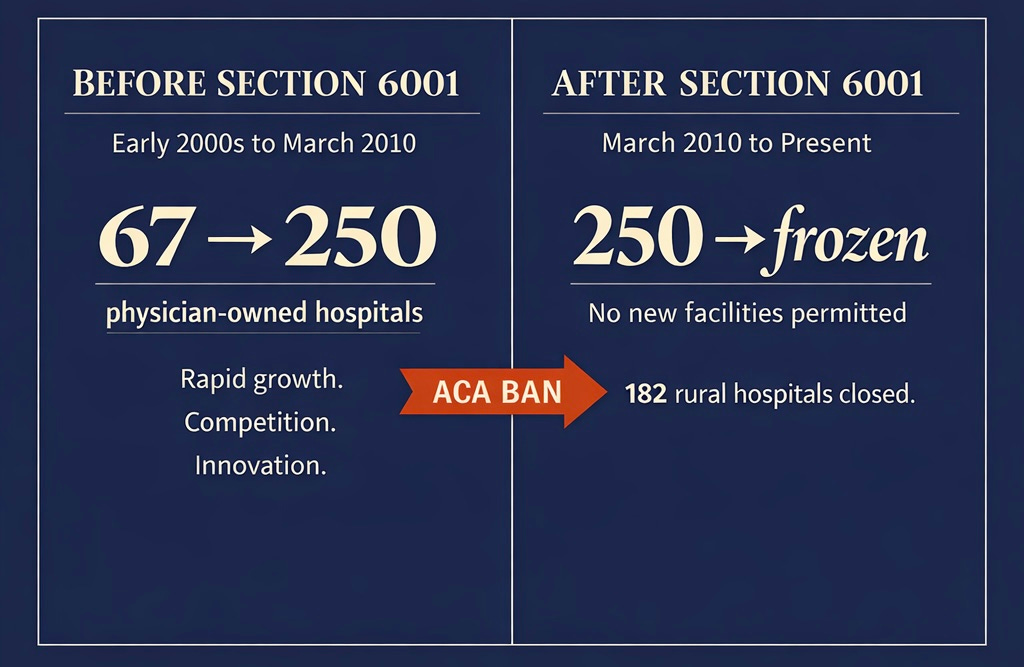
Congress banned physicians from opening new Medicare-participating hospitals they own via Section 6001 of the ACA in 2010, effectively freezing roughly 250 physician-owned hospitals at their 2010 bed and OR counts
The policy rationale was self-referral, cherry picking of profitable and healthier patients, and the fear that specialty hospitals would hollow out community hospitals that cross-subsidize money-losing service lines
The evidence on quality is mostly a wash, POHs look comparable or slightly better on CMS quality metrics, and the evidence on cost is muddled by patient mix and by the fact that the grandfathered sample is not a random draw
The cherry picking story has real support in older data, especially for cardiac and ortho specialty hospitals, and weaker support for the full service POHs that exist today
Physicians can already own ambulatory surgery centers with almost no restriction, which makes the hospital ban look less like a coherent self-referral policy and more like a historical accident
Lifting the ban probably increases entry in non-CON states with strong physician groups, does nothing in CON states, and the plausible endgame is a wave of POHs that eventually sell to health systems or private equity anyway
A House Judiciary Committee field hearing on healthcare competition put the issue back in play on September 14, 2026, and the standing bill, the Patient Access to Higher Quality Health Care Act, remains the vehicle
How a Congressman Named Stark Ended Up Naming a Hospital Fight
Pete Stark was a Democrat from California who spent decades on Ways and Means being a thorn in everyone’s side, and his lasting legacy is a statute that a generation of healthcare lawyers bill roughly a billion hours a year interpreting. The Ethics in Patient Referrals Act, passed in 1989 and expanded in 1993, is the thing everybody calls the Stark Law. The premise is simple enough to fit on a napkin. If a doctor has a financial interest in an entity that provides designated health services, the doctor cannot refer Medicare patients to that entity, and the entity cannot bill Medicare for those referrals, unless an exception applies. The original Stark I covered clinical labs. Stark II widened the net to imaging, PT, DME, home health, outpatient drugs, and inpatient and outpatient hospital services, among others.
That last one is where the fun starts. Inpatient and outpatient hospital services are designated health services, which means on paper a physician with any ownership stake in a hospital could not refer Medicare patients to it. Congress understood that this would blow up a bunch of existing arrangements and also that physician ownership of an entire hospital is a different animal from physician ownership of a lab down the hall. So they wrote what became known as the whole hospital exception. A physician could hold an ownership interest in a hospital as a whole, rather than a subdivision of it, and refer to it freely, on the theory that owning the whole thing dilutes the incentive to over-refer to any particular service line. If you own the entire enterprise, you eat the losses on the ER and the OB unit along with the profits on the cardiac cath lab, so the reasoning went, and that makes you more like a normal hospital operator and less like a doctor with a side hustle in MRI scans.
This is worth sitting with because the whole hospital exception is the load-bearing wall of everything that followed. The exception did not say physicians could own hospitals as long as they were good hospitals. It said physicians could own hospitals as long as they owned the whole thing. The rest of the story is essentially about what happens when physician-owners discovered that the whole thing did not have to include the parts that lose money.
The Specialty Hospital Panic of 2003 to 2005
By the early 2000s a new category had emerged that lawyers called specialty hospitals and community hospital CEOs called something unprintable. These were small, physician-owned facilities focused on cardiac care, orthopedics, or surgery, often built in states without certificate of need laws, which is why Texas, Oklahoma, Kansas, Louisiana and South Dakota became the epicenter. The numbers were not enormous, perhaps 90 to 100 facilities by 2003 and around 100 by 2005 depending on who was counting, but they were growing fast and they were located in exactly the markets where the incumbents had the most to lose.
The community hospital argument was and is basically a cross-subsidy argument. A general acute care hospital makes money on a handful of service lines, cardiac and ortho being the big ones, and loses money on the ER, behavioral health, OB in many markets, and anything involving a Medicaid or uninsured patient who arrives via ambulance at 2 a.m. If a physician group builds a cardiac hospital across the street with no ER, keeps the well-insured elective CABG patients, and sends the complicated Medicaid patients to the general hospital, the general hospital loses the margin that was paying for the ER. The specialty hospital then reports fantastic quality numbers because it never sees the sick people. This is the cherry picking story, and it is not crazy.
The counterargument was that specialty hospitals were focused factories. Do one thing, do it constantly, staff it with people who only do that thing, and you get better outcomes and lower cost. This is not crazy either, and there is a decent body of literature on volume and outcomes to support the intuition.
Congress, being Congress, did not resolve this. The Medicare Prescription Drug, Improvement, and Modernization Act of 2003, the same bill that created Part D, tucked in an 18-month moratorium on new physician-owned specialty hospitals and instructed MedPAC and GAO to study the question. GAO came back in 2003 and 2005 with findings that specialty hospitals clustered in states without CON, that they treated a lower share of Medicaid patients, and that their patients tended to be less severe within a given DRG. MedPAC’s 2005 report found similar patterns. Specialty hospitals treated patients who were less sick and more profitable, they did have shorter lengths of stay, but their costs per case were not obviously lower once you adjusted, and their impact on community hospital finances in the affected markets was real but modest at the aggregate level. The Deficit Reduction Act of 2005 extended the moratorium, CMS tightened some rules around disclosure and the definition of a whole hospital, and then the moratorium lapsed and the industry went back to building.
The one part of this that deserves more attention than it gets is that the FTC and DOJ, in their 2004 joint report on competition in healthcare, came down pretty clearly against restricting specialty hospitals. The antitrust agencies’ view was that entry is good, that cross-subsidy problems should be solved by paying correctly for the underpaid services rather than by blocking competitors, and that using entry restrictions to protect incumbents is generally how you get high prices and lousy service. That position has aged well in the sense that everyone now agrees hospital consolidation is a problem. It has aged less well in the sense that nobody ever fixed the underlying payment distortions, which is the whole reason the cross-subsidy argument still has teeth.
Section 6001 and the Great Grandfathering
Then came the ACA. Section 6001 amended the whole hospital exception so that it only applies to hospitals that had physician ownership and a Medicare provider agreement in place as of December 31, 2010. Any hospital that did not meet that test cannot use the exception, which in practice means a physician-owned hospital that opened in 2011 or later cannot bill Medicare for services referred by its physician-owners, which in practice means it cannot exist as a normal hospital. On top of that, the grandfathered hospitals were frozen. No increase in the aggregate physician ownership percentage, no expansion of licensed beds, operating rooms, or procedure rooms beyond the 2010 baseline, with a narrow exception process for hospitals in counties with rapid population growth or high Medicaid volume that basically nobody has successfully used at scale.
The count of grandfathered facilities is usually cited around 250, though the number bounces around because some closed, some converted, and the definitions vary. Texas alone has roughly 24 currently operating physician-owned hospitals in one current tracker, though broader counts for the state vary by definition and historical inclusion. Many of the grandfathered facilities are not the cardiac and ortho boutiques of 2004. A meaningful share are full service community hospitals with ERs that happen to have physician investors, in some cases because a physician group was the only entity willing to build a hospital in a rural or exurban market.
The politics of 6001 were not subtle. The American Hospital Association and the Federation of American Hospitals wanted it, they had leverage because the ACA needed hospital industry support and hospital industry money, and the physician lobby was busy fighting other battles. The stated rationale was self-referral and cherry picking. The unstated rationale was that hospital systems did not want new competitors and this was a chance to write that into federal law. Both things can be true and both were.
There is a small but revealing detail about how Congress scored this. When repeal has come up in subsequent years, CBO has tended to estimate that lifting the ban would increase federal spending by a few hundred million dollars over a decade, not because POHs are paid more per case, but because more capacity and more physician ownership tends to produce more volume. That is the honest version of the self-referral concern. It is not that POHs are expensive per unit. It is that ownership makes the unit count go up.
What the Evidence Actually Says About Quality and Cost
Here the story gets less satisfying for either side. The single most cited paper is Blumenthal, Orav, Jena, Dudzinski, Le and Jha in the BMJ in 2015, which compared 219 POHs to nearly 2,000 non-POHs on a range of measures. Their finding was essentially that POHs were not systematically different. Patient mix was broadly similar in terms of age and race. Medicaid share was slightly lower but not dramatically so. Quality on process measures and patient experience was comparable, mortality and readmissions were comparable, and costs and payments were comparable. The headline was that POHs are just hospitals, and the fears of the mid 2000s did not show up in the aggregate data on the grandfathered cohort. That said, the same paper found that POHs were more likely to be located in states without CON and were smaller, which is consistent with the entry story.
The industry-funded research paints a rosier picture. The Physician Hospital Association has commissioned a series of analyses, mostly by Dobson DaVanzo, that find POHs earn higher CMS star ratings on average, are overrepresented among top performers in the Hospital Value-Based Purchasing program, and, in the analyses that get quoted most, receive lower Medicare payments per beneficiary and per episode than non-POHs. There are also patient satisfaction findings where POHs do well, which is unsurprising when you are a small facility with one patient per room and a nurse to patient ratio that a large urban hospital cannot match.
The problem with both bodies of evidence is selection. The grandfathered POHs are survivors. They are the facilities that were built before 2010, made it through a decade of frozen capacity, and are still operating. A hospital that survives under a growth freeze is by construction a reasonably well run hospital. Comparing it to the universe of non-POHs, which includes every struggling rural facility and every overleveraged urban academic center, and concluding that physician ownership causes quality is a stretch. It is roughly like studying the health of marathon runners and concluding that running causes longevity. Maybe, but the sample was not random.
On cost the picture is genuinely mixed. Lower Medicare payments per episode can reflect efficiency, or lower acuity, or lower use of post-acute care, or simply that the facility does not run an ER and therefore has no ER admissions with their long tails. The industry studies risk adjust, but risk adjustment within a DRG is known to be imperfect, which was precisely MedPAC’s point in 2005. The academic studies find no cost difference. Nobody credible finds POHs to be more expensive per case, which is a meaningful finding on its own, given the amount of alarm in 2010.
The Cherry Picking Problem, Honestly Assessed
If you want to steelman the ban, this is the section. The concern was never really that a POH would deliver bad care. The concern was about three specific behaviors. First, that physician-owners would select healthier patients within a DRG because the payment is fixed and the margin is in the complexity. Second, that POHs would avoid Medicaid and uninsured patients, partly by not having an ER and partly through the referral patterns of their owners. Third, that ownership would drive volume, meaning more procedures than would otherwise occur, some of which are marginal.
The first behavior showed up clearly in the 2003 to 2005 data on cardiac and ortho specialty hospitals. Patients at those facilities had lower severity within DRG and were less likely to be transferred in from another facility. It shows up much less clearly in the 2015 data on the broader POH cohort, which includes a lot of full service hospitals. The reasonable read is that the boutique model does cherry pick and the full service model does not, or at least not detectably.
The second behavior is the most durable finding. Across nearly every study, POHs treat a lower share of Medicaid patients and provide less uncompensated care as a share of revenue. The magnitude varies and some of it is location, since POHs tend to be in suburban markets where the payer mix is better for everyone. But the ER point is real. Roughly half or more of grandfathered POHs operate an emergency department, which means a substantial share do not, and a hospital without an ER is structurally exempt from the EMTALA-driven charity care that defines the safety net. Whether that matters depends on your model of the safety net. If you think the safety net should be funded through explicit subsidies like DSH and Medicaid supplemental payments, then it is not obvious why a suburban ortho hospital should be forced to run an ER as a form of hidden tax. If you think the cross-subsidy model is the only politically sustainable way to fund emergency care, then every hospital that opts out is a defection.
The third behavior, volume induction, is the hardest to measure and the most important. There is a long literature on physician self-referral driving utilization in imaging, in PT, and in ASCs. It would be surprising if hospital ownership were the one setting where financial incentives did not affect referral behavior. The CBO scoring implicitly assumes it does. The industry response is that owners are subject to the same medical necessity rules as everyone else and that value-based payment increasingly ties them to outcomes rather than volume. That is true as far as it goes, and it goes about as far as value-based payment has actually gone in Medicare fee for service, which is to say not that far.
The Weird Asymmetry Nobody Talks About: ASCs Are Fine but Hospitals Are Not
Here is the thing that makes the whole framework look like a historical accident rather than a policy. Physicians can own ambulatory surgery centers. Not just a little. Physician ownership is the dominant model in the ASC industry, with the large majority of ASCs having some physician ownership and a substantial share being majority physician-owned, often in joint venture with an operator like SCA, USPI, or a health system. The Anti-Kickback Statute has an explicit ASC safe harbor for physician investors who actually perform procedures there, and ASC services are not designated health services under Stark, so the referral prohibition does not even apply.
So the current state of federal law is that a group of orthopedic surgeons can own an ASC, refer every Medicare patient they see to it, take distributions proportional to their investment, and this is not only legal but is the backbone of the site of care migration that CMS itself has been encouraging by adding procedures to the ASC covered list. The same surgeons cannot own a hospital and do the same thing, unless the hospital predates 2011. The line between a multi-OR ASC with extended recovery and a small surgical hospital is, in physical terms, mostly about whether there are inpatient beds and a license.
You can try to defend this on the grounds that hospitals are paid more than ASCs and therefore the self-referral incentive is bigger. That argument is fine except that the answer to it is site-neutral payment, which Congress has been talking about for a decade and has enacted only in the narrowest form for off-campus HOPDs. You can try to defend it on the grounds that hospitals have EMTALA and community obligations that ASCs do not. That argument is also fine except that it argues for requiring POHs to have ERs, not for banning them. The honest defense is that the ASC industry was too big and too well organized to touch in 2010 and the specialty hospital industry was not, and the law reflects the relative lobbying weights at the moment of enactment. That is not a policy. That is a snapshot.
Would Lifting the Ban Increase Competition
The pro-repeal argument in 2026 is almost entirely about consolidation, and it is a very different argument from the focused factory pitch of 2004. The facts of hospital consolidation are not in dispute among anyone who has looked. The large majority of metropolitan hospital markets are highly concentrated by the DOJ and FTC’s own HHI thresholds. Commercial hospital prices have grown faster than any other major category of health spending for two decades, and the price growth is concentrated in the markets that consolidated most. Cross-market mergers, which the older antitrust framework does not reach, have added to the pattern. New hospital entry by non-physician operators is close to nonexistent because the capital requirements are enormous, the regulatory hurdles in CON states are close to insurmountable, and the incumbents control the referral networks and the payer contracts.
Into that environment the POH advocates say the obvious thing. Physicians are the only group with the clinical expertise, the local relationships, and, increasingly with private equity and strategic capital behind them, the money to build competing hospitals. They are also, not coincidentally, the group that health systems have spent the last fifteen years employing, in part to control referrals. A physician group that can own its own hospital has a credible alternative to employment, which changes the negotiating dynamic between physicians and systems even if the group never builds anything. That is the strongest version of the argument. The ban does not just block competitors. It removes physicians’ outside option, which lets systems consolidate physician labor on top of consolidating facilities.
Whether repeal would actually produce entry is a question of where. In the roughly 35 states with some form of CON, lifting the federal ban does close to nothing, because the state will not issue the certificate, and incumbents have a veto in practice through the CON process. In the non-CON states, Texas being the obvious example, repeal would likely produce a real wave of construction, because there is a track record, there is an existing ecosystem of physician-owner management companies, and there is capital. The likely map of new POHs post-repeal looks a lot like the map of existing POHs, which is to say concentrated in the Sun Belt and the Plains, in suburban markets with good payer mix.
That geographic pattern matters for the competition argument. The markets that would get new POHs are, on average, not the most concentrated markets. Houston and Dallas have plenty of competition already. The most concentrated markets are mid-sized metros in CON states where a single system has 60 to 80 percent share, and repeal does not touch those. So the honest answer to whether lifting the ban increases competition is yes, in the markets that need it least, and no, in the markets that need it most, unless you also do something about CON, which is a state issue that Congress cannot easily reach.
Or Would It Just Accelerate the Roll Up
Now the other side of the ledger, and the part of the debate that the field hearing framing tends to skip. Suppose repeal happens and a few hundred new POHs get built over a decade. What happens to them.
The history of physician-owned enterprises in American healthcare is a history of eventual sale. Physician-owned ASCs sell to USPI, SCA, and Surgery Partners. Physician-owned practices sell to Optum, to PE-backed MSOs, to health systems. Physician-owned imaging centers sold to RadNet and the systems. The reason is structural. Physicians age, partners want liquidity, the next generation of physicians would rather be employed than buy in, and the operating complexity of a hospital, with its payer contracting, revenue cycle, compliance, and capital needs, is exactly the sort of thing that a scaled operator does better than a group of surgeons with a management company.
The grandfathered POHs are actually a natural experiment here. Many of them are no longer majority physician-owned in any meaningful operational sense. A significant number are joint ventures with health systems or are managed by hospital management companies with physician investors holding minority stakes. The freeze on ownership percentage under 6001 kept the physician share from growing, but nothing stopped the hospital side from growing its influence. Some grandfathered POHs have been acquired outright by systems, at which point they stop being POHs.
So one plausible endgame of repeal is a generation of physician-built hospitals that, within 10 to 15 years, are sold to the same systems and the same private equity sponsors that the repeal was supposed to compete with. The hospitals would still exist, which is new capacity and probably good for patients in the interim, but the competitive effect would be transient. In the most cynical reading, repeal becomes a mechanism for systems to outsource the risk and permitting hassle of new construction to physician groups, then buy the finished product. There is a private equity version of the same story, where the PE-backed physician platforms that have consolidated ortho, GI, and cardiology practices across the Sun Belt build hospitals as an extension of their MSO, and the roll up now includes inpatient beds. That is not obviously worse than the status quo, but it is not the small business physician entrepreneur that the hearing testimony tends to evoke.
There is a further wrinkle in the incentives created by repeal without site-neutral payment. If a PE-backed physician platform can convert its high-volume ASC into a licensed hospital and start billing HOPD rates for the same procedures, that is not competition, that is regulatory arbitrage. The current ASC to hospital rate differential for common procedures is large, often 40 to 60 percent or more depending on the code, and a rational operator would look very hard at whether the incremental cost of a hospital license is worth the rate uplift. The answer in many markets is yes. Advocates for repeal rarely mention this because it undercuts the cost story, but any serious version of repeal needs to be paired with site-neutral payment or it will produce exactly the volume and payment effects that CBO has been scoring all along.
The Politics, the Bills, and the Field Hearing
The legislative vehicle has been the same for years. The Patient Access to Higher Quality Health Care Act, carried in the Senate by James Lankford of Oklahoma and in the House by a rotating cast of Texas and Oklahoma Republicans, would repeal 6001 and restore the pre-2011 whole hospital exception. It has never gotten a floor vote in either chamber. The reason is that the AHA and FAH oppose it, and hospital lobbying in a given district tends to be organized around the local system’s board, which is composed of the local business elite, which the member of Congress hears from constantly.
What changed in 2025 and 2026 is that the competition framing gave the issue a new set of sponsors. The Trump administration’s healthcare rhetoric has leaned on competition and price transparency, and the antitrust agencies under this administration have been vocal about hospital consolidation. MedPAC has had commissioners, Brian Miller among them, who have written publicly that the POH ban is an entry barrier with weak evidentiary support. The House Judiciary Committee, which handles antitrust rather than health, taking the issue up in a field hearing on competition is a signal that the argument has migrated from the health policy committees, where the hospital lobby is strongest, to the antitrust committees, where the frame is entry and market power and the hospital lobby is one voice among several.
Whether that migration produces a bill is a different question. The most likely path is not standalone repeal but inclusion in a broader package, either a site-neutral and hospital price transparency bill or a reconciliation vehicle where the CBO score is small enough to absorb. The hospital industry’s counter has been to offer a partial expansion, allowing grandfathered POHs to add capacity in high-growth counties, which addresses the freeze but not the entry ban and is essentially a way to buy off the existing POHs while keeping new entrants out. Expect that compromise to be where the fight actually lands, because it lets everyone declare victory.
One more political note. The physician lobby is not united on this. The AMA formally supports repeal, but the employed physician majority does not have skin in the game, and the specialty societies most invested, ortho and cardiology, are also the specialties that have been most aggressively rolled up by PE. The constituency for repeal is a shrinking pool of independent proceduralists in non-CON states plus the capital that would like to back them. That is a real constituency but not a large one, which is why the competition frame, which brings in employers, payers, and the antitrust community, was necessary to give the issue any oxygen.
What a Sensible Person Would Actually Do
The evidence does not support the ban as written. The quality and cost fears of 2010 did not materialize in the grandfathered cohort, and the ASC asymmetry makes the self-referral rationale look arbitrary. But the evidence also does not support the version of repeal that the advocates want, which is clean restoration of the pre-2011 rules with no conditions, because the volume and site of care incentives are real and the safety net cross-subsidy problem has not been solved.
The sensible package looks something like this. Lift the entry ban and the capacity freeze. Require any new POH to operate a 24-7 emergency department subject to EMTALA, or to pay an explicit assessment that funds the safety net in its market, which is the cross-subsidy made visible and therefore honest. Pair repeal with site-neutral payment across the ASC, HOPD, and inpatient settings for the procedures where clinical equivalence is established, so that a hospital license is not a rate arbitrage play. Keep and strengthen the ownership disclosure rules so patients know when their surgeon owns the building. And tie Medicare participation for new POHs to the same value-based purchasing exposure as everyone else, with a look-back after five years on volume growth in owner-referred cases.
None of that will happen in that form, because it requires three committees and two lobbies to agree simultaneously. What will happen is the partial capacity expansion for grandfathered facilities, probably paired with some language about rural and high-Medicaid markets, and the entry ban will survive for another cycle. The market will do what it always does, which is route physician capital into ASCs, into PE-backed platforms, and into joint ventures with the very systems the policy was meant to constrain. The consolidation that the field hearing was nominally about will continue, and in five years someone will hold another hearing and discover, with fresh alarm, that hospitals are expensive and nobody new has entered the market. Stark, wherever he is, would probably find that funny
.