Welcome to Healthcare Markets & Technology.
Rigorous analysis of AI, policy, capital, technology, and clinical operations across U.S. healthcare — written for the people who build, invest in, and lead it.
Free subscribers get 2 public articles per week. Upgrade to paid → for the full 7 articles/week, paid podcast episodes, deal breakdowns, and the complete 538-deep-dive archive.
Subscribe or upgrade here →
One thing to bookmark: the searchable Knowledge Base at kb.onhealthcare.tech isn’t in Substack’s menu. Save it now — on mobile, tap share → “Add to Home Screen.”
Reply to any email with questions. I read every one.
— Trey
Welcome to Healthcare Markets & Technology.
Rigorous analysis of AI, policy, capital, technology, and clinical operations across U.S. healthcare — written for the people who build, invest in, and lead it.
Free subscribers get 2 public articles per week. Upgrade to paid → for the full 7 articles/week, paid podcast episodes, deal breakdowns, and the complete 538-deep-dive archive.
Subscribe or upgrade here →
One thing to bookmark: the searchable Knowledge Base at kb.onhealthcare.tech isn’t in Substack’s menu. Save it now — on mobile, tap share → “Add to Home Screen.”
Reply to any email with questions. I read every one.
— Trey
Abstract
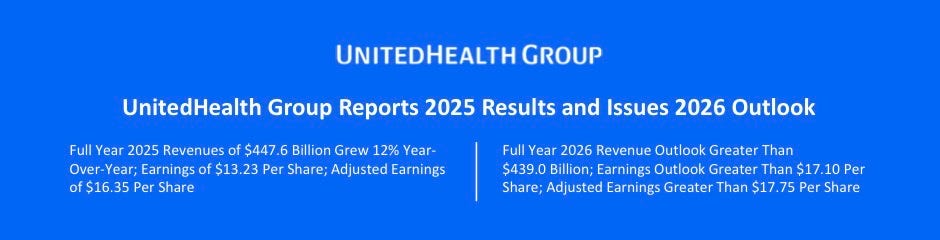
UnitedHealth Group reported full year 2025 revenues of $449 billion with adjusted earnings of $28.15 per share, representing 8% revenue growth but significant earnings pressure from medical cost trends. The company’s results reveal fundamental shifts in healthcare economics that directly impact health tech companies building in payer-adjacent spaces. Key themes include elevated medical utilization persisting beyond COVID normalization, Medicare Advantage margin compression forcing product redesign, Medicaid redeterminations creating permanent coverage gaps, and continued resistance to specialty drug cost trends. UnitedHealthcare’s medical loss ratio increased 330 basis points year over year while Optum Health struggled with risk adjustment headwinds and care delivery margin pressure. The results suggest a structural shift away from the benign cost environment of 2021-2023 and toward sustained pressure on margins, utilization management intensity, and care delivery economics. For health tech companies, this translates to increased scrutiny on ROI demonstrations, longer sales cycles for cost-reduction solutions, and potential opportunities in utilization management infrastructure and alternative site-of-care enablement.
Table of Contents
The Numbers That Matter
What Actually Happened in 2025
Medicare Advantage Is Breaking (In Slow Motion)
The Medicaid Hangover Nobody Talks About
Optum’s Reality Check
What This Means for Digital Health Companies
The Contrarian Opportunities
How To Think About Building Now
The Numbers That Matter
UnitedHealth just closed the books on 2025 and the top line looks fine until you start digging into what’s underneath. The company did $449 billion in revenue, up 8% from 2024, which sounds perfectly acceptable for a company that size. But the adjusted earnings per share came in at $28.15, which if you’re tracking along with Street expectations tells you pretty much everything about how the year actually went. Revenue growth without corresponding earnings leverage means margin compression, and margin compression at a company that touches roughly one in eight Americans tells you something structural changed in the healthcare economy.
The medical loss ratio for UnitedHealthcare hit 85.1% for the full year, up 330 basis points from 81.8% in 2024. For context, that’s the difference between a well-oiled insurance operation and one that’s suddenly spending an extra $12 billion on medical costs relative to premiums. The company blamed it on higher medical cost trends, which is corporate speak for people are using more healthcare and it costs more than we priced for. The fourth quarter was particularly rough with an MLR of 86.3%, suggesting the trend accelerated as the year progressed rather than moderating like everyone hoped.
What makes this especially interesting is that UHC grew revenues to $316 billion across the insurance business while operating earnings actually declined to $16.4 billion from $16.8 billion the prior year. That’s not a rounding error, that’s a fundamental shift in unit economics. When you’re adding billions in top line revenue and losing operating income, something broke in the pricing model or the utilization assumptions or both.
Optum, which everyone has spent the last five years calling UHG’s growth engine and margin expansion story, posted $214 billion in revenues but saw operating earnings decline 17% to $11.2 billion. The company tried to blame this on a cyberattack affecting Change Healthcare, which definitely hurt, but the guidance for 2026 suggests the problems run deeper than a one-time security incident. When your health services division that’s supposed to be delivering margin expansion is instead contracting margins, that tells you something about care delivery economics that should make every value-based care investor pause.
What Actually Happened in 2025
The simple version is that medical utilization stayed elevated all year and cost trends ran hotter than pricing. But that explanation obscures what’s actually interesting, which is why utilization stayed high and why costs surprised to the upside despite three years of health plans supposedly getting better at managing both.
Coming out of COVID, there was this prevailing theory that we’d see normalization of utilization patterns as deferred care got caught up and the system returned to pre-pandemic equilibrium. That happened partially in 2022 and 2023, which created this window where health plans had favorable medical cost trends because people were still being conservative about seeking care but acuity was normalizing. That window closed in 2024 and stayed closed in 2025.
What UHC is seeing, and what other plans are reporting in their earnings, is that utilization is running persistently above pre-COVID baselines across multiple categories. Outpatient activity is elevated, specialty care is elevated, diagnostic testing is elevated, and importantly these increases are showing up in commercially insured populations not just Medicare and Medicaid. The company specifically called out higher outpatient activity levels and increased intensity of services, which is healthcare consultant speak for people are going to the doctor more and getting more stuff done when they go.
The cost side is equally interesting because it’s not just volume, it’s price mix shifting toward more expensive sites of care and more expensive services within sites of care. Hospital outpatient departments are capturing more volume that used to happen in physician offices, specialty drugs are becoming standard of care for conditions that used to get managed with generics, and diagnostic capabilities that used to be limited to academic medical centers are now available at community hospitals. All of this shifts the cost curve independent of utilization volume.
UHC also took a $600 million hit from the Change Healthcare cyberattack, which disrupted claims processing and revenue cycle operations across thousands of providers. The interesting part isn’t the immediate cost, it’s what it revealed about system fragility. When one clearinghouse going down for a few weeks causes that much economic damage, it tells you how concentrated and brittle the administrative infrastructure has become. For health tech companies building in that infrastructure layer, that’s simultaneously a warning about single points of failure and an indication of how valuable resilience and redundancy will become.
Medicare Advantage Is Breaking (In Slow Motion)
The Medicare Advantage story is probably the most important one buried in these results for anyone building companies that touch seniors or value-based care. UHC’s Medicare Advantage membership grew to 8.5 million people, up 5% year over year, which looks like healthy growth until you realize the operating margin on that membership is compressing rapidly.
The company doesn’t break out Medicare Advantage MLR separately, but they made it pretty clear in the remarks that MA was a significant driver of the overall MLR deterioration. The combination of benchmark rate pressure from CMS, higher medical costs from an aging and increasingly complex membership, and continued challenges with risk adjustment coding created a perfect storm for margins.
CMS has been systematically reducing MA benchmarks through the rate notice process while simultaneously tightening risk adjustment documentation requirements and launching audits that claw back prior year payments. The 2025 rate notice was particularly painful, with effective rate increases well below medical cost trend, and the 2026 notice that came out a few months ago continues that pattern. Health plans are stuck between pricing plans that are attractive enough to drive enrollment while somehow making money on benchmark rates that don’t cover medical costs.
What makes this especially problematic is the membership mix is shifting unfavorably. The easy MA members, the ones who are healthy and low-cost and generate positive margins even at compressed benchmarks, have mostly already enrolled. The marginal member coming into MA now is older, sicker, more likely to have multiple chronic conditions, and more expensive to care for. As plans have expanded into rural areas and lower income populations chasing growth, the risk mix has deteriorated.
The risk adjustment model changes CMS implemented over the last few years have also created significant headwinds. The agency is trying to reduce risk score growth because they believe plans have been gaming the system through aggressive coding and diagnosis hunting. They’re probably right about the gaming, but the pendulum has swung far enough that plans are seeing risk scores decline even as their member populations get objectively sicker. UHC specifically called out risk adjustment challenges affecting Optum Health, where declining risk scores directly impact capitation revenues.
For health tech companies, this has huge implications. The entire value-based care infrastructure built over the last decade was predicated on expanding margins in MA creating room to invest in care transformation and technology. If MA margins are compressing structurally, the economics of value-based care change fundamentally. Groups that were planning to scale into breakeven or profitability on volume growth are going to discover their unit economics don’t work anymore. Technology vendors selling into MA-focused groups are going to face much harder ROI scrutiny and longer sales cycles.
The Medicaid Hangover Nobody Talks About
Medicaid should be a footnote in UHC’s results because it’s a relatively small part of their book, but it’s worth understanding because the dynamics are playing out across the industry and affecting companies building in that market.
The Medicaid redeterminations that happened through 2023 and 2024, where states went through their rolls and disenrolled people who were no longer eligible after the continuous coverage requirement ended, created massive disruption in coverage patterns. UHC, like every other health plan, saw significant membership declines as states worked through their backlogs. The company ended 2025 with materially fewer Medicaid members than it started with.
What’s interesting is that the members who remained tend to be higher acuity and more expensive to serve. The redetermination process disproportionately removed healthier, younger members who had other coverage options or who didn’t complete the renewal paperwork. What’s left is a sicker, more complex population with higher medical costs relative to the capitation rates states are paying.
States are also increasingly broke and unwilling or unable to increase Medicaid rates to keep pace with medical cost trends. The combination of state budget pressure, federal matching rate mechanics, and political resistance to Medicaid expansion means rates are lagging costs in most states. Health plans are stuck serving populations where the rate environment doesn’t cover medical costs and the only way to make money is aggressive utilization management, narrow networks, or just exiting markets entirely.
UHC has been relatively disciplined about exiting unprofitable Medicaid markets, which is why their Medicaid book is smaller than it used to be. But for health tech companies building Medicaid solutions, this should be a massive red flag. If the largest and most sophisticated health plan in the country can’t make money in Medicaid, how is a venture-backed startup going to make money solving Medicaid problems? The market opportunity might be large in terms of covered lives, but the revenue opportunity is constrained by rate structures that don’t support innovation investment.
Optum’s Reality Check
Optum is supposed to be the growth story within UHG, the diversified health services platform that delivers margins, creates competitive moats through vertical integration, and generates recurring revenue streams independent of insurance underwriting risk. The 2025 results suggest that narrative needs updating.
Optum Health, the care delivery and value-based care arm, grew revenues to $99 billion but saw operating margins compress significantly. The business serves 31 million people in value-based care arrangements, which sounds impressive until you realize the economics of those arrangements deteriorated materially in 2025. The combination of risk adjustment headwinds, higher medical costs, and challenges scaling their care delivery infrastructure created margin pressure across the portfolio.
The company has been investing heavily in building owned and operated care delivery assets, including primary care clinics, surgical centers, and specialty care facilities. The theory was that owning the care delivery allows better cost management, improved care coordination, and margin capture across the value chain. The reality in 2025 was that care delivery is hard, labor markets are tight, and the fixed cost base of owned facilities creates operating leverage that cuts both ways.
Optum Rx, the pharmacy benefit management business, did $174 billion in revenues, which is an absurd number that reflects both the underlying growth in specialty drug spending and their success capturing share in the PBM market. But the operating margin in the PBM business is compressing because the fundamental economics of PBM are changing. Spread pricing is under regulatory pressure, rebate retention is under scrutiny, and plans are increasingly demanding transparency that reduces the information asymmetry PBMs have historically exploited.
The Change Healthcare cyberattack hit Optum Insight particularly hard, disrupting the revenue cycle management and payment processing operations that serve thousands of providers. The direct costs were substantial but the indirect costs in terms of customer relationships, regulatory exposure, and needed security infrastructure investment are probably larger. For health tech infrastructure companies, this is a reminder that when you become critical infrastructure the consequences of failure become existential.
What This Means for Digital Health Companies
If you’re building a health tech company that touches payers or providers or relies on favorable health economics, these results should recalibrate your assumptions pretty dramatically.
First, sales cycles are going to get longer and ROI thresholds are going to get higher. When health plans are dealing with margin compression and elevated medical costs, every dollar of spend gets scrutinized more carefully. Solutions that might have gotten approved based on directional evidence of impact are now going to need to demonstrate clear ROI with conservative assumptions. Pilots that used to convert to enterprise contracts in six months are going to take twelve to eighteen months as organizations demand more proof before committing budget.
Second, the risk environment for value-based care companies just got materially harder. If Medicare Advantage margins are compressing structurally, the pathway to profitability for groups taking full risk gets much narrower. Companies that were planning to scale into profitability through membership growth are going to discover their unit economics don’t work when benchmark rates barely cover medical costs. The groups that survive are going to be the ones with genuine care transformation capabilities, not just risk aggregation plays.
Third, utilization management is going to become more aggressive across the board. When medical costs are running hot and margins are compressed, health plans have to manage utilization more tightly to hit their financial targets. That means prior authorization requirements expanding, step therapy protocols becoming more restrictive, and network designs getting narrower. Digital health companies that facilitate utilization are going to face more resistance than companies that demonstrably reduce utilization or shift it to lower cost settings.
Fourth, the pricing environment for health tech solutions is going to be under pressure. When customers are margin-constrained, they push back harder on vendor pricing and demand more favorable commercial terms. The days of 20% annual price increases are over for most categories. Companies need to plan for flat or declining unit pricing and make up for it through volume growth or operational efficiency.
Fifth, the regulatory environment is going to stay intense. When health plans are financially stressed, they tend to take more aggressive positions on things like risk adjustment coding, prior authorization, claims denials, and network adequacy. That creates more regulatory attention and enforcement action, which creates more compliance costs and operational friction. Health tech companies operating in regulated spaces need to plan for higher compliance costs and more regulatory scrutiny.
The Contrarian Opportunities
The flip side of all this margin pressure and cost growth is that it creates opportunities for companies that can genuinely solve the underlying problems rather than just selling software.
Utilization management infrastructure is going to be a massive opportunity. Health plans need better tools for managing prior authorization, for identifying inappropriate utilization, for steering members to cost-effective providers, and for preventing avoidable acute care. The legacy systems most plans use for this are terrible, which is why prior auth is so frustrating for providers and members. Companies that can build intelligent, clinically appropriate, operationally efficient utilization management tools are going to find a lot of demand.
Alternative site of care enablement is another big opportunity. One reason costs are elevated is because too much care happens in expensive settings like hospital outpatient departments and emergency departments when it could happen in ambulatory surgery centers, urgent care clinics, or even at home. Technology that makes it easier and safer to shift care to lower cost settings creates real value for payers. This includes things like hospital at home platforms, ambulatory surgical center enablement, diagnostic testing in retail settings, and specialty care telemedicine.
Risk adjustment and clinical documentation improvement is going to be permanently important. The tension between CMS trying to reduce risk score growth and health plans trying to capture appropriate risk adjustment isn’t going away. Companies that can help accurately document member acuity in clinically appropriate ways while maintaining compliance with documentation requirements are going to have durable businesses. The key is genuinely improving documentation accuracy rather than just maximizing scores, because the regulatory scrutiny on risk adjustment is only going to increase.
Specialty drug cost management is a massive unsolved problem. Specialty pharmaceuticals are the fastest growing category of medical spend and the hardest to manage. Prior authorization and step therapy help at the margins but don’t address the fundamental issue that these drugs are incredibly expensive and increasingly becoming standard of care. Companies working on specialty pharmacy logistics, biosimilar adoption, dose optimization, adherence improvement, or alternative business models for specialty drug access are working on problems that payers desperately need solved.
Claims processing and revenue cycle infrastructure is going to get rebuilt. The Change Healthcare incident proved how fragile the existing systems are and how concentrated the risk is in a few large clearinghouses. There’s going to be demand for more resilient, more distributed, more secure infrastructure for claims processing, eligibility verification, and payment processing. This is hard infrastructure work without obvious venture returns, but it’s genuinely valuable and the need is acute.
How To Think About Building Now
If you’re building a health tech company in this environment, the strategy needs to shift pretty materially from what worked in 2021-2023.
Customer selection matters more than ever. Not all health plans or provider organizations are equally attractive customers. The ones under the most margin pressure are going to be the hardest to sell to and the slowest to pay. Focus on customers with relatively stable economics, sophisticated procurement processes, and track records of implementing technology successfully. Avoid customers in financial distress even if they seem desperate for solutions.
ROI demonstration needs to be rigorous and conservative. Hand-waving about directional impact or long-term value creation isn’t going to work anymore. Customers need to see clear ROI with conservative assumptions, validated through pilots or case studies, with attribution methodologies they trust. Build your ROI modeling early and stress test it against skeptical assumptions. If your model doesn’t hold up under conservative assumptions, rework the business model.
Product pricing needs to align with customer economics. If your customers are margin-constrained, they can’t afford expensive software. Think about pricing models that align your success with their success, like performance-based pricing or risk-sharing arrangements. Avoid pricing models that create large upfront costs or ongoing fees that don’t scale with value delivered.
Sales cycles are going to be longer, so burn rate management becomes critical. If it’s taking eighteen months instead of six months to close enterprise deals, you need more runway to get to the same revenue milestones. Either raise more money, reduce burn, or both. The companies that die in this environment are the ones that run out of cash waiting for deals to close.
Regulatory compliance is table stakes, not a nice-to-have. If you’re working in spaces that touch PHI, claims data, or regulated transactions, compliance needs to be built in from day one. The cost of fixing compliance problems after the fact is prohibitive and the regulatory risk is real. Budget for compliance infrastructure, hire compliance expertise early, and design products with compliance requirements in mind.
Understand that health plans are going to be more conservative about vendor relationships. They’re going to ask harder questions about financial stability, business continuity, data security, and regulatory compliance. They’re going to demand more onerous contract terms, longer payment cycles, and more extensive proof of concept before committing. This is just the reality of selling into stressed organizations.
The companies that succeed in this environment are going to be the ones that solve genuine problems, demonstrate clear value, price appropriately for customer economics, and execute operationally at a high level. The market for incremental improvements and nice-to-have features is contracting. The market for must-have solutions to painful problems is still there, but the bar for what counts as must-have just went up significantly.
UnitedHealth’s 2025 results are a signal about where health economics are headed and what that means for companies building in this market. The benign cost environment of recent years is over and we’re entering a period of sustained pressure on margins, utilization management, and care delivery economics. That’s challenging if you’re building business models that depend on expanding margins and loose utilization management. It’s an opportunity if you’re building solutions that genuinely reduce costs, improve efficiency, or enable better care at lower expense. The companies that read these signals correctly and adjust their strategies accordingly are going to be the ones that succeed over the next several years.