
Video Preview
🎧 Part I Podcast free on Spotify.

🎧 Part II Podcast episode for paid subscribers only. Also available on Spotify.
To listen to paid episodes in Apple or Spotify, link your Substack subscription via the show settings on those platforms (instructions inside the Substack app under Subscriptions → Podcast).
Table of Contents
The viral tweet was half right, half stale, and entirely useful
The actual statute, laid out on a calendar
The compliance industrial complex: 80 hours a month, verified
The $50B rural fund is a procurement event wearing a policy costume
Churn as a permanent condition, and the businesses that eat it
Provider balance sheets go from state directed payments to self pay
The uninsured person is now a retail customer with a wallet
What gets harder, and what should not get funded
Underwriting this: pricing, contracting, and the timing problem
The window runs to 2033, and here is how it probably closes as
Abstract
CBO’s Feb 2026 baseline: uninsured up 3.4M in 2026, 7.5M in 2027, 8.7M in 2028, topping 35M by 2028, a third higher than 2025
Medicaid work requirements (80 hrs/mo, ages 19-64) hit all states by 1/1/27; interim final rule landed 6/1/26, effective 7/31/26; NE live 5/1/26, MT and AR 7/1/26, IA 12/1/26
$200M in federal grants for state eligibility system builds; half split evenly across 51 recipients, half by share of affected population
Rural Health Transformation Program: $50B over FY26-30, $10B/yr, avg state award $200M (range $147M NJ to $281M TX), money flows 10/1/26, up to 10% can go to a rural tech catalyst fund
Provider tax safe harbor drops 6% to 3.5% in expansion states, 0.5 pts/yr starting 10/1/27; SDPs capped at 100% of Medicare (110% non-expansion), grandfathered ones step down 10 pts/yr from 1/1/28
Enhanced PTCs expired 1/1/26: effectuated enrollment fell from 22.3M in 2025 to 19.2M in Feb 2026, and KFF projects about 17.5M for 2026, with some estimates as low as 16.5M; average subsidized premium payments up 114% ($888 to $1,904), benchmark premiums up 26%, with the largest drop in the 400%-500% FPL band
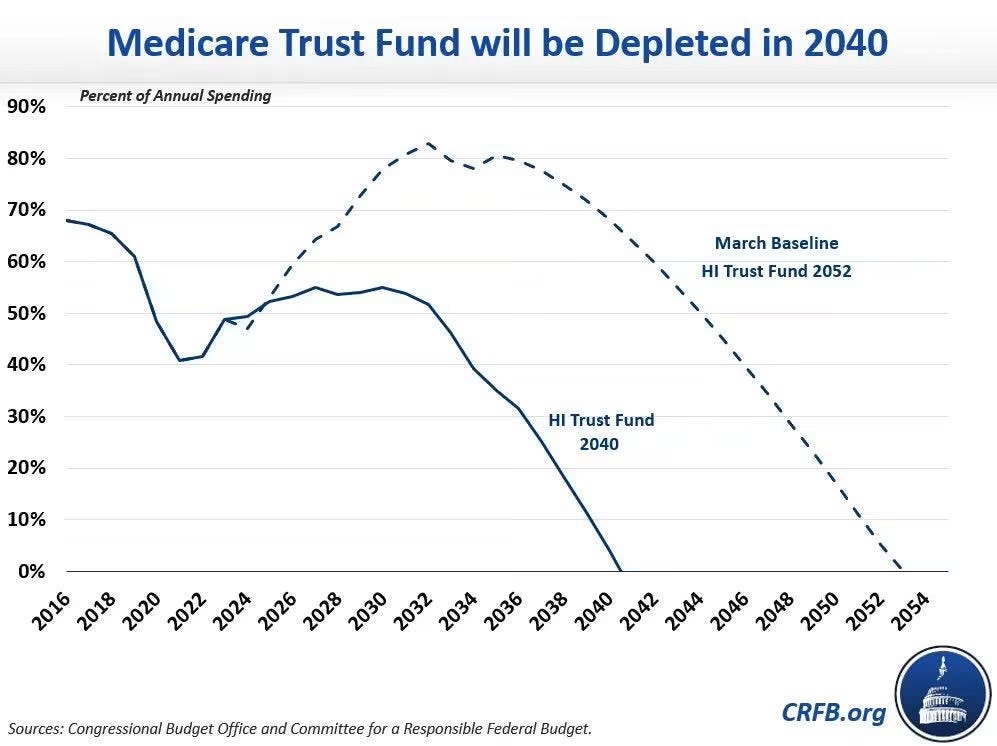
Medicare HI trust fund depletes Q2 2033, one quarter earlier than last year’s report, not 2040
The 4% PAYGO Medicare sequester never happened; the Nov 2025 CR wiped the scorecards
Digital health VC: $7.4B across 244 deals in H1 2026, up 15% YoY, mega deals took 45% of dollars
Thesis: the durable opportunities are in eligibility infrastructure, churn absorption, state procurement, self pay economics, and rural asset consolidation, not in coverage nostalgia
The viral tweet was half right, half stale, and entirely useful
Seven hundred fifty thousand engagements on a claim that Medicare solvency got yanked from 2052 to 2040 is a good reminder that the internet grades on vibes, not on actuarial tables. The 2026 Trustees report, published June 9, puts Hospital Insurance depletion in the second quarter of 2033. That is one quarter earlier than the 2025 report projected, and the deterioration traces mostly to the reconciliation law’s changes to the taxation of Social Security benefits, which trimmed HI revenue. One quarter. Not twelve years. At depletion, incoming revenue covers roughly 89 percent of Part A benefits, which translates into an 11 percent haircut on hospital payments growing toward 16 percent by 2040. That is genuinely bad and worth being upset about. It is just not the number in the tweet.
Same story with the 4 percent Medicare sequester that dominated healthcare finance panels through the back half of 2025. The reconciliation law added roughly $3.4 trillion to the deficit, which under statutory PAYGO should have triggered an OMB sequestration order in January 2026, capped at 4 percent for Medicare, worth about $45 billion in FY2026 and something near $490 billion through 2034. Then the continuing resolution that reopened the government on November 12, 2025 quietly wiped the PAYGO scorecards clean at the end of the calendar year, and the cut evaporated. The 2 percent Budget Control Act sequester is still there, humming along since 2013 like a subscription nobody remembers signing up for. Anyone who built a 2026 model around a 6 percent Medicare reduction spent Q4 of last year forecasting a ghost.
None of which means the underlying panic is misplaced. The $66 billion “nine year ban” in the second tweet is real and mostly accurately described: the law froze implementation of the Medicare Savings Program eligibility rule and the Medicaid and CHIP enrollment streamlining rule through September 30, 2034, and CBO scored the resulting non enrollment as savings. Roughly a trillion in gross Medicaid and CHIP reductions over ten years is real. Ten million additional uninsured by 2034 is real. The point for anyone building or writing checks is that the headline numbers circulating on social are a lagging, lossy compression of a statute whose actual mechanics are far more specific, far more dated, and far more addressable. The specifics are where the businesses are.
The actual statute, laid out on a calendar
Treat the law as a schedule of forcing functions rather than a single event, and the investable structure gets obvious fast. Retroactive coverage already shrank as of January 1, 2026, down to one month for expansion adults and two months for everyone else, which quietly moved a chunk of hospital admissions from “we will backfill eligibility later” into “this is self pay unless somebody catches it at registration.” Enhanced premium tax credits expired the same day. CMS issued its interim final rule on community engagement on June 1, 2026, effective July 31, and required state outreach to affected beneficiaries starting somewhere between July and September of this year depending on the approach each state picked. Every state has to be running work requirements by January 1, 2027, with good faith extensions available no later than December 31, 2028.
Then 2027 gets busy. Six month redeterminations replace annual renewals for the expansion adult group. Quarterly checks against the Social Security Death Master File begin, along with cross state duplicate enrollment matching, which is going to be its own comedy once two states discover they have both been paying capitation on the same person for three years. October 1, 2027 starts the provider tax safe harbor phase down in expansion states, 6 percent dropping half a point a year until it hits 3.5 percent in FY2032, with nursing facilities and intermediate care facilities carved out. January 1, 2028 begins the 10 percentage point annual step down for grandfathered state directed payments, headed toward 100 percent of Medicare in expansion states and 110 percent in non expansion states. October 2028 turns on cost sharing of up to $35 per service for expansion adults above the poverty line, with primary care, behavioral health, FQHC, RHC, and CCBHC services exempted.
CBO’s February 2026 baseline, its first real refresh since June 2024, priced all of this out: 3.4 million more uninsured in 2026 versus 2025, 7.5 million more in 2027, 8.7 million more in 2028, with the total uninsured population crossing 35 million by 2028, about a third higher than where it sat in 2025. Between 2025 and 2032, the number of people helped by marketplace credits or expansion coverage falls by 16.5 million, a 44 percent decline. Marketplace enrollment is the fastest moving piece. Effectuated 2026 enrollment looks like it is landing near 17.5 million, possibly as low as 16.5 million, down from 22.3 million in 2025, with an outsized share of the drop coming from the 400 to 500 percent of poverty band that made up only 3 percent of plan selections but 27 percent of the decline. Average subsidized premium payments went from $888 to $1,904, a 114 percent increase, while benchmark premiums rose 26 percent, the biggest jump in eight years, and average deductibles climbed about $1,000 per person.
The compliance industrial complex: 80 hours a month, verified
Here is the least glamorous, most bankable observation in the whole thing. Congress just mandated that fifty state agencies, most of which are running eligibility systems that were modernized during the Obama administration and have been patched by a rotating cast of systems integrators ever since, must verify a monthly behavioral attestation for more than twenty million people, on a deadline, with an interim final rule that arrived seven months before go live. CMS put $200 million on the table for the build, half distributed evenly across the 51 eligible recipients and half weighted by the share of enrollees subject to the requirement. Two hundred million dollars. Split fifty one ways. For a nationwide data integration program touching payroll records, education enrollment, volunteer hours, job training participation, and medical frailty determinations, with a 30 day cure period before anyone can be terminated and an explicit prohibition on delegating enforcement to managed care plans.
That last detail matters enormously and almost nobody outside state Medicaid directors is talking about it. States cannot hand this to the MCOs. The plans have the member contact data, the care management staff, the outreach infrastructure, and the incentive to keep members enrolled, and they are structurally barred from owning the verification. So the state has to do it, the state does not have the staff, and the state’s incumbent eligibility vendor quoted a number with a comma in it that made the budget office laugh. Every one of those gaps is a contract.
The realistic product surface breaks into a few clusters. Data brokerage and ex parte verification is the biggest: whoever can pull payroll data, gig platform earnings, student enrollment, and unemployment insurance wage records and return a clean monthly determination without asking the beneficiary for a document is going to print money, because every avoided manual review is an avoided appeal, an avoided procedural termination, and an avoided lawsuit. Arkansas learned in 2018 that the failure mode is not people refusing to work, it is people not knowing they had to report. Notice and outreach orchestration is the second cluster, and it is more interesting than it sounds given the rule requires notification by mail plus at least one additional channel, which means somebody has to maintain deliverable contact data on a population that moves constantly. Medical frailty and exemption adjudication is the third, and it is the one where clinical data actually matters, because proving an exemption from claims history and problem lists beats making a sick person assemble a paper file. Fourth is appeals and fair hearing workflow, which is going to get absolutely buried starting in the first quarter of 2027.
The live pilots are already running. Nebraska went first on May 1, 2026. Montana and Arkansas launched July 1, with Arkansas holding enforcement until January. Iowa comes online December 1. Those four states are the reference customers for everything that follows, and their vendor selections over the next two quarters are the single most useful public signal available for anyone underwriting this category.
The $50B rural fund is a procurement event wearing a policy costume
CMS announced Rural Health Transformation Program awards on December 29, 2025, and the structure is unusual enough to deserve real attention. Fifty billion dollars across FY2026 through FY2030, ten billion a year, all fifty states approved, first year awards averaging $200 million with a range from $147 million in New Jersey to $281 million in Texas. Half the annual pot splits evenly among approved states regardless of size, which is why the per capita math is completely unhinged: discretionary funding per thousand rural residents ranges from about $26,600 in Michigan to about $662,800 in Alaska. Averaged nationally, the program works out to roughly $144 per rural resident over five years, against independent estimates that federal Medicaid spending in rural areas falls by $137 billion over the same decade. So it is not a replacement. It is a transition subsidy with a spending deadline attached, and money starts flowing October 1, 2026.
CMS also stood up an Office of Rural Health Transformation inside the Center for Medicaid and CHIP Services, which tells you they expect this to require ongoing referee work. States are already in procurement, and the approaches are all over the map: direct gubernatorial allocation in some, third party administrators in others, and in North Dakota, of all things, the Bank of North Dakota running a rural facility infrastructure loan program. Rhode Island handed oversight of health center allocations to its primary care association. Several states are standing up rural technology catalyst funds, which the statute allows up to 10 percent of the award to support, aimed at consumer facing chronic disease prevention and management technology. Alaska’s plan includes unmanned drone delivery, remote pharmacy dispensing units, and portable diagnostics, because when your service area has no roads, the vendor evaluation criteria look different.
For founders, this is a rare moment when a large pot of money is chasing a category rather than the reverse, and the buyers are inexperienced at buying. That cuts both ways. Performance based contracting is being pushed hard by policy shops precisely because states are under pressure to obligate first year dollars fast, which is exactly the condition under which somebody sells a state a $12 million telehealth platform that six critical access hospitals will never log into. The companies that win the durable share here are the ones that can survive the five year cliff, meaning products with a real payer or provider revenue model underneath that use RHTP as customer acquisition subsidy rather than as the business. Hub and spoke specialty models, rural clinically integrated network enablement, shared services for revenue cycle and supply chain across small hospital cohorts, cybersecurity remediation for facilities that have never had a CISO, and interoperability plumbing to connect referral pathways all fit that description. Anything priced as a five year grant funded pilot does not.
Churn as a permanent condition, and the businesses that eat it
The most underappreciated structural change is not the level of coverage, it is the volatility. Six month redeterminations for expansion adults double the number of eligibility events per member year. Monthly work verification adds twelve more decision points. Quarterly Death Master File runs and cross state duplicate checks add periodic mass adjudications. Retroactive coverage shrank, so the safety net under an eligibility error got thinner. Cost sharing arrives in 2028 for a population that has never had a copay. Stack all of that and the expansion adult population stops being a coverage cohort and starts being a flow, with people cycling between Medicaid, marketplace, employer coverage, and uninsured on a cadence measured in months.
Health plans feel this first and worst. Risk pools built on annual enrollment assumptions get a selection problem when the healthy leave on the first missed report and the sick fight through the appeal. Medical loss ratios move in ways actuaries have not had to model since the unwinding, except now it is permanent rather than a one time event. Marketplace plans get the mirror image, absorbing a sicker, older, more subsidy sensitive book after the healthy walked when their premium doubled. Anybody selling risk adjustment accuracy, mid year risk score recapture, or rapid onboarding assessment into that environment is selling into acute pain.
Providers feel it at registration. The single highest ROI product in American healthcare over the next thirty six months might be boring real time coverage discovery, because the failure mode is now systemic rather than incidental. A patient who was Medicaid eligible in March, terminated in May for a missed work report, restored in July on appeal, and shows up in June with chest pain generates a claim that will deny, appeal, and eventually get written off unless something in the front end catches the gap and either restores eligibility, initiates presumptive eligibility, or routes the person into a financial assistance pathway before discharge. Multiply by an uninsured population growing from 19.2 million in February 2026 to roughly 35 million by 2028 under the CBO baseline.
The enabling data infrastructure is the quiet arbitrage. Eligibility status, coverage history, and the ability to reconcile a person across state lines and across payers is exactly the kind of identity resolution and record retrieval problem that has been an unglamorous back office function for twenty years and is about to become a front line clinical and financial control. Volume goes up, stakes go up, latency requirements go up. Pricing power follows.
Provider balance sheets go from state directed payments to self pay
The financing provisions are where the sophisticated money should be paying attention, because they are slower, larger, and far less reversible than the coverage provisions. Nearly every state uses provider taxes to fund the non federal share of Medicaid, and about two thirds use state directed payments to push managed care rates above the fee schedule, historically toward average commercial rates. The law bans new provider taxes, freezes existing ones, tightens uniformity requirements, and in expansion states walks the safe harbor from 6 percent to 3.5 percent between FY2028 and FY2032. Separately, CMS finalized a rule effective April 3, 2026 barring states from taxing Medicaid managed care organizations at higher rates than non Medicaid plans, which closes another door. On the SDP side, new arrangements cap at 100 percent of Medicare in expansion states and 110 percent in non expansion states, and grandfathered preprints step down 10 percentage points per rating period starting January 1, 2028.
Translate that into hospital finance and the picture is stark. A safety net system in an expansion state that has been earning average commercial rates on its Medicaid managed care volume through a grandfathered directed payment program is looking at that spread compressing to Medicare rates over roughly seven years, while the tax mechanism funding the state share shrinks simultaneously, while the uninsured share of its volume climbs. One estimate has hospitals losing $68.6 billion in revenue across 2026 and 2027 alone, with nearly half of that, $33.6 billion, coming out of commercial revenue as people lose marketplace coverage rather than Medicaid. Uncompensated care rises by something like $204 billion over ten years, $63 billion of it landing on hospitals and $24 billion on physicians. Revenue recognition under ASC 606 gets genuinely hairy when the payment rate for a grandfathered program is a declining function of a rating period that has not been approved yet.
The investment implications are not subtle. Distressed and special situations capital should be sharpening pencils on rural and safety net hospital assets, physician groups with heavy Medicaid mix, skilled nursing operators exposed to the pieces of the phase down they thought they were exempt from, and behavioral health providers whose payer mix is structurally Medicaid. Consolidation accelerates, and it will be politically ugly. On the operating side, anything that materially improves cash conversion for a provider losing 5 to 15 percent of net revenue over five years gets bought without a long sales cycle: denials prevention, prior authorization automation, coding accuracy, contract modeling against the new SDP caps, cost accounting good enough to decide which service lines to close. The macro backdrop is not hostile to this. Digital health startups raised $7.4 billion across 244 deals in the first half of 2026, up 15 percent from $6.4 billion in the same period last year across essentially the same deal count, with median deal size up from $12 million to $14 million and mega rounds absorbing 45 percent of all capital. Revenue cycle in particular is drawing enterprise scale capitalization, which means the buyers on the other side of a seed stage exit actually exist.
The uninsured person is now a retail customer with a wallet
Eleven million additional people paying cash for healthcare over a decade is, whatever else it is, a market. This part makes people uncomfortable and it should, but ignoring it does not make the patients better off, and the alternative to a functioning cash market for them is not coverage, it is nothing.
The pieces already exist in fragments. Direct primary care memberships in the $70 to $150 a month range look very different to a 45 year old at 420 percent of poverty whose marketplace premium just went from $400 to $900 with a $7,500 deductible. Cash pay imaging and lab marketplaces have been niche curiosities for a decade and are about to have a moment. Generic and biosimilar direct to consumer pharmacy, transparent surgical bundles at ambulatory surgical centers, and telehealth priced per visit rather than per month all get a demand shock. The GLP-1 category already proved that millions of Americans will pay cash monthly for a healthcare product if the value is legible, which is the single most important consumer behavior datapoint of the decade and is being wildly underused as a template for anything other than weight loss.
What is missing is the connective tissue. Nobody has built a credible financial navigation layer that tells a specific person, given their income, their state, their conditions, and the month, whether they should be pursuing Medicaid restoration, a special enrollment period, hospital charity care, a cash rate, a payment plan, or a manufacturer assistance program, and then actually executes it. That product has to work in all fifty states, has to be accurate on eligibility rules that changed twice this year, and has to be monetizable without charging desperate people. The natural payers are hospitals, who currently spend enormous sums on eligibility vendors and collection agencies for exactly this population and get poor results, and employers, who are watching part time and variable hour workers lose Medicaid and show up asking questions HR cannot answer.
The adjacent opportunity is charity care and presumptive eligibility automation. Nonprofit hospitals have community benefit obligations, financial assistance policies most patients never learn about, and a coming wave of self pay volume. Making that machinery actually function is simultaneously a margin improvement for the hospital, a bad debt reduction, a compliance asset, and the thing that keeps a family out of bankruptcy. Rare alignment. Build it.
What gets harder, and what should not get funded
Symmetry demands the negative list. Anything whose unit economics depend on stable Medicaid expansion enrollment over a multi year member relationship just got structurally worse. Medicaid focused care management companies built around continuous engagement, value based primary care models with attribution logic that assumes members stay attributed, complex care and high utilizer programs with twelve to eighteen month payback periods, and social determinants platforms funded through managed care in lieu of services dollars are all exposed to the same failure mode: the member churns out before the intervention pays back. That does not make the models wrong. It makes their contracts wrong, and contracts are fixable if the founder is honest about it early.
Long term services and supports faces its own squeeze, with the home and community based services waiver pathway not arriving until 2028 while nursing facility economics tighten and the staffing rule moratorium removes a cost that was also, arguably, a quality floor. Anything that assumed the ACA marketplace grows forever needs a haircut: insurtech distribution, enhanced direct enrollment plays, and broker technology all just watched their addressable population shrink by roughly three million effectuated enrollees in 2026, with KFF projecting about 17.5 million effectual enrollees for the year and some estimates as low as 16.5 million.
The category most likely to attract dumb money is work requirement compliance itself. Yes, it is a real spend. It is also a $200 million federal appropriation split across 51 recipients, procured through state contracting processes that favor incumbents with existing master service agreements, on a timeline that rewards whoever can deploy in six months rather than whoever built the better product. Some of that spend becomes durable eligibility infrastructure. A meaningful share becomes a 2027 pilot that gets cancelled in 2029 when a new administration or a court changes the rules. Underwrite accordingly, which mostly means preferring companies whose product still has a buyer if work requirements go away.
Underwriting this: pricing, contracting, and the timing problem
Three practical filters separate the real opportunities from the policy tourism. First, does the customer have money in a specific fiscal year, from a specific line item, with a specific person who signs. State Medicaid agencies, RHTP administrators, hospital CFOs facing SDP compression, and health plans facing MLR volatility all qualify. “The healthcare system” does not. Second, does the product survive a reversal. Political durability here is genuinely uncertain: the enhanced subsidies could come back, work requirements are already drawing litigation, and 2028 is an election. A company selling verification workflow is fragile; a company selling identity resolution and coverage discovery that happens to power verification workflow is not. Third, is the sale a budget reallocation or a new budget request. In a year when hospitals are cutting, the products that get bought are the ones that come out of an existing spend line, which is why revenue cycle keeps winning and why anything requiring net new operating dollars is a two year sales cycle minimum.
On contracting, the shift toward performance based structures in state procurement is real and mostly good, but founders should read those terms very carefully, because a state agency’s definition of a measurable outcome tends to arrive after the contract is signed and tends to be measured on data the vendor does not control. Milestone based payment tied to deployment and volume is survivable. Outcome based payment tied to enrollment retention in a program explicitly designed to reduce enrollment is a trap.
On exits, the picture is better than the sentiment suggests. Consolidated dollars, 45 percent of capital going to mega rounds, and a narrow IPO window with a watchlist that includes several genuine scale businesses all point toward strategic and sponsor M&A as the base case rather than the disappointment case. Health systems and plans are buying capability under duress, which is the best possible condition to sell into if the product is real, and payers with compressed margins are more willing to buy than to build for the first time in about four years.
The window runs to 2033, and here is how it probably closes
Zoom all the way out. Medicare expenditures totaled roughly $1.21 trillion last year across 62.2 million aged beneficiaries and 7.1 million disabled, with 51 percent now enrolled in Part C. The program runs from 3.9 percent of GDP in 2025 to 6.5 percent by 2050 under current law. The HI trust fund hits partial depletion in the second quarter of 2033. Nothing in this statute changes that trajectory, and Parts B and D, which cannot go insolvent because general revenue backfills them, are the faster growing and larger problem that gets a fraction of the attention because they lack a scary date.
Which means the reconciliation law is not the endgame, it is the first move. A program running toward a hard fiscal constraint seven years out, with an aging population, a demonstrated legislative willingness to reduce eligibility rather than reduce prices, and a states side that just lost its favorite financing mechanisms, is going to produce more legislation, not less. The bet worth making is that the next round targets Medicare spending directly, most likely through site neutral payment, Medicare Advantage risk adjustment and benchmark reform, and further drug pricing action, because those are the places with hundreds of billions of scoreable dollars and constituencies too diffuse to stop it.
That framing changes what looks attractive today. Businesses positioned around eligibility infrastructure, churn absorption, cash conversion for stressed providers, state level procurement, and self pay economics are aligned with a decade long direction of travel rather than a single bill. Businesses that require the coverage expansion of 2021 through 2025 to persist are fighting the tape. The unpleasant truth underneath all of it is that the country just decided, through the ordinary operation of its budget process, to trade roughly ten million people’s coverage for a set of tax provisions, and the healthcare economy will reorganize around that decision whether or not anybody in it approves. Entrepreneurs who see clearly and build the connective tissue that keeps people from falling through will do well and will also be doing something worth doing. Everyone else can keep quote tweeting the wrong trust fund date
.